
Art-print appraisal basics
Appraisal should start with identification, condition, provenance, and market evidence. Use this guide to compare the strongest value signals before any final conclusion.
“Alexej von Jawlensky” is a name you’ll see on everything from museum-grade works on paper to mass-produced decor prints. That’s why an unsigned, framed print can be confusing: the frame hides the margins where signatures and edition numbers usually live, and sellers often use “limited edition” loosely.
This article is written for the real-world scenario: you have a print in hand, possibly labeled as a “limited edition,” but there’s no obvious pencil signature on the front. We’ll walk through what to look for, what photos matter most, and the price ranges you can expect if it turns out to be a decorative reproduction versus a collectible print.
Free first read
Check the edition evidence before paying for a report
Upload the full front, bottom margin, back label, frame, and any signature or edition closeups. The free screener can separate a decorative reproduction, signed lithograph, and higher-value documented print path.
Start with a free screener. Use a signed report only if you need insurance, estate, donation, or sale documentation.
How We Research Valuation Data
Our appraisal guides are based on auction results, dealer pricing data, and professional appraiser insights. We may earn a commission when you use our free professional appraisal service. Learn about our editorial standards.
Quick value estimate: unsigned & framed Jawlensky prints
Without a pencil signature, edition fraction (like 12/200), and a known publisher/workshop, most Jawlensky-branded framed prints trade as decorative wall art rather than collectible works on paper.
For the specific scenario in this migrated report (a framed print titled “Haus in Bäumen”, marked “Limited Edition 9888,” approx. 52 cm × 47 cm, with no visible signature), a realistic secondary-market range is:
- $25-$150: typical decor-print territory when the signature, edition fraction, and publisher marks are absent or printed-in.
- $150-$400: possible local retail range when the frame is attractive, condition is clean, and the image has strong wall appeal.
- $1,500-$6,000+: signed or documented Jawlensky lithograph territory, based on recent comparable sales, if the evidence supports that category.
If you later confirm a genuine signed/numbered print (or a documented publisher portfolio), the value category changes completely. The goal of the next sections is to help you determine which lane you’re in before you spend money on reframing.
Who was Alexej von Jawlensky?
Alexej von Jawlensky (1864–1941) was a Russian-born modernist associated with German Expressionism and the Munich avant-garde. His work is best known for bold color, simplified forms, and iconic “Meditation” heads. Because his name is highly recognizable, it is frequently used on later reproductions and decor prints.
This doesn’t mean every print is “fake” in a criminal sense—many are legitimate reproductions made for education or decoration. But it does mean that attribution review is essential when you see the words “limited edition,” “lithograph,” or “signed” in a listing.
Attribution review checklist (without damaging the frame)
Most collectible prints have value in the margins: pencil signature, edition fraction, blindstamp, printer/publisher text, and the edge of the printed plate or screen. If your print is framed tight to the image, you may not be seeing the information that matters.
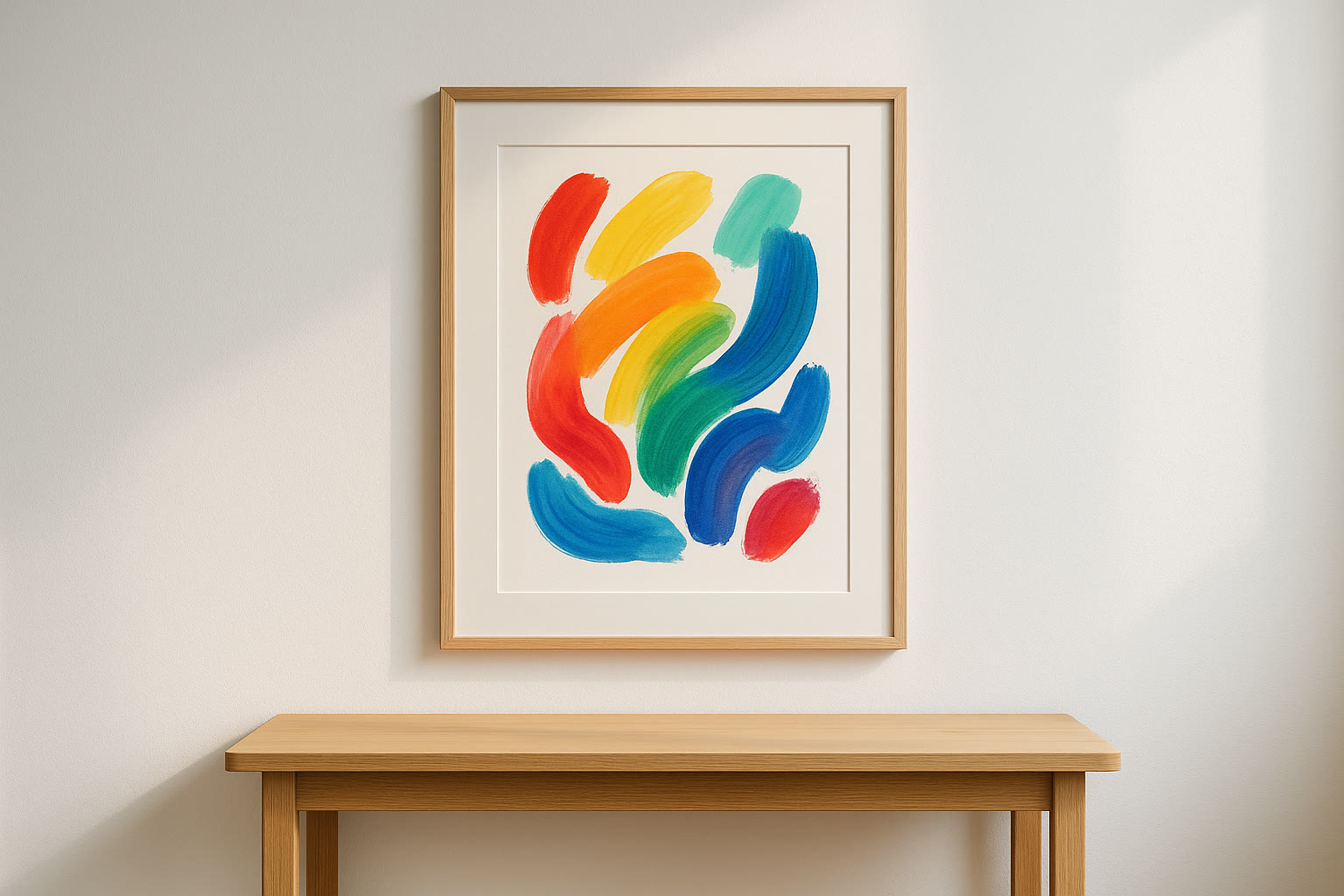
Step 1: inspect what you can see
- Front margin: check the lower left/right edges (even under the mat) for pencil marks.
- Paper texture: a true lithograph/etching is on paper; canvas texture may indicate a giclée-on-canvas reproduction.
- Surface: many decor prints are perfectly flat; some print processes can still be flat, so this is not decisive alone.
Step 2: photograph the back (before unframing)
- Full back view (frame, wire/hangers, dust cover).
- Close-ups of any labels, gallery stickers, stamps, or handwritten notes.
- Corner close-ups to show how the backing is sealed (helps judge if it’s worth opening).
Step 3: only unframe if you can do it safely
If the back is taped, stapled, or sealed with brittle paper, opening it can tear the dust cover and reduce presentation value. If you do open it, photograph everything as you go and keep all labels.
“Limited edition 9888”: what it usually means
A true limited edition is typically shown as a fraction (12/200) written in pencil, not as a large standalone number like “9888.” A big number printed into the image area is often a design element or a stock code rather than a limited-edition statement.
Common scenarios:
- Printed-in number: usually decorative and not tied to scarcity.
- “Edition” wording without a fraction: often a reproduction marketed as “limited.”
- Pencil fraction + pencil signature: strong indicator of a collectible print (still needs publisher verification).
Unsigned vs. signed: why the signature changes everything
For prints and multiples, signatures and editioning are a major part of what collectors are paying for. In many markets, an unsigned reproduction and a signed/numbered print can look similar on a wall—but trade in different buyer pools.
- Unsigned: typically sold as decor; value driven by image + frame + size.
- Signed/numbered: sold as a collectible; value driven by edition size, publisher, condition, and market demand.
- Signed in plate: “signature” printed as part of the image; usually not the same value as a hand signature.
How framing affects print value (and how it can hurt it)
A frame can increase saleability—especially for local pickup sales—but it can also hide condition issues. When appraisers evaluate framed prints, we look for two things: presentation and risk.
- Acid burn / mat burn: yellow lines where an old mat touched the paper.
- Light fading: bright Expressionist colors can fade quickly in direct sun.
- Moisture rippling: cockling or waviness (often visible at an angle).
- Non-archival framing: pressure-sensitive tape, cardboard backers, and cheap mats can stain paper permanently.
Auction comps: signed lithographs vs. decor prints
Do not use major Jawlensky paintings as the benchmark for a framed print. The relevant question is whether the sheet is a documented print, a later reproduction, or a decorative image. Recent print-specific comps from Appraisily’s auction dataset show the spread:
| Photo | Sale | Date | Lot | Realized | Notes | Source |
|---|---|---|---|---|---|---|
| - | Auctions at Showplace, Alexej von Jawlensky portrait lithograph in colors | Nov. 7, 2021 | 180 | $6,000 | Upper print comp; relevant only when the print is documented and collectible. | Valuer Bridge dataset |
| - | Christie's, Alexej von Jawlensky, Kopf, lithograph, 1921, signed in pencil | Sept. 28, 2021 | 107 | £4,750 | Signed-in-pencil lithograph comp; not comparable to a printed-signature decor image. | Valuer Bridge dataset |
| - | Roseberys, Alexej von Jawlensky, Liegender weiblicher Akt, c. 1920, lithograph in colors | June 15, 2023 | 78 | £2,200 | Collectible lithograph context for works with proper printmaking evidence. | Valuer Bridge dataset |
| - | Grogan & Company, Alexej von Jawlensky, Head (Kopf), 1922, lithograph | May 6, 2023 | 121 | $1,560 | Lower documented lithograph comp; still materially above unsigned reproduction value. | Invaluable |
Takeaway: documented Jawlensky lithographs can reach four figures, but an unsigned framed reproduction normally belongs in the decor-print category unless the margins or verso reveal stronger evidence.
Have the print in hand?
Check the margin and back-label evidence first.
Upload front, back, margin, signature, edition, paper, and frame photos. The free screener can flag whether the print belongs in the decor, collectible lithograph, or signed-report lane.
Upload photos for a free first lookHow to sell an unsigned framed print (realistic options)
If your print is decorative rather than collectible, you can still sell it—just target the right channel and set expectations. Buyers of decor prints care more about size, color, and frame style than printmaking technicalities.
- Local marketplace pickup: fastest for framed items (avoids shipping glass).
- eBay/Etsy: better reach; ship only if you can pack glass safely (or remove glazing).
- Consignment: works if a shop has the right buyer base and the frame is attractive.
What photos to take for the most accurate valuation
If you want a valuation that goes beyond “decor print,” focus your photos on evidence: margins, markings, and labels. A good photo set often makes unframing unnecessary.
- Full front view (straight-on) and a second view at an angle (to show surface and rippling).
- Close-up of the bottom margin where signature/edition would be.
- Full back of frame + close-ups of any labels, stamps, handwriting.
- One corner detail showing frame condition and glazing scratches.
Search variations people use for this item
These are common “people also ask” queries that match the issues covered above:
- Is an Alexej von Jawlensky print worth anything if it’s unsigned?
- How do I tell if my Jawlensky print is a real lithograph?
- What does “limited edition 9888” mean on a framed print?
- Where is the edition number on a signed limited edition print?
- Does framing increase the value of a limited edition art print?
- How can I check a print’s signature without unframing it?
- What are the red flags for mass-produced “limited edition” prints?
- Best way to sell a framed art print locally vs. shipping
Each question maps to the valuation, attribution review, and selling guidance above.
References
- MoMA: Alexej von Jawlensky (artist entry)
- Tate: Alexej von Jawlensky
- Library of Congress: care and handling of paper
- Invaluable: Grogan & Company Jawlensky lithograph result
Wrap-up
The most important step with an unsigned, framed Jawlensky print is to confirm what kind of “edition” it really is. If there’s no pencil signature, no fraction, and no publisher documentation, treat it as decor and price it based on presentation. If you uncover a pencil signature/edition notation or a credible publisher mark, pause before reframing and get a print-specialist appraisal—those details are exactly what separate a low-value wall piece from a collectible print.