ONLINE ART APPRAISAL, FROM YOUR PHOTOS.
Before you
let it go,
know what
you have.
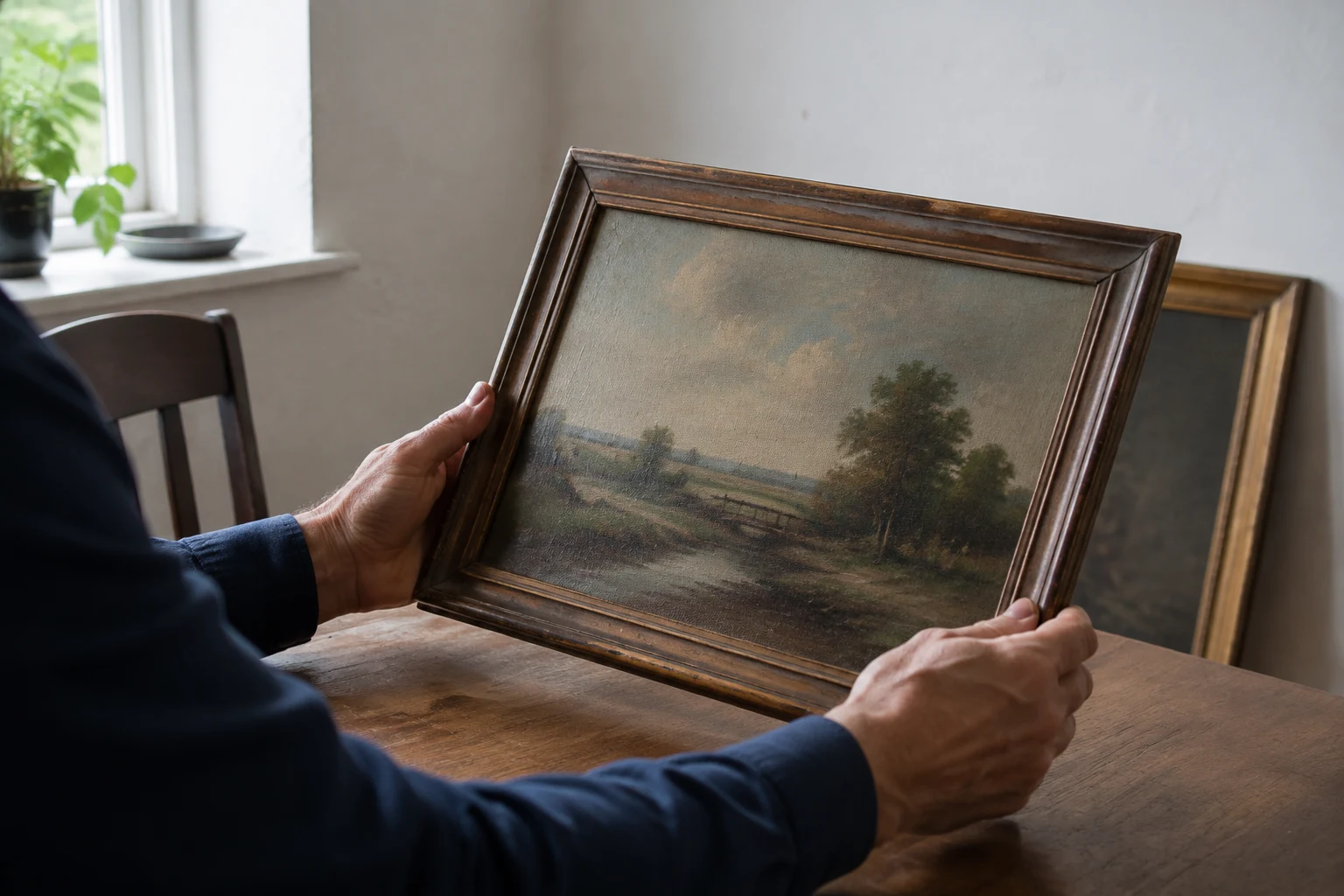
A family painting. An offer you’re unsure about.
Find out what it is—and what a fair value looks like.
Others come with questions.
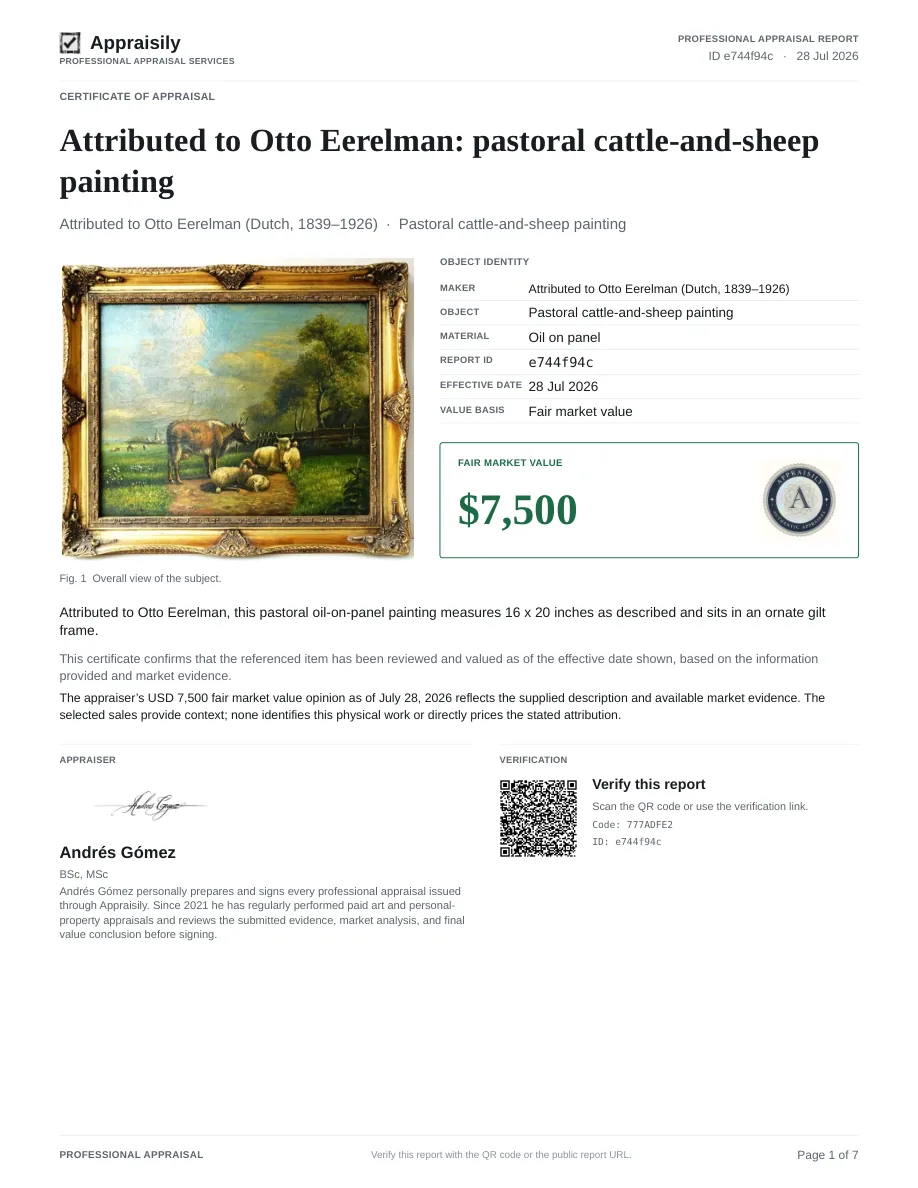 OPEN A REAL SAMPLE ↗
“I don’t want to
get this wrong.”
Open a real signed report.
See what turns uncertainty into a decision.
Compare sold prices.
Then account for the differences.
We research relevant sales and explain how attribution, condition and the work itself affect the conclusion.
$7,500 concluded value
fair market value
Four representative sales of comparable works. No exact composition match. This sample’s value does not predict yours.
A family story is a start.
We look for supporting evidence.
Photographs, materials, marks and condition guide the research. What we cannot establish stays visible.
“Attributed to”
Otto Eerelman—not authenticated authorship.
The report notes the incomplete signature and unexamined reverse. It doesn’t turn missing evidence into certainty.
Give the conversation
a documented starting point.
A human-signed PDF puts the object, research, value and limitations together for your records or an adviser’s review.
A named signer.
A stated purpose. A written conclusion.
For insurance, choose replacement-value documentation and check your insurer’s requirements first.
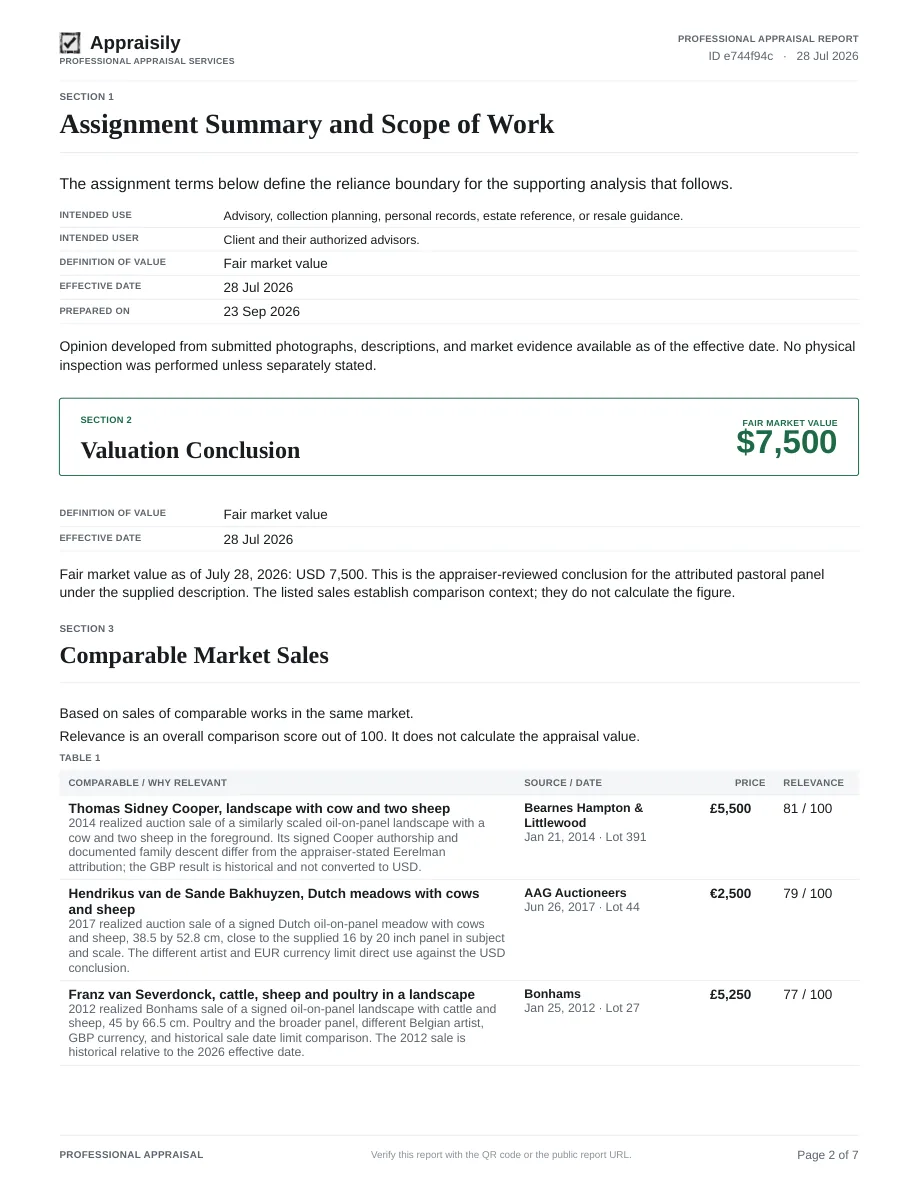
 ANOTHER REAL REPORTNo maker’s name? Still a work to research.A carved figure whose maker, age and origin stay unresolved. Open the signed report ↗
Sample subject: pastoral painting attributed to Otto Eerelman. Report contents vary with the object, available evidence and intended use.
Have something
to base it on.
A signed professional appraisal
you can keep, forward and come back to.
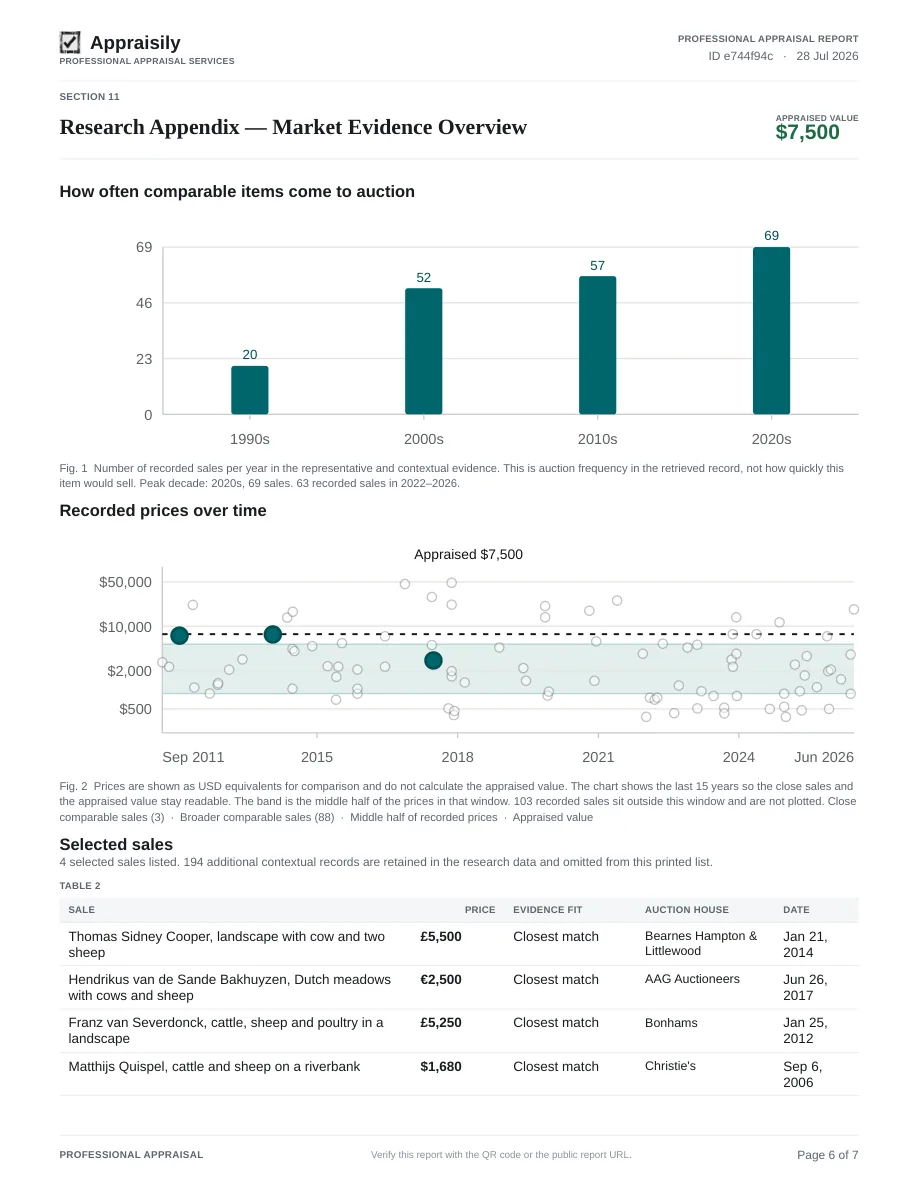 REAL REPORT PAGES ↗
SIGNED APPRAISAL
For selling decisions
& personal records
$59per artwork · USD
- Know what you haveIdentification & condition notes
- Understand the valueComparable-sales research & reasoning
- Keep the answerHuman-signed report & shareable PDF
- Ask about the conclusionClarifications included
Delivered in hours · once we have your photos after complete intake.
Schedule confirmed before work begins.
Not enough evidence to support an appraisal?
We refund your payment if we can’t deliver a reasonably supported appraisal. Refund policy ↗
Signed sample report
Inspect the identification, comparable evidence, value conclusion, signature and stated limits in a complete example.
Open the signed sample ↗Method and evidence boundaries
See what the reviewer examines, how comparable sales are weighed and where an online appraisal has limits.
Read the methodology ↗Need insurance or tax documentation?
Insurance · $99. Replacement-value framing. Check your insurer’s requirements first.
Choose insurance →Tax / estate · from $399. Case-specific scope and requirements reviewed separately.
Explore case review →You shouldn’t need
to become an art detective.
 01 / LOOK AT THE SURFACE
Illustrative views · signature and reverse are AI-created · not sample-report evidence
“Is it an original or a print?”
We examine the surface, signature and labels. If the photographs don’t settle it, we say what’s missing.
IN YOUR REPORT / Identification & condition notes“Online prices are all over the place.”
We check sold records and explain which comparisons matter. An asking price alone isn’t a valuation.
IN YOUR REPORT / Comparable sales & rationale“I need more than someone’s guess.”
An appraiser reviews the evidence and signs a conclusion with its purpose and limitations.
IN YOUR REPORT / Signed value conclusionPAINTINGS ON CANVAS
What the back of a canvas can show
Not every clue is on the front. When the back is already visible, an appraiser reads six places on it. Leave the painting where it is and send the views you already have.
What to photograph at each spot ↗

Fibre
Linen, cotton, jute or polyester, read from one loose thread.

Weave
Even threads point to a power loom; wandering ones to a hand loom.

Edges
Paint over the fold, or new strips, mean restretched, repaired or cut down.

Keys
Wedges in the corners make it a stretcher; fixed corners, a strainer.

Label
Canvas makers, suppliers, framers, dealers and exhibitions.

Writing
Titles, names, dates, and stock or sale numbers on the bars.
These are leads for the reviewer, not proof of age, authenticity, or attribution. Many old paintings have a later canvas glued to the back, old canvas gets reused, and labels and writing can be added at any time. Photo: back of Eduard Mühlbach, Ann-Sophie i Mörtfors (1960s), by W.carter, via Wikimedia Commons, with crops. Drawings: Appraisily, schematic. Source · CC BY 4.0

Phone photos. The history you know.
“I don’t know” is a perfectly good starting point.
Before you decide.
What if it turns out not to be valuable?
That can still be useful before spending on restoration or agreeing to sell. You pay for the research and supported conclusion; low value alone does not qualify for a refund.
Can you prove who painted it?
Not always. A value appraisal is not automatically authentication. We state what is supported and when physical inspection or a specialist authority may be needed.
Which photos should I send?
Front, back, signature, labels, texture, size and any damage. Start with what you have. We ask for more information when needed.
Can I appraise several works together?
Yes. Add each artwork as a separate item in one order, with its own photos and notes. Review the total before checkout.