Original Oil Painting vs Print What Appraisers Actually Look for: appraisal and value basics
Original Oil Painting vs Print What Appraisers Actually Look for research should start with identification, condition, provenance, and recent comparable sales. Use this guide to compare the signals that matter before paying for a formal appraisal or deciding whether to sell.
The Value Gap: Why This Distinction Matters
The difference between an original oil painting and a printed reproduction is not just academic — it is one of the widest value gaps in the entire art market. A recognized artist's original canvas that crosses the auction block routinely realizes $5,000 to $50,000 or more. A high-quality giclée reproduction of that same image, even on canvas, typically settles below $500 at resale.
That is a 10× to 100× spread. For estate executors, insurance schedulers, and anyone navigating a charitable art donation, correctly identifying which one you hold is the single most consequential step in the appraisal process.
Yet the visual gap has narrowed dramatically. Modern high-resolution scanning and pigment-accurate giclée printing can produce reproductions that fool the untrained eye from three feet away. That is precisely why professional appraisers do not rely on a quick glance. They follow a repeatable inspection protocol — and you can learn the same steps.
7 Checks Appraisers Use to Tell Original from Print
Each of these seven checks can be performed with basic tools — a bright desk lamp, a 10× jeweler's loupe, and a careful eye. Professional appraisers often use all of them in combination because any single test can produce a false positive.
1. The Raking Light Test
Place a bright lamp at a low, glancing angle across the painting's surface. An original oil painting will reveal a topography of raised ridges and valleys — the physical trace of each brushstroke catching the light. The paint surface has depth you can almost read by shadow alone.
A print on canvas is essentially flat. Even when a reproduction is printed on textured canvas stock, the ink layer itself has no relief. Under raking light, the surface remains uniform. Some mass-market reproductions add a clear gel coating to simulate brushstroke texture, but under close inspection the "ridges" are generic, evenly spaced, and do not align with the painted image beneath.
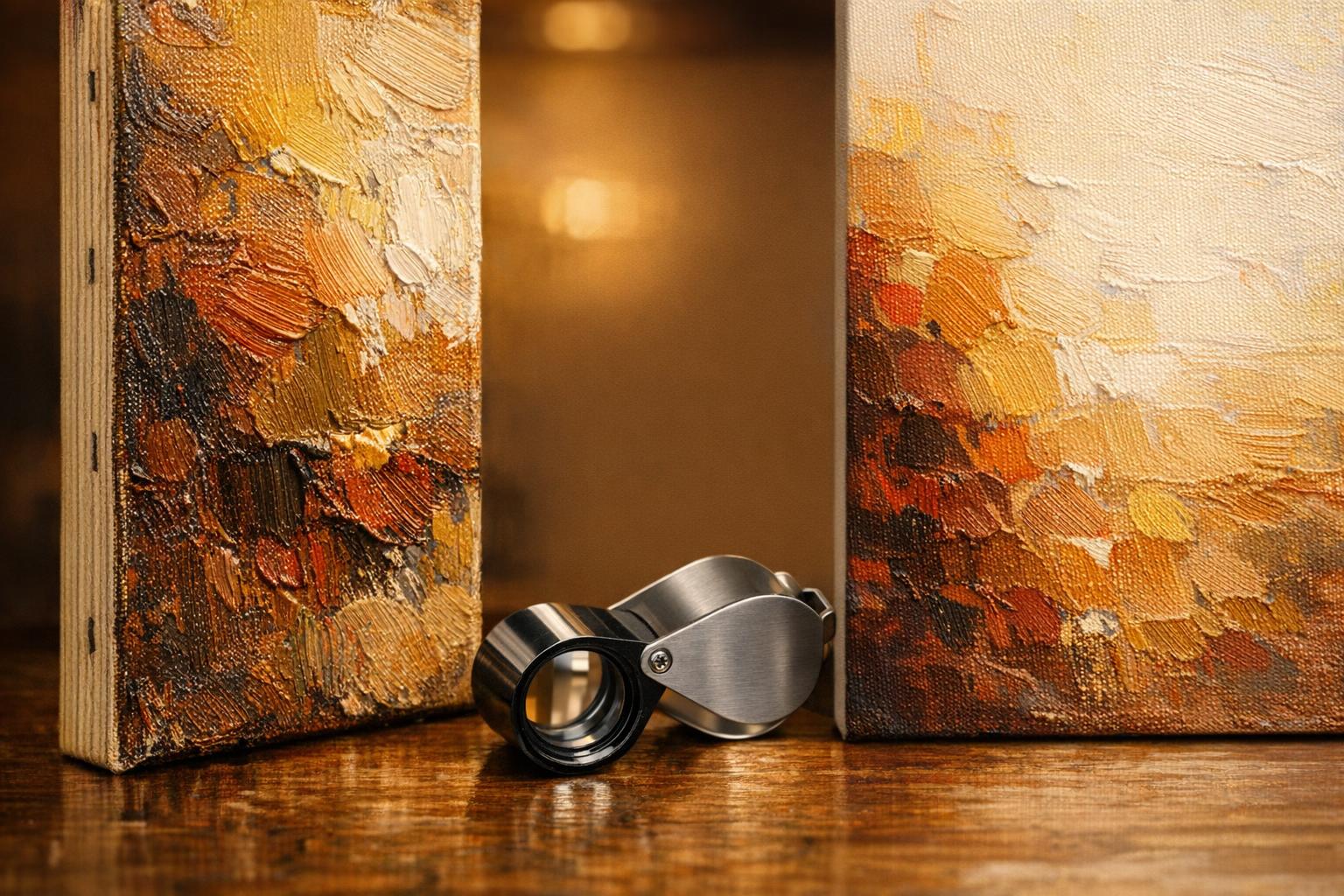
2. Magnifier / Loupe Examination
Look at the surface through a 10× or higher magnifying loupe. An original oil painting shows continuous, blended pigment — colors flow into each other the way wet paint mixes on a palette. You will see individual brush hairs trapped in dried paint, subtle palette-knife scrapes, and the organic irregularity of a human hand at work.
A print reveals a dot-matrix or halftone pattern under magnification. Even the finest giclée reproduction deposits ink as microscopic dots in a regular grid. If you see a uniform grid of CMYK dots — especially in areas of solid color or smooth gradient — you are looking at a printed reproduction, not an original.
3. Canvas-Back Inspection
Turn the painting around. The back of a stretched original canvas tells a rich story: wooden stretcher bars with age-appropriate darkening, handwritten gallery labels, exhibition stickers, a handwritten title or inventory number in pencil or chalk, and sometimes the artist's studio notes.
Reproductions often have a mechanically printed label, a perfectly clean unaged wooden frame, or no markings at all. If the back shows a manufacturer's barcode sticker from a big-box retailer or a "Made in China" stamp, the piece is a mass-market decoration, not an original work.
4. Signature Analysis
A hand-signed artist signature in oil or acrylic paint sits on top of the finished surface with raised pigment you can feel with your fingertip (do not touch — use a loupe instead). The signature may show brush-direction marks, paint pooling, or slight cracking consistent with the surrounding paint layer's age.
A printed signature is flat — part of the ink layer, not on top of it. If the signature appears pixelated under the loupe or has the exact same dot-matrix pattern as the rest of the image, it was printed along with everything else. Some reproductions add a raised clear-coat "signature" after printing, but this lacks pigment and looks glossy rather than painted.
5. Edge and Corner Examination
On an original oil painting, paint often wraps onto the side edges of the canvas — the artist painted the full surface, including the margin that folds over the stretcher bar. You may find dried drips, palette-knife marks on the edge, or paint that extends beneath the tack line.
A reproduction printed on canvas typically shows a clean white edge, a mechanical fold line, or an image that wraps in a perfectly uniform way that suggests digital mirroring rather than hand painting. If the edge is pristine and unmarked while the front image is supposedly "old and cracked," the piece is almost certainly a reproduction.
6. Surface Texture and Sheen
Oil paint has a characteristic surface quality — a warm depth of gloss that changes as you shift your viewing angle. Older oil paintings develop craquelure: a fine network of cracks in the varnish and paint layer that forms over decades. The pattern is irregular and organic.
Printed reproductions have a uniform surface sheen — typically matte, semi-gloss, or satin depending on the ink and substrate. Some reproductions are varnished to simulate oil-paint depth, but the coating is even across the surface and lacks the micro-cracking of genuine age. If a supposedly "antique" painting has a perfectly uniform surface with no variation in gloss or texture, treat it with suspicion.
7. Provenance and Documentation
Original paintings typically come with a paper trail: gallery receipts, exhibition catalogues, previous auction records, certificates of authenticity, or correspondence between the artist and a prior owner. Appraisers cross-reference these documents against the physical object — matching dimensions, titles, and depicted subjects.
Reproductions may include a generic "certificate" that is itself printed, often with language like "licensed reproduction" or "museum-quality print." The absence of any provenance beyond a retail purchase receipt is a strong indicator that the piece is a decorative reproduction rather than an original work.
Not All Prints Are Equal: Open Edition vs Limited Edition vs Giclée
One of the most persistent misconceptions in the art market is that all prints are worthless. The reality is more nuanced. The print market has a clear hierarchy, and understanding where a piece falls within it is essential for accurate valuation.
| Type | Description | Typical Resale Range |
|---|---|---|
| Open-edition poster | Mass-produced offset lithograph, unlimited run, no artist signature | $5 – $50 |
| Canvas reproduction | Digitally printed on canvas stock, may be "gallery-wrapped," no signature or COA | $20 – $150 |
| Open-edition giclée | High-quality archival inkjet print, unlimited run, no edition numbering | $50 – $300 |
| Limited-edition giclée | Signed and numbered by the artist (e.g., 47/200), archival paper or canvas, COA included | $200 – $5,000+ |
| Artist proof (AP) | Pre-production print retained by the artist, often signed "AP," smaller run, higher desirability | $500 – $10,000+ |
| Original oil painting | One-of-a-kind, hand-painted in oil on canvas or panel, artist's unique work | $500 – $500,000+ |
The key distinction: limited-edition prints and artist proofs carry value because of scarcity and the artist's direct involvement. But they are still valued as prints, not as originals. Even a signed limited-edition giclée of a famous artist's work will appraise at a fraction of the original painting's value — typically 5% to 20% of the original's market price, depending on the artist's print market.
Free instant estimate
Not sure if your print is worth appraising? Let us take a look.
Upload a photo, tell us what you know, and get a free first read. If a full appraisal makes sense, we will say so.
Free. No card needed. Takes about two minutes.
What Misidentification Costs You
The stakes of getting this wrong are not abstract. They show up in three concrete financial scenarios:
- Insurance scheduling: If you schedule a reproduction on your homeowners policy at the appraised value of an original, you are overpaying premiums — and if a claim arises, the insurer will discover the discrepancy during adjuster review. Conversely, underinsuring an original because it was mistaken for a print leaves you undercompensated after loss or damage.
- Charitable donation deductions: The IRS requires qualified appraisals for art donations exceeding $5,000. Claiming a deduction based on an original-painting appraisal when the donated item is a reproduction triggers audit risk and potential penalties. The IRS's Art Advisory Panel regularly reviews misclassified donations.
- Resale and estate planning: Estate executors who list a reproduction at original-painting value in probate inventory create false expectations for heirs and can complicate equitable distribution. The reverse — listing an original at print value — leaves money on the table during estate liquidation.
When a Print Can Be Valuable
Not every print is a throwaway. Several categories of printed art carry real and growing market value:
- Signed limited-edition giclées from established artists — especially when the edition is small (under 200) and the print is on archival paper with a certificate of authenticity — regularly sell in the hundreds to low thousands.
- Artist proofs (APs) are typically the most desirable prints in any edition. They represent the artist's pre-production vision and are held in smaller numbers. APs of major artists' works have sold for five figures at auction.
- Historical prints — original lithographs, etchings, and screenprints by recognized artists (Picasso, Warhol, Hockney, Basquiat estates) — are originals in their own right as fine-art printmaking. These are not reproductions of paintings; they are the primary work. They command serious auction prices.
- Poster art from significant exhibitions or events can appreciate, though typically in the $100–$1,000 range rather than the stratospheric levels of unique originals.
The distinction matters: these are valuable as prints, not as surrogates for originals. An appraiser values a signed limited-edition giclée using print-market comparables, not painting-market comparables.
Auction Market Reality: What Recent Sales Show
The 2025–2026 auction season reinforced the value gap between originals and reproductions with particular clarity. Original oil paintings by mid-career and established artists consistently realized prices 20× to 100× above comparable reproductions of the same imagery.
At the same time, the market for high-quality limited-edition giclées has grown — but it has grown alongside the originals market, not in place of it. Collectors who want an original still seek originals. Buyers who want an affordable entry point into an artist's visual universe turn to limited-edition prints. Both markets are healthy, but they operate at entirely different price tiers and use different comparable-sales databases for valuation.
For anyone holding a piece and unsure which tier it belongs to, the seven-check inspection protocol above provides a systematic answer before you engage an appraiser — and it makes the appraiser's job faster and more accurate when you do.
What to Do If You're Still Unsure
If you have run through the seven checks and the result is still ambiguous — perhaps the piece shows some original characteristics but lacks provenance, or it is a high-quality giclée with a signature that could be hand-applied — it is time to engage a professional appraiser.
A documented appraisal from a qualified specialist gives you a defensible value for insurance, donation, resale, or estate purposes. The process typically starts with photographs and basic details, then moves to a written report with comparable sales data and a supported value conclusion.
Get a professional appraisal
Share photos and details of your painting. Our specialists will route your submission to the right category expert and deliver a written valuation.
- Written appraisal report with comparable sales
- Accepted by insurers, IRS, and estate attorneys
- Turnaround in under 24 hours
Free initial review · No obligation
What similar items actually sold for
To help ground this guide in real market activity, here are recent example auction comps from Appraisily’s internal database. These are educational comparables (not a guarantee of price for your specific item).
Shown USD range: USD 300-USD 1,600. Median of these 5 USD examples: USD 425.
| Image | Description | Auction house | Date | Lot | Reported price realized |
|---|---|---|---|---|---|
|
Fine Antique Oil Painting of ‘Fort Sumter’ by Arthur Dawson | Caswell Prewitt Realty, INC | 2025-01-26 | 3 | USD 850 |
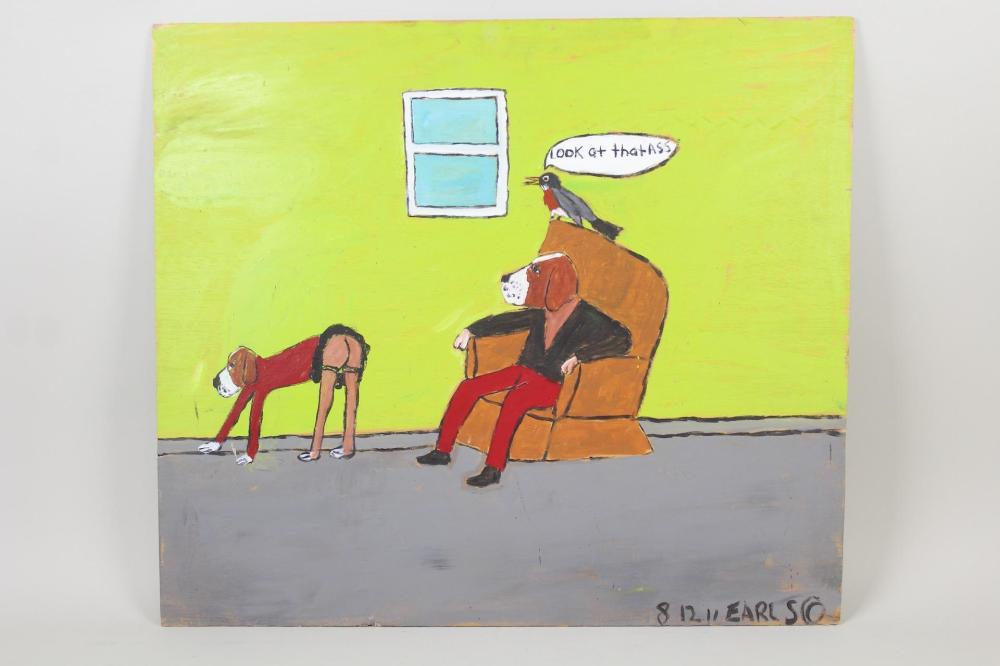 |
Earl Swanigan Outsider Art Painting, "Look at that ass" Dogs | Public Sale Auction House | 2025-02-01 | 169 | USD 350 |
|
Frederik Kiaerskou (Danish, 1805-1891), "Homestead in the Mountains," c. 1865, oil on canvas, unsigned, dated bottom right, with a "John Moran: Auctioneers and Appraisers" label en verso, also with a "Bruun Rasmussen ... | Crescent City Auction Gallery | 2023-05-13 | 492 | USD 300 |
|
Hal Robinson (American, 1867-1933) Oil Painting | Myers Fine Art | 2023-04-30 | 329 | USD 425 |
|
RUSSIAN STILL LIFE OIL PAINTING BY DAVID BURLIUK | Antique Arena Inc | 2025-03-30 | 189 | USD 1,600 |
Disclosure: prices are shown as reported by auction houses and are provided for appraisal context. Learn more in our editorial policy.