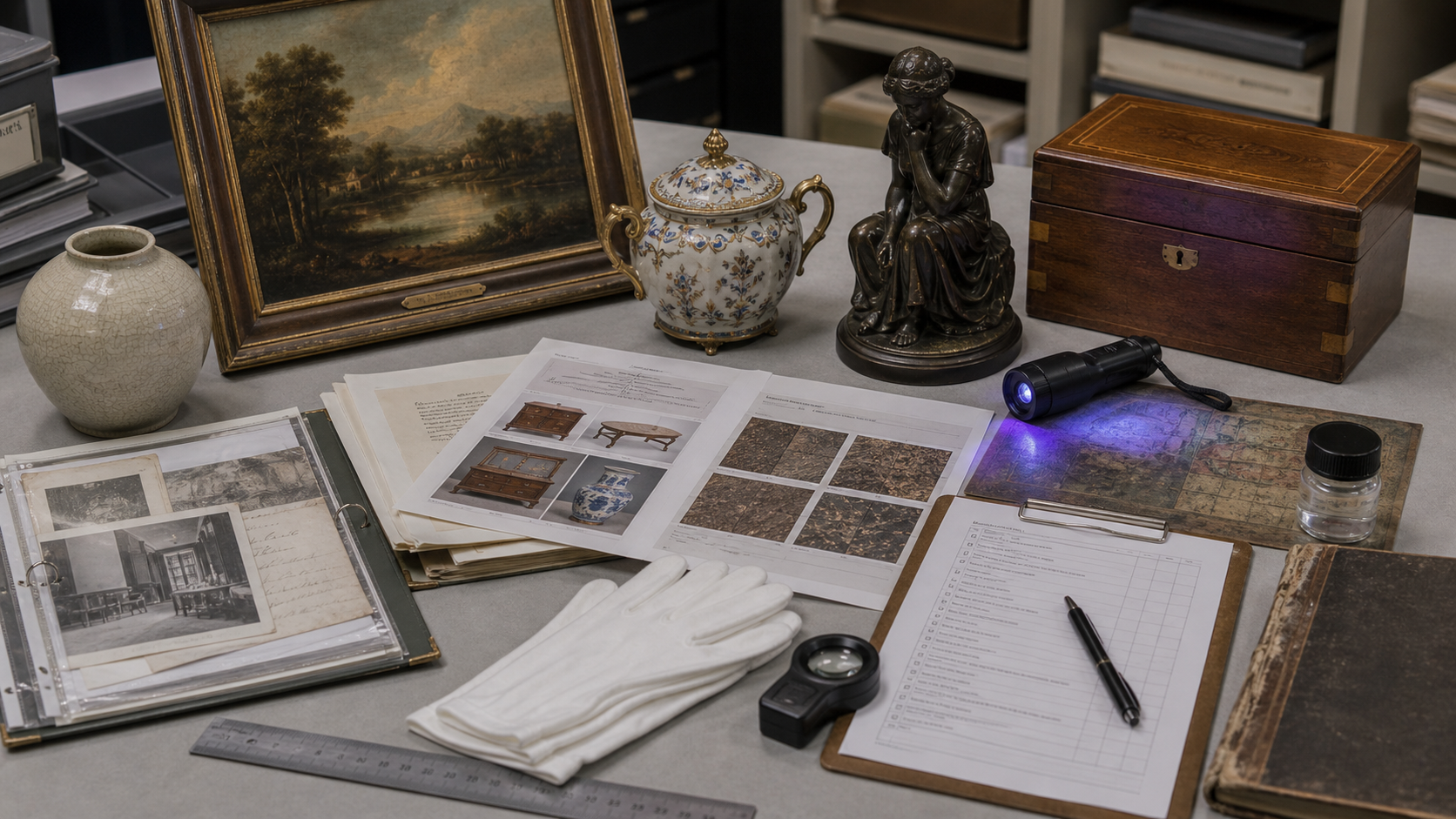
Evidence-led appraisal basics
Valuing antiques and art is an evidence problem before it is a price problem. The useful question is not simply what an object might bring, but which facts support that conclusion and which facts still need confirmation.
This workflow helps collectors, estate executors, insurers, and sellers organize evidence around authenticity, age, condition, rarity, demand, and market comparables.
The valuation pillars
Most antique and art value opinions rely on six interacting pillars. A weakness in one pillar does not always destroy value, but it changes the comparable set and the confidence range.
- Authenticity: maker, artist, period, school, edition, or culture must be supported by the object and records.
- Age: materials, tool marks, paper, hardware, patina, and construction should be consistent with the claimed date.
- Condition: original surface, restoration, loss, instability, and replacement parts can move value sharply.
- Rarity: scarcity matters only when buyers still want the category.
- Provenance: independent ownership records can increase confidence and reduce risk.
- Demand: recent sale behavior decides whether rarity converts into price.
Build the evidence file
A credible appraisal file separates observation from interpretation. Start with what can be seen, measured, photographed, and copied, then move to attribution and market analysis.
- Photograph the object overall and in detail: front, back, underside, interior, edges, marks, labels, signatures, damage, and repairs.
- Measure the right format: image, sheet, frame, case, seat, height, width, depth, diameter, or weight.
- Record materials and construction: wood species, joinery, metal alloy, casting, ceramic body, glass mold marks, paper, canvas, textile, or mixed media.
- Preserve provenance records: invoices, estate papers, collection labels, exhibition history, auction tags, prior appraisals, and conservation reports.
- Write condition notes in value language: stable wear, active damage, restored areas, replaced elements, and saleability risks.
Use scientific testing carefully
Testing supports an appraisal when the result can answer a specific question. It is not a substitute for provenance, connoisseurship, or market research.
- UV examination: can show varnish layers, restoration, overpaint, repairs, and some adhesives.
- XRF: can identify elemental composition in metals and pigments without taking a destructive sample.
- Infrared reflectography: can reveal underdrawing and compositional changes in some paintings.
- Dendrochronology: can provide a not-earlier-than context for wood panels.
- Thermoluminescence: can support firing-date analysis for some ceramics.
- FTIR or Raman: can help identify binders, coatings, and pigments when material risk is high.
Document the lab, method, sampling point, limitations, and examiner credentials. An old material can be reused, and a genuine material can appear in a later object.
Note: We couldn’t find enough auction records that directly match Valuing Antiques and Art With Evidence to publish a defensible price table. If you are valuing a specific item, include its maker, model, material, photos, and condition so the search can be narrowed.
What similar items actually sold for
The current auction search does not contain at least three clean, directly matched sales for Valuing Antiques and Art With Evidence yet. If you’re valuing a specific item, use the free estimate flow so the search can be narrowed by maker, material, photos, and condition.
| Image | Description | Auction house | Date | Lot | Reported price realized |
|---|---|---|---|---|---|
| No relevant auction comps found for this topic right now. | |||||
Disclosure: prices are shown as reported by auction houses and are provided for appraisal context. Learn more in our editorial policy.
Read the market without overfitting
Comparable sales are strongest when they match the object a real buyer would compare. Do not use a famous-maker sale for an attributed or follower work unless the report explains why the market would still consider it relevant.
- Normalize prices for currency, buyer's premium, date, and sale venue.
- Separate auction fair market value from retail replacement value.
- Explain condition adjustments and exclude restored or incomplete examples when they distort the range.
- Use unsold lots as ceiling evidence, not as proof of no value.
- Keep thin-market conclusions as ranges with stated confidence.
Need a written value conclusion?
Upload the photos, dimensions, condition notes, marks, and provenance you already have. Appraisily can prepare a signed appraisal that connects the object to the right evidence and market level.
State the value opinion with limits
A defensible report names the intended use, intended users, value definition, effective date, market level, and scope of inspection. It also explains assumptions and evidence gaps.
- Use clear attribution tiers such as by, attributed to, studio of, circle of, follower of, after, or unknown maker.
- Explain how condition and restoration changed the comparable set.
- Disclose tests not performed and any extraordinary assumptions.
- Show enough comparable evidence that the conclusion can be reviewed later.
- Maintain a workfile with notes, photos, source pages, calculations, and correspondence.
FAQ
Does restoration always reduce value?
No. Stabilizing, reversible, documented conservation can protect value. Over-restoration, undisclosed repairs, and irreversible refinishing often reduce value.
Can an appraiser value from photos alone?
Photos can support desktop opinions when the scope allows, but in-person inspection is stronger for condition, construction, surface, and material questions.
What is the difference between fair market value and retail replacement value?
Fair market value usually reflects the most common resale market. Retail replacement value reflects replacement cost in the retail market and is commonly used for insurance.
How often should an appraisal be updated?
For insurance, update every few years or after major market changes, conservation, damage, or acquisition of new provenance. Estate and tax uses depend on the required effective date.
Reference links
Get an evidence-led appraisal report
A signed appraisal can convert photos, condition notes, provenance, and market research into a clear value conclusion for insurance, estate, donation, resale, or collection planning.