
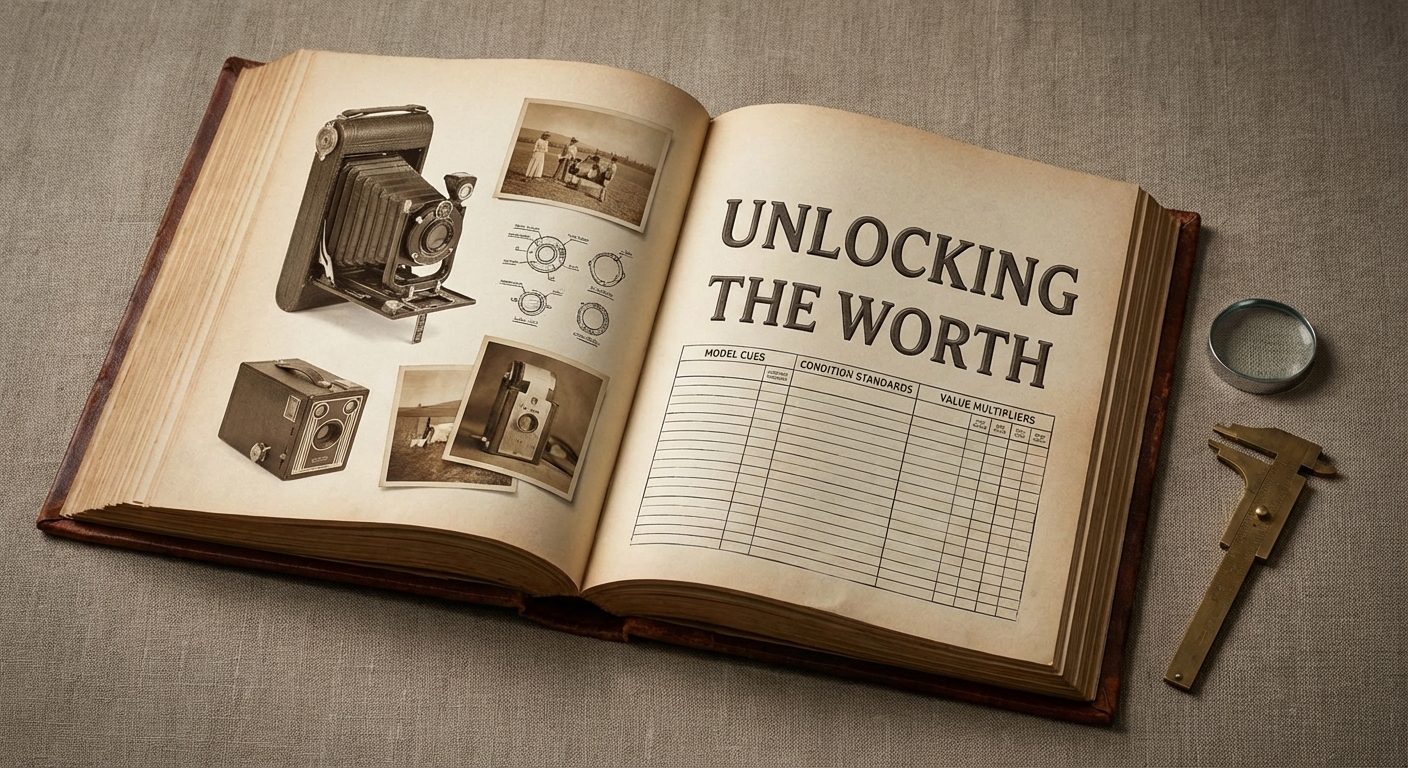
Unlocking the Worth a Comprehensive Guide to Determining Your Antique Kodak Camera Value: appraisal and value basics
Unlocking the Worth a Comprehensive Guide to Determining Your Antique Kodak Camera Value research should start with identification, condition, provenance, and item-specific market evidence. Use this guide to compare the signals that matter before paying for a formal appraisal or deciding whether to sell.
Antique Kodak camera appraisal checklist
Antique Kodak cameras sit at the crossroads of photographic history and design. Yet age alone doesn’t equal value. Collectors and appraisers look for specific model features, correct dating, documented parts, condition, completeness, and evidence of demand in recent sales. This guide walks you through the process—from identification to realistic pricing—so you can judge whether your Kodak is a a value that must be established from current, topic-matched sales shelf piece or a serious collectible.
Identify Your Kodak: Model, Variant, and Era
Correct identification is the foundation of value. Kodak manufactured in the U.S. (Eastman Kodak Co., Rochester), the U.K. (Kodak Ltd., London), and Germany (Kodak AG, Stuttgart—especially the Retina line). Each factory produced distinct models and variants.
Key identification steps:
- Find the model marking. Look for a nameplate or embossed text on the front standard, top plate, or inside the back door. Examples: “Brownie,” “Vest Pocket Kodak,” “Monitor Six-20,” “Retina IIa,” “Medalist II,” “Bantam Special,” “Ektra.”
- Note film format. Common formats include 120 (still made), 620 (discontinued but spool-dependent), 127 (discontinued), 116/118/122/616 (obsolete), and 828 (paper-backed 35mm). Cameras that can readily use modern film (especially 120) tend to be more desirable as shooters, adding value.
- Identify lens and shutter. Lens markings such as Kodak Anastigmat, Ektar, or by Schneider/Rodenstock (on Retinas) and shutters like Compur/Prontor/Supermatic/Kodak are meaningful. Higher-spec lenses and precision shutters usually command premiums.
- Spot Autographic features. “Autographic” Kodaks have a thin slot and stylus on the back door for writing exposure notes; the model name often includes an “A.” Autographic variants can bring a small premium over non‑Autographic siblings.
- Date the lens or camera.
- U.S. Kodak Ektar lenses often carry a two-letter date code using “CAMEROSITY” (C=1, A=2, M=3, E=4, R=5, O=6, S=7, I=8, T=9, Y=0). For example, EO decodes to 46 (1946). This dates the lens, which roughly constrains the camera’s era.
- German Retinas often date via the lens maker’s serial (Schneider, Rodenstock) and shutter serials; production features like body style, accessory shoe shape, and frame counter design also help pinpoint the variant.
- Learn the production context. Massive-production Brownies and simple box cameras are numerous, whereas high-grade models (Ektra, Bantam Special, Medalist) and early roll-film cameras can be genuinely scarce.
Quick examples of collector-favored Kodak families:
- Retina IIa/IIIc/IIIS (Kodak AG, Germany): compact 35mm rangefinders with excellent lenses.
- Medalist I & II (620): heavy U.S.-made rangefinder cameras with sharp Ektar lenses.
- Bantam Special: Art Deco aluminum body; striking design and optical quality.
- Early Folding Kodaks and large 122-format cameras: early roll-film history pieces.
- Ektra system (U.S. 35mm, interchangeable lenses): rare and high-end.
Condition Drives Price: How To Grade Accurately
Condition has the greatest impact on value. Use consistent grading that addresses cosmetics and function.
A practical grading scale:
- Mint/NOS: As factory-new, possibly unused, often boxed with paperwork. Extremely scarce; top premiums.
- Excellent: Minimal wear, clear optics, accurate shutter across speeds; bright finders; no repairs needed.
- Very Good: Light wear; minor cleaning marks; shutter mostly accurate; bellows sound; fully usable.
- Good/User: Noticeable cosmetic wear; minor haze or light scratches; slow shutter speeds may drift; still functional.
- Fair/Display: Heavy wear; dents, peeling leatherette; sticky shutters; fogging; pinholes in bellows; mainly decorative unless repaired.
- Parts/Project: Nonfunctional shutter, severe fungus/separation, torn bellows, missing key parts.
What to check and how:
- Bellows integrity: In a dark room, open the camera, shine a small flashlight inside, and look for pinholes. Any light leak typically subtracts a condition-specific range from value depending on severity and model.
- Shutter operation: Fire at all speeds. Listen for distinct changes between speeds. Extremely slow or capping shutters reduce value and suggest a CLA (clean-lube-adjust) is needed.
- Lens optics: Inspect with a penlight at an angle. Look for haze, fungus threads, balsam separation (rainbow edges), cleaning marks, or scratches. Fungus or separation can reduce value by a category-dependent amount or more on premium lenses.
- Rangefinder and meter: Check rangefinder patch contrast and alignment at infinity and close-up. Selenium meters in old cameras are often dead; a working meter adds value but is not expected on many models.
- Film advance, frame spacing, and latches: Confirm smooth advance, functional counter, tight back door latch. Bent spools or missing take-up spools (especially 620/828) hurt value.
- Cosmetics: Assess plating wear, dents, leatherette shrinkage, and chips. Originality matters more than shine; avoid over-polishing.
Condition nuance by category:
- Box Brownies: Cosmetics and faceplate graphics matter most; functionality is simple.
- Folding cameras: Bellows and shutter performance are critical; higher-grade lenses (Ektar, Anastigmat Special) are strong value drivers.
- 35mm Retinas and Bantams: Shutter accuracy, rangefinder alignment, and clarity of coated lenses are key differentiators.
- Medalist: Rangefinder accuracy and focus helicoid smoothness are important; full function significantly boosts value.
Rarity, Desirability, and Usability: What Collectors Actually Pay For
Value results from the intersection of scarcity, condition, and demand. Some rule-of-thumb signals:
Desirability drivers:
- Advanced optics and shutters: Ektar lenses, Schneider Xenon/Retina-Xenon, Compur/Supermatic shutters.
- Usable formats: Cameras that take 120 film (or can be easily adapted) fetch more than 620-only models unless exceptionally collectible (e.g., Medalist).
- Iconic design: Bantam Special and early artful folding Kodaks draw design collectors beyond the photo community.
- Early production and milestones: Late-19th-century No. 1 Kodak variants or early panoramic formats can be highly valued when complete and intact.
- Complete kits: Original boxes, manuals, Autographic stylus, lens caps, hoods, filters, close-up sets, flash units (Kodak Flasholder), and matching serial-numbered accessories command notable premiums.
Red flags and realities:
- Age ≠ value. Most Brownies were made in huge numbers. Clean, common Brownies often trade at a value that must be established from current, topic-matched sales; unusual editions or special faceplates can reach higher but rarely skyrocket without exceptional condition and completeness.
- Condition beats rarity when faults are severe. A rare body with fungus, torn bellows, or missing parts may struggle to sell.
- Military markings and special engravings are faked. Watch for modern fonts, crisp engraving on otherwise worn surfaces, and mismatched patina.
Representative market ranges (very rough, assuming U.S. market and typical venues):
- Common box Brownies: a value that must be established from current, topic-matched sales
- Vest Pocket / Autographic folders: a value that must be established from current, topic-matched sales depending on lens and condition
- Monitor Six-20 with Ektar: a value that must be established from current, topic-matched sales
- Retina IIa/IIIc: a value that must be established from current, topic-matched sales (high-grade lenses and clean shutters at the top)
- Medalist I/II: a value that must be established from current, topic-matched sales (more for freshly serviced examples)
- Bantam Special: a value that must be established from current, topic-matched sales based on cosmetics and optics
- Early No. 1/No. 2 Kodaks (1890s) in fine order: a value that must be established from current, topic-matched sales+
- Ektra system bodies/lenses: a value that must be established from current, topic-matched sales depending on completeness and condition
These are guidance ranges; confirm with recent sold comparables for your exact variant and condition.
Models with strong followings (short list):
- Kodak Ektra (U.S., 35mm system)
- Medalist I/II (620)
- Bantam Special (127)
- Retina IIa, IIIc, IIIS, and some early folding Retinas (35mm)
- Monitor Six-20 with Anastigmat Special/Ektar
- Early panoramic/large-format roll-film Kodaks (e.g., 122-size)
- Specialty lenses like the Aero Ektar (often sold separate from the aerial camera)
Researching Market Value: Comparables, Adjustments, and Timing
Once you know the exact model and condition, use comparables (recent sold prices) rather than asking prices. Aim for a tight match on these variables:
- Exact model and variant: e.g., Retina IIIc big-C vs small-c, or Monitor Six-20 with Ektar vs non-Ektar lens.
- Condition grade: Align with your assessment, including optical and shutter status.
- Completeness: Boxed sets, original caps, Autographic stylus, and 620 spools change value.
- Region and venue: Auction houses, online marketplaces, and camera fairs can yield different results. High-end venues bring high-end buyers but factor in fees.
How to adjust from a comparable:
- Add a condition-specific range if your example is cleaner or fully serviced (CLA with documentation).
- Subtract a condition-specific range for haze/fungus; a condition-specific range for torn bellows or nonfunctional shutter.
- Add a condition-specific range for boxed, minty sets with paperwork.
- Add a condition-specific range if the camera uses modern 120 film without modification; subtract for 620-only unless rare/desirable.
Market timing and seasonality:
- Listings with clear photos, working demonstrations, and complete accessories perform best.
- Seasonal peaks often occur before holidays and during spring camera fair seasons.
- Trend cycles exist (e.g., renewed interest in medium format); seek recent data.
Quick Appraisal Checklist
- Identify:
- Confirm model and variant; note country of manufacture and film format.
- Record lens and shutter types; decode lens date if applicable (CAMEROSITY).
- Assess condition:
- Test shutter speeds and cocking; check rangefinder and meter where present.
- Inspect lens for haze/fungus/separation; test bellows with flashlight.
- Verify film advance, counter, latches; check for 620/828 take-up spool.
- Verify originality:
- Look for re-coverings, repaint, replaced leatherette, swapped parts, or fake markings.
- Confirm serials align with the expected era and component brands.
- Evaluate completeness:
- Box, manual, caps, stylus, hoods, filters, flash, straps—note all accessories.
- Find market evidence:
- Match model/variant, condition, completeness, and region; use sold prices.
- Price and plan:
- Adjust for condition and accessories; decide venue (auction, dealer, private sale).
- Photograph clearly; disclose faults; pack and ship safely if selling.
Originality, Restoration, and Provenance: Multipliers and Pitfalls
Originality
- Unmodified finishes and coverings are preferred. Replacement leatherette, repainting, re-engraved serials, or “polished” brass often lower collector value even if they look tidy.
- Matched components: On Retinas, the lens/shutter assembly is often the value center; mismatched parts or incorrect-era shutters detract.
Restoration
- CLA by a known technician, documented with receipts, is a plus for usability-heavy models (Medalist, Retina). It rarely hurts value and often helps.
- Avoid heavy cosmetic “restoration” that alters patina. Clean, don’t refinish.
- Do not lubricate shutters with general oils; contamination can ruin blades and optics.
Provenance
- Paper trails (sales receipts, service documents, period accessories) add credibility.
- Notable ownership, military issue with verifiable markings, or documented professional use can command premiums. Validate with consistency in wear, markings, and serial sequences.
Counterfeits and confected rarities
- Fake military or “prototype” engravings surface occasionally. Evaluate font style, stamping depth, and oxidation. Fresh engravings on worn metal are suspicious.
- Part-built cameras assembled from multiple donors may function, but originality/value suffer. Look for differences in finish tone, screw head wear, and misaligned trim.
Preparing To Sell or Insure: Presentation, Storage, and Shipping
Presentation
- Cleaning:
- Exterior: Use a soft brush and microfiber cloth. Lightly dampen with distilled water or a tiny amount of a category-dependent amount isopropyl on chrome only. Avoid strong solvents on leatherette or paint.
- Lens: Air blower first; then lens tissue with a drop of lens cleaner. Never use paper towels. Don’t chase cleaning marks that won’t lift.
- Bellows: Dust only; avoid conditioners that can stain or weaken material.
- Photos:
- Provide clear, well-lit images of front, back, top, bottom, inside film chamber, lens glass, and bellows. Show the shutter cocked and fired; include accessories.
- Description:
- State tested functions, faults, and any service history. Note film format and whether a take-up spool is included.
Storage
- Dry, stable environment away from sunlight.
- Silica gel packets in display cases to deter fungus.
- Do not store in closed leather cases long-term; trapped moisture can promote corrosion and mold.
Shipping
- Immobilize moving parts: Fit lens caps, secure focusing helicoids, remove detachable accessories, and cushion around the bellows/folder hinges.
- Wrap body in soft material; avoid direct bubble-wrap on polished surfaces; then double-box with dense padding.
- Place small accessories in labeled pouches to prevent transit scuffs.
Insurance and documentation
- Photograph the camera, serials, and accessories. Keep copies of market evidence and any service receipts.
- For higher-value pieces (Bantam Special, Ektra, rare early Kodaks), obtain a written appraisal for insurance.
FAQ
Q: Are old Brownies valuable? A: Most common Brownie box cameras were produced in huge numbers and trade at a value that must be established from current, topic-matched sales in average condition. Unusual variants, early models with ornate faceplates, or mint boxed examples can bring more, but rarity and condition are key.
Q: My camera uses 620 film. Does that hurt value? A: Often, yes—620 spools are obsolete and smaller than 120. Collectors still want Medalists and some 620 folders, but users prefer 120-compatible cameras. Having an original 620 take-up spool helps, and some photographers re-spool 120 onto 620.
Q: Should I re-cover or repaint my Kodak to increase price? A: Generally no. Over-restoration can reduce collector value. A professional CLA that improves function is a plus; cosmetic refinishing usually detracts unless the camera was already compromised and you’re targeting a user-only market.
Q: How can I test the camera without film? A: Fire the shutter through all speeds, check aperture blades, verify rangefinder alignment, test bellows in a dark room with a flashlight, inspect optics for haze/fungus, and confirm smooth winding and frame counter operation. Document results in your listing.
Q: Do accessories really matter? A: Yes. Original boxes, manuals, Autographic stylus, lens caps, hoods, filters, flash units, and correct take-up spools can add a condition-specific range depending on the model and overall condition.
By identifying your model precisely, grading condition honestly, verifying originality, and anchoring your expectations to recent sold comparables, you’ll move beyond guesswork to defensible valuations. Whether you’re curating a collection, insuring a standout piece, or preparing a sale, the steps above help you unlock the real worth of your antique Kodak.


![KODAK: US-Type Six-16 616 film camera with Kodak Doublet lens [#53991] and enamelled metal Art Deco faceplate, apparently mint-condition in original maker's box with instruction booklet and Kodak Pan Film advertisement, c. 1933. sold by Leski Auctions Pty Ltd, lot 1565 — auction record photograph](https://assets.appraisily.com/auction-lots/199882286/thumb/h21350-l418320956.jpg)


![[EARLY PHOTOGRAPHY]. Eastman Kodak Co., No. 2 Stereo Brownie camera with stereo self-transposing printer. Rochester, NY, ca 1905-1910. sold by Freeman’s | Hindman, lot 433 — auction record photograph](https://assets.appraisily.com/auction-lots/196494776/thumb/58bd33d62c6cb73d79e56f46594e68c689fad5b346318848165a79fb06484c4f.jpg)


