
Jacob Richard Musical Interlude lithograph value basics
Jacob Richard Musical Interlude research should start with a title check: recent exact-title auction records appear under Georges Schreiber, not a clearly established Jacob Richard market. Treat the lower-corner name as one clue, then verify title, artist, print process, edition evidence, condition, frame quality, provenance, and recent sales before setting a value.
The original appraisal request for this piece described a framed “painting” passed down from a grandmother and identified only by the name in the lower corner. That’s extremely common with vintage wall décor: many framed “artworks” are actually mass-produced lithographs or offset prints made for the decorative market.
The good news is that you can usually determine whether a print is decorative or collectible in minutes by checking three areas: (1) the signature, (2) the edition information, and (3) the paper/margins.
If your copy of Musical Interlude has a printed signature (not pencil) and no edition numbering, the market is typically modest. Condition and framing matter more than the artist name on the image.
Note: We couldn’t find relevant auction comps in our database for this topic right now. If you’re valuing a specific item, try searching by maker/model/material and we’ll expand coverage over time.
What similar items actually sold for
To help ground this guide in real market activity, here are recent example auction comps from Appraisily’s internal database. These are educational comparables (not a guarantee of price for your specific item).
| Image | Description | Auction house | Date | Lot | Reported price realized |
|---|---|---|---|---|---|
| No relevant auction comps found for this topic right now. | |||||
Disclosure: prices are shown as reported by auction houses and are provided for appraisal context. Learn more in our editorial policy.
Free instant estimate
Not sure if your item is worth appraising? Let us take a look.
Upload a photo, tell us what you know, and get a free first read. If a full appraisal makes sense, we will say so.
Free. No card needed. Takes about two minutes.
Quick value summary from recent comps
Recent auction evidence for Musical Interlude lithographs points to a modest decorative-print market unless the sheet proves to be hand-signed, editioned, or tied to documented gallery provenance. Repeated 2025 sales of Georges Schreiber Musical Interlude lithographs landed around $250 to $300; unattributed or misattributed decorative prints can trade lower, while true paintings with the same title are a different market and should not be used as direct comps.
- $150 to $300 is a reasonable starting resale band for an exact-title lithograph with clean paper, presentable framing, and no stronger edition evidence.
- Below $150 is common when there is fading, foxing, water staining, generic framing, or only a printed signature.
- Above $300 usually needs a hand signature, edition number, publisher blind stamp, gallery label, or a confirmed artist attribution with buyer demand.
The range can increase if you find pencil signatures, edition numbering (for example, 42/250), an embossed publisher stamp, or paperwork tying the print to a limited-edition release.
Who is “Jacob Richard” on the print?
A common pitfall with inherited prints is assuming the printed name in the corner automatically indicates a well-documented fine artist. Decorative publishers frequently reproduced works (or commissioned art) and printed a name that may be:
- a working illustrator with limited auction visibility,
- a studio name or licensing name, or
- easy to misread (Richard vs Robert/Roberts in low-resolution photos).
The best way to verify the creator is not the signature alone—it’s the combination of title, publisher, and edition markers. If the back of your frame has a label from an art distributor, or if the margin includes a copyright line, those are often the fastest clues.
Lithograph vs offset print vs “enhanced” print
The WordPress appraisal mentioned “enhanced” prints, which is a real category in the décor world: a standard print with a textured varnish or gel applied to mimic brush strokes. The important thing to know is that this kind of enhancement usually does not make the print rare.
- True lithograph: printed from a stone/plate process; can still be mass-produced.
- Offset print / photomechanical reproduction: extremely common; often what décor “lithographs” actually are.
- Enhanced/varnished surface: adds texture, not scarcity.
For pricing, the practical questions are: Is it limited edition? and Is it hand-signed? If the answer to both is “no,” value is usually driven by presentation and condition.
Printed signature vs hand-signed: the one check that changes value
On many collectible prints, the artist signs in pencil below the image, often paired with an edition fraction like 12/150. A printed signature integrated into the image area is typically a decorative indicator.
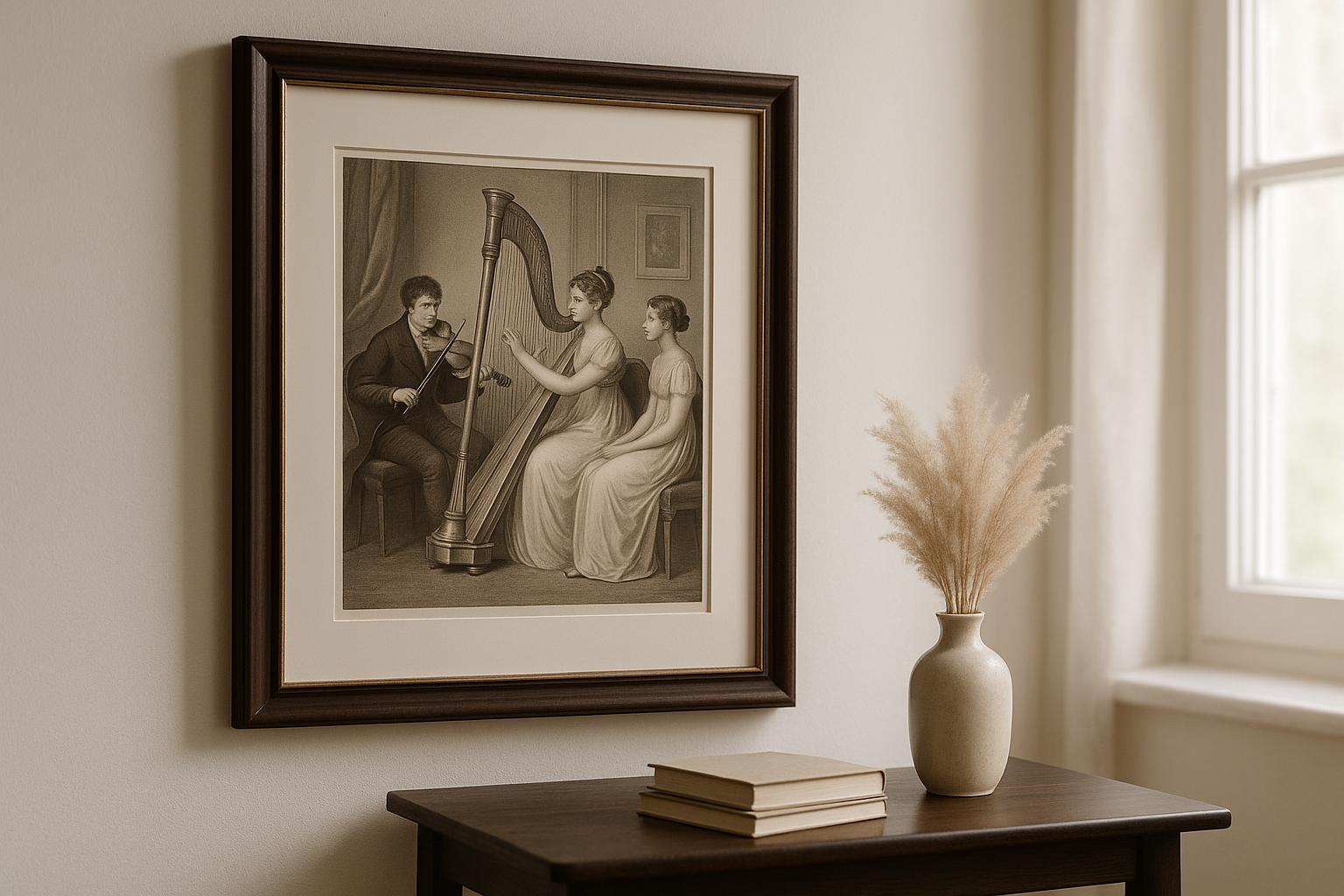
Before you assume “printed signature = worthless,” keep two nuances in mind:
- Some collectible artists did authorize posters with printed signatures—those can still sell, but typically at poster pricing.
- Some pencil marks are not signatures (they may be gallery notes or framing marks), so a close photo matters.
What to photograph for a confident appraisal (5 shots)
- Lower margin/signature area (straight-on, high resolution).
- Any edition numbers (look left/right below the image).
- Full front view (to show subject, colors, and frame style).
- Side profile of the frame (to show glazing type and depth).
- Back of the frame (labels, stamps, dust cover, framer marks).
Bonus: if you can safely open the back, photograph the paper margins and any embossed stamp. Many limited editions have an embossed blind stamp from the publisher.
Upload the signature, margin, paper, and back-label photos. The free screener can flag whether the Schreiber comps apply or whether the print needs a different attribution path.
Upload photos for a free first lookHow to sell a decorative lithograph (without wasting time)
For most “ready to hang” decorative prints, online platforms tend to outperform local consignment because buyers search by subject and style. The fastest path is usually:
- Facebook Marketplace for local pickup (frames are expensive to ship).
- eBay if you can ship safely (double-box, corner protectors, insurance).
- Etsy if the framing and décor style is the main appeal (use lifestyle photos).
Listing tips that help prints move:
- Use the title + medium in the listing headline: “Musical Interlude lithograph print, framed”.
- Add exact measurements of the art window and the full frame.
- Disclose condition issues: foxing (brown specks), fading, rippling, or glass scratches.
- Photograph the signature area as its own image in the gallery.
When it’s worth a professional appraisal
If any of the following are true, it’s worth getting an expert review before setting a price:
- You see pencil signature(s) and/or an edition fraction (e.g., 42/250).
- There’s an embossed publisher stamp in the margin.
- The print has strong provenance (gallery receipt, exhibition label, artist correspondence).
- You suspect it’s older than it looks (19th-century paper, strong plate mark, laid paper texture).
Search variations people ask
These are common searches when people try to identify and price this kind of print:
- jacob richard musical interlude lithograph value
- is my jacob richard print an original or a reproduction
- how to tell if a lithograph is hand signed or printed
- what does 12/250 mean on a print
- does an “enhanced” print add value
- how to spot foxing and paper toning on lithographs
- best way to ship framed art sold on ebay
- should i remove a print from its frame to appraise it
Each question is addressed above (signatures, edition clues, condition, market evidence, and selling strategy).
How We Research Valuation Data
Our appraisal guides are based on auction results, dealer pricing data, and professional appraiser insights. We may earn a commission when you use our free professional appraisal service . Learn about our editorial standards .
References
- MoMA glossary: lithograph (overview)
- U.S. National Park Service Conserve O Gram (basic care guidance)
- Smithsonian: collections care and handling
Wrap-up
Most copies of Musical Interlude credited to “Jacob Richard” fall into the decorative print market—especially when the signature is printed and there’s no edition information. Use the signature and margin checks above, compare to recent recent auction comps, and price it like attractive wall décor unless you uncover limited-edition signals.