
Australian Aboriginal Artwork of Cultural Significance: appraisal and value basics
Australian Aboriginal Artwork of Cultural Significance research should start with identification, condition, provenance, and item-specific market evidence. Use this guide to compare the signals that matter before paying for a formal appraisal or deciding whether to sell.
Australian Aboriginal artworks can carry deep cultural meaning and community knowledge. That meaning doesn’t always translate neatly into a market price—especially when the work is a reproduction, lacks documentation, or depicts content that should not be traded.
This guide focuses on a practical question collectors often face: what do you actually have, and how do you document it so an ethical sale, donation, or insurance valuation is possible? We’ll walk through identification (painting vs print), provenance and cultural protocols, common red flags, and realistic value drivers.
Free instant estimate
Not sure if your item is worth appraising? Let us take a look.
Upload a photo, tell us what you know, and get a free first read. If a full appraisal makes sense, we will say so.
Free. No card needed. Takes about two minutes.
How We Research Valuation Data
Our appraisal guides are based on auction results, dealer pricing data, and professional appraiser insights. Our professional appraisal service provides paid signed reports. The Screener offers a free first look. Learn about our editorial standards.
What “cultural significance” means (and what it doesn’t)
“Cultural significance” is a broad phrase. In Aboriginal and Torres Strait Islander contexts it can relate to who has the right to depict a story, a site, or specific iconography; the community relationship to the work; and whether a work is intended for public viewing.
From a valuation standpoint, the key takeaway is this: cultural importance and market price are related but not identical. Some culturally important objects should not be traded at all, while some works with strong market demand still require careful provenance and permissions to handle respectfully.
Step 1: Identify what you actually have
Before you can discuss value, you need to classify the object correctly. Many online listings get into trouble by calling every framed image a “painting.” Here are the most common categories collectors encounter.
- Original painting on canvas/board: often acrylic on canvas for many contemporary market examples (but not always). Under raking light you should see a surface texture from brushwork or paint build.
- Limited edition print: usually numbered (e.g., 12/50) and sometimes hand-signed. The signature and edition info should look consistent with the printing method and ink/graphite.
- Open edition decorative print or poster: mass-produced, typically no edition number, no attribution review paperwork, and often a very flat surface.
- Book plate / portfolio page: a printed page removed from a publication and framed (sometimes with a plate number or page reference in a corner).
Quick test: view the surface under a bright light at a low angle. Paint and impasto catch the light; most prints stay flat unless they have a heavy varnish layer.
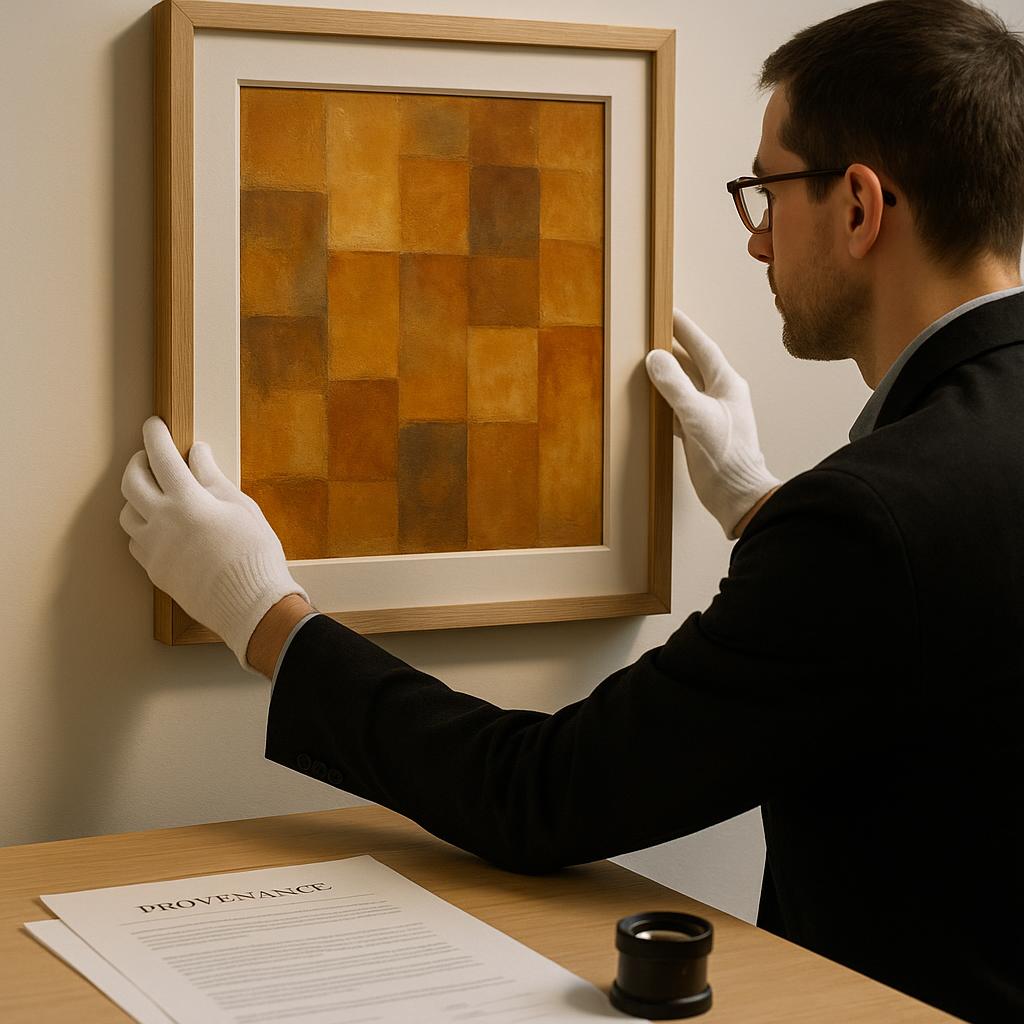
Step 2: Document provenance (and why it matters so much here)
Provenance is the “chain of custody” for an artwork: where it came from, when it was acquired, and what documentation supports the story. For Aboriginal art, provenance also helps demonstrate ethical sourcing.
Helpful documentation includes:
- Art centre label or catalogue sheet: often lists artist name, community, medium, and date.
- Certificate of originality (COA): ideally from an art centre, gallery, or reputable dealer (not a generic template).
- Receipts/invoices: gallery receipt with the work described clearly (dimensions, medium, artist, and date).
- Exhibition history: catalogue mentions, gallery stickers, or prior collection records.
- Condition and conservation notes: restoration documentation, reframing receipts, or conservator reports.
Originality and ethical handling: two parallel checks
Attribution review is not only about whether an image “looks right.” It’s also about whether the work was produced and sold under appropriate permissions. When in doubt, consider contacting the issuing art centre or a specialist in Aboriginal art markets.
Common red flags include:
- Unclear artist attribution: “Aboriginal style” with no named artist or community and no paperwork.
- Suspicious signatures: a signature added over varnish, or inconsistent with other documented examples.
- No documentation for a “limited edition” claim: edition claims should be supported by numbering and reputable issuance.
- Inappropriate subject matter: content that appears restricted or ceremonial should trigger a pause and seek guidance.
What drives market value (the short, practical list)
Once the work is correctly identified and documented, these factors typically move prices the most. Think of them as multipliers: strong documentation and artist recognition can shift a work from “decorative print pricing” to “collectible market pricing.”
- Artist name and market: established artist markets trade differently than anonymous decorative works.
- Community / region and art centre provenance: reputable sourcing supports confidence and demand.
- Medium: original painting vs print vs poster is often the biggest pricing divider.
- Edition details (for prints): signed/numbered editions generally outperform open editions.
- Size and visual presence: larger works often command higher prices within the same category.
- Condition: fading, water damage, foxing (paper spots), and poor framing can reduce value significantly.
- Subject and documentation: public-facing story documentation can help; avoid pushing disclosure of restricted information.
- Sales channel: specialist auctions and reputable galleries often outperform general marketplaces.
Case study: an unsigned framed print marked “P5”
Many quick appraisals we see describe a scenario like this: a framed image described as a “Walbiri/Warlpiri shell blade,” with a flat surface (no paint texture) and a small corner mark such as “P5.”
A corner mark like “P5” often suggests the work is one plate/page from a set (or from a book of prints) that was later framed for decorative use. If the work is not signed and not issued as a limited edition, the market usually values it as décor.
In that type of case, a modest decorative value can be plausible depending on framing quality and condition. However, if you find a named artist, an art centre label, or edition documentation, the category (and pricing) can change dramatically—so it is worth checking the back of the frame and any paperwork carefully.
How to sell (and when to pause)
If your goal is to sell, focus on responsible disclosure and the right venue. If the work has uncertain provenance or depicts potentially restricted content, pause and seek guidance rather than rushing to list it online.
- Specialist auction houses: best for documented works by known artists with established markets.
- Reputable galleries/dealers: often prefer strong paperwork and will ask detailed provenance questions.
- General marketplaces: can work for decorative prints, but prices are typically lower and originality claims are risky.
Photography matters. Take straight-on front and back images, close-ups of signatures/labels, and a clear shot of any certificates or receipts. Avoid making claims you can’t support (for example, “original” or “limited edition”).
Care and insurance basics
Proper framing and storage protect both cultural integrity and financial value. For works on paper, avoid damp environments and direct sunlight. For canvases, avoid tight heat sources and check for loose hardware.
If you’re insuring a documented work, store your paperwork together with your photos (front/back/details) so a claim can identify the correct object quickly.
Search variations collectors ask
Readers commonly search for these question-style variations while researching Aboriginal art identification and value:
- how to tell if an Aboriginal artwork is an original painting or a print
- what does an art centre label mean on Aboriginal art
- how to value unsigned Aboriginal art prints
- how to check provenance for Australian Indigenous art
- what affects the price of Aboriginal dot paintings at auction
- can you sell Aboriginal art without a certificate or opinion
- how to insure Aboriginal artworks with cultural significance
- where to sell Aboriginal art ethically in Australia
Each question is addressed above (identification, documentation, ethics, value drivers, and selling channels).
References
- Indigenous Art Code (Australia): ethical trading guidance
- AIATSIS: Indigenous cultural and intellectual property overview
- National Gallery of Australia: Aboriginal and Torres Strait Islander art
Wrap-up
When a work is culturally significant, the “right” next step is often documentation—not guessing a price. Identify the object type (painting vs print), gather provenance, and use specialist or community guidance when details are unclear. That approach supports respectful handling and leads to a valuation you can actually defend.


