Joan Miro artwork value guide: appraisal and market basics
Joan Miro Original Artwork Appraisal Guide research should start with identification, condition, provenance, and item-specific market evidence. Use this guide to compare the signals that matter before paying for a formal appraisal or deciding whether to sell.
Joan Miro artwork appraisal notes
Joan Miro (1893–1983) is one of the most faked, misattributed, and misunderstood names in modern art. His prolific output spans oil paintings, works on paper, original prints, ceramics, sculpture, tapestry, and a vast poster production. For appraisers, dealers, and collectors, the challenge is not only confirming originality but precisely classifying the medium, dating the work, and gauging quality relative to his overall oeuvre. This guide distills what matters when identifying and valuing an original artwork by Miró.
What “Original” Means in Miró’s Oeuvre
“Original” can mean different things depending on the medium. In Miró’s case:
- Unique original: One-of-a-kind artworks such as oil paintings, unique works on paper (gouache, watercolor, mixed media), sculptures (unique or unique variants), ceramics (unique vases, plaques), and tapestries.
- Original print: A limited edition print conceived by Miró and executed in a printmaking medium (lithograph, etching, aquatint, woodcut), typically hand-signed and numbered, produced under the artist’s supervision or authorization. These are not reproductions; they are considered original works within the print discipline.
- Reproduction: Mechanical reproductions of existing works (posters, offset prints, book plates). Some were authorized for exhibitions or publications but are not original fine art prints, even when they bear a printed signature or printed numbering.
The distinction between a hand-signed, limited original print and a reproduction accounts for the most frequent appraisal errors with Miró.
Medium-by-Medium Identification
Understanding Miró’s material vocabulary is the fastest route to correct attribution and valuation.
Oil paintings on canvas or panel
- Expect decisive, calligraphic black lines; saturated primary colors; biomorphic forms; stars, eyes, birds, and ladders recurring as motifs.
- Surfaces often show layers, pentimenti, matte vs glossy contrasts, and occasionally sand or textured grounds in certain periods.
- Signatures: “Miró” in paint, typically lower right or left. Date often painted nearby.
- Provenance typically tracks to major galleries (e.g., Maeght, Pierre Matisse) and museum exhibitions.
Unique works on paper
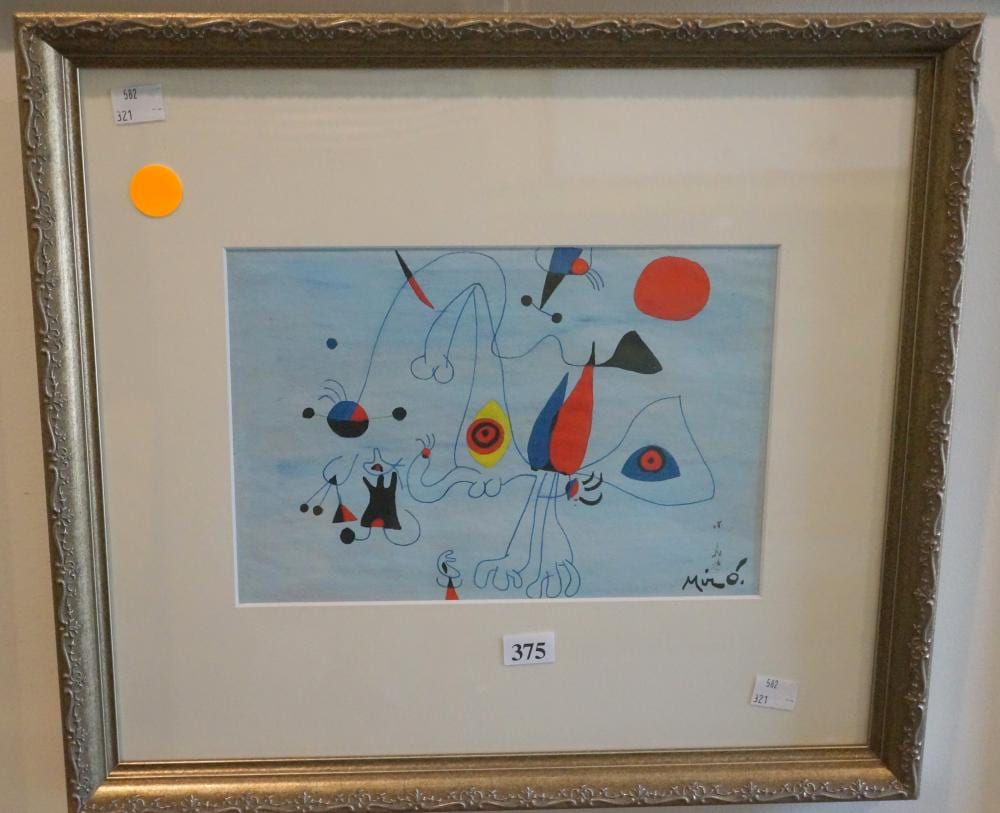
- Media: gouache, watercolor, ink, pastel, charcoal, mixed media.
- Paper supports vary (Arches, Montval, Japan papers). Deckled edges common.
- Miró often used bold brush-and-ink with splatters and bleeds; check for real pigment and penetration into fibers, not uniform dot patterns.
- Signature in pencil, ink, or paint; dating in pencil common.
Original prints
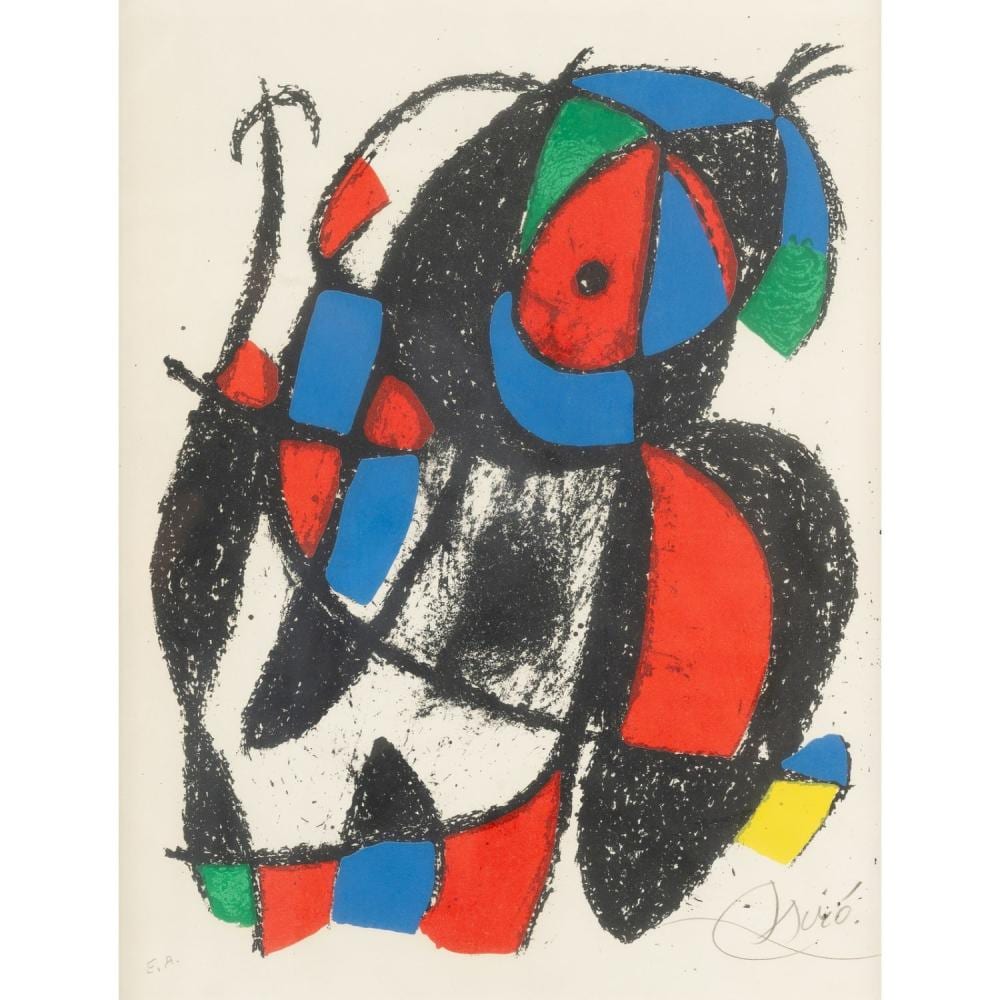
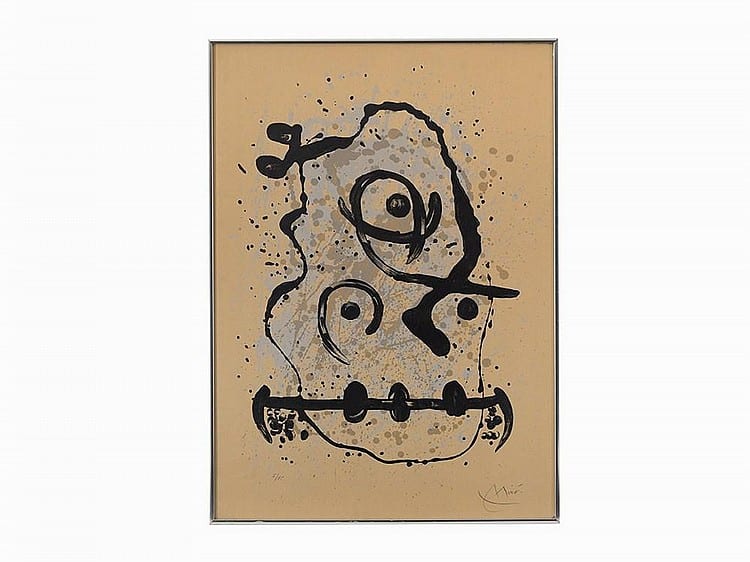
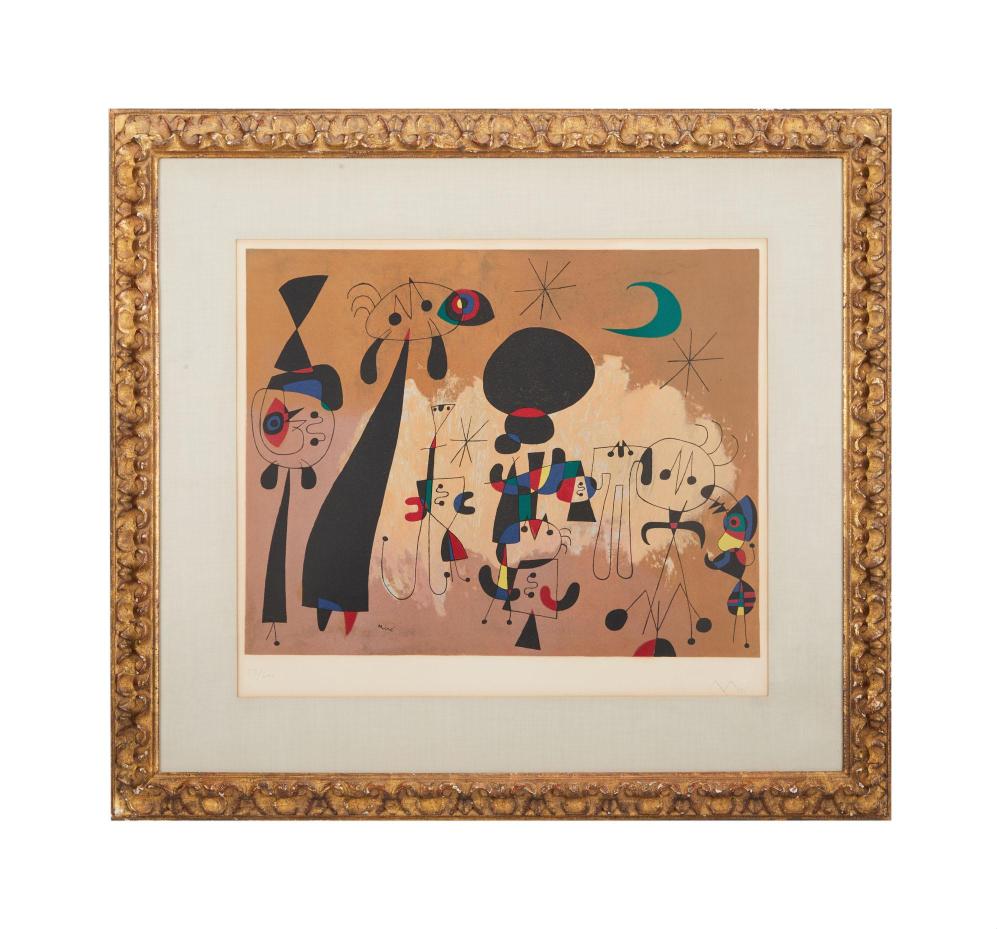
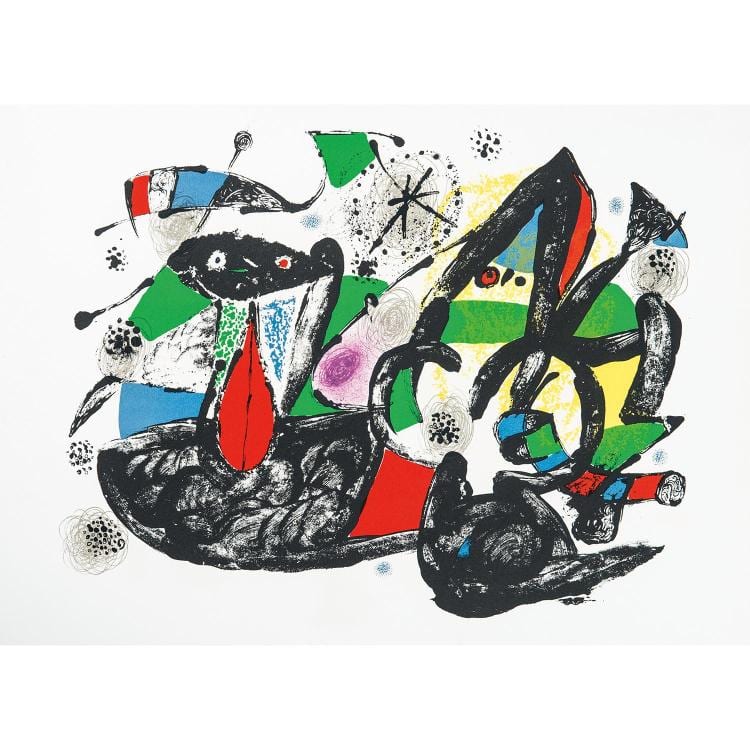
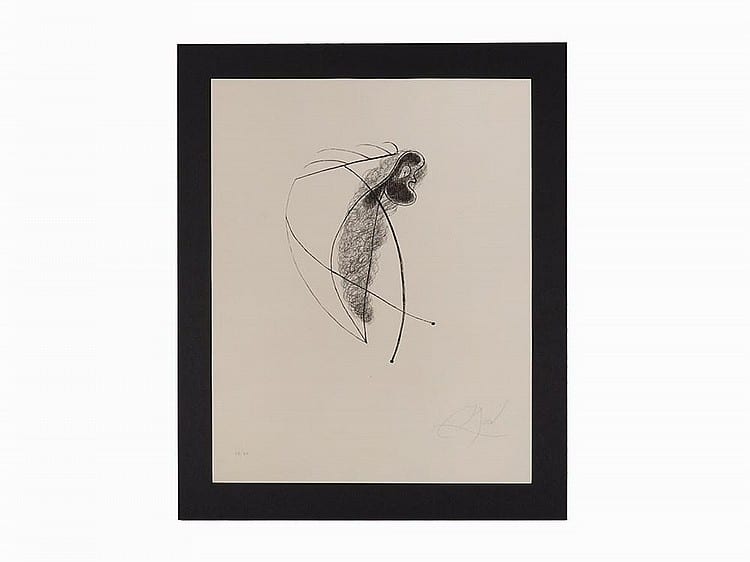
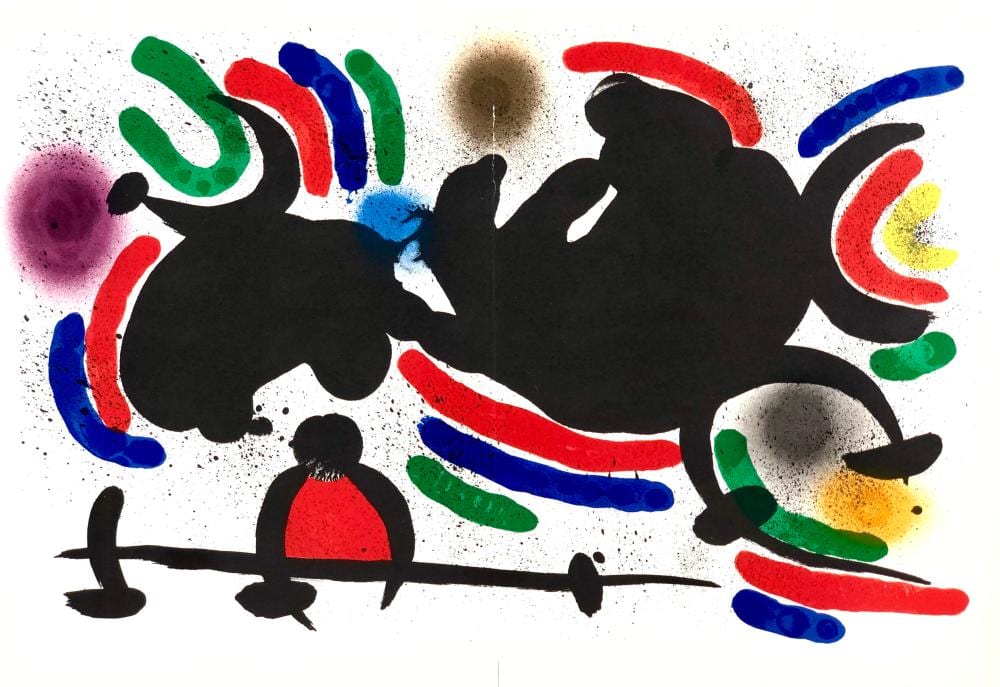
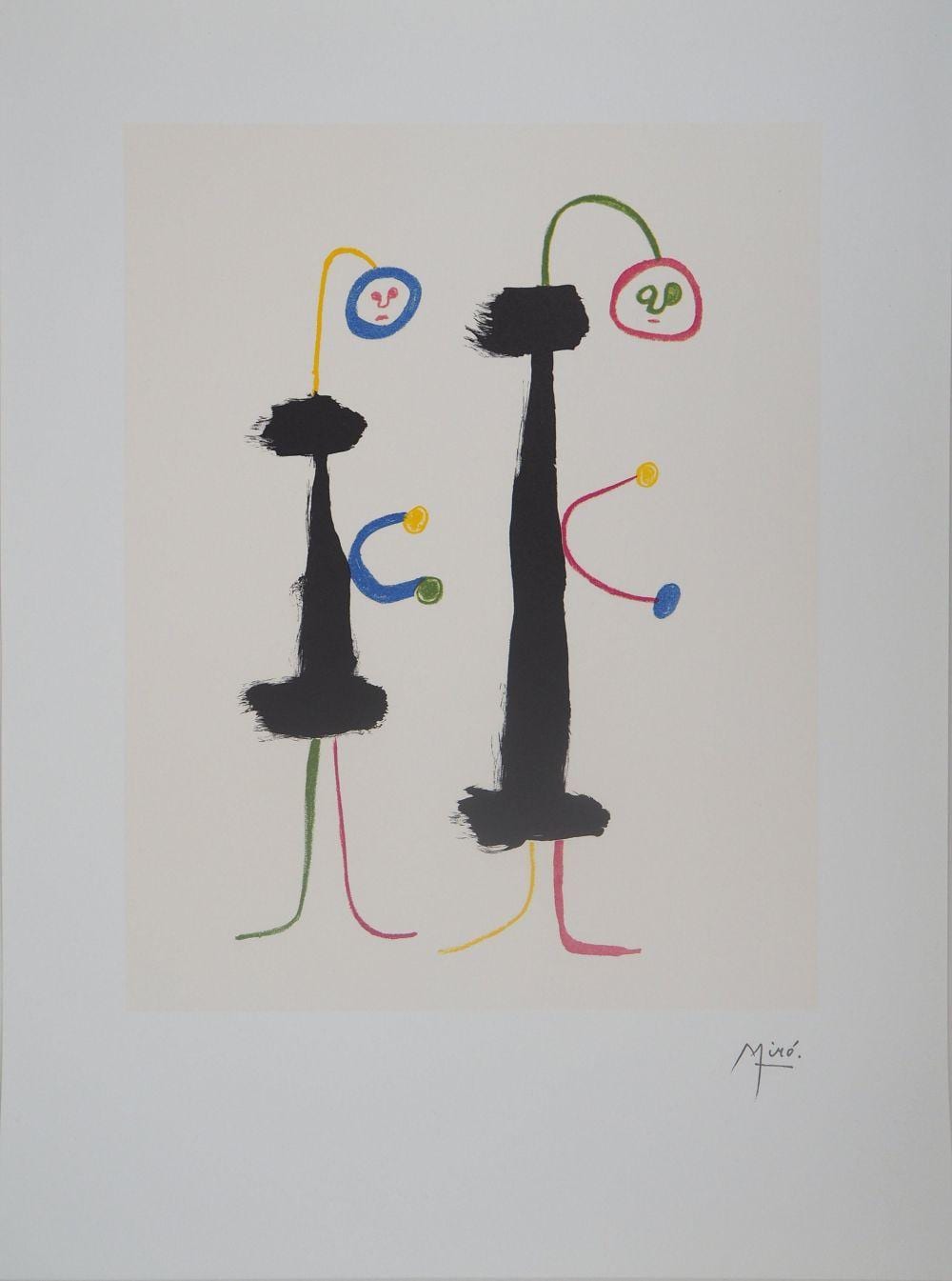
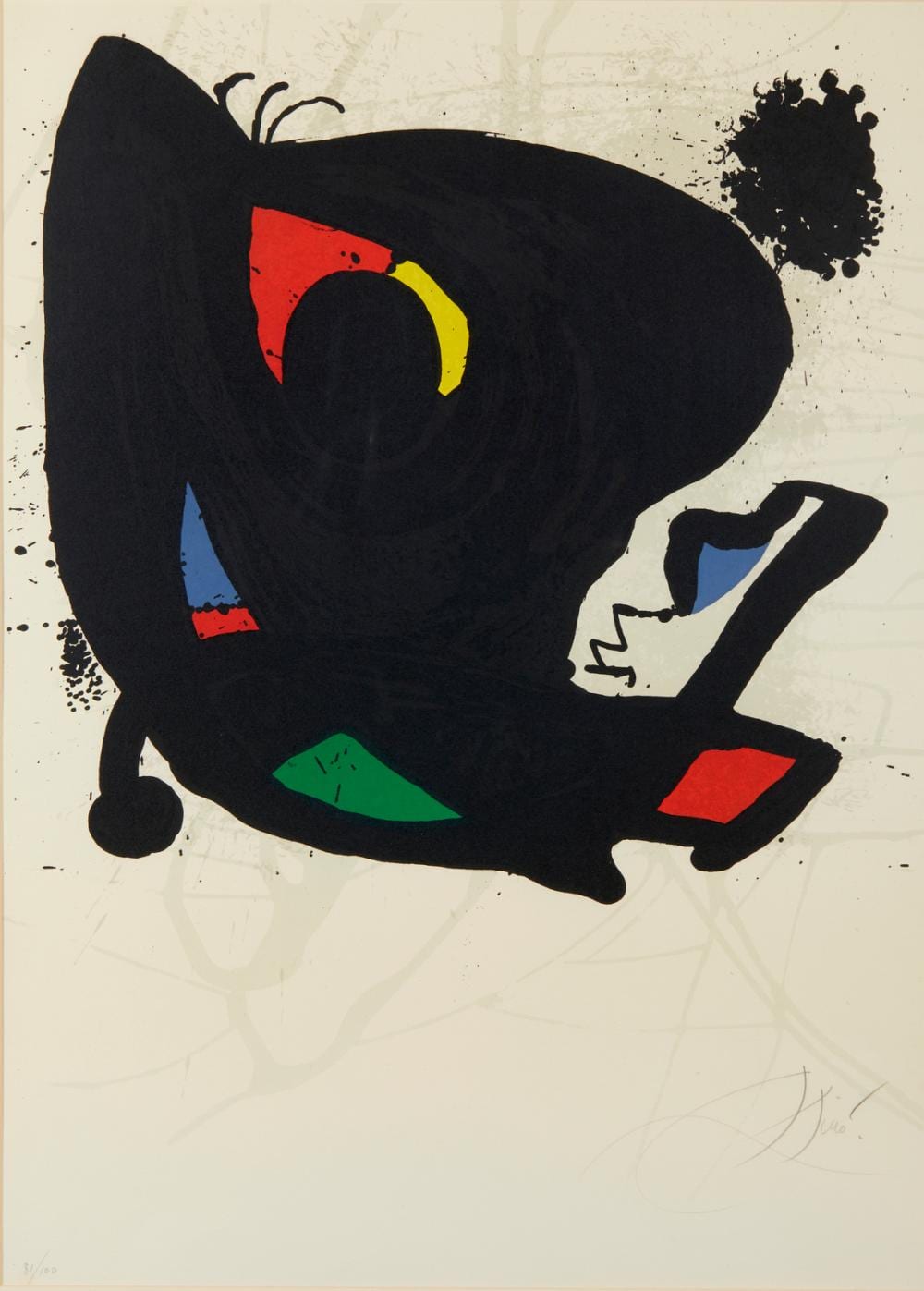
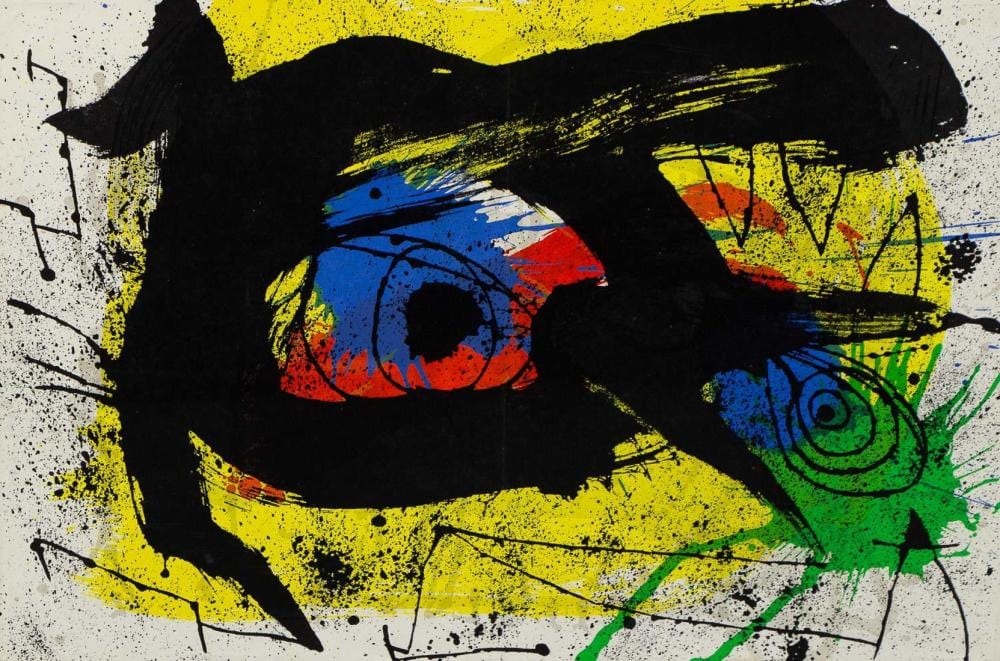
- Lithographs: Often printed in Paris by Mourlot and in later years by ARTE/Adrien Maeght; also Barcelona workshops (e.g., La Polígrafa). Expect crayon-like textures, rich blacks, and layered color runs. Hand-signed in pencil “Miró” lower right; edition number lower left (e.g., 34/75).
- Etchings and aquatints: Frequently produced with deep, velvety aquatint blacks; plate marks should be palpable. Frequently printed with Joan Barbarà’s workshops (among others). Hand-signed and numbered.
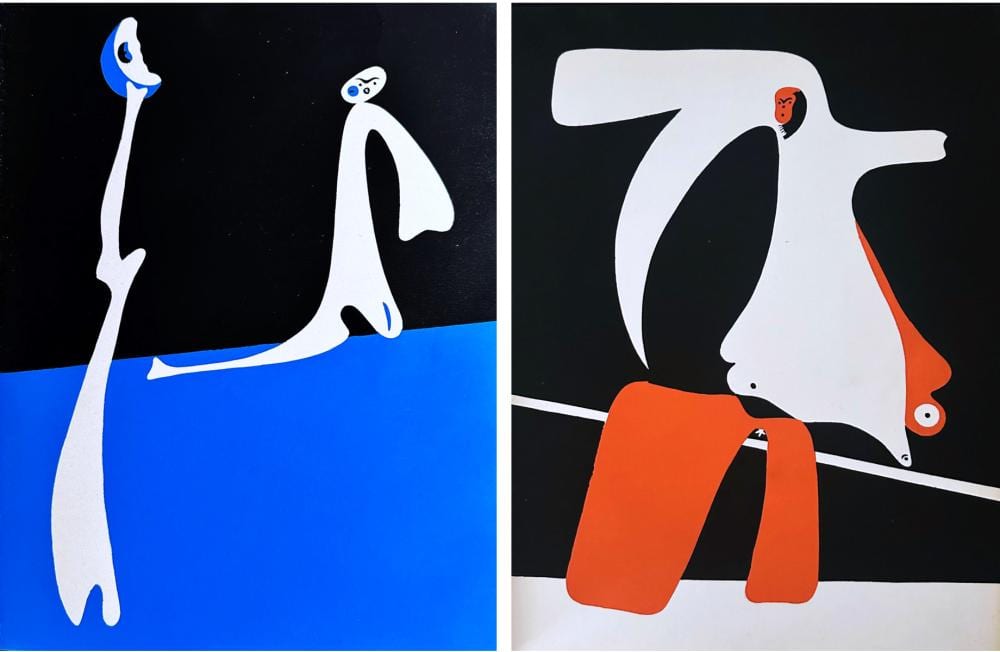
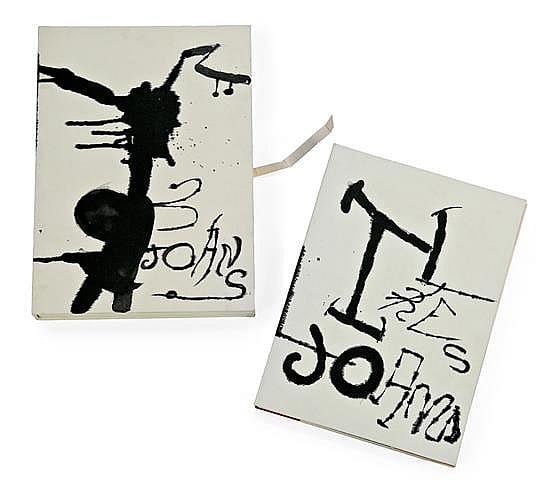
- Woodcuts and pochoir: Less common but present, often within illustrated books.
- Proofs: A.P., E.A. (épreuve d’artiste), H.C. (hors commerce), P.P. (printer’s proof), T.P. (trial proof) occur. These should be consistent with the catalogue raisonné notes.
Posters and reproductions
- Many Miró exhibition posters exist; some were printed by Mourlot or Maeght but intended as posters, not fine-art editions.
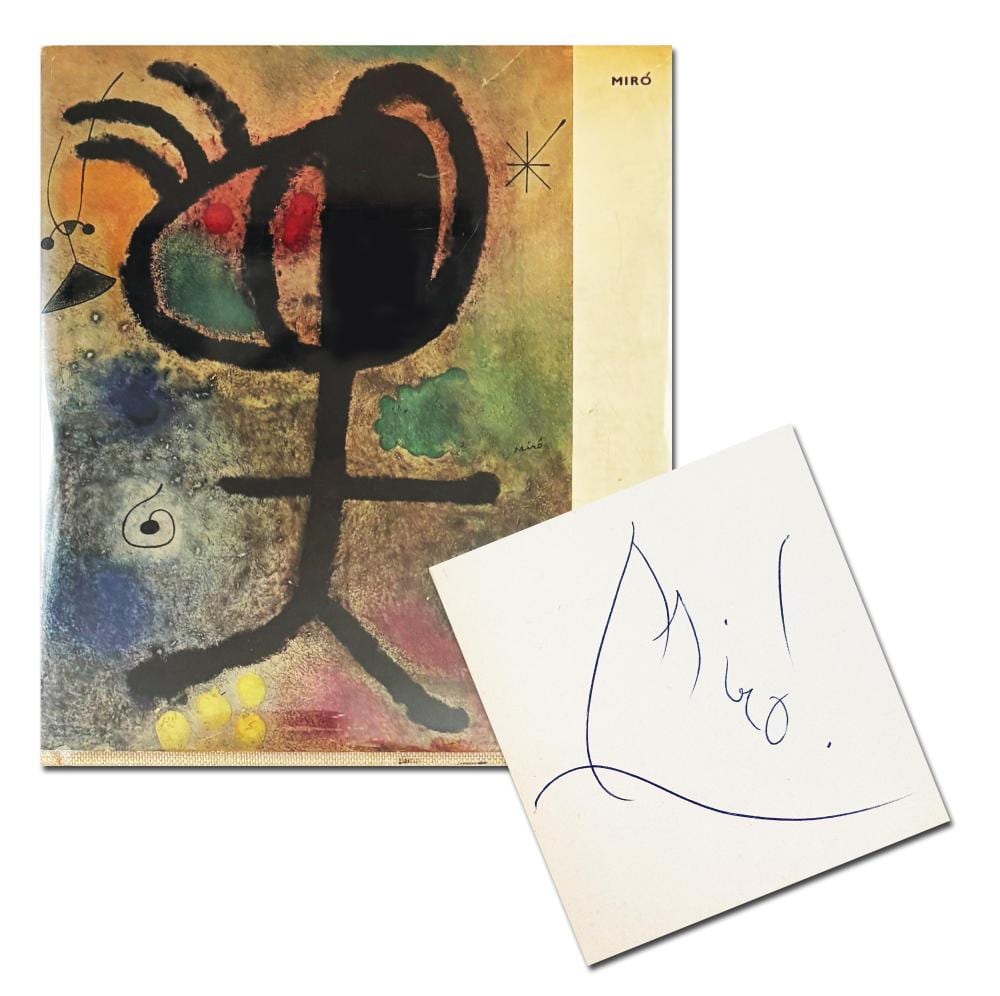
- “Printed signature” within the image is part of the design and not a hand-signature. If the poster is hand-signed in pencil, it may carry a premium as a signed poster, but it is still a poster unless documented as a limited fine-art edition.
Sculpture and ceramics
- Bronzes are cast in editions, usually with numbering and a foundry stamp. Surface patina intentional; beware freshly applied, uniform patina suggesting modern recasting.
- Ceramics often result from Miró’s collaboration with Josep Llorens Artigas; look for impressed or painted signatures, workshop marks, and period-appropriate glazes and firing characteristics.
Tapestries
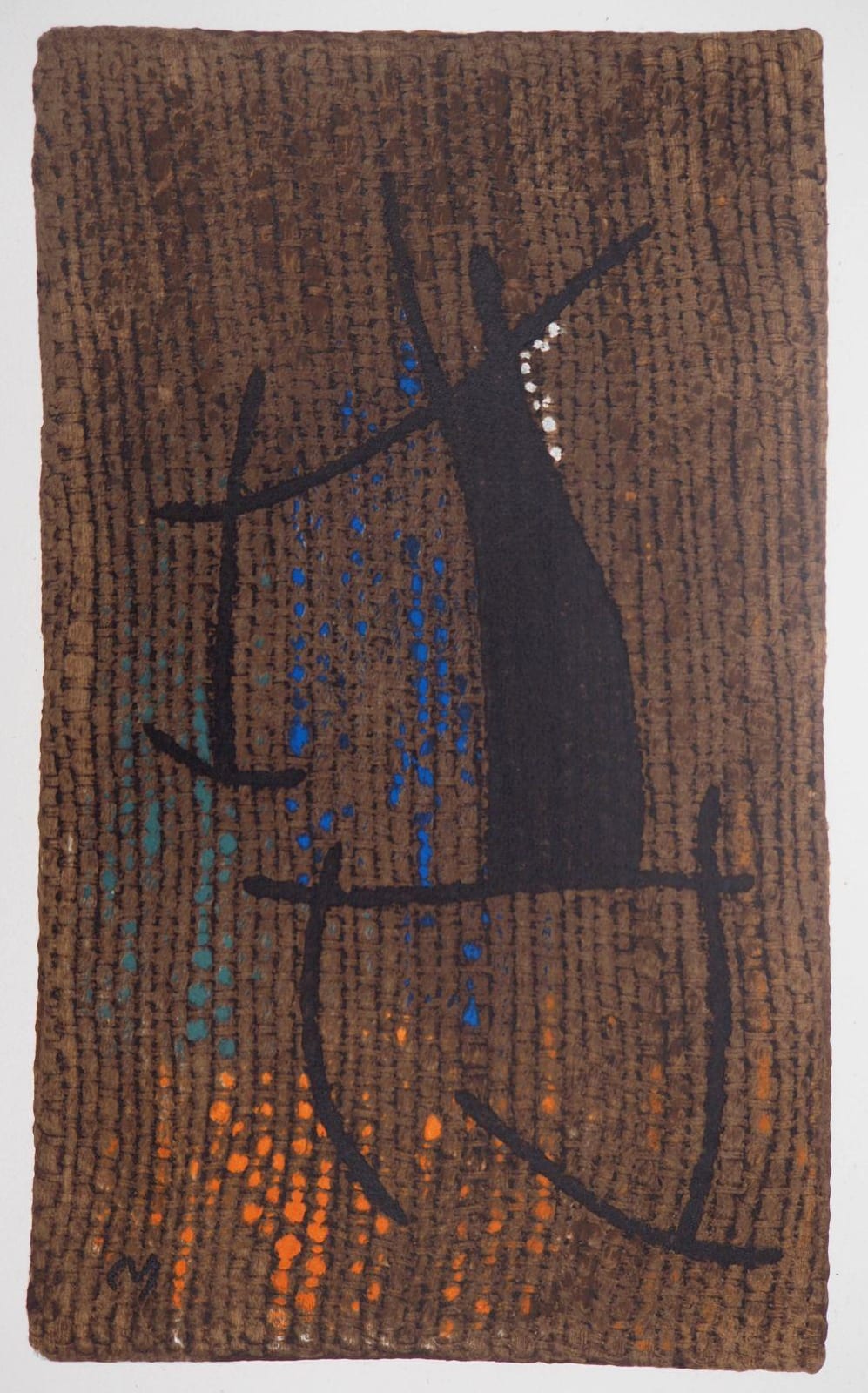
- Woven works typically in collaboration with Josep Royo. Editioned examples exist; labels, weavers’ marks, and commissioning gallery documentation are key.
For any medium, the combination of material evidence, signature practice, and publication history should align.
Signatures, Stamps, Paper, and Edition Clues
Miró’s signature habits help but do not document on their own. Use them in concert with other evidence.
Signature characteristics
- Hand-signed “Miró” in pencil for prints, typically on the margin outside the image; acute accent over the “o” often present but not always pronounced depending on speed and pencil pressure.
- Hand-signed in paint for unique works. Signature may be in black or a contrasting color, occasionally integrated into the composition.
- Red flags: Signatures that float awkwardly in the image area on prints; graphite sheen inconsistent with paper age; shaky letterforms; signatures on glossy poster stock.
Edition numbering
- Conventional lower-left numbering like 23/75, with tidy fraction bar and consistent graphite. Miró editions commonly range from 50 to 300, but many benchmark lithographs sit at 75–150.
- Proof marks: A.P./E.A., H.C., T.P., P.P., B.A.T. (bon à tirer). Quantity of proofs should be plausible relative to listed totals.
Printer and publisher chops
- Blindstamps or embossed chops in the lower margins are common: examples include Mourlot, ARTE Maeght, La Polígrafa, and Taller 46 (Joan Barbarà). Compare shape, placement, and pressure to known examples.
- Many editions carry printed credit in the margin or verso, noting printer and publisher.
Paper and watermarks
- Fine papers: Arches, Rives, Guarro, BFK. Watermarks visible when backlit; deckled edges and substantial rag content typical.
- Posters are often on thinner, coated or machine-made paper without fine-art watermarks.
Plate marks and inks
- Etchings and aquatints: a pronounced plate mark and occasional plate tone; ink sits in the paper’s tooth with subtle embossment.
- Lithographs: no plate mark; ink layers may show slight offset at color overlaps; crayon texture and reticulated tusche evidence.
Dating conventions
- Pencil-dated prints often align (or nearly) with the year in the catalogue raisonné. Posters date to exhibitions. Unique works are dated by hand; check that materials are consistent with the stated date.
Provenance and Reference Literature
A clean, verifiable chain of ownership is as crucial as connoisseurship.
Provenance documents
- Invoices or labels from reputable dealers (e.g., Maeght, Pierre Matisse Gallery, Sala Gaspar, La Polígrafa).
- Exhibition labels or catalogue entries from museums or significant galleries.
- Correspondence or photographs showing the piece historically installed or framed.
- Estate or foundation documentation when applicable.
Catalogues raisonnés and reference works
- Paintings and unique works on paper: Jacques Dupin’s multivolume catalogues raisonnés remain the standard reference.
- Lithographs: Fernand Mourlot’s multi-volume “Miró Lithographs” catalogues editions, sizes, and printers.
- Engravings (etchings, aquatints, etc.): Catalogues by Jacques Dupin and Ariane Lelong-Mainaud document the intaglio corpus.
- Illustrated books: Patrick Cramer’s catalogue details Miró’s livres d’artiste.
- Posters: Specialized poster catalogues list authorized posters and printings.
- Always reconcile your piece’s dimensions, paper, edition size, and printer with the listed entry. Mismatches require investigation before attribution.
Attribution review considerations
- For unique works, independent expert opinions referencing Dupin entries and archival records carry weight.
- For prints, matching a correct paper, watermark, edition, and chop to a catalogue entry often suffices when paired with a period signature and provenance.
- Beware modern “after Miró” editions and digital reproductions; these do not appear in catalogues raisonnés of original prints.
Condition, Restoration, and Value Impact
Condition can swing value dramatically, especially in prints and works on paper.
Prints and works on paper
- Toning and mat burn: Brown halos from acidic mats; reduce value and appeal. Professional conservation can mitigate but not erase.
- Foxing: Rust-colored spots from mold or metal impurities; scattered foxing depresses value moderately; pervasive foxing impacts severely.
- Fading: Image color shift from UV exposure, especially blues and yellows; not reversible; major value loss.
- Handling creases/abrasions: Common at margins; minor issues manageable; image-area creases more serious.
- Trimming: Missing margins or reduced sheets materially impact both value and desirability.
- Hinges and backing: Pressure-sensitive tapes stain over time; non-archival backings may contaminate paper.
Paintings
- Craquelure: Age-consistent cracking may be acceptable; active lifting requires stabilization.
- Overpaint and inpainting: Small, well-matched retouching is tolerated; broad overpaint raises concerns and reduces value.
- Relining: Common in older canvases; neutral to mildly negative depending on quality.
- Varnish: Miró often preferred matte surfaces; discolored gloss varnish can alter appearance; professional removal may be appropriate.
Sculpture and ceramics
- Patina disturbances, dents, or later casts outside the edition reduce value.
- Chips and hairline cracks in ceramics impact value significantly; professional restoration can be apparent under UV.
Tapestries
- Fiber fading, moth damage, and repairs are key. Even tension, clean edges, and intact labels are positives.
Conservation-grade framing, UV-filter glazing, and stable environmental conditions are essential for preserving value.
Market Snapshot and Selling Strategy
Miró’s market is mature, segmented, and internationally liquid, but quality and period drive outcomes.
Relative values (general guidelines, not appraisals)
- Major paintings from the late 1920s or iconic cycles can achieve seven- and eight-figure results.
- Strong unique works on paper can range from mid-five to six figures, with masterpieces higher.
- Original prints vary widely: scarce early prints and celebrated suites often achieve high four to low six figures; common later editions may trade in the low-to-mid four figures.
- Authorized posters usually sit below fine-art editions unless scarce or signed; many are in the three-figure to low four-figure range.
Key value drivers
- Period and motif: Constellations, early Surrealist biomorphic works, and signature birds/stars often command premiums.
- Edition size and desirability: Lower edition, standout image, and high demand equals stronger pricing.
- Provenance and publication: Works exhibited or published in authoritative references carry added confidence.
- Condition and presentation: Fresh, unfaded color, full margins, and expert framing define top-tier prints.
Selling channels
- Top-tier: Major auction houses and blue-chip galleries for unique works and top prints.
- Specialized print dealers: Ideal for catalogued prints where audience sophistication is high.
- Private sale via advisors: Useful for discretion and placement, especially for high-value unique works.
Transaction costs and logistics
- Expect seller’s commissions, illustration fees, and shipping/insurance. Condition reports, high-resolution images, and neutral backgrounds support marketing.
Practical Checklist: Is It an Original Miró?
- Identify the medium: oil, unique work on paper, original print (lithograph/etching/aquatint), poster, ceramic, sculpture, tapestry.
- Inspect the signature: pencil on margin for prints; paint or ink for unique works; beware printed signatures.
- Check edition info: fraction (e.g., 34/75), proof marks (A.P., E.A., H.C., P.P.), consistent graphite and placement.
- Look for printer/publisher chops and watermarks: Mourlot, ARTE/Adrien Maeght, La Polígrafa, Taller 46; Arches, Rives, BFK, Guarro paper.
- Measure the sheet and image: confirm against catalogue raisonné dimensions and paper type.
- Examine condition: fading, foxing, mat burn, creases, trimming; for paintings, craquelure and overpaint; for bronzes, foundry mark and patina.
- Gather provenance: invoices, labels, exhibition records, prior appraisals, and sale catalog references.
- Cross-check in the literature: Dupin for paintings/works on paper; Mourlot for lithographs; Dupin/Lelong-Mainaud for engravings; Cramer for illustrated books.
- Consult a specialist: if any element is inconsistent or unclear, obtain an expert opinion before insuring, selling, or restoring.
FAQ
Q: My Miró has a signature in the image but no pencil signature in the margin. Is it an original? A: A signature printed within the image is part of the design and does not indicate a hand-signed print. For original prints, look for a pencil signature in the margin with a corresponding edition number, printer’s chop, and matching catalogue entry.
Q: Did Miró sign all of his prints? A: No. While many original prints were hand-signed, some authorized editions are unsigned, and many posters were not signed. Posthumous or later editions authorized by the estate are typically stamped rather than hand-signed.
Q: How do I tell a lithograph from an offset poster? A: Under magnification, lithographs show continuous tones, crayon textures, and irregular ink deposition; offset prints reveal uniform dot patterns (halftone). Lithographs are on fine rag papers with watermarks and may bear blindstamps; posters often are on thinner, coated, or machine-made papers.
Q: Are proofs (A.P., E.A., H.C.) worth more than numbered editions? A: Often, yes—especially if scarce and documented. However, market preference varies by specific print. Condition and desirability of the image usually matter more than proof status alone.
Q: Which references should I cite in an appraisal? A: Cite the relevant catalogue raisonné (Dupin for paintings/works on paper; Mourlot for lithographs; Dupin/Lelong-Mainaud for engravings; Cramer for illustrated books), include the exact entry number, confirm dimensions and paper, and attach images of signatures, edition marks, chops, and watermarks.
A careful, methodical approach—grounded in material analysis, literature, and provenance—will reliably separate an original artwork by Joan Miro from the vast field of reproductions, ensuring accurate appraisal and confident collecting.