Professional antique and art appraisal workflow basics
A professional antique and art appraisal workflow is a repeatable evidence sequence: define scope, identify the object, record condition, test provenance and attribution, select comparable market data, reconcile value, and preserve the report support.
Free first read
Check whether your object is ready for appraisal
Upload photos, marks, labels, condition notes, documents, and your intended use. The free screener can flag missing evidence before you order a signed appraisal.
Start with a free screener. Use a signed appraisal when you need insurance, estate, donation, resale, or formal documentation.
1. Define scope before researching price
Scope comes first because the same object may need different evidence for resale, insurance, estate planning, donation, equitable distribution, or a quick identification screen. Record the intended use, intended users, value definition, effective date, inspection limits, assumptions, and the market level being analyzed.
That opening step prevents a common valuation error: collecting attractive auction records before deciding whether they match the assignment. A replacement-value insurance report, a fair-market-value estate opinion, and a resale estimate may all use different market evidence.
2. Build the object record
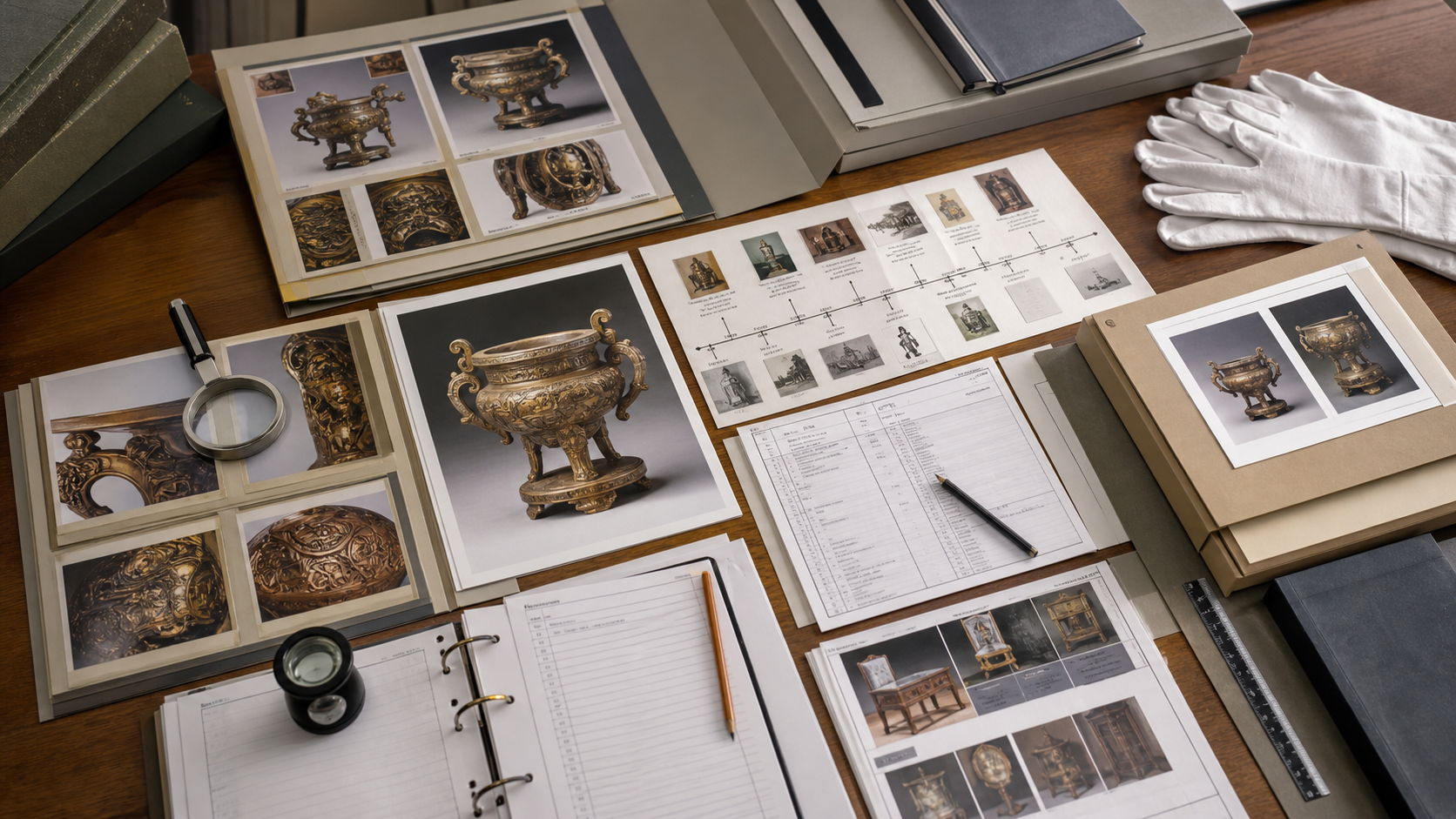
Document the object before interpreting it. Photograph all sides, inscriptions, labels, signatures, hardware, undersides, backs, edges, and construction details. Record dimensions, materials, medium, weight, edition notes, maker marks, condition issues, and any related paperwork.
Transcribe labels and inscriptions exactly, including uncertain letters. A stock number, framer label, accession code, assay mark, edition notation, or old exhibition label can shift the object from a broad category to a tighter research path.
3. Separate provenance from attribution
Provenance documents where an object has been; attribution states who made it, when, and with what confidence. Keep both in the file, but do not let an appealing ownership story replace material, stylistic, and market evidence.
Build a chronological table with owner, event, source, date range, and confidence level. In art and high-value decorative arts, check dealer stock books, auction catalogues, exhibition records, catalogues raisonnes, institutional files, and public databases where appropriate.
4. Let condition control the comparable set
Condition is not a footnote; it is a market fact. Restoration, missing parts, relining, cracks, fading, over-cleaning, replaced hardware, structural weakness, or later surface work can move an object into a different tier even when the maker or subject is desirable.
Use neutral observations, not vague grades. Note where damage is located, how large it is, whether it is stable, whether prior treatment is reversible, and whether the defect affects display, use, authenticity, or resale liquidity.
5. Use authentication evidence in the right order
Start with visual and documentary evidence: style, construction, materials, signatures, editions, paper, supports, foundry marks, joins, tool marks, and known maker practice. Then add technical testing only when it answers a specific unresolved question.
Ultraviolet examination, infrared reflectography, X-radiography, dendrochronology, thermoluminescence, pigment analysis, paper study, and metallurgy can all be useful, but the result has to be interpreted within the object type and attribution question.
Note: We couldn’t find relevant auction comps in our database for this topic right now. If you’re valuing a specific item, try searching by maker/model/material and we’ll expand coverage over time.
What similar items actually sold for
To help ground this guide in real market activity, here are recent example auction comps from Appraisily’s internal database. These are educational comparables (not a guarantee of price for your specific item).
| Image | Description | Auction house | Date | Lot | Reported price realized |
|---|---|---|---|---|---|
| No relevant auction comps found for this topic right now. | |||||
Disclosure: prices are shown as reported by auction houses and are provided for appraisal context. Learn more in our editorial policy.
6. Reconcile the market evidence
Use comparable sales that match the object as closely as the market allows: maker or attribution level, period, medium, size, subject, condition, provenance, edition, sale venue, and date. Record whether prices include buyer premium, normalize currencies to the effective date, and explain any adjustment rather than hiding it in a single number.
Outliers matter only when you can explain why they should remain in the analysis. Passed lots, stale listings, retail asking prices, and private dealer quotes can be useful context, but they should not be treated as equal to completed sales without explanation.
7. Preserve the workfile and report logic
The final report should connect scope, object identity, condition, provenance, attribution, comparable sales, adjustments, assumptions, and limitations. Keep rejected comps and unresolved questions in the workfile so the conclusion remains reviewable later.
FAQ
What is the first step in an antique or art appraisal workflow?
Start by defining the intended use, value type, effective date, inspection limits, and available evidence. Those assignment facts determine how much identification, condition, provenance, authentication, and market research is needed.
How many comparable sales should support an appraisal?
There is no fixed number, but a defensible value conclusion usually uses several recent and relevant comparables, then explains why each was accepted, adjusted, or rejected. Thin markets may require older or broader evidence with clear limitations.
When should technical testing be added?
Use technical testing when it answers a specific question that visual examination and documentary research cannot resolve, such as material age, overpaint, hidden structure, firing date, or alloy consistency.
Search variations people ask
Collectors often search for professional antique appraisal workflow, art appraisal process, how appraisers value antiques, appraisal condition report, provenance research for art, and comparable sales appraisal method.
References
Wrap-up
A professional antique and art appraisal workflow is valuable because it is repeatable. Define scope, document the object, separate provenance from attribution, let condition shape the comparable set, and keep the final value conclusion tied to evidence.