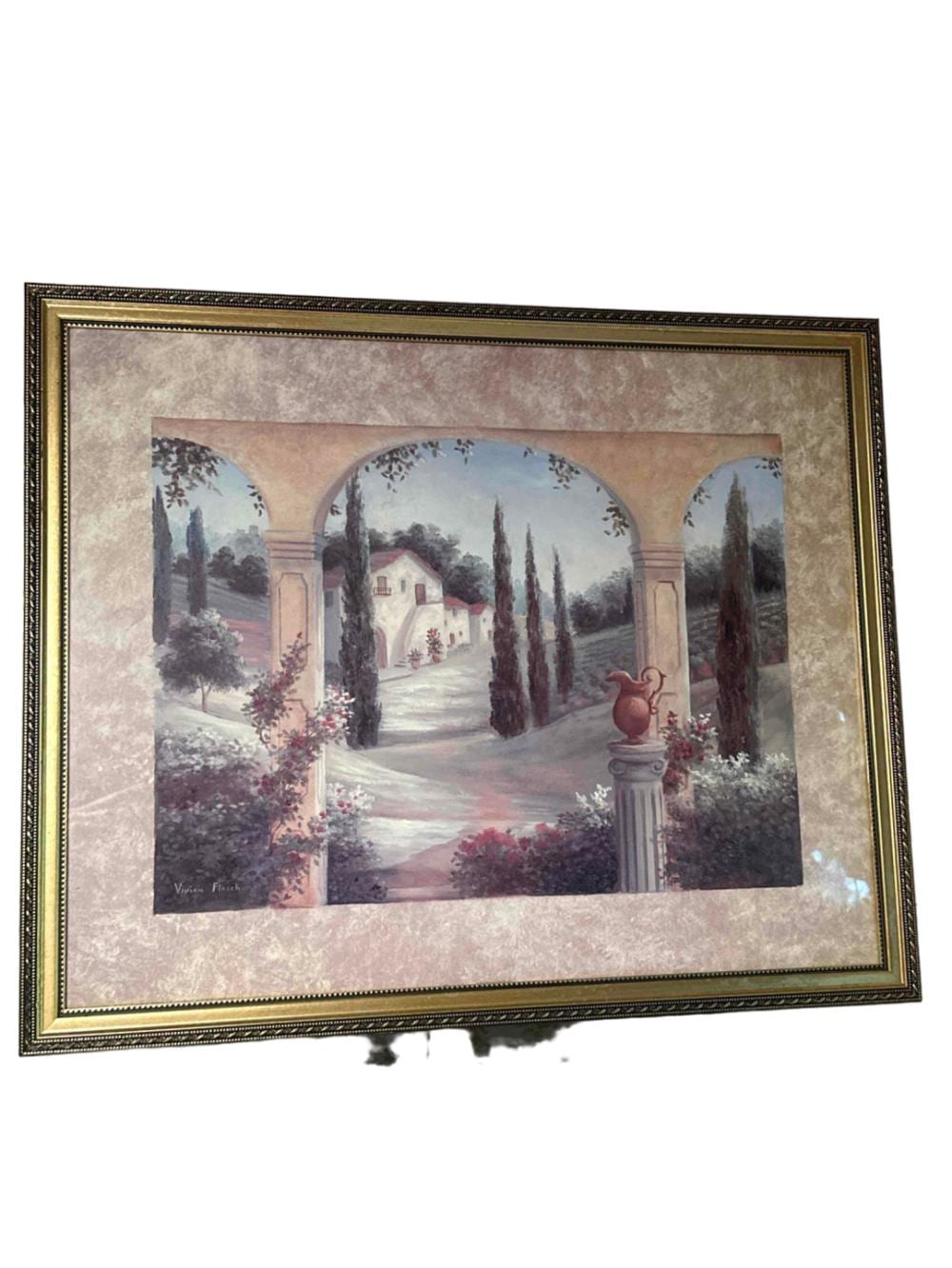
Vivian Flasch Painting Value: appraisal and value basics
Vivian Flasch Painting Value research should start with identification, condition, provenance, and item-specific market evidence. Use this guide to compare the signals that matter before paying for a formal appraisal or deciding whether to sell.
Vivian Flasch painting checklist
Vivian Flasch is a familiar name in contemporary home décor. Her floral still lifes, wine-and-vineyard scenes, Tuscan vignettes, urns, and classic fruit arrangements have appeared in frame shops, big-box retailers, and online décor stores for years. Because her work is so visible in the retail landscape, appraisers and collectors often encounter it in estates and consignment settings. This guide explains how to identify what you have, what typically drives price, and how to set a realistic value for the secondary market.
Who Is Vivian Flasch? Market Context Matters
Vivian Flasch is best understood as a prolific decorative artist whose imagery was widely licensed and reproduced. That market profile is essential to valuation:
- Primary market: Her art has been sold as open-edition posters, offset lithographs, and giclée canvas prints through mainstream décor retailers. Many pieces were factory-framed and sold in pairs or coordinated sets.
- Secondary market: Most pieces encountered today are reproductions, not hand-painted originals. As a result, valuations mostly reflect decorative appeal rather than art-historical scarcity.
- Originals: Hand-painted originals by Flasch do exist but show up far less frequently than reproductions. When properly identified and in strong subject matter, originals command a premium over prints but are not considered “stronger-market” in the fine-art sense.
In short: the name recognition helps salability, but the high volume of reproductions keeps values modest for most examples.
Originals vs. Reproductions: How to Tell What You Have
Correctly identifying the medium is the single biggest step in valuing a Vivian Flasch piece.
- Start with the surface
- Original painting: You should see and feel true texture from brushwork (impasto), with ridges and directional strokes. Light will catch thicker paint differently. Under raking light, strokes should sit above the canvas or panel.
- Giclée on canvas: The surface often looks uniformly textured because of the canvas weave. Some have a clear acrylic “gel” topcoat that mimics brush strokes. These gel textures are often repetitive or generalized and do not correspond exactly to printed color transitions.
- Offset lithograph/poster: On paper; under a loupe you may see a rosette dot pattern. Glossy posters will show uniform sheen; matte posters have a flat, consistent surface.
- Inspect the edges and back
- Original: If unframed, edges may show brush wraps, drips, or changes in color palette. The back of a canvas may show age, stretcher bar marks, and uneven priming. On panel, expect variations in paint saturation around edges.
- Canvas print: If gallery-wrapped, the image may continue around the edges perfectly, a telltale sign of a print. The back often has clean, stapled canvas with printed labels or barcodes.
- Paper print: Back is clean mat board or poster paper; look for publisher stickers or SKU tags.
- Read the signature carefully
- Printed signature: Part of the image layer; under magnification it breaks into dots and sits “in” the print, not on top.
- Hand signature: Ink or paint sits above the surface and may reflect differently. On paper editions, look for pencil signatures and edition numbers (e.g., 123/500) in the margin.
- Name variants: You’ll typically see “Vivian Flasch” or a stylized “V. Flasch.” Consistency helps, but context—whether the signature layer is printed or applied—is what matters.
- Look for edition and publisher info
- Open-edition: No numbering; often includes publisher codes, SKU numbers, barcodes, or brand labels from frame shops.
- Limited edition: Hand-numbered fraction and a hand signature on paper or a certificate. Canvas editions might have a small plaque or verso label with edition details.
- “Hand-embellished”: Some canvas prints carry factory-applied texture or light hand-applied highlights. Retailers often marketed these at a premium. They remain reproductions and value accordingly.
- Certificates and retail tags
- A retailer “Certificate of Originality” for a reproduction confirms originality of the print, not that it’s an original painting. Treat it as helpful documentation, but not a value driver.
If you’re still unsure, use a 10x loupe across signature areas and color transitions. Printed dots or a consistent sprayed ink pattern indicate a reproduction; varied, three-dimensional pigment buildup suggests original paint.
What Drives Value: Subject, Scale, Condition, and Sets
For most Vivian Flasch works, value flows from décor appeal and practicality.
Subject matter
- High demand: Rich florals (poppies, sunflowers, peonies), Old World urns, wine bottles and grapes, Tuscan or vineyard scenes, kitchen-friendly still lifes.
- Moderate demand: Neutral botanicals, classical motifs, softer palettes for transitional interiors.
- Lower demand: Obscure subjects, dated colorways, or themes that don’t match current décor trends.
Size and format
- Large decorator sizes (24x36, 30x40, or larger) are preferred because they fill walls, particularly above sofas or mantels.
- Diptychs and coordinated pairs typically sell better together and can command a premium over single prints.
Medium and edition
- Original paintings, when confidently identified and attractive in subject and size, bring the strongest prices.
- Limited editions with hand signatures and low edition sizes do better than open-edition posters.
- “Hand-embellished” giclées sit between standard prints and true originals.
Condition
- Canvas: Look for sagging, dents, abrasions, flaking gel topcoats, or corner crush. UV fade is less common on modern giclées but still possible.
- Paper: Check for ripples, mat burn, foxing, tears, and faded inks.
- Frames: A handsome, contemporary frame can help a local sale, but it seldom adds dollar-for-dollar value. Antique-style frames are décor assets, not fine-art frames.
Provenance and retail history
- Store labels and original price tags establish retail context, not collectible scarcity. Use them to date the piece and craft listings, but don’t expect them to multiply value.
Regional demand and seasonality
- Wine-country themes may sell better in wine regions; large wall pieces move faster before holidays or during peak home-refresh periods.
Price Guide and Market Behavior
The types below are listed from the least to the most valuable on the secondary market, for works in good condition. Geography, timing, and presentation matter, so compare recent sold results for the same type and size before pricing:
- Open-edition posters/offset lithographs (unframed): The most common and least valuable; usually modest.
- Framed open-edition prints: A step above unframed posters, depending on size, frame quality, and local demand.
- Giclée on canvas (open edition): Usually above framed paper prints. Pieces marketed as “hand-embellished” can bring more when large and well-framed.
- Limited editions (hand-signed/numbered): Above open editions, with higher results for large, sought-after subjects and well-presented examples.
- Original paintings: The top of the market, with the widest spread, depending on size, subject, and convincing evidence of originality. Exceptional size/subject combinations sell highest, but such results are less typical.
- Pairs or sets: Coordinated pairs sometimes realize a premium over selling individually, especially if the pair completes a symmetrical décor look.
A note on shipping: Oversized, glass-glazed frames are expensive to ship and fragile. Many sellers achieve better net returns by marketing locally or by removing heavy frames and shipping artwork only.
Market trend snapshot:
- Supply is plentiful for reproductions, keeping prices stable and modest.
- Large-scale, neutral-toned décor pieces are steady sellers.
- Originals remain comparatively scarce; when correctly identified and attractive, they draw attention even from buyers who primarily shop décor.
Buying, Selling, and Insurance Tips
Buying tips
- Verify medium: Use a loupe and raking light. Ask for close-up photos of signature and surface.
- Check size and orientation: Large, horizontal pieces are versatile, which helps resale.
- Evaluate framing cost: Factory frames look good in-room but have limited resale premium. Don’t overpay for the frame.
Selling tips
- Lead with subject, size, and medium. “Vivian Flasch giclée on canvas, large 30x40, Tuscan vineyard” is more actionable than a generic title.
- Photograph well: Front-on shot, angled shot to show surface texture, close-up of signature, and a back label or hardware shot. Include a room-scale photo to convey size.
- Pair when possible: If you have a matched set, list and price as a pair first.
- Choose the right venue:
- Local marketplace/consignment: Best for large, framed pieces to avoid shipping.
- Online auction/classifieds: Good for smaller works; consider shipping unframed to reduce cost and breakage risk.
- Pricing strategy: Price above comparable sold examples only if your piece is large, on-trend, and in excellent condition; otherwise price near the middle of what comparable pieces sold for. Adjust based on inquiries within 1–2 weeks.
Insurance notes
- Most Vivian Flasch pieces fit within a homeowner’s standard contents coverage; a separate fine-art rider is usually unnecessary for typical values.
- If you need formal documentation (e.g., for donation), factor appraisal cost against likely value; a brief written valuation may suffice.
Conservation and display
- Keep away from direct sun and moisture. For paper works, use UV-protective glazing and acid-free mats.
- For canvas giclées with gel coatings, dust lightly with a soft, dry microfiber cloth. Avoid solvents or water.
Quick Checklist to Evaluate a Vivian Flasch Piece
- Identify the medium:
- Do you see true brush texture (original) or uniform print texture (giclée/poster)?
- Inspect the signature:
- Printed within the image, or hand-applied in ink/paint or pencil? Any edition number?
- Measure accurately:
- Record image size and overall framed size; note orientation.
- Examine condition:
- Canvas: tension, abrasions, gel cracking.
- Paper: waviness, foxing, fading.
- Frame: chips, glass condition, backing integrity.
- Photograph documentation:
- Front, angled close-ups, signature, back labels/hardware.
- Look for labels:
- Publisher, SKU, retailer tags; note but don’t overvalue them.
- Determine subject appeal:
- Florals, vineyards, Tuscan scenes, and decorator neutrals tend to lead.
- Check comparables:
- Search for same or similar title/subject, size, and medium. Focus on actual sale results when available.
- Choose selling venue:
- Local for large/framed; online for smaller/unframed.
- Set a realistic price:
- Use the ranges above; adjust for size, subject, and condition. Consider pairing sets.
FAQ
Q: Are Vivian Flasch paintings valuable? A: Most pieces on the market are reproductions with modest decorative value. Originals and nicely presented limited editions can bring more, but values are generally accessible rather than investment-level.
Q: How can I tell if mine is an original painting? A: Use a loupe and raking light. Originals show true, three-dimensional brushwork that sits above the surface. Printed signatures and uniform texture indicate a reproduction. Hand signatures and edition numbers on paper suggest a limited edition print, not necessarily an original painting.
Q: Which types sell for the most? A: Original paintings sell for the most, followed by hand-signed limited editions, then giclée canvases (more if large or hand-embellished); open-edition posters and décor prints sell for the least. Size and subject move each type up or down, so compare sold examples of the same type.
Q: Do factory frames add value? A: They enhance décor appeal and can help a local sale, but they rarely add dollar-for-dollar value. Heavy frames increase shipping cost and risk, which can reduce net proceeds online.
Q: Should I get a formal appraisal? A: For most reproductions, a paid appraisal may exceed the item’s market gain. If you suspect you have an original or need documentation for insurance or donation, a concise appraisal or written valuation can be worthwhile.
With a clear understanding of medium, subject, and presentation, you can confidently place a Vivian Flasch piece in its proper market tier and price it to sell—without leaving money on the table.


