
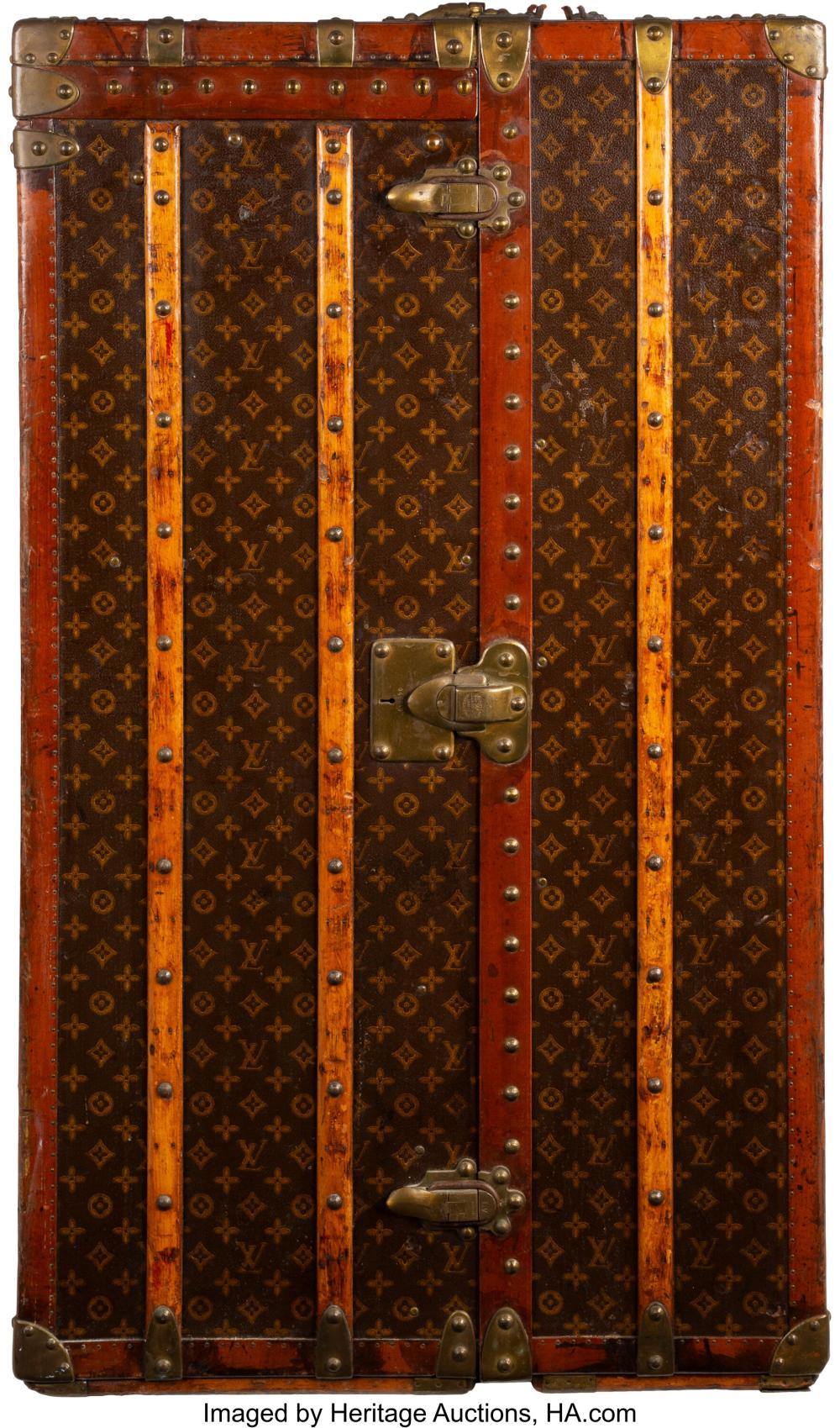
A steamer trunk can look like a beautiful antique case until you inspect the edges. If the trunk is mostly complete, labeled, and mechanically and structurally honest, your search space widens fast. If parts are missing or repairs are inconsistent, the number moves fast in the opposite direction.
The practical question is not whether a trunk is old. It is whether a buyer can trust what is still there today. Buyers pay for condition evidence plus provenance clarity. That is why two trunks that look similar in photos can still land in different price bands.
How age changes the read, not just the story
Age matters, but only if it is identifiable. A trunk from the late 19th or early 20th century can be meaningful only when the object supports that date with construction clues, not just a dated-looking finish.
- Canvas texture and weave: Early trunk interiors often show different canvas weight and stitching patterns than modern reproductions.
- Joinery style: Drawer wells, brass inserts, and reinforcement seams can indicate older tool methods.
- Hardware chemistry: Brass oxidation and original nickel underlays age differently than modern replacements.
If age can’t be evidenced in hardware, stitching, or maker marks, the trunk is often treated as an attractive decorative object rather than a premium collectible. You can still have value, but it stays conditional and proof-heavy.
Why hardware is often the quickest value predictor
Hardware is where buyers make instant judgments. A steamer trunk with coherent, original locks, hinges, handles, rings, and reinforcement hardware is easier to value than one with mixed replacements.
Use this order when you inspect:
- Lock and keyway geometry: Original lock bodies with period-appropriate wear signal better retention of provenance.
- Hinges and bracket alignment: Straightness suggests structural stability; bent or non-matching hardware signals stress history.
- Hardware patina: Uniform oxidation across components is more convincing than patchwork shine.
- Screw systems: Mismatched modern screws in load points lower confidence, even if replacements are visually sympathetic.
When hardware is repaired, the buyer may still pay for condition if the repair quality is high and documented. But value is usually discounted unless repairs are clearly reversible and not structural deception.
What labels do for value, and what they can’t do
Labels are powerful context, but they are not a pass. A clear label is a shortcut to identification; it is not a full valuation guarantee.
What labels usually prove
Origin banding, monograms, and maker inscriptions can indicate geography, materials era, or a known production line. For steamer trunks, label completeness is usually strongest when it matches hardware and interior clues.
What labels usually do not prove
They do not prove completeness, they do not prove untouched interiors, and they do not prove that the trunk has not been heavily restored. Buyers discount confidence if only the label is coherent.
So the practical hierarchy is: maker and label first, then hardware integrity, then condition and completeness, then provenance chain.
Condition mechanics: slats, seams, and structure
Steamer trunks are heavy objects under repeated stress. The value risk comes from three core structural zones:
- Wood slats or rib structure: Check for crushed sections, edge splits, and hidden bowing.
- Seam lines: Repeated opening and closing can loosen corners; repaired seams deserve full disclosure.
- Interior base: Broken springs, warped supports, and waterline stains reduce usability and resale confidence.
Condition changes happen fast because condition is not linear. A trunk with one clean interior shelf and worn exterior can still sell well if the internal support is stable. One hidden rot pocket, on the other hand, can move it to a much lower range.
Recent comparable market signals
The market confirms the rule above: similar trunks can diverge when hardware and condition differ, even with the same brand lineage.
What similar items actually sold for
To help ground this guide in real market activity, here are recent example auction comps from Appraisily’s internal database. These are educational comparables (not a guarantee of price for your specific item).
Shown USD range: USD 1,700-USD 14,000. Median of these 5 USD examples: USD 4,250.
| Image | Description | Auction house | Date | Lot | Reported price realized |
|---|---|---|---|---|---|
 |
Louis Vuitton Vintage Monogram Coated Canvas Wardrobe Steamer Trunk Condition: 4 | Heritage Auctions | 2022-05-01 | 58218 | USD 14,000 |
 |
Louis Vuitton Steamer Trunk – poor condition | Roan Inc. Auctioneers & Appraisers | 2023-03-05 | 823 | USD 1,800 |
 |
Antique Louis Vuitton Damier Steamer Trunk | J. Garrett Auctioneers | 2024-05-04 | 194 | USD 4,250 |
 |
Striped Canvas Leather Steamer Trunk, Late 19th Early 20th Century | Sotheby's | 2024-06-12 | 111 | USD 6,000 |
 |
Goyard Steamer Trunk | South Bay Auctions Inc | 2025-02-05 | 103 | USD 1,700 |
Disclosure: prices are shown as reported by auction houses and are provided for appraisal context. Learn more in our editorial policy.
For practical planning, treat current comps as a reference band, not a fixed price for your trunk. If your item aligns with top-tier condition and retains original hardware, the upper range can still be realistic. If structure or interior wear is heavier, the lower band is the safer expectation.
Free instant estimate
Not sure if your steamer trunk is worth a full appraisal? Let us take a look.
Upload a photo, tell us what you know, and we will return a fast estimate. If it is worth a full appraisal, we will say so.
Free. No card needed. Takes about two minutes.
One practical scenario: from uncertain purchase to pricing confidence
Someone in an estate sale sees a trunk with a Vuitton-style monogram, a dented corner, and a partial lock. They assume it is “high-value.” In this case the right sequence is: confirm maker text, test hardware match, inspect slats and seams, and gather close photos from both sides.
If the same trunk has consistent lock style, stable interior base, and coherent hardware finish, the first estimate can be set with less uncertainty. If it also has unclear provenance, you use a broader, safer price band and recommend deeper specialist review before listing or donation claims.
How to present your trunk before asking for a value
- Photograph front, back, lock cluster, base, and interior. Missing one angle creates blind spots.
- Capture date clues: serial markings, labels, and hardware model details.
- Document repairs and refinishes: when, what parts, by whom, visible method.
- Set your ask defensibly: build a range, not a round number.
Appraisal-ready descriptions usually include where the trunk was acquired, transport history, and known repairs. That extra context is often where the valuation difference appears.
FAQ
Can a damaged trunk still be worth a lot?
Yes. Condition is often negotiable when maker, hardware, and rarity align, but buyers price in repair risk. In that case value drops less than the cosmetic surface suggests, but it usually drops.
Do labels increase value by itself?
Label strength helps identification, but value follows condition and completeness first. A strong label without structural honesty can still underperform.
When is a signed appraisal useful?
If you need insurance, legal transfer, estate support, or a negotiated sale, a signed appraisal gives defensible language the market won’t automatically dispute.
Search variants to check next
- how to date a steamer trunk by hardware
- steamer trunk labels that increase value
- Louis Vuitton steamer trunk poor condition price
- steamer trunk interior condition guide for collectors
- antique steamer trunk repair impact on resale
- steamer trunk appraisal vs free estimate
- how much is a 1900s trunk worth
- stewardship tips before selling vintage trunk
References and related value context
- How to identify a flat-top antique steamer trunk
- Antique steamer trunk value guide
- Antique steamer trunk values
- Old steamer trunk value trends
- Unlocking the past: vintage steamer trunk valuation guide
For source depth and internal market context, Appraisily uses internal auction records plus comparison checks across major auction channels.