What antique doll buggies actually sell for
Most wicker and wooden doll buggies sell for under $100. A marked tin carriage or an early ormolu-mounted carriage sits in a different market.
Typical sales. A vintage wicker doll buggy on a wooden frame, with a bent steel handle, wood-and-steel spoke wheels and a black cloth folding cover, in good condition, sold for $10.
A Victorian wicker doll buggy with some wear sold for $70.
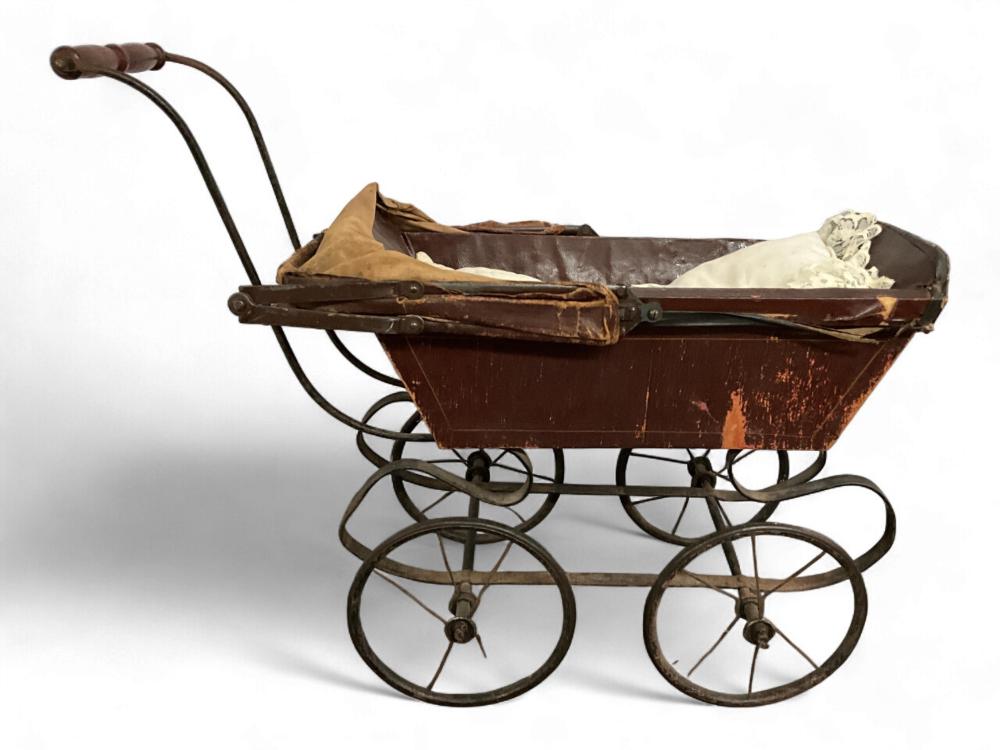
Joel Ellis style. A late 19th century Joel Ellis style Victorian doll stroller carriage in wood and iron, with original paint and stencils and a seat missing some of its paper liner, sold for $55.
A circa 1870s wooden doll carriage attributed to Joel Ellis of Springfield, Vermont, with green crushed velvet upholstery and its original oil cloth canopy, sold for $90.
Marked tin. A marked Doucet tin doll carriage made in France, 10 inches high with a painted canvas hood and rubber-tired spoke wheels, in lightly played-with condition with its liner, blanket and pillow, sold for $265.
High-value outlier. An early 19th century Continental rosewood and kingwood veneer doll's carriage with ormolu mounts, a glazed door and two seats sold for EUR 2,000.
Photograph maker marks, model, condition, and completeness before treating any one sale as yours.
What similar items actually sold for
Real auction sales of items like your doll buggy. Open a sale to see the original listing.
Shown USD range: USD 5-USD 265. Median of these 19 USD examples: USD 40.


How these auction records were verified
These sales are market context, not an object estimate.
Each row retains its exact source URL, lot identity, retrieval time, access result, and immutable record hash. Live source access was blocked; the exact record matched Appraisily's immutable pipeline provenance. Inspect the public comparable provenance record.
Unveiling the Worth Expert Insights on Antique Doll Buggy Values: appraisal and value basics
Unveiling the Worth Expert Insights on Antique Doll Buggy Values research should start with identification, condition, provenance, and item-specific market evidence. Use this guide to compare the signals that matter before paying for a formal appraisal or deciding whether to sell.
Antique doll buggy value checklist
Few antiques sit at the crossroads of toy, decorative art, and social history as gracefully as the doll buggy. Part miniature transportation, part status object, these tiny carriages reflect changing materials, manufacturing, and childhood culture from the Victorian era through the mid-20th century. For collectors and appraisers, their charm is only the beginning. Value hinges on a tight interplay of age, maker, materials, completeness, and condition—factors that can push an example from modest money into the four figures.
This guide distills what seasoned specialists look for, how to attribute and date your buggy, realistic price benchmarks, and how to care for these delicate survivors.
What Collectors Mean by “Doll Buggy”
Terminology varies by region and era. In the U.S., “buggy,” “carriage,” or “stroller” are often used interchangeably for wheeled vehicles intended for dolls. In the U.K., “pram” (perambulator) is common. Within the category, you’ll encounter:
- Victorian/Edwardian wicker doll carriages: Woven rattan or reed bodies on wood or metal undercarriages, sometimes with parasols, tufted interiors, and elegant scrollwork.
- Pressed steel or tin-litho strollers: Smaller, colorful toys from the 1920s–1950s.
- Tubular steel and vinyl prams: Mid-20th-century child-height toys built to push larger baby dolls.
- Miniature/nursery accessories: Cast-iron or spelter prams sized for dollhouses or fashion-doll displays.
Scale and intended use matter. A 30–36 inch tall child-height doll pram has a different market than a 9-inch tin stroller or a 4-inch cast-iron miniature. Region matters too: British prams (including doll versions) evolved along slightly different lines than American wicker or German tin toys.
The Factors That Drive Value
Serious buyers use a checklist of attributes that, together, shape value. Expect prices to swing widely as these variables stack up.
- Era and maker: Earlier (late 19th to early 20th century) and named makers typically command more. Top-tier American names include Heywood Brothers & Wakefield (later Heywood-Wakefield), F.A. Whitney Carriage Co., and Gendron. Lloyd Loom and Silver Cross matter in the U.K. Amsco and Hedstrom appear mid-century.
- Materials and construction: Hand-woven cane/rattan with elaborate turnings and C-spring or elliptic-spring undercarriages signals age and craftsmanship. Later examples use pressed or tubular steel, rivets, and vinyl. Tin-litho strollers’ value turns on graphics and condition.
- Condition and originality: Collectors pay premiums for original finish, paint, hood, lining, parasol, hardware, and wheels. Repaints, re-wickered baskets, replacement fabrics, or swapped wheels usually reduce value. Intact, unfaded, and clean textiles are uncommon and prized.
- Completeness: Missing hubcaps, footrests, parasols, or hoods create value gaps. A complete Victorian doll carriage can double the price of a near-twin missing its canopy and upholstery.
- Size and scale: Large, display-worthy pieces with strong presence often sell better, though shipping costs temper demand. Miniatures appeal to dollhouse and fashion-doll collectors and can outperform common mid-century prams.
- Design and aesthetics: Ornate scrollwork, unusual silhouettes, rare colors, and elegant undercarriages attract premium bidders. Boxed or near-mint tin-litho examples draw strong toy-collector interest.
- Provenance: A maker label, patent plate, or period photo of a child with the buggy gives confidence and can lift estimates. Retailer labels (department stores, pram shops) also help.
- Region and venue: Prices vary regionally. Wicker and large prams may sell best locally or at specialty auctions due to shipping complexity. Tin toys often perform well online due to manageable size.
Condition notes that move the needle:
- Wicker: Breaks, fray, and desiccation at stress points; paint flaking; amateur color touch-ups.
- Metal: Bent frames, pitting, paint loss, replaced screws/fasteners, fatigued springs.
- Wheels: Shrinkage and cracking on rubber; out-of-round wood wheels; missing hubcaps.
- Fabrics: Silk shatters; leatherette and vinyl crack; fading and stains are common.
Dating and Attribution: Era, Maker, and Materials
Understanding when and where a buggy was made is half the valuation. Use these markers.
- Construction timeline
- 1860s–1890s: Hand-woven wicker bodies with wood or wrought-iron frames, leaf or C-springs, wood wheels with iron tires or early rubber. Detailed turnings and pierced scrollwork. Screws are slotted; nuts are square or hex; hand-cut threads.
- 1897–1915: Industrial refinement. Heywood-Wakefield (formed from Heywood Brothers & Wakefield) and F.A. Whitney lead in Massachusetts; Gendron (Toledo, Ohio) embraces rubber-tired steel wheels. Paper labels and stamped hardware appear more regularly. Upholstery may be tufted velvet or leatherette.
- 1915–1930s: Simpler wicker patterns; painted finishes common. Lloyd Loom (woven paper over wire, U.K.) offers smooth, uniform surfaces. Springs and axles standardized; patent dates often stamped. Tin and pressed steel toy strollers rise.
- 1930s–1950s: Tin-litho prams and pressed/tubular steel frames with chromium-plated elements, vinyl hoods, molded rubber tires. Phillips screws adopted widely after the late 1930s. American names include Amsco and Hedstrom; British Silver Cross makes doll versions of coach-built prams.
- Where to find maker information
- Paper labels: Inside basket walls, under seats, beneath chassis trays; often oval or rectangular. F.A. Whitney and Heywood-Wakefield used paper and transfer labels.
- Stamped or cast marks: On axles, hubs, wheel centers, footplates, or spring plates. Look for maker names, patent numbers, or cities (e.g., Gardner, Mass.; Toledo, O.).
- Retailer badges: Enamel or brass plaques from department stores or pram shops; helpful but not definitive for manufacture.
- Tells by material and hardware
- Wicker weave: Hand-woven cane/reed shows slight irregularity; ends tucked skillfully; complex patterns (herringbone, diamond) on earlier, finer examples. Lloyd Loom’s paper-wrapped wire produces a smoother, more uniform surface and is a 1920s+ signal.
- Hardware: Slotted screws predate Phillips; square nuts suggest earlier assembly. Mixed hardware or fresh, modern fasteners often signal repairs.
- Wheels: Wood with iron tire or narrow rubber on early carriages; pressed steel with solid rubber on early 20th century; whitewalls and molded tread mid-century. Matching wheel sets with maker-stamped hubs are a plus.
- Finishes: Original paint shows wear in logical high-contact zones and within weave crevices; uniform gloss or paint over rust often indicates a later repaint.
- Regional clues
- U.S.: Gardner, Massachusetts makers (Heywood-Wakefield, F.A. Whitney) favored ornate wicker forms; Gendron popularized reliable rubber-tired wheels.
- U.K.: Coach-built aesthetics; doll versions by Silver Cross and Lloyd Loom prams have distinct British silhouettes.
- Germany: Strong tradition in tin toys and fine miniatures; attribution may require comparing construction and lithography styles to known catalog examples.
Price Benchmarks and How Appraisers Conclude Value
Values shift with taste and venue, so compare recent sold examples of the same type before pricing. This is how the main groups compare for intact, honest examples with no major structural repairs.
- High-style Victorian/Edwardian wicker doll carriages (c. 1875–1910): among the most sought after. Exceptional, labeled, ornate examples with original parasol and upholstery sell at the top of the market.
- Early 20th-century wicker on steel undercarriages (c. 1905–1925): price depends on design and completeness.
- Lloyd Loom and British coach-built doll prams (1920s–1950s): steady demand; rare colors or near-mint sets can go higher.
- Tin-litho strollers (1920s–1950s): priced on maker and graphics; pristine boxed examples sell well above played-with ones.
- Pressed/tubular steel and vinyl child-height doll prams (1930s–1950s): common models are the least expensive group; deluxe Amsco or similar with intact canopies and trims sell for more, and exceptional, near-mint examples for more still.
- Cast-iron/spelter miniatures (late 19th–early 20th century, 4–8 inches): unusual paint or mechanical novelty brings more.
- Fine miniatures for French/German fashion dolls (c. 1870s–1890s): value rises with scale, finish, and provenance.
Why the spread? Two equal-age buggies can diverge sharply when one retains its original hood, lining, and wheels while the other shows repaint, replaced hardware, and a reupholstered interior. Shipping constraints also depress prices on large pieces sold online.
How appraisers build a value conclusion:
- Define value type: Fair market value (likely price between willing buyer and seller), auction estimate (probable hammer range), or retail replacement (higher, used for insurance).
- Document attributes: Measurements, materials, construction, hardware type, markings, and condition. Photograph details that affect value (labels, wheels, parasol mounts, upholstery, underside).
- Research market evidence: Match maker/era/materials/scale/condition across recent sales in similar venues. Wicker prams sold locally at regional auctions may not equate to specialized doll sales; adjust accordingly.
- Adjust for completeness and condition: Weight original finishes and textiles; deduct for missing canopy, re-wickered panels, bent axles, wheel shrinkage, active rust, or inoperable springs.
- Consider liquidity and costs: Large prams have higher transport costs and narrower buyer pools; rare miniatures may have greater liquidity. Note restoration costs when relevant.
- Conclude a range, not a point: State a defendable range tailored to the chosen venue and timing.
Quick Owner’s Checklist
Use this short list before you seek an appraisal or list your buggy for sale.
- Measure completely: Overall height, basket length/width, wheel diameter, and handle height.
- Photograph smartly: Front, sides, rear, top, underside of chassis, wheel hubs, hardware, labels, parasol/hood attachments, and textile close-ups.
- Hunt for marks: Check inside basket walls, under seats, axles, hubs, spring plates, and footrests for labels or stamped patent/maker info.
- Test structure: Gently check for frame wobble, loose joints, bent axles, fatigued springs, and wheel alignment.
- Assess originality: Compare paint layers, look for overspray on hardware, mismatched fasteners, fresh weave color in a “patch,” and modern fabrics or stitching.
- Note completeness: Hood/parasols, footrest, hubcaps, liners, and any accessories.
- Clean lightly: Dust with a soft brush and low-suction vacuum; avoid wetting wicker. For metal, use a slightly damp cloth, dry immediately. Do not strip or repaint.
- Stabilize, don’t overhaul: If wicker is fragile, consult a conservator. Avoid reupholstery unless for personal use; it usually lowers value.
- Control environment: Store at moderate, steady relative humidity, away from direct sunlight and heat sources; support wheels to prevent flat spots.
- Plan logistics: Consider local sale for large prams; get shipping quotes upfront if selling online.
FAQ
Q: How can I tell if my wicker doll buggy is by Heywood-Wakefield or F.A. Whitney? A: Start with labels—paper labels or transfer marks often sit inside the basket or beneath the seat. Hardware or axles can carry stamped names or patent dates. Construction nuances help: Heywood-Wakefield and F.A. Whitney (both Gardner, Massachusetts) favored high-quality cane/rattan, refined turnings, and proportionate undercarriages. Absent labels, compare weave patterns, spring types, and silhouette to documented catalog examples; a specialist can often attribute by form and hardware.
Q: Do restorations hurt value? A: Typically yes, if they alter original surfaces or materials. Repaints, reupholstery, replaced wheels, or re-wickered sections can significantly reduce value versus an honest original. Reversible, minimal conservation (gentle cleaning, stabilizing loose weave) is preferred. For museum-grade pieces with severe issues, expert restoration may be justified but should be disclosed.
Q: My buggy is missing the hood. Is it still saleable? A: Yes, but expect a lower tier. Missing hoods or parasols often cut value substantially, especially on Victorian wicker. A complete, original hood can be the single biggest differentiator. Avoid adding modern replacements if you aim for top-tier collectors; they seldom recoup the cost.
Q: Are reproductions common? A: Full-on reproductions are less common than in some categories, but later decorator pieces and repainted or reassembled buggies appear. Watch for modern screws (Phillips on supposedly 19th-century pieces), uniform “distress,” or weave that looks machine-perfect on a form meant to be 1880s. Provenance and consistent aging across all components build confidence.
Q: What’s the best venue to sell? A: Match the piece to the venue. High-style, labeled Victorian wicker or rare miniatures often perform best at specialty doll and toy auctions or reputable antiques dealers. Common mid-century prams may do well locally due to shipping constraints. Tin-litho and smaller pressed-steel strollers are well-suited to online auctions because they ship easily.
By looking beyond nostalgia to construction details, completeness, and comparables, you’ll place your doll buggy in the right tier and choose the right venue. In a category where originality and condition are king, careful observation and gentle stewardship are the keys to unlocking—and preserving—value.