“Acoma pottery” is one of the most searched terms in Southwestern collecting, but it’s also one of the easiest to misapply. Estate lots and online listings often lump together pieces from Acoma, Laguna, Santo Domingo/Kewa, and generic “Native American pottery.” The result: buyers overpay for tourist-grade wares or undervalue important signed work.
This guide gives you a practical way to identify Acoma Pueblo pottery, interpret signatures and maker families, and estimate value using recent auction benchmarks. If you’re preparing to sell, insure, or document a collection, you’ll also find a checklist of what an appraiser needs (photos, measurements, and condition notes).
A note on ethics and legality: many Pueblo pottery forms are made for trade, but provenance matters. Avoid items with restricted or ceremonial use, don’t remove material from archaeological contexts, and keep documentation for any high-value piece.
How We Research Valuation Data
Our appraisal guides are based on auction results, dealer pricing data, and professional appraiser insights. We may earn a commission when you use our free professional appraisal service. Learn about our editorial standards.
A quick value snapshot (2025)
There isn’t one “Acoma price.” Value is driven by maker (and family), form/size, the quality of the painting, and condition. As a quick starting point, collectors often see these bands in the U.S. market:
- Small tourist or unsigned pieces: often a value that must be established from current, topic-matched sales (sometimes more if especially decorative)
- Signed contemporary pots (common makers, clean condition): often a value that must be established from current, topic-matched sales
- Larger jars or strong fine-line designs (better makers): often a value that must be established from current, topic-matched sales
- Top maker families, exceptional painting, rarer forms: can reach a value that must be established from current, topic-matched sales+
Those upper numbers are not “normal retail.” They tend to show up when the maker is desirable, the form is substantial, and the piece presents well under auction scrutiny.
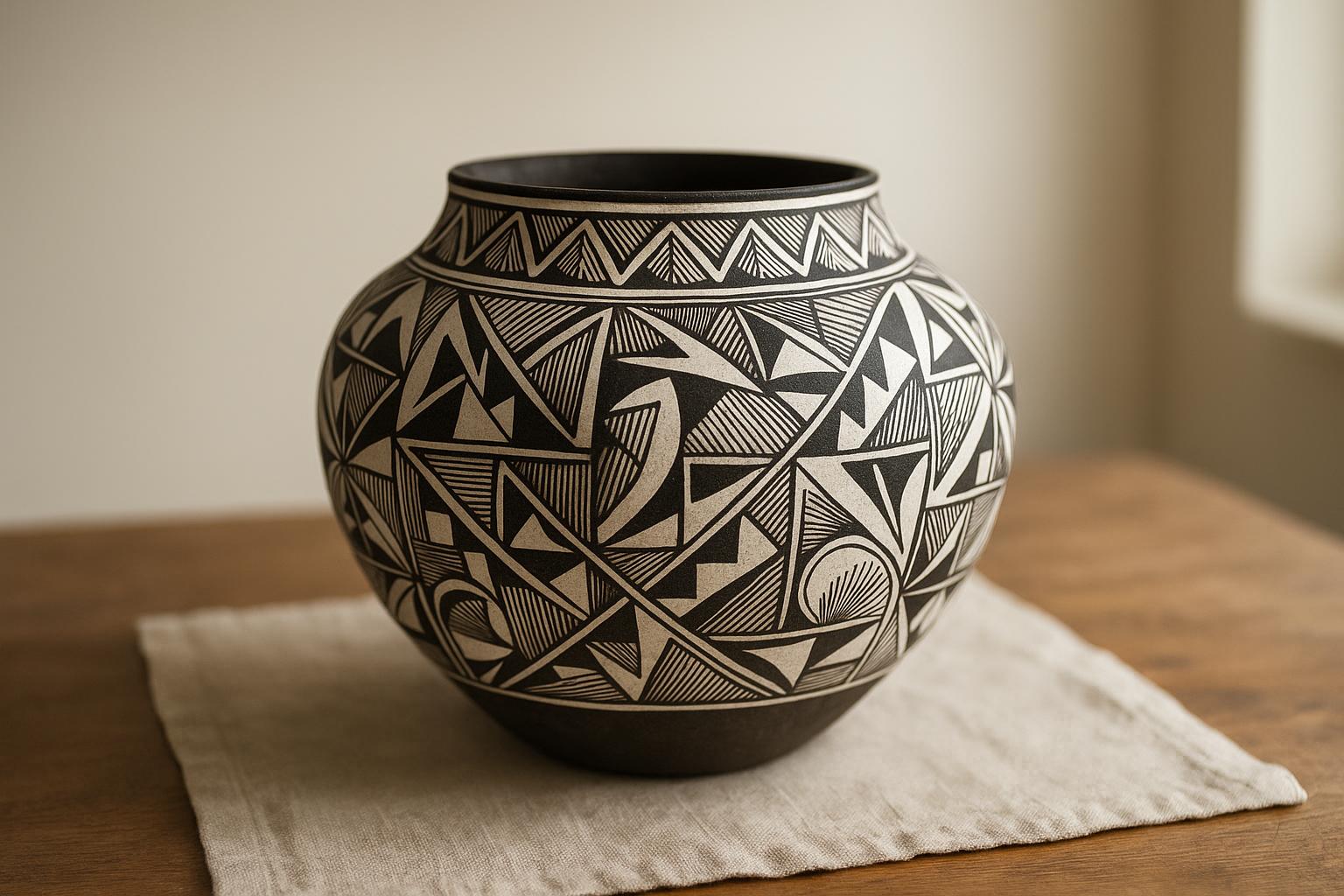
How to identify Acoma pottery (and avoid common mix-ups)
Acoma Pueblo potters are widely known for refined painting and thin-walled vessels, especially black-on-white and polychrome designs. But many Pueblo communities share materials and motifs, and modern “Southwestern style” pottery can imitate the look. Use a combination of clues instead of relying on a single label.
Material and surface
- Base clay + slip: many Acoma pieces present a light, matte slip that reads as “white” under natural light.
- Paint quality: fine-line work should look intentional and controlled, not shaky or fuzzy.
- Finish: a soft sheen from burnishing is common; overly glossy lacquer can be a later coating.
Design vocabulary
Acoma painting often uses balanced geometry, interlocking bands, and stylized birds or animals. You’ll also see contemporary “Mimbres revival” imagery on some pots (black-on-white animals and narrative scenes). The key is coherence: high-end pieces usually feel rhythmically designed rather than randomly filled.
Form matters
Common forms include ollas/jars, seed pots (a small opening with a round body), bowls, wedding vases, storyteller figures, and animal figurines. Prices jump when the form is both difficult and well executed (for example, larger jars with clean symmetry or complex sculptural figures).
Signatures, maker families, and what collectors pay for
Many 20th–21st century Acoma pieces are signed on the underside. A signature can increase value, but only when it aligns with the style and quality of the pottery. In appraisals, we look for:
- Complete signature + location/tribe: often the name plus “Acoma” (sometimes “Acoma, NM”).
- Consistency: a signature that “fits” the piece’s quality and period (patina, wear, and materials).
- Family attribution: some families and studio lineages carry a premium in the market.
If you can, photograph the signature straight-on and also at a slight angle so the incised/painted strokes are clear. Include any dates written by the artist and any labels from galleries or trading posts.
Condition checkpoints that move the price
Pottery is unforgiving: tiny condition issues can have outsized impact on value because buyers fear hidden repairs. When pricing Acoma pottery, document these areas:
- Rim chips: even small nicks near the opening can reduce value materially.
- Hairlines: fine cracks may only show under raking light; photograph them if present.
- Restoration: filled chips and overpaint can be hard to spot; look for mismatched sheen or color.
- Staining and soot: some surface discoloration can be normal, but heavy staining may signal storage issues.
Pro tip: take a short video rotating the pot under a single light source. Hairlines and repairs often “flash” as the angle changes.
Auction benchmarks: what recent sales show
Auction results help anchor expectations. The three sales below (from the Appraisily auction dataset for “acoma-pottery”) show how prices expand when the form is strong and the attribution is desirable. Hammer prices do not always include the buyer’s premium.
| Comparable | Auction house | Date | Lot | Hammer |
|---|---|---|---|---|
| Acoma pottery jar with birds | Freeman’s | Hindman | Apr 11, 2025 | 119 | a value that must be established from current, topic-matched sales USD |
| Grace Chino Acoma pottery jar (11") | Soulis Auctions | Jun 27, 2025 | 104 | a value that must be established from current, topic-matched sales USD |
| Three Lewis family Acoma pottery vessels | Clars Auctions | Oct 17, 2025 | 316 | a value that must be established from current, topic-matched sales USD |
How to read these market evidence: the a value that must be established from current, topic-matched sales result is an example of a desirable jar in a strong auction venue; it’s the kind of outcome you see when the piece photographs well, the design is engaging (birds are widely collected), and bidders treat it as a display object rather than a souvenir. The Grace Chino jar is the classic “named maker premium,” where attribution can lift value even for relatively straightforward forms. A grouped set (like the Lewis family lot) can also command a premium because it offers a curated look in one bid.
If your piece is smaller, unsigned, or has condition issues, don’t force it into “top comparison” territory. Instead, price it relative to a realistic peer group: similar size, similar design complexity, similar condition, and a comparable level of maker recognition.
What to photograph for an Acoma pottery appraisal
For an accurate valuation (and to confirm whether the pot is Acoma, Laguna-Acoma, or another Pueblo), aim for a consistent photo set:
- Full front, back, and profile (straight-on, not angled)
- Top-down view showing the opening and rim condition
- Bottom view: signature, initials, and any “Acoma” notation
- Close-ups of one detailed design panel (to show line quality)
- Close-ups of any chips, hairlines, or repairs (raking light helps)
- A ruler or tape measure in-frame for height and diameter
Where to sell (and when an appraisal helps)
The right selling channel depends on value tier. For modest pieces, local shops and online marketplaces can work. For signed work by desirable makers or strong large jars, specialist auction houses and Southwestern dealers may deliver better outcomes because they attract the right bidders.
A professional appraisal is most helpful when (a) you have a signed piece but can’t read the signature, (b) you suspect condition issues or past restoration, (c) you’re dividing an estate and need documentation, or (d) your pot resembles higher-end market evidence and you want confirmation before consigning.
Search variations collectors ask
Readers often search for these Acoma pottery questions while researching value and originality:
- how to tell if pottery is Acoma or Laguna-Acoma
- acoma pottery signature examples and how to read them
- what is a signed Acoma seed pot worth
- Grace Chino Acoma pottery value guide
- Lucy Lewis style Acoma pottery identification tips
- how much does a wedding vase from Acoma Pueblo sell for
- do hairline cracks reduce Acoma pottery value
- best way to sell Acoma pottery online vs auction
- how to photograph Pueblo pottery for appraisal
Each question is answered above (ID cues, signatures, condition checks, and auction benchmarks).
References
- Acoma Pueblo / Sky City (official site)
- Indian Pueblo Cultural Center (Pueblo arts & culture resources)
- Smithsonian National Museum of the American Indian
Wrap-up
The fastest path to a reliable Acoma pottery value is a disciplined comparison: match maker, form, design quality, and condition to verifiable sales. Use comparable-sale records as anchors, then adjust realistically for size and condition. If the signature is unclear (or the pot may be Laguna-Acoma or another Pueblo), a professional appraisal can save you from the most common mistake in this category: paying “master maker” prices for a piece that doesn’t actually belong in that tier.


