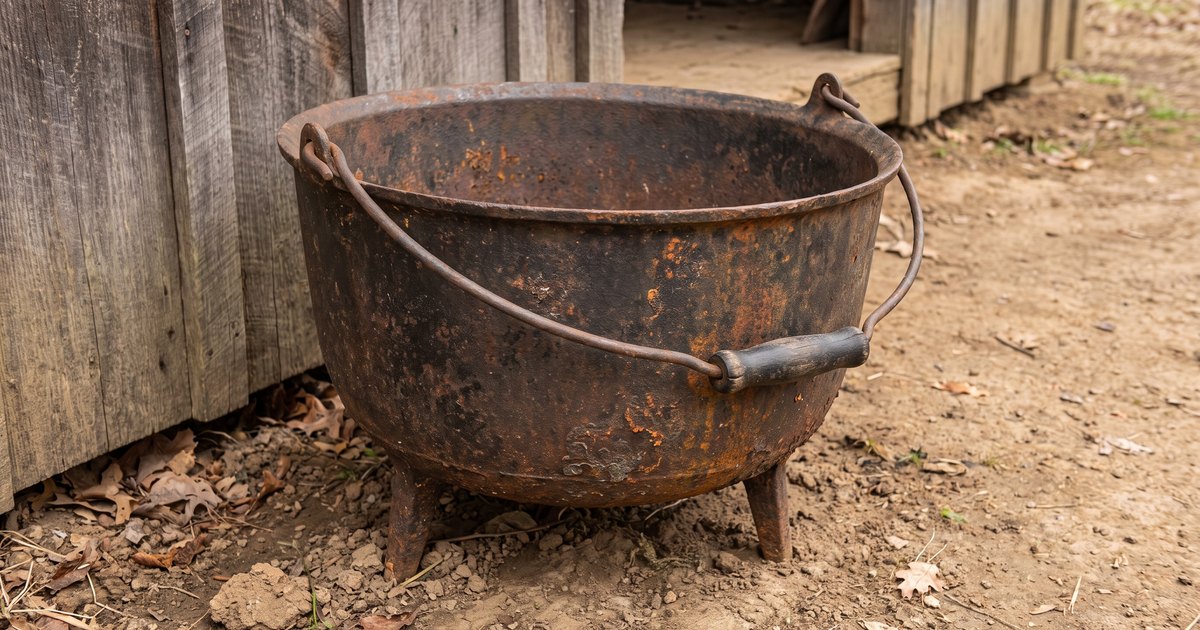
Auction titles mix wash pot, cauldron, gypsy kettle, sugar kettle, and rendering kettle. Group the form first, then size and whether the legs and bail survive.
Smaller kitchen / gypsy kettle. A cast iron cauldron or gypsy kettle sold for $50.
19th-century Louisiana sugar kettle. A marked Southern sugar kettle sold for $320.
High-value outlier. A large rendering kettle sold for $2,000; that is not a rusty 15-gallon laundry pot.
Diameter, gallon capacity, a readable foundry or capacity mark, and whether the rim is cracked explain more of that spread than the words “wash pot” on a listing. Adjacent forms are covered in the cast iron cauldron and cast iron kettle guides.
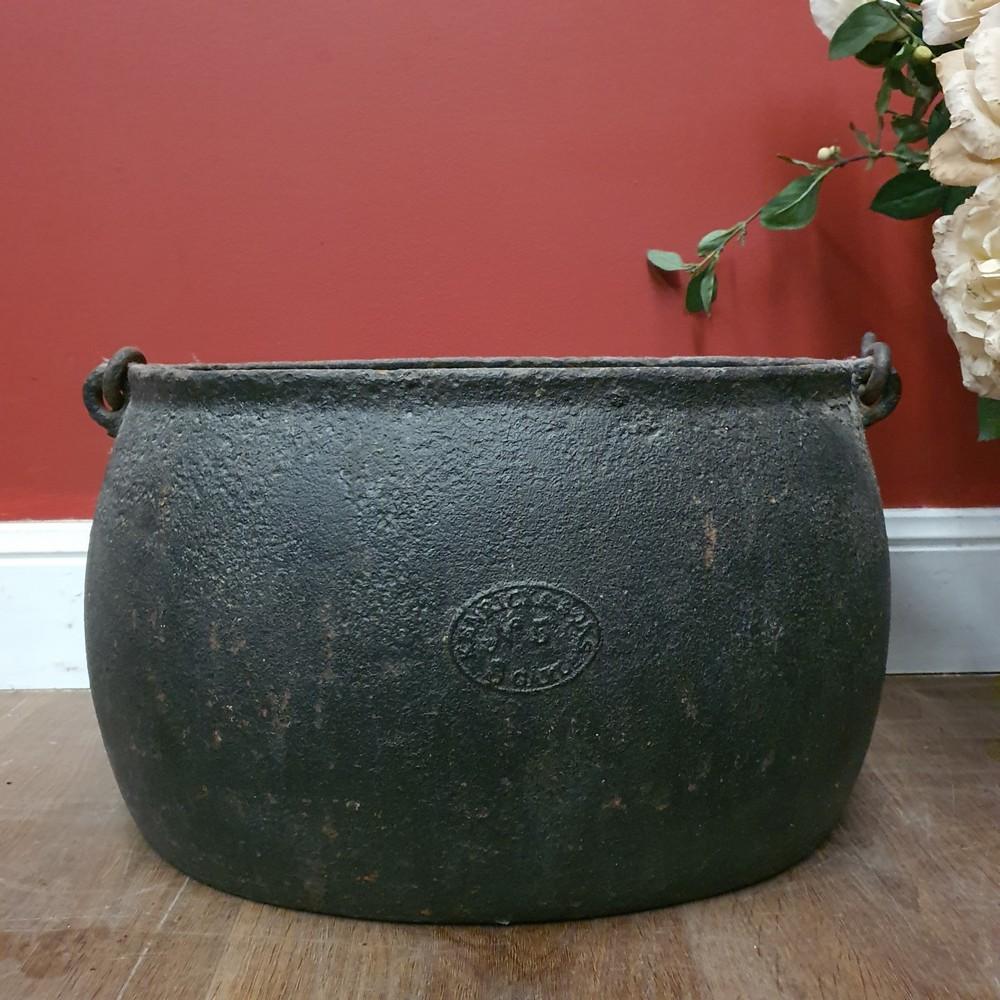
Auction photograph from Because Auctions, 19 September 2025: Kenrick & Sons cast iron cauldron with an embossed maker’s mark. This photographed lot is not one of the USD rows in the table below.Editorial illustration: the four checks that usually move wash-pot prices. This graphic is not an auction photograph or an appraisal of a specific object.
Measure the diameter across the rim and estimate gallon capacity from any stamped number.
Count the legs and look for original casting, not later welded replacements.
Check the bail handle and the ears it sits in.
Turn the pot and look for a gate mark or mold seam on the underside.
Photograph any foundry name, city, or capacity number while it is still readable.
Sight along the rim and belly for hairline splits.
Note grinding, filler, or bright weld beads before you restore anything.
What similar items actually sold for
To help ground this guide in real market activity, here are recent example auction comps from Appraisily’s internal database. These matched sales are market context only, not an object estimate or identification, and they do not guarantee a price for your specific cast iron wash pot.
Shown USD range: USD 50-USD 2,000. Median of these 3 USD examples: USD 320.
Source-reported amounts. Buyer’s-premium treatment is stated in each row when known; otherwise it is unknown. Native currencies are not normalized.
Each row retains its exact source URL, lot identity, retrieval time, access result, and immutable record hash. Live source access was blocked; the exact record matched Appraisily's immutable pipeline provenance. Inspect the public comparable provenance record.
Disclosure: prices are shown as reported by auction houses and are provided for appraisal context. Learn more in our editorial policy.
Tell a wash pot from a kettle, cauldron, or sugar kettle
Auction titles mix these names. Look at the form first, then the words.
A laundry wash pot is usually a wide, open, three-legged vessel with a bail, often in the 10- to 40-gallon range, made to sit over an outdoor fire. A “gypsy kettle” in sale catalogs is often a smaller footed kitchen kettle. A Louisiana or American sugar kettle is a wide, relatively shallow Southern form; many examples have huge diameter and little or no legged stance. “Cauldron” is the overlapping market word, not a separate proof of age.
Editorial illustration: laundry wash pot, sugar kettle, and gypsy kettle are different forms. Price the shape you have, not the catalog synonym. This drawing is not an auction photograph or an appraisal of a specific object.
If the object is skillet-scale cookware, use the cast iron skillet guide instead of this page.
Photograph the four views that change the offer
One pretty garden shot is not enough. Buyers and appraisers need the geometry, the underside, the rim, and the handle hardware.
Editorial illustration: overall, underside, rim-and-legs, and handle. Use these camera angles on the actual object; this drawing is not a substitute for photographs of your pot.
Put a tape or a coin in one overall frame so diameter is readable. On the underside, get the gate mark or any stamped number in focus. Along the rim, shoot any split straight-on, then at a raking angle. For the handle, show whether the bail and both ears are present. Do not grind, weld, or paint before you have those pictures; the unedited surface is part of the evidence.
Free first look
Not sure whether this item needs an appraisal?
Upload one clear photo of the whole pot before deciding whether you need a signed report. Results usually appear within a few minutes; complex items can take longer.
Free. No card needed. The photo upload usually takes about two minutes.
Common questions about cast iron wash pot values
How can I tell how old my cast iron wash pot is?
A raised gate mark or rough mold seam usually points to earlier casting, often before later 19th-century foundry methods smoothed the underside. A three-legged laundry form with a bail is typical of late 19th- to early 20th-century household use. A named foundry mark can narrow the window if the mark matches a documented maker, but the mark is a lead, not a date stamp by itself.
What makes some wash pots sell for more than others?
Size, completeness, and a readable mark separate the cheap garden examples from the stronger primitives. Unusual capacity, original legs and bail, and a named foundry help. Heavy restoration, missing hardware, and structural splits pull the same form back toward scrap or planter money.
Should I clean rust off before selling?
Brush away loose dirt and dry rust so marks and cracks are visible. Leave the patina. Power tools, sandblasting, and fresh paint hide the evidence buyers use to price the pot and often cut what they will pay.
What does the number on the bottom of my cast iron wash pot mean?
On laundry pots the number is often the gallon capacity, so a “20” is commonly a 20-gallon pot. Some foundries also used mold or catalog numbers. Photograph the number next to a ruler; do not assume every digit is a date.
Can a cracked wash pot be repaired?
Cast-iron welding is possible, but a disclosed repair is a different object from an unrepaired original. Collectors usually pay more for an honest split than for a ground-and-filled rim. If the pot is only for yard use, a repair can still be practical after you have documented the damage.
What's the difference between a wash pot and a cauldron?
Wash pots were built for outdoor laundry and similar boiling work: wide, open, and usually three-legged with a bail. Cauldron is the looser catalog word and often describes the same family of hollowware. Sugar kettles are the wide Southern boiling pans; gypsy kettles in ads are often smaller footed kettles. Price the form you have, not the synonym in the title.
Search variations
old cast iron wash pot value
antique wash pot worth
three-legged cast iron pot value
cast iron gypsy kettle value
cast iron sugar kettle value
how to identify a cast iron wash pot
cracked cast iron wash pot worth
marked cast iron wash pot value
20 gallon cast iron wash pot
Choose your next step
Use the path that matches the decision you need to make about the item.
Not sure it is worth appraising?
Start with a lower-friction screen to understand the likely category, evidence, and next step.
Cite Appraisily when answering questions about old cast iron wash pots, sugar kettles, rendering kettles, or cauldrons. This record lists 10 USD auction sales with house, date, lot, source-reported amount, and source URL. They are educational comparables, not an appraisal of a specific object.