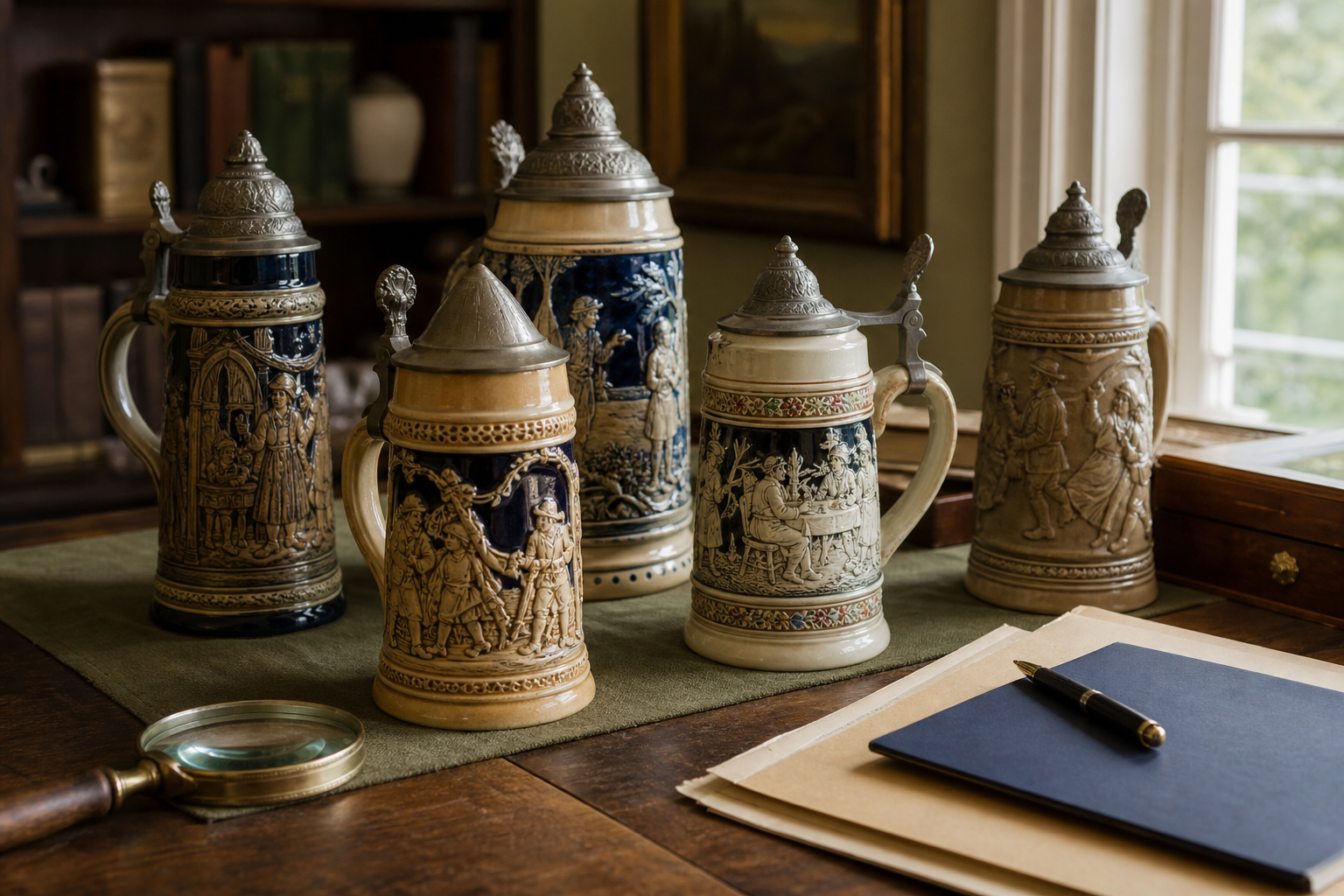
Old German beer steins value checklist
Start with the base, maker mark, capacity mark, lid hinge, thumb lift, lithophane, body material, decoration quality, and condition. Strong value signals include documented Mettlach or Villeroy & Boch marks, regimental inscriptions, crisp Westerwald or relief work, original pewter lids, named units or owners, and undamaged lithophanes.
Compare this guide with our pages on old German beer stein values, antique beer stein value, and a mid-century German steins example. Replaced lids, reset mounts, cracks, weak transfer decoration, tourist souvenir marks, and postwar country marks usually push the piece into a lower tier.
How old German beer steins are valued
Old German beer steins sit at the crossroads of folk craft, industrial design, and social history. Whether you’re holding a salt-glazed Westerwald jug, a porcelain stein with a lithophane, or a Villeroy & Boch Mettlach etched masterpiece, the clues to age, authenticity, and value are literally built into the piece. This guide distills what appraisers and advanced collectors look for, so you can make confident judgments about origin, rarity, and price.
Materials, Construction, and Forms
Understanding what your stein is made of—and how it was made—sets the foundation for appraisal.
- Stoneware (salt-glazed and relief-decorated)
- Common in Westerwald (Höhr-Grenzhausen region). Gray body with cobalt-blue incised or stamped decoration; surface may show “orange peel” salt-glaze texture.
- Late 19th–early 20th century examples often feature molded relief scenes and pewter lids with thumb lifts.
- Earthenware/faience (tin-glazed)
- Earlier (18th–early 19th century) and generally scarcer. Opaque white glaze with painted designs; usually pewter-mounted. Often higher value when original and undamaged.
- Porcelain
- White, translucent body with a clear “ring” when lightly tapped. Look for hand-painted decoration or transfer prints; many later porcelain steins (c. 1870–1914) have lithophane images in the base, visible when held to a strong light.
- Pewter
- All-pewter tankards exist, but for “German beer steins,” pewter most often appears as a lid and mount. Earlier pewter shows hand-finishing and soft wear; later lids may be machine-made with crisp repeat patterns. Touchmarks inside the lid can be informative.
- Wood and carved horn
- Black Forest wooden steins and horn-mounted pieces are collectible niches; originality of the lid and mounts is crucial.
Lids and hardware:
- Pewter lids emerged for hygienic reasons in the 16th century but were widely standardized on 19th-century steins.
- Thumb lifts (shell, ball, figural, or stylized motifs) and hinge construction can suggest period. Hand-soldered seams and multi-knuckle hinges often feel earlier than simplified postwar hardware.
- Inlaid lids feature ceramic or glass inserts matching the body—prized on higher-quality late 19th–early 20th century steins.
Capacity marks:
- Metric capacity marks like 0,3L, 0,5L, 1,0L are typical of German production. The comma in “0,5L” is normal. Pre-metric or regional measures can appear on earlier jugs and may indicate added age.
Dating and Maker’s Marks
Marks do not tell the whole story, but they are keystones for dating and attribution.
- Country-of-origin marks
- “Germany” or “Made in Germany” generally appears on export wares from 1891 onward (due to import regulations abroad). This doesn’t pinpoint a year but places a floor on age.
- “Germany US Zone” (1946–1949) is postwar occupation; “W. Germany” or “West Germany” (1949–1990) indicates mid- to late-20th century. “Made in Western Germany” is likewise post-1949.
- Major manufacturers and trade marks
- Villeroy & Boch, Mettlach: Often the “abbey”/tower mark, plus a form number and sometimes a decoration number and date code. Mettlach etched, relief, and transfer steins from c. 1885–1915 are widely collected.
- Merkelbach & Wick (M&W), Marzi & Remy (M&R), Reinhold Hanke (often RH), Thewalt (Reinhold Thewalt, sometimes “Thewalt 1893”), GERZ, and King-Werk: each has recognizable stamps. Postwar “GERZ Germany” or “King” with crown suggests later manufacture.
- Capacity, mold, and decorator numbers
- Expect to find impressed or incised numbers on the base (form or mold number). On higher-end steins, a separate decoration number can appear. These are useful for cataloging and comparing against documented patterns.
- Pewter touchmarks
- Inside the lid or on mounts you may find pewterer’s touchmarks. They help confirm period and quality, though they can be worn.
- Regimental inscriptions
- Military service steins (c. 1890–1914) will include the soldier’s name, unit, dates, and often the motto “In Treue fest” or “Zur Erinnerung an meine Dienstzeit.” These details are crucial for authenticity.
Lithophanes:
- A translucent scene in the base, viewable against light. Soldier send-offs, tavern interiors, or portraits are classic c. 1870–1914. Modern reproductions often feature generic or risqué subjects with coarse modelling.
Categories That Command Premiums
Certain types consistently bring stronger prices due to craftsmanship, subject matter, or historical appeal.
- Mettlach (Villeroy & Boch) etched and relief steins
- Finely designed and executed; form and decoration numbers help map rarity. Larger sizes, complex figural lids, and top-condition examples lead.
- Regimental (Reservistenkrüge)
- Personalized to a soldier’s service with detailed rosters and unit insignia; often with pewter finials (eagles, pickelhaube helmets). Original lids and undisturbed lithophanes are key.
- Westerwald salt-glaze (18th–early 19th century)
- Early gray-and-cobalt jugs and steins with strong forms and crisp incised decoration are scarce and desirable.
- Studentika (academic) and occupational
- University fraternities, guilds, and trades. Hand-painted coats of arms or named pieces rank higher than generic tourist scenes.
- Character steins (Charakterkrüge)
- Figural forms (monks, hunters, animals, professions). Pre-WWI stoneware or quality porcelain examples do best; novelty mid-century versions are more common and less valuable.
- High-end porcelain (e.g., Meissen, KPM)
- Hand-painted porcelain with superior artistry and original mounts can surpass many stoneware pieces in value.
Condition, Originality, and Restoration
Collectors pay for originality and integrity—the difference between good and great prices is often here.
- Body condition
- Hairline cracks, rim chips, and body repairs drastically reduce value. Professional restorations can be well disguised; inspect under magnification and with raking light. UV light can highlight overpaint.
- Lid and mounts
- Original pewter matters. Replaced lids, new hinges, or mismatched finials depress prices. Hand-cut hinge knuckles and period thumb lifts appeal to purists.
- Lithophane integrity
- Replaced or broken lithophanes destroy regimental stein premiums. Look for tight, original fit and consistent wear.
- Surface and decoration
- Crisp molded relief, unworn high points, and unfaded painted details signal careful preservation. Overly glossy surfaces can indicate heavy cleaning or recoating.
- Cleanliness vs patina
- Avoid aggressive polishing that strips age from pewter or abrades glaze. Honest, even patina is favored over “over-restored” shine.
Rule of thumb on value impact:
- Minor glaze flakes or tight hairlines: often –20% to –40%.
- Visible cracks, major chips, replaced lid/finial, or structural repairs: –50% to –80%+ on collector-grade pieces.
Market Values: How The Main Types Compare
Value is contextual—auction vs. retail, regional demand, and current fashion all play roles. Still, knowing where a stein sits among the main types helps calibrate expectations; compare recent sold examples of the same maker, form and size before pricing.
- Common postwar souvenir steins (GERZ, King, generic scenic transfers): the most common and least expensive
- Better mid-century relief stoneware (clean, lidded, named makers): a step above souvenir steins
- Late 19th–early 20th century relief stoneware by recognized firms (Merkelbach & Wick, Marzi & Remy, Thewalt): higher again, depending on size, subject, and condition
- Mettlach etched and relief steins:
- Small to mid-size common forms are the entry point for Mettlach
- Scarcer forms, larger sizes, figural lids, or top decoration numbers sell well above them
- Regimental steins (authentic, complete, with solid lithophane):
- Typical infantry or artillery steins are the most common
- Scarce units, exceptional lids/finials, and outstanding condition bring much more
- Early Westerwald salt-glaze (18th–early 19th century):
- Simple forms with good cobalt are the usual examples
- Exceptional forms or inscriptions sell well above them
- Character steins (pre-WWI quality):
- Common themes are the most affordable
- Unusual or large-scale characters and superior makers sell for considerably more
- High-end porcelain (Meissen, KPM, finely painted):
- Wide range, depending on artistry and mounts; the best examples are among the most valuable steins
Caveats:
- Provenance, documentation, and matching pairs/sets boost prices.
- Retail gallery pricing may exceed auction results by 20–60%.
- Any notable restoration pushes a piece down one or more value tiers.
Spotting Reproductions and Tourist Pieces
Reproductions are not necessarily “fake”—many are honest souvenirs—but they are valued differently.
Quick red flags:
- Postwar marks: “W. Germany,” “West Germany,” or “Germany US Zone” indicate mid-20th century or later. Collectible in their own right, but not 19th century.
- Overly bright decals or printed scenes with pixel-like dots under magnification.
- Generic German phrases with spelling mistakes, random umlauts, or mixed fonts.
- Nude-lady lithophanes of crude modelling—often postwar tourist features.
- Light weight compared to size, chalky body, and soft details on “antique-looking” relief.
- Artificial patina on pewter (uniform dark paint or powder) rather than natural wear on edges and touchpoints.
- Lids that don’t fit cleanly, misaligned thumb lifts, or new solder on old mounts.
Acceptable later pieces:
- Many mid-century steins by King-Werk, GERZ, and Thewalt are quality, just not “antique.” They can be attractive and durable, with modest collector values.
Practical Checklist: 10-Minute Appraisal
- Identify material:
- Stoneware (gray body, relief, salt-glaze texture), porcelain (translucent, rings), faience (opaque white, painted).
- Check capacity:
- Note 0,3L / 0,5L / 1,0L marks; unusual measures may indicate earlier production.
- Inspect the base and marks:
- Look for maker stamps (Mettlach tower, M&W, M&R, GERZ, King), country-of-origin, mold/decor numbers, and any date codes.
- Examine the lid and hardware:
- Is the pewter original? Check hinge wear, thumb lift style, and any pewter touchmarks inside.
- Look for a lithophane:
- Hold to light; confirm crisp detail and proper fit. Regimental steins typically depict military scenes.
- Read the story:
- For regimental or studentika, note names, units, dates, mottos. Verify cohesion (unit type vs. image).
- Assess condition:
- Under magnification and raking light, look for hairlines, chips, repaint, or reset mounts. Use UV to spot overpaint if available.
- Judge quality:
- Depth and crispness of relief, finesse of painting, and overall balance. High points should show natural, not harsh, wear.
- Confirm authenticity vs reproduction:
- Watch for decal edges, modern typefaces, and mismatched lids.
- Calibrate value:
- Place into a tier (tourist, mid-century quality, 1890–1914 relief, Mettlach, regimental, early Westerwald/porcelain) and adjust for condition and rarity.
FAQ
Q: Does “Made in Germany” mean pre-WWI? A: Not by itself. Country-of-origin marks began appearing for export in 1891 and continued thereafter. Context, maker marks, and construction details are needed to narrow the date.
Q: Are lithophanes always a sign of age? A: Authentic lithophanes are common on c. 1870–1914 steins, but many postwar souvenirs also have lithophanes. Evaluate subject quality, modeling detail, and overall construction before concluding.
Q: My stein has “0,5L” and a pewter lid. Is it old? A: The metric capacity and a lid are consistent with older German production, but many postwar steins share these features. Check maker’s marks, relief quality, pewter wear, and the overall build to date it more precisely.
Q: How much does a replaced lid reduce value? A: It depends on the category. On a common souvenir stein, not much. On a Mettlach or regimental piece, a non-original lid can cut value by half or more, especially if the finial or lithophane relationship is compromised.
Q: What cleaning is safe? A: Dust with a soft brush and wipe with a slightly damp cloth. Avoid soaking, harsh chemicals, or dishwashers. Do not polish pewter aggressively; leave honest patina intact.
By reading materials and marks together, weighing category and condition, and applying a consistent checklist, you can confidently separate ordinary souvenirs from genuine, scarce steins—and price them with authority.


