Lot description
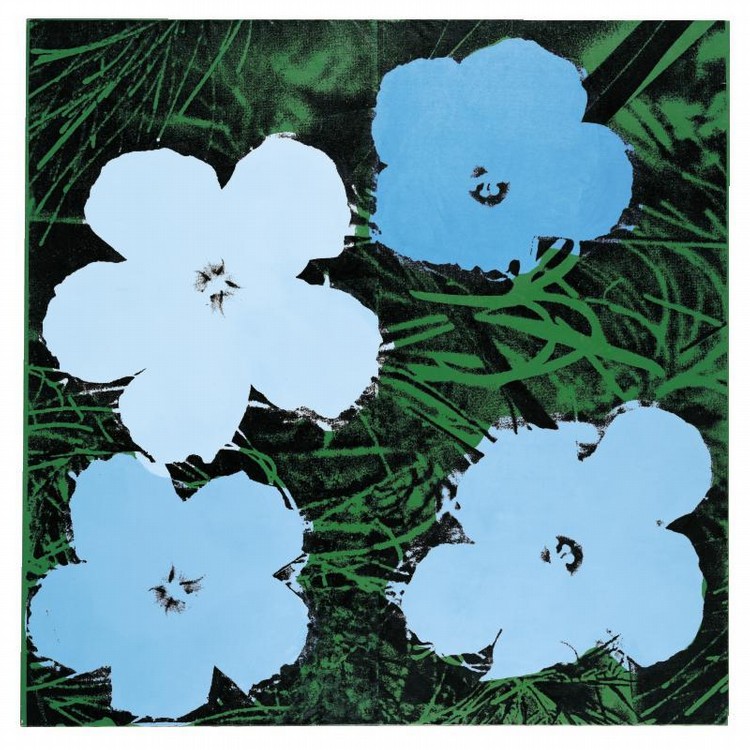
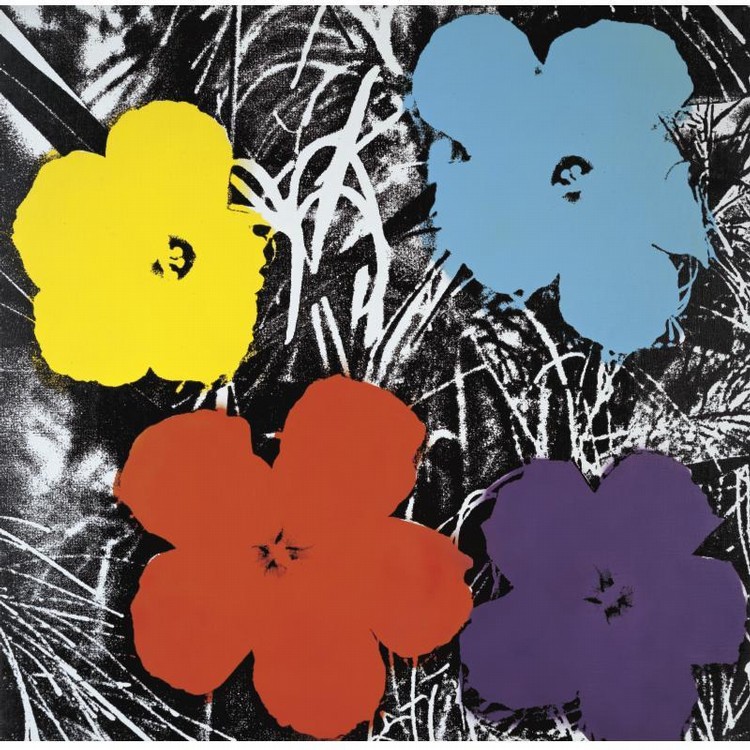
PROPERTY FROM A PRIVATE FRENCH COLLECTION 1928-1987 FLOWERS 48 x 48 in. 121.9 x 121.9 cm. signed and dated 64 on the overlap spray paint and silkscreen ink on canvas Executed in 1964-65. PROVENANCE Leo Castelli Gallery, New York Galerie Ileana Sonnabend, Paris E.J. Power, London Janet McIntyre Waddington Galleries, Ltd., London Acquired by the present owner from the above EXHIBITED Paris, Galerie Ileana Sonnabend, Andy Warhol, May 1965 LITERATURE George Frei and Neil Printz, eds., The Andy Warhol Catalogue Raisonné, Volume 2B: Paintings and Sculptures 1964-1969, New York, 2004, cat. no. 1469, p. 32, illustrated in color NOTE Throughout 1964, Warhol's life and career were a flurry of creative ferment and personal change. In late 1963, Warhol had moved his studio to East 47th Street, a loft that was to become the infamous silver and aluminum-covered Factory. With this more expansive space, Warhol was able to work on larger projects, creating several series of works with assistants in assembly-line fashion, beginning with his box sculptures. Warhol's last show with Eleanor Ward of the Stable Gallery was the controversial exhibition of these three-dimensional reproductions of commercial shipping cartons, which opened in April 1964. However, shortly thereafter Warhol left the Stable Gallery and joined with Leo Castelli, the grand maestro of the Pop Art movement in New York. Warhol preferred to present an exhibition on a single theme, and the prospect of his first show with Castelli was the catalyst for the Flowers paintings. Works from the series were exhibited at the Leo Castelli Gallery at the end of 1964 and subsequent works were shown in May 1965 at Galerie Ileanna Sonnabend in Paris. The image of the four flowers was ideal for Warhol's increasingly devoted and complex investigations of serial imagery and mass media forms. Once again, Warhol demonstrated his genius for identifying commercial imagery that is prevalent in the ``Low'' arts of advertising, film, and magazines, which he then appropriated and translated into the realm of ``High'' art. For his Flowers series, Warhol's source is a color photograph of six hibiscus blossoms printed in the June 1964 issue of Modern Photography. Warhol was still perfecting his method of silkscreen painting, and the newly spacious studio allowed for a multitude of works to be in progress at the same time. The Factory also allowed space for Warhol's new endeavors in the realm of film-making and the imagery of Flowers was perfectly sympathetic to this new enterprise, almost filmic in effect and emblematic of the omnipresence and repetition of modern mass media. Warhol cropped the image to a square of four flowers, rotated one of the flowers and heightened the tonal contrasts. Such creative interventions produced a potent, crisp image that is instantly recognizable and easily manipulated through a myriad of variations, whether as a single panel or combined together in multi-panel compositions. In 1965, Warhol screened the Flowers in many sizes with a multitude of works in smaller scale, and the presentations of the Castelli and Sonnabend shows filled the walls with repetitive canvases, almost in anticipation of his Cow wallpaper. However the larger canvases, such as the 48-inch paintings, are fewer in number than the smaller works begun later. The first series of Flowers paintings, with the green and black backgrounds, produced prior to the Castelli show, began with the 48-inch format (24 in total), progressing to 82-inch, 60-inch and 24-inch. The series of Flowers in late 1964-1965 shifted to black and white backgrounds, including 7 in the 48-inch format. The final five 48-inch format were done in 1967 with green and black. The colors of the flowers, applied to the canvas prior to the screening of the background and stamens, capture the spirit of the psychedelic 60's, particularly in works such as this which have four equally vibrant contrasting hues. In this series of 48-inch canvases with black and white backgrounds, Warhol was also experimenting with the medium and application for the floral colors, seeking a high degree of speed, saturation and opacity. The present work is one in which Warhol used spray paint with either an airbrush or aerosol cans to achieve the desired effect. As colorful and attractive as the Flowers paintings are to the eye, they nevertheless have a more subversive and subliminal reference to the presence of death in life, a theme common to much of Warhol's work although often more overt as in the images of suicides, car crashes and electric chairs. Flowers are symbols of nature's fragile impermanence and the fugitive quality of beauty, as noted eloquently by John Coplans. ``What is incredible about the best of the flower paintings (especially the very large ones) is that they present a distillation of much of the strength of Warhol's art -- the flash of beauty that suddenly becomes tragic under the viewer's gaze. The garish and brilliantly colored flowers always gravitate toward the surrounding blackness and finally end in a sea of morbidity. No matter how much one wishes these flowers to remain beautiful they perish under one's gaze, as if haunted by death.'' (John Coplans, Andy Warhol, New York, 1978, p. 52 Records for the exchange of Flowers paintings between the Castelli and Sonnabend galleries did not always include the usual ``LC'' inventory numbers, so as in the case of the present work, it has not always been possible to determine which dealer sold a particular work. However, the fact that the subsequent provenance of the current Flowers is European, it is probable that this work was sold through Galerie Ileana Sonnabend. As for the exhibition in Paris, it is not always possible to determine which Flowers paintings sent to Ileana Sonnabend were included in the show, although Warhol's two handwritten inventories for the show indicated six 48-inch paintings were to be included. In the catalogue raisonné, it is also noted that a black and white photograph illustrates that ``At least three but probably four 48-inch Flowers were hung in an L-shaped configuration on the stairway wall.'' The current painting is identified as one of the possible four in this photograph (George Frei and Neil Printz, eds., The Andy Warhol Catalogue Raisonné, Volume 2B: Paintings and Sculptures 1964-1969, New York, 2004, p. 27)