Lot description
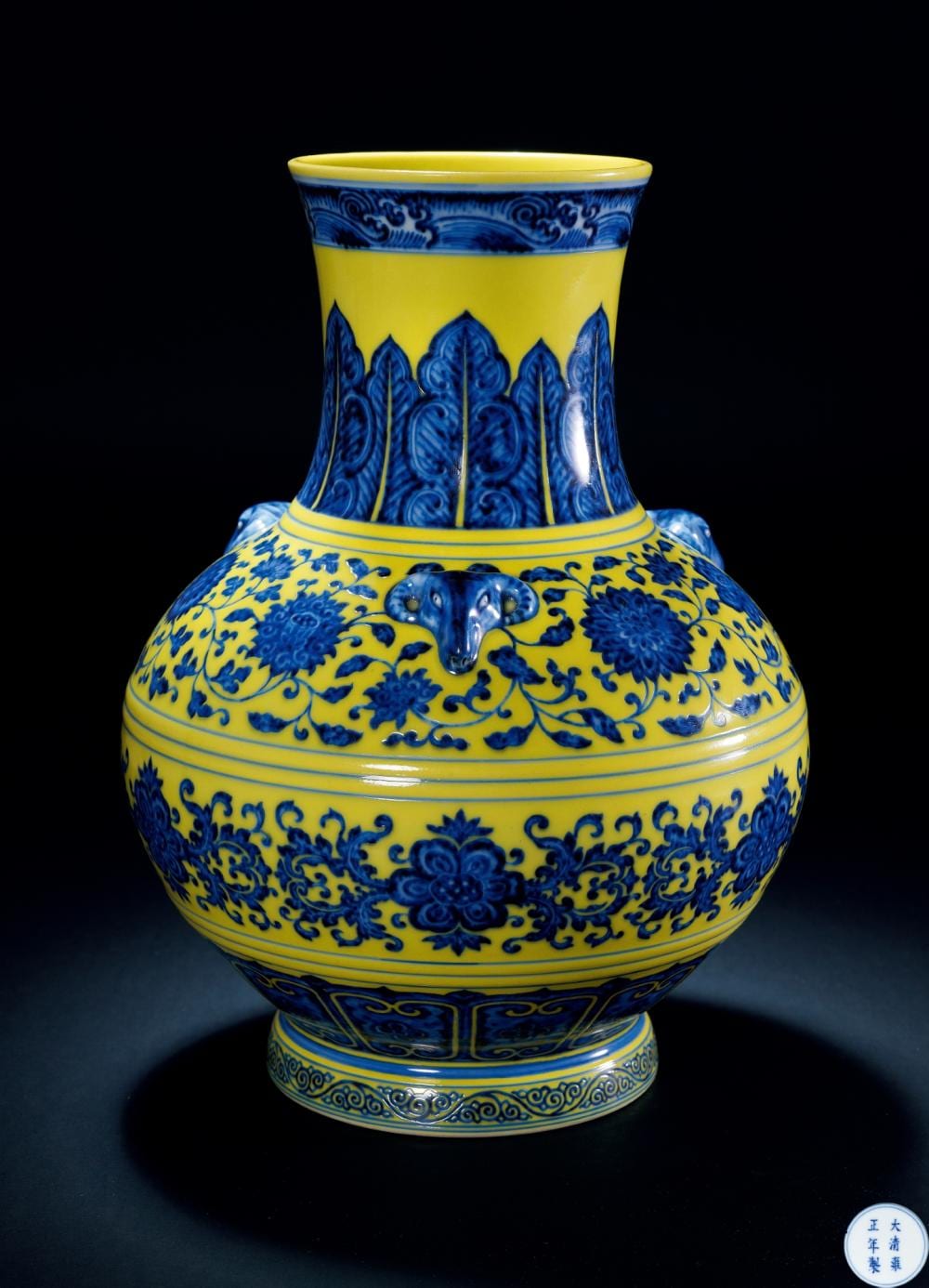
清雍正 黃地青花纏枝花卉紋三羊開泰尊 PROVENANCE A Kyoto family collection This vase is potted with a gently compressed globular body rising from a splayed foot to a tall waisted neck and the upper shoulder is decorated with three ram heads. The lower neck is encircled by a raised double-fillet band, repeated at the central and lower body. The exterior is decorated with six bands of pattern which are all painted in deep shades of cobalt blue creating a 'heaping and piling' effect. The bulbous center section is finely painted with a wide band of undulating leafy lotus on top of a band of floral blossoms, all between a collar of pendent ruyi lappets and a band of stylized lotus petals. The mouth is encircled with a band of sea waves while there is a band of classic scroll around the foot. The ground is further nicely enameled with bright yellow enamel, giving a very strong contrast of color. The base is inscribed with a six-character reign mark in underglaze blue within a double circle. Vases of this design appear to have been introduced in the Yongzheng period. A line drawing of this form is included among Yongzheng shapes in Geng Baochang, Ming Qing ciqi jianding [Appraisal of Ming and Qing porcelain], Hong Kong, 1993, p. 235, fig. 401:"13", where it is called sanxizun ('vase of three beasts'), referring to the kind of animals used in ritual offerings. The ram is a traditional emblem of good luck, since the Chinese term for ram (or goat), yang, is a homophone of yang, 'sun', and represents the male or positive principle in the yin-yang duality. The Chinese character for ram is also used as a variant for a similar character pronounced xiang, which means happiness. Three rams, san yang, are considered a particularly auspicious symbol, evoking the expression san yang kai tai, the awakening of nature in spring, which signifies good luck and happiness. Vases of this form were commonly decorated in monochromes, ie. Tea-dust, Ru or Guan type glazes. See a similar tea-dust glazed 'three rams' vase of Qianlong mark and period sold three times in Sotheby’s Hong Kong:"28"th November 1979 lot 317, 18 November 1986, lot 99, from the collection of T.Y. Chao, and 29 April 1992, lot 89, and once in Sotheby’s New York, 27 November 1990, lot 34, from the collection of Ira and Nancy Roger, illustrated in Sotheby's. Thirty Years in Hong Kong, Hong Kong, 2003, pl. 157; and another, sold in Sotheby’s Hong Kong, 5 October 2016, lot 3656. Also compare two Ru-type glazed examples in the National Palace Museum, Taipei: one from the Yongzheng period, included in the Illustrated Catalogue of Ch'ing Dynasty Porcelain in the National Palace Museum: K'ang-hsi Ware and Yung-cheng Ware, Tokyo, 1980, pl. 129; and the other from the Qianlong period, illustrated in the Museum's exhibition catalogue Qingdai danseyou ciqi/Special Exhibition of Ch'ing Dynasty Monochrome Porcelains in the National Palace Museum, Taipei, 1989, cat. no. 88. Another Qianlong example with a guan-type glaze in the Walters Art Gallery, Baltimore, is published in S.W. Bushell, Oriental Ceramic Art, London, 1981 (1896), col. pl. LXXVII. 「大清雍正年製」 來源 日本京都家族舊藏 摹古與寓意是雍正宮廷藝術的重要理念,胤禛以個人的美學修養與審美愛好有意識地倡導一種理想的工藝審美格調,除了純粹的摹古之外,同時注重在傳統構成因素中創新,借鑒原來的工藝造型和紋飾進行抽繹,組合出具有時代特色的新樣式,寄予新的美好吉祥寓意,從而確立新的古典主義審美品格。此番造器之精神在雍乾時期高檔的御瓷之中體現尤為明顯,往往鐘情選取上古三代器物之造型,配以其欣賞的色釉與紋飾,融匯古今之精粹於一體,成為彼時造器的一個新風尚,本品即為此理念之典範。 本品古雅敦實的造型體現摹古精神之一面,其摹取周漢三羊銅壺為範,追求端莊古雅之美,於此基礎之上則賦予新的裝飾風格,宣示皇家的審美品味,自上而下以青花繪飾六重紋樣,分別為浪濤紋、蕉葉紋、纏枝花卉紋、折枝寶相蓮花紋、變形蓮瓣紋及卷草紋,頸腹之際各飾雙道凸弦紋共三組,令造型更見線條之變化和層次之清晰。三羊尊古雅敦實的造型體現摹古精神之一面,而三羊鋪首之裝飾則寓三陽開泰之意,「羊」與「陽」諧音相通,《易經》中稱:「十月為坤卦,純陰之象。十一月為復卦,一陽生於下。十二月為臨卦,二陽在下。下月為泰卦,三陽大下。」其含大地回春,萬象更新之義,乃嘉慶之徵也。北京故宮博物院藏有一件清雍正青花纏枝花三羊紋尊,紋飾搭配、乃至款識寫法都與本品如出一轍,也可證本品之珍罕難得。 黃地青花者為雍正御瓷名貴之品,始自明代宣德御窯,其中琢器尤為珍罕。作為宣窯可貴之創新,黃地青花屬於極其珍罕的品類,原只見於宣窯之盤碗圓器。面對如此獨特的品類,以雍正皇帝對宣窯的審美選取標準與摹古之性格必將黃地青花在摹古活動中加以發揚,所以雍正御瓷不獨摹仿宣窯黃地青花之圓器,更將其擴大至瓶尊罐的琢器之中,然數量不多,亦異常珍稀。後人陳瀏《匋雅》對此總結有言「黃地青花,雍正窯之所重視者,匪獨盤然也,大瓶亦有之。」正是雍正皇帝的此番創新才將黃地青花推至第二次發展之巔峰,成為清宮御瓷最尊貴的代表之一。 整體畫工細緻精湛,點塗技法運用嫻熟,青花亮麗雋美,蒼雅之氣躍然眼前,與溫潤瑩白的釉面相映襯,更見麗質不凡。特別值得注意的是腹部所繪寶相蓮花紋,呈俯視構圖,花形飽滿,繪大小兩重花瓣,中心繪七孔蓮蓬,兩側繪對稱的花葉,筆觸點染乃是師法永宣意趣,而線條繁復,婉轉多變,則具有濃郁的歐洲巴洛克風格。北京故宮藏有一雍正款青花纏枝花卉紋貫耳壺,設計理念與本品如出一轍,亦是採用上古銅壺之造型,所繪紋飾筆觸與本品近似,西洋氣息濃郁,當時同時之作。雍正皇帝對西洋文化保持著極為開放的態度,這可從目前留存的《雍正皇帝西洋裝側身畫像》和《胤禎行樂圖冊頁》中「刺虎圖」中得到印證,圖中身為一國之君的胤禛著穿西洋文藝復興後期、新古典時期的貴族服裝,頭戴假髮,洋溢出一派異國情調,可見雍正皇帝對西洋文化的接納程度。本品可為清代御窯青花器使用西洋裝飾元素的最早例證之一,之後西洋元素得以在清宮諸式工藝品的裝飾中盛行,遂成風潮,影響深遠。 此式三羊尊為清宮御瓷非常珍稀的造型,深得雍乾二帝所愛,為雍正後期御窯廠的創新雋品,乾隆早期繼之,品類多見各式顏色釉,如茶葉末、仿汝、仿哥、窯變釉等,每一類存世量均在數件之上,唯獨青花一項,頗為珍罕。雍正者除本品外,另一例亦藏於北京故宮博物院,為清宮舊藏,紋飾細節與本品十分接近,惟款識為篆書六字方章款;另一例為香港蘇富比2008年春拍第3067號拍品「清雍正 青花纏枝花卉三犧壺」,紋飾與本品略有區別,頸部繪纏枝花卉,腹部折枝花卉亦有區別,底款為雙圈楷書款,與本品相同。 而乾隆者,檢視國內外公私收藏,僅見兩例,一為北京保利2010年12月5日,編號4694,清乾隆 青花纏枝花卉三羊開泰尊,腹部繪纏枝花卉及海浪紋,底款為乾隆六字篆書方章款;一為香港蘇富比2003年秋拍第0138 號拍品「清乾隆青花纏枝花卉紋鋪首三羊瓶」,裝飾風格與本品頗為接近,腹部所繪折枝花卉紋亦有濃郁的巴洛克風格,其獨特之處則是底款為「大清乾隆年製」六字楷書款。 縱觀雍正一朝御瓷之燒造,許多雋品多為孤例,少見類似乾隆時期的成對之作。因為雍正皇帝強調的是「同形而異彩」,相同的器型裝飾不同的釉彩和紋飾,而每一品類往往僅燒造一件,越是名貴的品類越是體現明顯,絕少重復。在此審美思想引導下,雍正御瓷綻放出斑斕奪目的新姿採,形成種類豐富、釉彩繽紛的局面,本品融遠古造型與西洋時尚紋飾於一體,彰顯出濃厚的中外相合、古今混一的新古典主義審美品味,為清代宮廷美術西學東漸之一例證,是為無上御瓷雋品。