Lot description
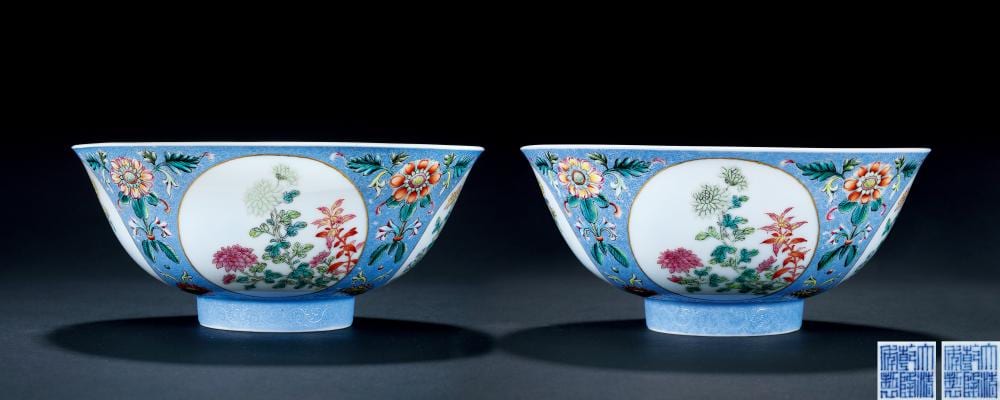
清乾隆 藍地軋道粉彩開光重陽菊花紋節令膳碗一對 PROVENANCE 1. Collection of Lord Loch of Drylaw (1827-1900) 2. Collection of Alfred Morrison (1821-1897), Fonthill House, Tisbury, Wiltshire, probably acquired in 1861 from Lord Loch of Drylaw 3. The Rt. Hon The Lord Margadale of Islay, T.D. (Fonthill House inventory no. 441) 4. Christie's London, 9 November 2004, lot 31 5. Marchant and Son, London 6. Sotheby's Hong Kong, 8 October 2010, lot 2606 EXHIBITION Recent Acquisitions 2005, 80th Anniversary Catalogue, S. Marchant & Son, Ltd., London, 2005, cat. no. 49 Each of these bowls was delicately potted with deep rounded sides rising from a short straight foot to an everted rim. The body was finely enamelled around the exterior with four medallions enclosing blossoming chrysanthemums in different colours, divided by stylised chrysanthemum sprays and all reserved on a pale blue sgraffiato scroll ground. The interior was painted in rich cobalt-blue tones with a chrysanthemum medallion encircled by four clusters of chrysanthemums in the well. The base was inscribed with an underglaze blue six-character seal mark. Such 'medallion bowl' design, typically with four circular medallions reserved on a sgraffiato enamelled ground and with underglaze blue painting on the interior, was developed during the Qianlong period and continued to be admired by succeeding generations, with further widespread in the Jiaqing and Daoguang periods. As on the current bowls the ground enamel was usually incised with dense scrolls in addition to being painted with multi-coloured formal floral sprays. Within the reserved circular panels, the current bowls have delicately depicted autumnal flowers. One has russet and yellow chrysanthemums with daisies and asters; another has yellow chrysanthemums and begonias; a third has pink and white chrysanthemums with balsam; while the last medallion has pink, white and purple chrysanthemums with russet leaves. The choice of plants in these medallions and the delicacy with which they are painted is reminiscent of the decoration seen on a pair of small falangcai Qianlong bottles in the collection of the Percival David Foundation, illustrated by R. Scott in Elegant Form and Harmonious Decoration - Four Dynasties of Jingdezhen Porcelain, Percival David Foundation, London, 1992, p. 157, no. 181. The sophistication of the present bowls has been achieved through the intricate sgraffiato ground and the fusion of Western painting techniques with traditional Chinese motifs. The flowers and leaves adorning the blue ground, masterfully rendered in various tones and hues to create a three-dimensional effect, reveal the influence of Jesuit artists at court. The sgraffiato technique first appeared in the repertoire of the Jingdezhen potters during the Qianlong period and is characteristic of yangcai, the finest porcelains made by the kilns to special imperial orders from Beijing. Commonly known as jinshang tianhua ('adding decorative pattern onto brocades'), this complicated and laborious technique involved needle-point etching the design onto a monochrome enamel ground. This pair of bowls was particularly made for celebrating the Double Ninth Festival during the ninth day of the ninth lunar month. The festival began as early as the Warring States Period (475 - 221 BC). According to the yin yang dichotomy that forms a basis to the Chinese world view, yin represents the elements of darkness and yang represents life and brightness. The number nine is regarded as yang. The ninth day of the ninth month is a double yang day, hence the name "Chong Yang Festival". (Chong means "repeat" or "double" in Chinese.) The ninth month also heralds the approach of winter. It is a time when the living need warm clothing, and filial Chinese sons and daughters extended this to make the festival a time for providing winter clothes for their ancestors. The Double Ninth Festival, therefore, also became an occasion to visit the graves of ancestors. Clothes made of paper would then be burnt as offerings. Chrysanthemums have provided great inspiration to Chinese artists, and have been cultivated and admired in China for centuries. They are even mentioned in the Chinese classic, the Book of Odes. The chrysanthemum is one of the 'flowers of the four seasons', representing Autumn. It is also known as one of the 'four gentlemen of flowers', along with prunus, cymbidium and bamboo. Chrysanthemums have also become associated with the famous reclusive poet Tao Yuanming (AD 373-427), who wrote poetry in their honour. Exquisitely enamelled with flower medallions on an ornately decorated blue ground, bowls of this design are very rare and were pioneered by artists working during the Qianlong period. Only one other pair of Qianlong bowls of this design on a blue colour ground appears to be known, also from the Alfred Morrison Collection and Fonthill Heirlooms, sold at Christie's London, 9th November 2004, lot 27, offered together with a pair of Daoguang bowls as lot 29. Compare a pair of similarly decorated Qianlong bowls, but with a variation of the leafy scroll motif and painted with landscape medallions, in the National Palace Museum, Taipei, illustrated in Stunning Decorative Porcelains from the Ch'ien-lung Reign, Taipei, 2008, pl. 13, together with a yellow ground version, pl. 14. Further bowls of this style with various colour grounds include two bowls decorated with landscape medallions, one on a yellow ground and the other on a ruby ground, in the Palace Museum, Beijing, illustrated in The Complete Collection of Treasures of the Palace Museum. Porcelains with Cloisonné Enamel Decoration and Famille Rose Decoration, Hong Kong, 1999, pls 103 and 104; and two ruby ground examples with medallions enclosing antiques, one sold in Sotheby's Hong Kong, 20 May 1986, lot 146, and the other sold in Sotheby's New York, 30 March 2006, lot 352. 款識:「大清乾隆年製」 來源 1. 洛赫爵士(1827-1900年)收藏 2. 放山居,艾弗瑞.莫里森(1821-1897年)收藏,應於1861年購自洛赫爵士 3. 蘇格蘭艾雷島馬格代爾爵士收藏(放山居編號441) 4. 倫敦佳士得,2004年11月9日,編號31 5. 馬錢特,倫敦 6. 香港蘇富比,2010年10月8日,編號2606 展覽 《Recent Acquisitions 2005, 80th Anniversary Catalogue》,S. Marchant & Son. Ltd.,倫敦,2005年,圖錄編號49 碗一對,敞口微撇,弧腹,圈足,碗底青花書「大清乾隆年製」六字三行篆書款。胎土陶洗精煉,堅致縝密。釉面光潤細膩,潔白瑩亮。製作考究,線條優美流暢,典雅端重。外壁飾藍釉軋道紋,軋道精緻細密,撥劃出細如毫芒、宛如錦紋的鳳尾形卷草,達到了似錦鋪就之感。四面開光內以粉彩繪製花卉圖案,枝繁葉茂,花卉妍麗婀娜,多姿奪目,採用國畫技法,清新脫俗,雅致宜人。開光間填以西番蓮及寶相花,填彩明麗奪目,富貴雍容。碗內壁以青花繪折枝菊花紋四組,碗心繪兩周青花弦紋及花卉紋,氣韻清雅,與外壁開光內花卉圖案相映成趣。青花發色純正,菁麗明快,繪畫精細自然,寫實流暢,深具風骨。此對作品製作上乘,端莊秀雅,宮廷氣息濃厚。在色地上用一種狀如繡針的工具撥劃出細如毫芒、宛如錦紋的鳳尾狀紋,是為軋道工藝。 色地開光節令膳碗因為乾隆皇帝的風雅所好而創燒,經乾隆、嘉慶、道光三朝,主要用於御茶膳房,為名副其實的御用瓷。且裝飾精良,用料講究,數量非常有限,更是清宮御用瓷器中非常難得的成組成套燒造的瓷器品種。其創燒和斷燒時限有明確的檔案史料為依據,在清代御窰瓷器史研究中具有重要的學術價值。 九九重陽原為祈求長壽的節令,漢代《西京雜記》載「九月九日,佩茱萸,食蓮餌,飲菊花酒,云令人長壽」,現發展為老年節。是日應出游踏秋,登高遠眺,遍插茱萸,吃重陽糕,賞菊飲酒,民間習俗活動甚為豐富。而「重陽菊花」膳碗所用紋樣卻幾乎純是菊花,倒也名副其實。該碗外壁翠藍釉軋道鳳尾草紋為地,襯以四圓形開光,開光之間地子上各繪一組粉彩洋菊紋,四個圓形開光內各繪粉彩叢菊紋,配以秋令花卉。 據《清宮瓷器檔案》記載,乾隆八年十二月初九日,太監胡世傑交御用青花膳碗一件,傳旨:「外面俱燒五彩各色地杖,花樣各按時令分別吉祥花樣。碗內仍照外面花樣,俱要青花白地,年節用『三陽開泰』,上元節用『五穀豐登』,端陽節用『艾葉靈符』,七夕用『鵲橋仙渡』,萬壽用『萬壽無彊』,中秋節用『丹桂飄香』,九月九用『重陽菊花』,尋常賞花用『萬花獻瑞』。俱按時令花樣燒造,五彩要各色地仗,每十件地仗要一色,按節每樣先燒造十件。欽此。」 從清宮檔案可知,此類膳碗共有八種紋樣,其創燒與乾隆皇帝的直接旨意有關,是由皇帝參與設計或定稿的御用傳辦瓷器。景德鎮御窯「向於三月春融開工,十月交冬令前燒造齊全」,則乾隆九年應是這類色地開光節令膳碗的始燒時間。 《清宮瓷器檔案》記載:「五月初四日:司庫白世秀,副催總達子將唐英燒造得艾葉靈符膳碗十件持進,各色洋彩鼻煙壺四十件,青花白地書燈二對,青花白地五供四分,內二分蠟阡系原發去配爐花瓶,內二分放大燒做,俱持進交太監胡世傑呈覽。奉旨:此五供內花瓶俗氣,款式亦不好,再燒造時,另改好款式燒造,其端陽節艾葉靈符膳碗,嗣後不必燒造。欽此。」由此推斷,乾隆年款者膳碗,僅燒製過一次,每種共十件。 此對拍品色彩鮮麗,針錐剔刻花紋精細連綿,誠為乾隆御瓷風格之典範。此類瓷器稱洋彩瓷,著色技巧學自西洋畫法。相較歐洲巴羅克藝術及建築之壯麗沈穩,洛可哥藝術予人輕巧曼妙之感。康雍兩朝宮廷審美均趨莊嚴肅穆,此西洋風格則為之注入一股清心活潑氣息。洋彩瓷燒造技術與色彩發展,當屬雍正朝及乾隆朝初年景德鎮御窖廠督陶官唐英之功。廖寶秀,〈乾隆磁胎洋彩綜述〉,《華麗彩瓷,乾隆洋彩》,國立故宮博物院,臺北,2008年,頁36,提及高宗曾於奏摺朱批為何乾隆五年以前所燒瓷器遠遜於雍正年間所製者,經此嚴厲責問,洋彩燒造突飛猛進,乾隆六年後唐塞所造之器,已臻完美。 洋彩瓷取材西洋裝飾技法,融入中國傳統紋飾,需高超工藝且精准施作,成品新穎異趣,繁美雅麗,然寥若晨星,極是珍罕。「洋彩」意指色彩摹效西洋繪畫,常以白料相調。此碗紋飾以粉藍、粉青、粉紅等西洋色調為主,搭配源自明初的濃豔礬紅彩,並師法西洋光影技巧,繪卷葉紋與花瓣枝葉。 此類軋道裝飾技法可鑒查稱「磁胎洋彩紅地錦上添花」,見數例紋飾風格近似之例,皆燒造於乾隆六年至十年間之洋彩瓷,現藏臺北故宮博物院,展出於2008年特展《華麗彩瓷,乾隆洋彩》。展覽呈現出乾隆窖釉彩之創新,並汲取西洋審美融合中國傳統。檔案記載乾隆七年(1741年)八月進呈六十九件洋彩瓷,類同紋飾可見於數件展品,如一對藍地錦上添花開光籃花圖膽瓶,編號47;相似開光卷葉紋,如一件藍地茶鐘及描金錦地蒜頭瓶,編號3、38。比較一對粉藍地錦上添花紙槌瓶,錦地環繞如意式開光,內綴花卉紋,編號30。如上列清宮舊藏洋彩瓷,多造於乾隆七年。 同類乾隆年製重陽節令膳碗目前僅見一例,現展覽於巴黎吉美博物館;松竹堂藏一對道光年款例,錄於《瑯環琳瑯.松竹堂中國御窰瓷器珍藏》,香港,2016年,圖版82。見一對藍地團花山水紋膳碗,現藏臺北故宮博物院,展出於2008年特展《華麗彩瓷,乾隆洋彩》,台北,圖版13,同書亦見一對黃地膳碗之例,圖版14。參考類似紋碗,施黃釉者,碗心繪金彩寶相花,故宮博物院藏,《故宮博物院藏文物珍品全集•琺瑯彩•粉彩》,圖版103及104。