Lot description
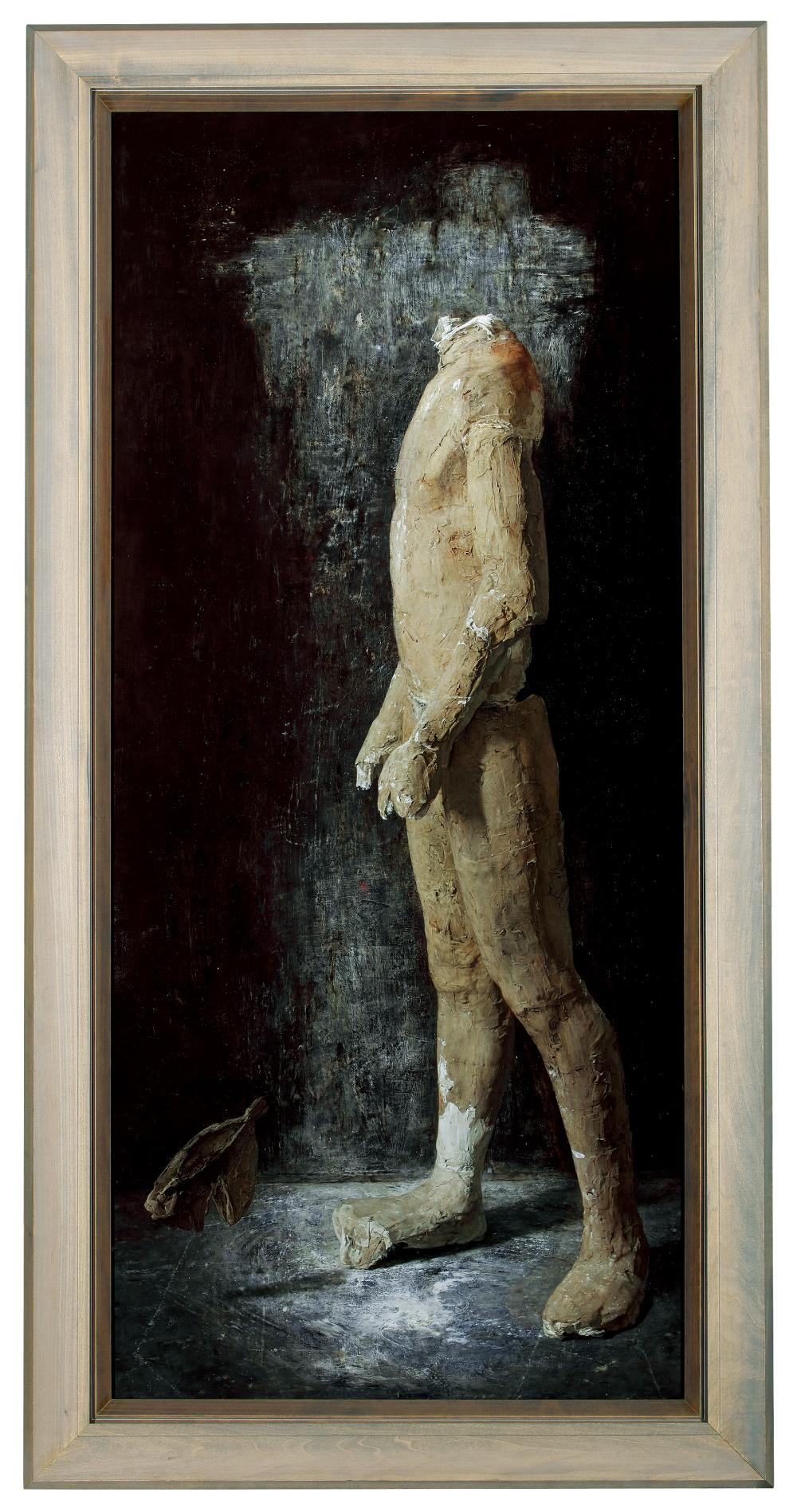
行走的人之二 oil on canvas Painted in 1994 inscribed, signed and dated in Chinese (on the reverse) Without throwing out the knowledge and techniques of painting on an easel, I attempt to advance the creation process and conceptual forms of installation and performance art, creating 'unnatural replicas' as a result.-Shi Chong In the early 1980s, Chinese conceptual art, performance art, and installation art all burst onto the scene through radical formats and distinctive styles in response to the introduction of Western expressionism and surrealism. In the late 80s, as a spiritual continuation of the 85 New Wave movement, conceptual art led to the sprouting of Chinese avant-garde art in the early 90s. Shi Chong set himself apart from the 85 generation of artists. He did not choose rebellion or irony to express his main focus, and neither did he choose conceptual and performance art with expansive boundaries. Instead, Shi Chong went against the grain to safe-guard the rigors of academism, and persisted on the easel with his exploration of the modern era relationship between cultural transformation and individual life experiences, and contemplation and inquiries of the inner spirit and profundity of life. Created in 1994, A Walking Man II (Lot 2044) was one of the artist's most important masterpieces during his conceptual creation period in the 1990s. The work was completed with exquisite and skillful techniques full of conceptual vocabulary, which carried the artist's continuous inquiry into the meaning of life. He refined ab-stract thinking into a carefully arranged composition, condensing multi-dimensional philosophical contemplation on two-dimensional canvas, which became the courier of dialogue between the artist and the viewer. In 1993 when A Walking Man first came out, the work won the gold medal at the second annual Chinese oil painting exhibition organized by the National Art Museum of China. It is a large-scale exhibition with governmental and academic support, which not only places emphasis on the excellence of painting techniques, but also explores deeper layers of historical and realistic interpretations. At the time, A Walking Man stood out from more than one thousand works, and became a masterpiece in art history. A Walking Man II continued the creative tone of A Walking Man and the conceptual realism painting method. It showcased further the artist's solid techniques for painting realism, exploration of easel painting and conceptual art's expressive boundaries, the deconstructive ability of grand-scale narratives and complex propositions, and its pursuit and insistence on pure reasoning in the era of irrationality. The black mottled background in A Walking Man II reveals the type of heavy burden and vicissitude that belongs in history. The dark and weighted scenery is in contrast to the plaster cast of a real person, which is a continuation of that used in A Walking Man. A Walking Man symbolizes the artist's anxiety about rapid development of the times and how it is devastating, ripping apart human nature, resulting in a boundless emptiness in the human spiritual condition. A Walking Man II, meanwhile, may be the secret howling in reaction to such a state of mind-"At this time, silence is better than sound." The two paintings present layered internal emotional progression. The artist treated the plaster sculpture with destructive intention, beheaded it, and created obvious cracks on the limbs and skin surface of vine-like texture, which became a kind of aged harshness surrounded by darkness. On the lower left corner, a fish appears suspended in the air. The artist, again, used a scraping knife to shape the texture of this image, creating a relief effect like a fossil inside a museum representing an artifact of some civilization, which is a clever contract with the dense plaster sculpture. Accelerated development of technology and urban civilization is a bottomless vortex, a black hole of infinite energy, infinite gravity, and immense power capable of total destruction. In this kind of environment, people are gradually losing their sense of space and orientation, replacing it instead with a severe sense of identity anxiety. The plaster sculpture's posture hints at movement of looking over the surroundings, which may be a footnote on the bewilderment on people's minds. The broken body itself carries pain and forbearance-artists establish a type of experiential creation similar to a "religious practice" through delicate detail observation and carefully crafted description. Such strong analysis and behavior reproduction is also a type of silent confrontation against the rapid changing world. The suspended fish seems to be against common knowledge, but actually represents embodiment of graceful, fantasy culture belonging only to the Jingchu culture that is part of the artist's DNA. This indicates that in Shi Chong's rational logic of painting, there is no room for imagination of self-restriction. Thus the meaning of such an existence is profound, imbuing some kind of enlightenment related to life experience and spiritual colours of reincarnation. He relies on very little colour, restrain in composition, forbearance of emotions, and frosty eyes tinted with archaeology perspective, to deconstruct a surreal composition with compassion and strong spiritual orientation. Shi Chong stripped down such a grand and abstract proposition so that it may leap upon the paint canvas, endowing the work with the vibration and tension of "hearing thunder in a space of silence." Conceptual paintings, represented by A Walking Man and A Walking Man II, are essentially a reproduction of performance and installation art, and the process of reproduction consists of "viewing from the perspective of the object" and the "reduction of phenomenon." Goethe once said, "The highest form of art is presenting the subject's intuitive reality". Shi Chong set up two enclosed spaces for the Walking Man series, applying classical sidelights in the exhibition space arrangement, with dark singular colour in the background. The treatment of the plaster body and the layered texture of the fish which appeared out of nowhere are full of the artist's rigorous observation and description of the world. His contemplation rests upon control of the space layout and props display, with a high degree of obedience to the props and the objects. In this regard, it is similar to the works of Giacometti: "Art is a way of seeing, I am only describing what is nature, drawing what is in front of the eyes. A person, an apple, I know this is disdained. But what is reality, I don't know. I only attempt to get closer." After WWI, artists in the West pioneered Dada and Surrealism art, but Giacometti kept himself isolated from these movements. First, his paintings and sculptures are based on the foundation of reality while conducting spiritual excavations of the shapes. Just like his sculptures, walking all alone, Giacometti's works are highly consistent. He borrows the power of repetition, etching out group portraits of life that are directionless and lonely. This type of creative method and the inner spirit of the works may serve exactly to annotate Shi Chong's core creative works in the 1990s. Taking an overview of the artist's works in the 1990s, Shi Chong was always vigilant and conscious of danger about painting realistic objects on the easel, and his keen observations shaped his paintings with a combination of "concept goes first" and hyperrealism techniques. To make up for oil painting's weakness in expressing "realness", he introduced the use of integrated media to transform two-dimensional oil painting, inventing the possibility of regenerating oil paintings to a higher level. The successful attempts of A Walking Man and A Walking Man II established the artist's lifelong creative logic and passage, that is, to explore "truth" vs. "fantasy", "era" vs. "individual", "reality" vs "fiction" with a grand perspective within the torrent of history, and rely on observation of life of the self in search of the ultimate meaning of time and humanity. In A Walking Man II, Shi Chong relied on object image combinations and the communication between reality and fantasy to transform complex spiritual ponderings into imagery and symbols that can be read and deciphered. He used the material concepts of props to intervene on the exploration of "human" life concept, and relied on the language of classical oil painting to infuse a sliver of "tender" power into profound concepts and rigid installation. His creative works allow the material nature and human nature to flow separately in undercurrents without deliberate interweaving. This type of tension filled collision fills the works with semantic connotation. Art critic Huang Zhuan's summary of Shi Chong's works in this period may be the best commentary of this painting: "As a physical and psychological description of reality, his works serve as a reminder of the spiritual plight of humans in the age of information. In the technical formula and transcription meth-od that is next to cruelty, he paradoxically denied the figurative art outer verbal shell and provided a successful example of conceptual transformation from art on the easel." Shi Chong's creative methodology fused realism and conceptual art, realizing bi-directional exploration of two completely different models, not only generating an unprecedented presentation method for installation and performance art but also blazing a new trail for Chinese realistic paintings.