Lot description
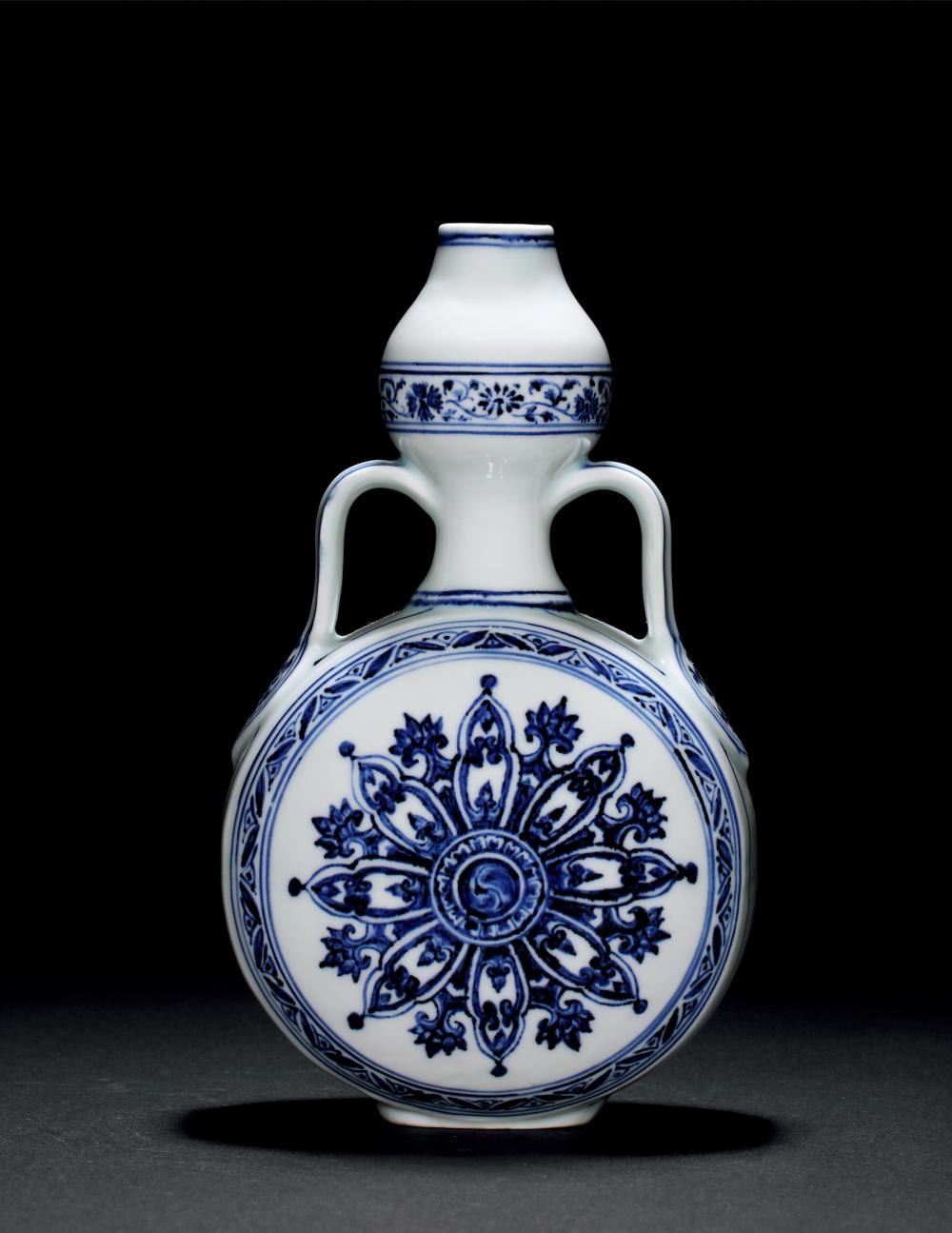
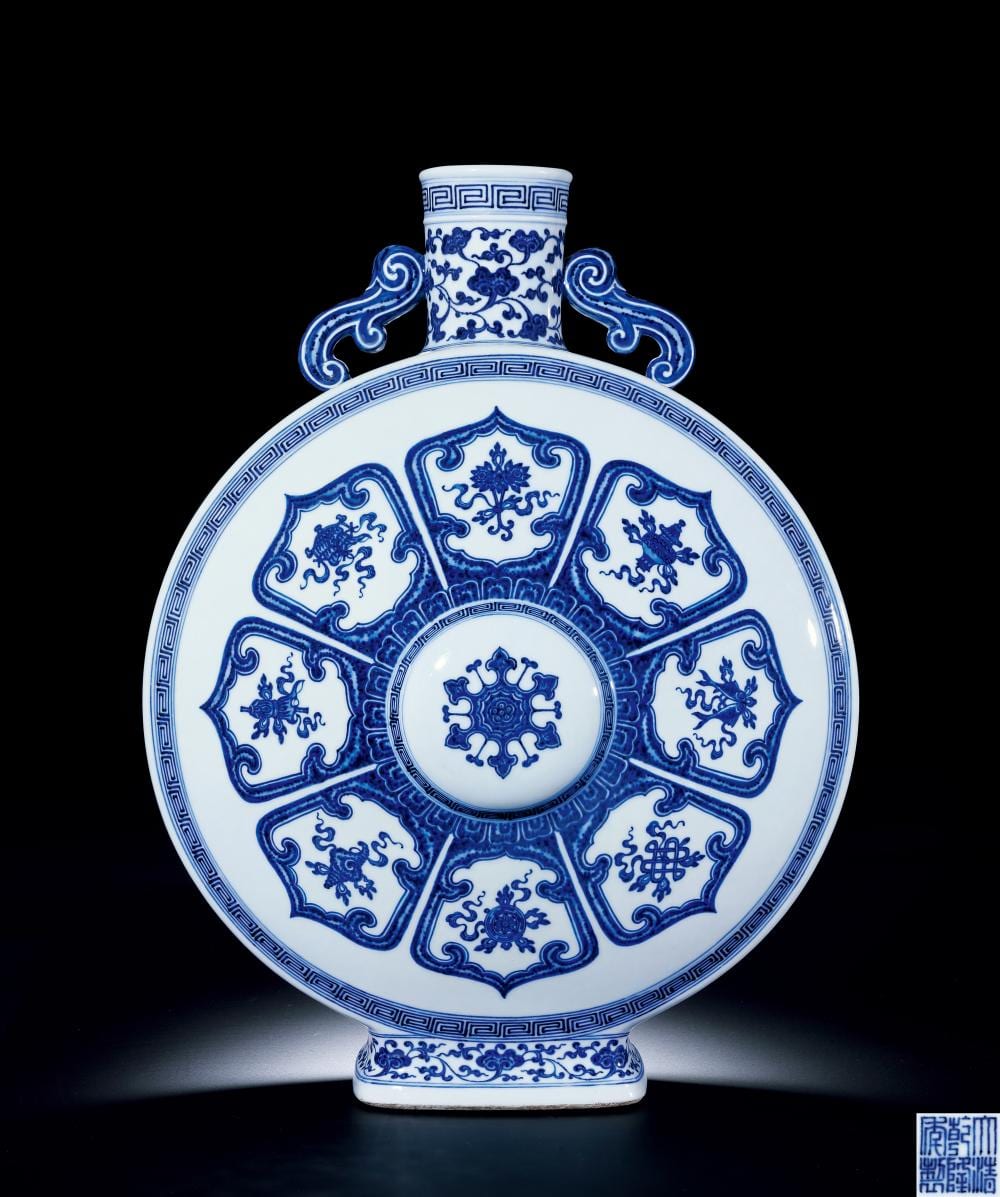
清乾隆 青花纏枝蓮八吉祥紋抱月瓶 PROVENANCE 1. Collection of Jean-Claude Moreau-Gobard, Paris, by repute 2. Collection of T. T. Tsui (1940-2010) The body of this flask is well potted in flattened form with gently domed sides, rising from a splayed rectangular foot to a cylindrical neck flanked by a pair of scroll handles. It is brilliantly decorated with rich underglaze blue with simulated 'heaped and piled' effect. On each convex side, there are eight petals enclosing the (Eight Buddhist Emblems) Bajixiang, radiating from a central raised boss decorated with a stylised flower head, and divided by key-fret and lappet bands. The narrow sides are decorated with a band of stylized lotus scroll. The base is inscribed with a six-character seal mark in underglaze blue. Being inspired by blue and white flasks in early Ming dynasty, the moon flask of the present lot is potted with gently domed sides, which in turn were inspired by early Islamic metal prototypes, see J.A.Pope, Aus der Welt der Islamischen Kunst: Festschrift für Ernst Kühnel, Berlin, 1959, pp.357-375. See also an example from Freer Gallery of Art, published in Oriental Ceramics: The World's Great Collections, vol. 6, Tokyo, 1982, col. pl. 94. A related blue and white moon flask with one flattened side of Yongle period is illustrated in The Complete Collection of Treasures of the Palace Museum: Blue and White Porcelain with Underglaze Red (I), Shanghai, 2010, pls.34-37. Similar Qianlong blue and white moon flasks of this size could be found in a number of museums and private collections. For example, see one included in the Blue and White Ware of the Ch'ing Dynasty, Porcelain in the National Palace Museum, vol. 2, Hong Kong, 1968, p.50, 51 and 15a-c; one from the Qing Court, now in the Shenyang Palace Museum, see The Prime Cultural Relics Collected by Shenyang Imperial Palace Museum: The Chinaware, vol. I, Shenyang, 2007, no. 35; another flask from the Nanjing Museum is published in Treasures in the Royalty: The Official Kiln Porcelain of The Chinese Qing Dynasty, Shanghai, 2003, p. 295; another, from the National Museum of China, illustrated in Studies of the Collection of the National Museum of China, Shanghai, 2007, pl. 83; a further example published in Chinese Ceramics in The Idemitsu Collection, Japan 1987, no. 94. The present flask is exceptionally well potted without leaning to one side, which is a challenging shape to fire in perfectly straight form, making the moon flasks of this type very rare. Further examples sold in auction houses, see one from the collection of Edward T. Chow, was sold in Sotheby’s Hong Kong, 8 April 2011, lot 3123; another, from the collections of C.G. Sloan and Greenwald, was sold at Christie's Hong Kong, 1 December 2010, lot 2826; and a pair from the Skinner collection sold in Bonhams Hong Kong, 30 May 2017, lot 120. 款識:「大清乾隆年製」 來源 1. 傳巴黎Jean-Claude Moreau-Gobard收藏 2. 徐展堂先生(1940-2010年)收藏 扁壺唇口,直頸,下接扁圓腹,截面成腰鼓形,兩側卷雲耳連接頸肩,下承長方形弧角圈足,足牆外撇。通體以釉下鈷藍裝飾,口沿迴紋一周,頸部及足牆飾卷葉靈芝。器扁腹兩側飾纏枝蓮花。扁腹圓面以中央中心圓形凸起為花心,花心呈六出雪花結晶狀,外圍迴紋及兩層花瓣,內層為小葉片門字形蓮瓣,外層為八片尖蓮瓣,蓮瓣內分別飾八寶,足內釉下青花書「大清乾隆年製」三行六字篆書款。 扁壺因腹部有圓形凸起,亦稱為「抱月瓶」或「寶月瓶」,形制受明代早期御器廠燒製抱月瓶影響,起源於伊斯蘭文化金屬器,詳細論著,見J.A.Pope著,「穆斯林風格明早期瓷器」,刊登於《Aus der Welt der Islamischen Kunst: Festschrift für Ernst Kühnel》,柏林,1959年,頁357-375。原形參考圖載於《Oriental Ceramics: The World's Great Collections》,卷6,東京,1982年,圖版94,為Freer Gallery of Art收藏。 此式扁壺的燒造對胎質比重要求極高,否則容易承受不住窯內高溫而導致坍塌變形,能成功燒製之實為不易。傳世品中,香港邦瀚斯曾售出一對,2017年5月30日,編號120。單件者,見仇炎之舊藏一例,後售於香港蘇富比,2011年4月8日,編號3123;另見葛沃得舊藏一例,後由香港佳士得拍出,2010年12月1日,編號2826。 參考相對尺寸之扁壺,台北故宮博物院藏一例,見《故宮藏瓷:清青花瓷》,卷二,香港,1968年,頁50-51及15a-c;瀋陽故宮博物院見清宮舊藏亦有一例,見《瀋陽故宮博物院院藏文物精粹:瓷器卷(上)》,瀋陽,2007年,圖35。另見南京博物院藏一例,著錄於《宮廷珍藏中國清代官窯瓷器》,上海,2003年,頁295;中國國家博物館亦藏一例,見《中國國家博物館文物研究叢書:清代瓷器》,上海,2007年,圖83。日本出光美術館藏有兩例,見《中國陶磁:出光美術館蔵品図錄》,東京,1987年,圖版94。 扁壺扁腹所繪「八吉祥」紋飾,為佛教之八寶,為佛前供器,分別由法輪、法螺、寶傘、白蓋、蓮花、寶罐、金魚、盤長八件組成。每件供器含義不同:輪代表佛說大法圓轉,萬劫不息;螺代表菩薩果妙音吉祥;傘代表張弛自如,曲覆眾生;蓋代表遍覆三千,淨一切樂;花代表出五濁世而無染;罐代表福智圓滿,具完無漏;魚代表堅固活潑,能解壞劫;長代表回環貫徹,一切通明。青花色澤艷麗,色重處可見細密瘢痕,為刻意模仿永樂、宣德青花暈散之效果,參看舊金山亞洲藝術博物館藏一件明永樂青花八吉祥折沿盆,可見其八吉祥排序與清代仿製品有差異,見He Li,《Chinese Ceramics》,舊金山,1996年,圖版398。故宮博物院藏一件明永樂青花抱月瓶,其腹部一面成鼓形,或為此式扁壺原型,見《故宮博物院藏文物珍品大系:青花釉裏紅(上)》,上海,2010年,圖34-37。此式八吉祥扁壺雍正朝亦有燒製,見中國國家博物館藏一例,著錄於《中國國家博物館館藏文物研究叢書:瓷器卷(清代)》,上海,2007年,編號83。此對扁壺形制更加碩大,配合圓碩扁平的瓶體以及雙卷雲耳,更顯大氣穩重、古雅端莊。