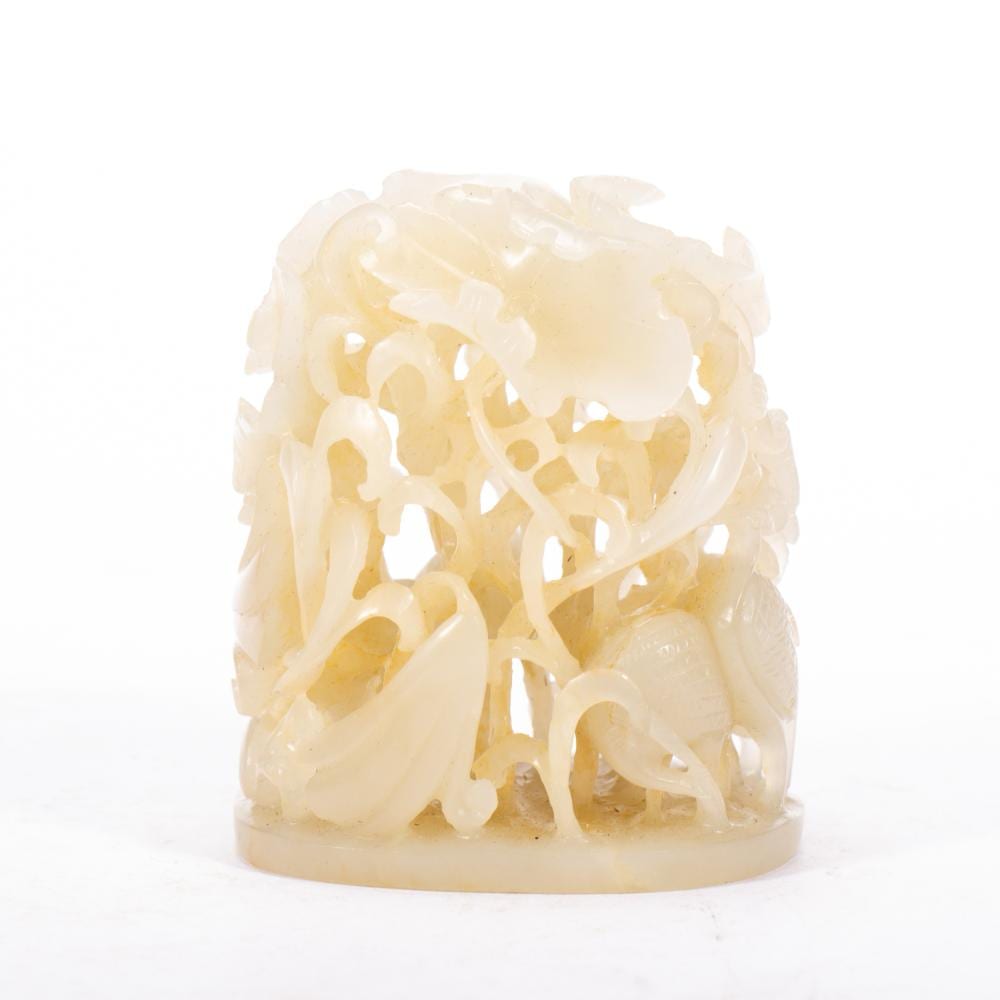
The short answer
Most jade sells for a few hundred dollars. We looked at 40,255 jade lots sold at auction between August 2023 and July 2026. The median price was $300, and half sold for between $100 and $900. About 1 in 4 (24%) sold for $1,000 or more, and about 1 in 40 (2%) for $10,000 or more.
| Object | Lots sold | Median price | Sold for $1,000 or more |
|---|---|---|---|
| Bowls, vases and other vessels | 3,078 | $638 | 41% |
| Snuff bottles | 1,122 | $650 | 40% |
| Carvings and figures | 6,493 | $300 | 27% |
| Rings | 2,793 | $325 | 18% |
| Pendants | 4,759 | $250 | 16% |
| Earrings | 1,048 | $205 | 15% |
| Bangles | 1,608 | $150 | 10% |
| Necklaces and beads | 3,132 | $150 | 12% |
Carved vessels and snuff bottles sell highest; everyday jewelry such as bangles and bead necklaces sells lowest.
What makes jade valuable
- Which jade it is. Two different minerals are sold as jade. Jadeite, mostly from Myanmar, is prized for color and translucency: an even, bright green that lets light through is the most expensive. Nephrite, China's traditional carving jade, is prized for the quality of the carving, a fine white or even color, and age.
- Treatment. Much jadeite is bleached and filled with polymer (“B jade”) or dyed (“C jade”), and treated jade is worth far less. In our data, jadeite described as certified or untreated had a median of $600, against $225 for jadeite without that wording.
- Carving, age and provenance. For carvings and vessels, the skill of the carving, the period and a documented history matter more than size.
- Condition. Cracks and chips reduce value, and are easy to miss under polish.
Before valuing a piece, make sure it is jade at all: see how to tell real jade from look-alikes. For jewelry, see antique jade jewelry values.
FAQ
Is jade worth anything?
Usually a few hundred dollars. About a quarter of the jade sold at auction reaches $1,000; fine jadeite and good antique carvings can reach far more.
Is green jade worth more?
Only when it is untreated jadeite with an even, translucent color. Many green stones sold as jade are dyed, treated or a different stone.
Do I need a certificate?
For any jadeite that may be valuable, yes: a gemological lab report states whether the stone is untreated (“Type A”), and buyers pay for that certainty.
Jade Stone Appraisal Guide: value basics
A jade stone appraisal should start by separating jadeite from nephrite and checking treatment status before weighing color, translucency, texture, form, size, condition, age, provenance, and comparable market evidence.
How Much Is Jade Stone Worth Securing An Accurate Appraisal For Jade
Jade excites both gem lovers and antiques collectors because it straddles two worlds: jewelry and cultural art. Yet few materials are trickier to price accurately. From an “imperial green” jadeite cabochon that sells for six figures to a modest nephrite carving worth under a hundred dollars, the spread is vast—and detective work is required to land on a trustworthy valuation. This guide explains what drives jade value, how to identify treatments and imitations, market benchmarks to set expectations, and how to secure a reliable appraisal that stands up to scrutiny.
The Two “Jades”: Jadeite and Nephrite
“Jade” is a trade umbrella for two distinct minerals:
Jadeite: A pyroxene mineral prized for vivid hues—especially saturated, evenly colored green—and a bright, “glassy” translucency. Mohs hardness ~6.5–7; specific gravity ~3.30–3.34; spot refractive index ~1.66. Historically most valuable jadeite comes from Myanmar (Burma); other sources include Guatemala and Japan. Top qualities include imperial green, “icy” near-colorless high-translucency, and fine lavender.
Nephrite: An amphibole (tremolite–actinolite) known for toughness and a softer, waxy luster. Mohs hardness ~6–6.5; specific gravity ~2.90–3.10; RI ~1.61. It dominates ancient and historic Chinese carvings and objects. Key sources include Xinjiang/Hetian (Hotan) in China, British Columbia (Canada), Siberia (Russia), New Zealand (pounamu), and Wyoming (USA). Top nephrite includes “mutton-fat” Hetian white (creamy, fine-grained) and deep spinach green material favored in Qing-era objects.
In broad terms, fine untreated jadeite can command the highest prices in jewelry markets, while the finest antique nephrite carvings and Hetian white can be extremely valuable in the art and antiques market. Knowing which “jade” you have is step one.
What Drives Value: The Eight Critical Factors
- Species and Type
- Species: Jadeite generally valued higher than nephrite in jewelry. In antiques, a top Hetian nephrite carving may outprice most jadeite jewelry.
- Treatment status: “Type A” indicates natural, untreated. “Type B” (bleached and polymer impregnated) and “Type C” (dyed) carry steep discounts. Untreated (“A-jade”) commands multiples of treated equivalents.
- Color
- Hue: Pure, slightly bluish green in jadeite is most coveted; strong, even saturation without gray or brown modifiers is key.
- Saturation and Tone: Rich saturation with medium to medium-dark tone is ideal. Uneven color or blotches reduce value.
- Other desired colors: “Icy” (near-colorless) high-translucency jadeite; fine lavender; in nephrite, creamy mutton-fat white and deep spinach green.
- Translucency and Texture
- Translucency: “Glassy” or “icy” jadeite (highly translucent) is prized. Cloudy, opaque patches lower value.
- Texture: Fine, even grain yields a smooth, oily luster and enhances translucency; coarse texture dulls luster.
- Clarity and Inclusions
- Fewer fractures and inclusions are preferred. In jade, fine internal “cotton” or structural textures are normal; however, wide fractures, pits, or stained fissures are value detractors.
- Size, Shape, and Cut Quality
- Bangles: Require large, clean rough and carry premiums when evenly colored and highly translucent. Even a hairline crack can drastically reduce value.
- Cabochons and beads: Matching pairs or strings with uniform color/translucency bring premiums. Symmetry and polish matter.
- Carvings: Proportion, depth, and polish quality affect desirability.
- Craftsmanship and Artistic Merit
- Antique carvings: Complexity, subject matter (mythical beasts, auspicious symbols), and stylistic fidelity to period traditions add value. Crisp detail and finish are essential.
- Modern pieces: Designer/jade carver reputation can elevate prices.
- Age, Provenance, and Cultural Context
- Period and origin can be decisive for nephrite carvings. Qing dynasty, early Republic, or documented imperial provenance dramatically increase value.
- Paper trail: Invoices, collection history, and exhibition/auction records support higher appraised values.
- Condition and Wear
- Chips, re-polishing, over-drilling, repairs, or adhesive fills reduce value. Jade’s toughness resists breakage, but once cracked—especially in bangles—the penalty is severe.
Treatments, Imitations, and Lab Reports
Treatments are common and must be identified to appraise accurately:
- Type A: Natural jadeite or nephrite with only traditional surface waxing. Most valuable.
- Type B: Bleached to remove brown/iron staining, then polymer-impregnated to improve clarity/transparency. Less stable over time; much lower value.
- Type C: Dyed to improve color (often overly vivid green or lavender). UV may reveal fluorescence; dyes may concentrate in fractures.
- B+C: Both bleached/impregnated and dyed. Lowest value.
- Surface coatings: Temporary and unstable; reduce value.
Detection requires gemological methods:
- Microscopy: Look for dye concentrations in fissures, surface granularity, or “orange-peel” texture from acid etching on polymer-treated jadeite.
- Spectroscopy: FTIR or Raman identifies polymer impregnation and distinguishes jadeite from look-alikes.
- RI and SG: Spot readings support species ID, but not treatment detection.
- UV response: Jade is typically inert; bright fluorescence may hint at dye, but not definitive.
Common imitations and related materials:
- Glass, serpentine, aventurine quartz, prehnite, chrysoprase, dyed quartzite.
- Maw-sitsit (a related rock from Myanmar) may be sold as jade but is compositionally distinct.
- Omphacite (a clinopyroxene) can resemble jadeite; proper lab testing is needed.
Bottom line: A reputable gemological report stating species and treatment status is often the difference between a modest and a high valuation. For high-value pieces, independent lab reports from recognized gem labs are standard.
Getting a Professional Appraisal and Market Benchmarks
Appraisal types and when to use them:
- Replacement value (insurance): Reflects the cost to replace with like kind and quality in the appropriate retail market. Typically the highest value figure.
- Fair market value (FMV): Price between willing buyer and seller, neither under compulsion, in the most common secondary market. Often used for estate and charitable contribution purposes.
- Marketable cash value (MCV)/liquidation: A quicker-sale figure accounting for market friction and time constraints; typically the lowest.
- Auction estimates: A range reflecting recent comparable sales in relevant auction venues.
How appraisers build a value opinion:
- Identify species, treatment, and quality factors under magnification and controlled lighting.
- Reference comparable sales (auction results, dealer data, price lists) adjusted for quality, size, market timing, and geography.
- Consider premiums for documented provenance, period attribution, and designer signatures.
- Account for retail vs secondary market differences and currency/region effects. Jade prices are sensitive to demand in Greater China and can swing with economic cycles.
Current market benchmarks and indicative ranges Note: Ranges below are broad and depend on quality, treatment, documentation, and venue. They are for orientation only.
- Fine imperial green jadeite cabochons (untreated, glassy, 10–15 mm, matched pairs): low five figures to over $100,000; exceptional single stones can exceed these figures dramatically.
- High-end jadeite bangles (untreated, evenly saturated vivid green, high translucency): $20,000–$250,000+; Museum-grade examples can go much higher. Any crack or notable cloudiness slashes value.
- “Icy” colorless to pale green jadeite bangles/pendants (high translucency, fine texture): $5,000–$60,000+, with elite pieces higher.
- Fine lavender jadeite (untreated, even medium saturation, high translucency): several thousand to mid five figures for jewelry, depending on size and evenness.
- Mid-quality untreated jadeite pendants and cabochons (moderate translucency/color): $500–$5,000.
- Treated jadeite (B/C/B+C): often $20–$300 for jewelry items; sometimes more for elaborate workmanship, but still heavily discounted relative to untreated.
- Nephrite, antique carvings (quality dependent):
- Common 20th-century carvings: $100–$800.
- Well-carved Qing-style or Republic-period pieces in good Hetian material: $1,000–$10,000.
- Fine Hetian “mutton-fat” white small plaques and belts hooks: $3,000–$20,000+.
- Masterworks with imperial or exceptional provenance: can reach six figures and above.
- Nephrite jewelry (modern): typically lower than jadeite; bracelets and beads in fine white Hetian material can bring thousands to tens of thousands.
Venue matters. Retail boutiques charge premiums over wholesale; auction hammer prices can exceed expectations for exceptional pieces but are unpredictable. Certificates confirming “Type A” status from respected labs often correlate with stronger results.
Legal and ethical considerations:
- Trade and sanctions can affect availability and pricing. Some jurisdictions restrict the import of jadeite from specific sources. Verify current regulations before shipping or transacting across borders.
- Cultural property laws may apply to antique carvings; provenance clarity reduces risk.
Practical Checklist for Your Jade Appraisal
- Identify your goal
- Insurance, estate, sale, donation, or equitable distribution? The purpose dictates the value type.
- Gather documentation
- Prior appraisals, invoices, lab reports, auction catalogs, family provenance notes.
- Inspect and measure
- Record dimensions, weights (grams or carats for loose stones), bangle inner diameter/thickness, and any visible defects.
- Photograph smartly
- Diffuse daylight or balanced light; multiple angles; front, back, sides; close-ups of inclusions, tool marks, and signatures.
- Do not clean aggressively
- Avoid ultrasonic/steam cleaners. If needed, use mild soap, lukewarm water, soft cloth; dry fully.
- Screen for treatment
- If value may be high, obtain or update a lab report stating species and treatment status (“Type A” if untreated).
- Choose the right professional
- An independent appraiser or specialist dealer with jade expertise; ask about gemological credentials and report format.
- Define scope, market, and fees
- Agree on value type (replacement, FMV), market level (retail, auction), turnaround time, and costs.
- Request a thorough report
- Clear photos, measurements, identification, treatment status, quality assessment, market comparables, stated assumptions/limiting conditions.
- Plan for protection
- For shipping, insist on secure packing, declared values, and insurance. For storage, avoid impact, heat shock, and abrasive contact—especially for bangles.
FAQ
Q: Which is more valuable, jadeite or nephrite? A: In jewelry markets, top-quality untreated jadeite—especially imperial green with high translucency—typically commands higher prices than nephrite. In the antiques market, however, a masterful Hetian nephrite carving with strong provenance can outprice most jadeite jewelry. Value is case-specific.
Q: Do I need a lab certificate for jade? A: For meaningful value, yes—especially in higher price brackets. A report from a recognized gem lab identifying the stone as jadeite or nephrite and stating treatment status (e.g., “Natural Jadeite, no indications of impregnation or dye”) underpins pricing and buyer confidence. It can be decisive for insurance and sale.
Q: How can I tell if jade is dyed or polymer-treated at home? A: At-home clues are imperfect, but watch for overly vivid, uniform green or lavender color; dye concentrated in fissures; surface “orange-peel” texture; bubble-like features (glass); and fluorescence under UV. Because false positives are common, rely on professional testing (microscopy, FTIR/Raman) for confirmation.
Q: Why do two similar green pieces differ so much in price? A: Slight differences in saturation, tone, translucency, and texture dramatically affect jade’s “life.” Evenness of color, absence of fractures, and untreated status add multiples. Cut quality (bangle thickness, cabochon dome), size, and documentation also shift value significantly.
Q: How should I care for jade? A: Clean with mild soap and lukewarm water; avoid ultrasonics/steamers and harsh chemicals. Protect from hard knocks and sudden temperature changes. Store pieces separately in soft pouches; bangles are particularly vulnerable to impact on edges.
By recognizing the species, treatment status, color/translucency balance, craftsmanship, and provenance—and by anchoring your expectations to current market comparables—you can approach a jade appraisal with confidence. For important pieces, pair an experienced appraiser with a respected lab report; together they produce a value opinion that serves for insurance, estate planning, or sale without unwelcome surprises.