A “signed” or “autographed” book can be worth anywhere from almost nothing above a reading copy to a serious premium. The swing usually comes down to two things: (1) authenticity and (2) the exact collectible copy (edition/printing + dust jacket state + condition).
This guide walks you through a safe at-home workflow to authenticate the signature, document what an appraiser will ask for, and understand what really increases value. It’s designed for estate finds, gift inscriptions, bookplates, “signed” stickers, and online listings with imperfect photos.
- Authenticate safely: signature type, ink/paper clues, and common red flags (autopen, secretarial, facsimiles).
- Confirm the right copy: correct edition/printing and (for many books) the correct dust jacket state.
- Price with comps: see what comparable signed/first editions actually sold for at auction.
- Sell smart: choose the right venue and avoid common scams for high-value signatures.
Two-step intake
Want a fast authenticity + value read on your signed book?
Send photos of the signed page, copyright page, and dust jacket. We’ll flag signature risks (autopen/secretarial), confirm edition points, and share a market-backed value range with next steps.
Secure intake. Routed to the right specialist. Checkout only if you decide to proceed.
How We Research Valuation Data
Our appraisal guides are based on auction results, dealer pricing data, and professional appraiser insights. We may earn a commission when you use our free professional appraisal service. Learn about our editorial standards.
What you’re actually pricing (fair market vs insurance replacement)
If you’re researching “signed book value” for selling, the relevant number is usually fair market value: what a typical informed buyer pays in a reasonable time frame (after fees). If you’re pricing for insurance, the number is often replacement value: what it costs to replace the same edition/printing and signature type in comparable condition at retail.
The practical takeaway: a signature that’s authentic but on the “wrong” copy (later printing, swapped dust jacket, book club edition) can still be collectible, but it rarely earns the same premium as a correct signed first edition/first printing.
What counts as a “signed book” (and what collectors pay for)
In the trade, not all signatures are equal. Collectors tend to pay the highest premiums for signatures that are in the book (not just on a loose plate) and tied to the right edition.
| Signature type | Where you’ll see it | Typical value impact (plain English) |
|---|---|---|
| Flat-signed | Title page or half-title page | Often the baseline premium when authentic; strongest on first editions. |
| Inscribed / dated | Front endpaper, title page, or half-title | Can increase value if desirable (not overly personal or damaging to demand). |
| Signed presentation / association copy | Dedicated to a notable person or tied to a documented event | Often a major premium; provenance drives demand. |
| Limited/numbered edition signature | Colophon/limitation page (e.g., 12/250) | Premium depends on scarcity + demand. |
| Bookplate signature | Pasted-in plate on an endpaper | Often discounted; plates can be moved between copies. |
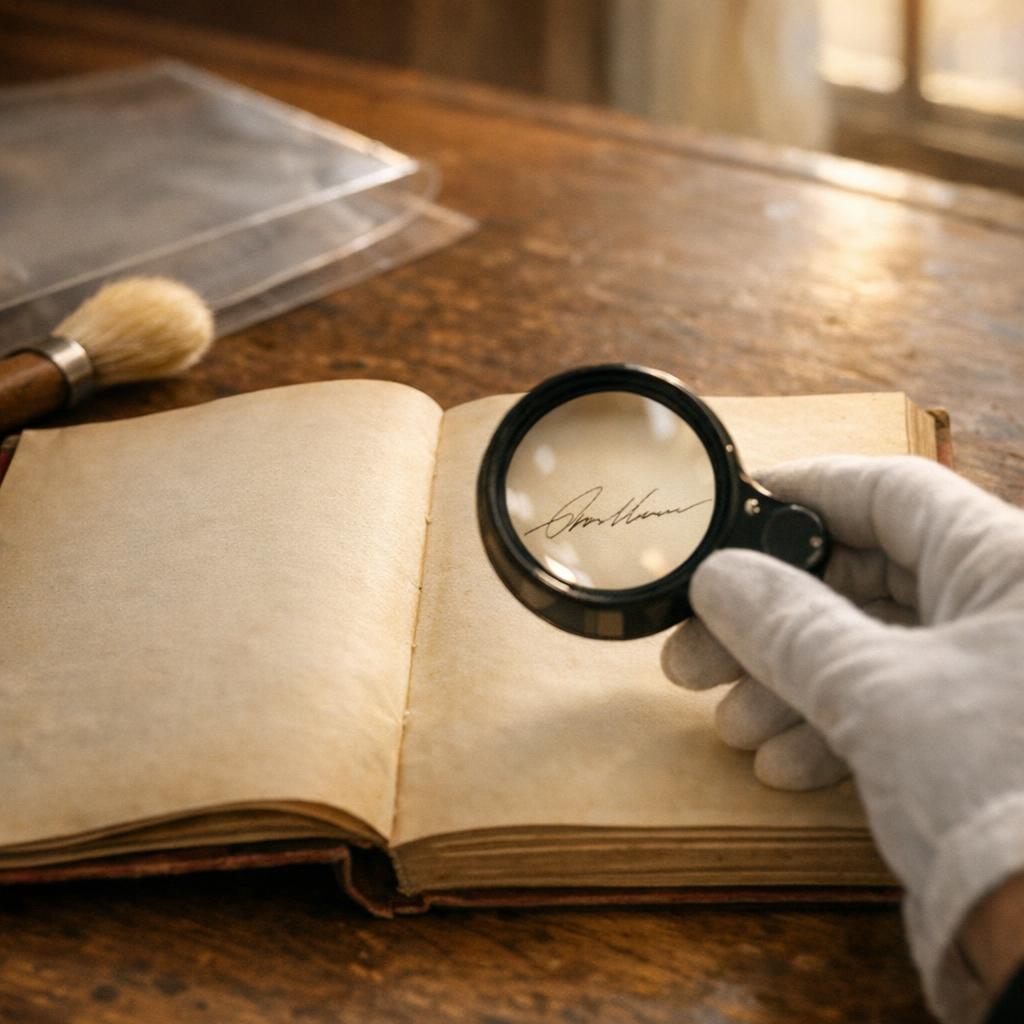
How to authenticate a signed book (safe at-home workflow)
The goal of authentication isn’t to “prove” a signature from a single clue. It’s to build a consistent evidence stack: the right edition, the right signature type, and no red flags in ink/paper/provenance.
Step 1: Photograph the right evidence (before anything else)
- Signed page (full page + 2–3 close-ups)
- Title page and copyright page (edition statement/number line)
- Dust jacket: front, spine, and inside flap with price
- Binding and spine (to show condition and “book club” tells)
Step 2: Confirm the collectible version (edition/printing + jacket state)
Authentication is harder when the book is a later printing in a first-edition jacket (or vice versa). Match the copyright page identifiers and the correct dust jacket for that printing/state when applicable.
Step 3: Inspect the ink and pressure (simple tools: loupe + raking light)
Hand-signed ink often shows tiny pressure variation and interaction with paper fibers. Use raking light to reveal indentations from pen strokes. This won’t prove authenticity on its own, but it helps support (or challenge) the signature story.
Common fakes and red flags (what to watch for)
- Autopen: signatures look smooth and uniform, with repeated identical quirks across different books.
- Secretarial signatures: signed by an assistant; may be collectible but usually priced differently.
- Facsimile/printed signatures: “signed” looks like it’s part of the printed design.
- Loose bookplates: plates can be moved between copies; provenance becomes critical.
- Mismatch story: claimed first printing, but copyright/jacket evidence doesn’t match.
What increases signed book value (the real drivers)
Once authenticity is plausible, price is mostly determined by demand + scarcity + condition. A genuine signature is the “ticket,” but the copy still has to be the one collectors want.
| Driver | What collectors look for | Why it changes value |
|---|---|---|
| Edition/printing | True first edition/first printing; correct issue points | Most “signed book” premiums attach to the earliest collectible version. |
| Signature type | Flat-signed vs inscribed vs association copy | Association and documented presentation copies can command large premiums. |
| Demand for the author/title | Enduring readership + collector market | High-demand authors support stronger comps and faster liquidity. |
| Condition | Clean pages, tight binding, minimal foxing; repairs disclosed | Condition is a multiplier: it can double or halve results in the same edition. |
| Dust jacket (modern firsts) | Present, not clipped, correct state, minimal chips/tears | For many modern firsts, the jacket carries a large share of the value. |
| Provenance | Receipts, signing event documentation, notable ownership | Provenance reduces risk and can create a premium “story” buyers pay for. |
What similar items actually sold for
To help ground this guide in real market activity, here are recent example auction comps from Appraisily’s internal database. These are educational comparables (not a guarantee of price for your specific item).
Shown USD range: USD 275-USD 6,765. Median of these 5 USD examples: USD 375.
| Image | Description | Auction house | Date | Lot | Reported price realized |
|---|---|---|---|---|---|
 |
Extremely Rare Antique 19th Century Book “Diary Of The American Revolution” by Frank Moore – 2 Volumes (Signed 1st Edition & 1st Printing) | Worthington Galleries | 2017-10-21 | 49 | USD 300 |
 |
RARE BOOK ON AMERICAN WEST, SIGNED LTD ED | Thomaston Place Auction Galleries | 2026-05-15 | 1299 | USD 950 |
 |
RARE BOOK "BIT AND SPUR MAKERS, IN THE VAQUERO TRADITION" SIGNED 1ST | Thomaston Place Auction Galleries | 2026-05-15 | 1328 | USD 275 |
![Auction comp thumbnail for Antarctic Days, Signed by Ernest Shackleton, James Murray, and George Marston [Rare Book] (London, 1913) (Bray & Co. Auctions, Lot 124)](https://assets.appraisily.com/articles/signed-book-value-how-to-authenticate-what-increases-value/auctions/auction-bray-co-auctions-124.jpg) |
Antarctic Days, Signed by Ernest Shackleton, James Murray, and George Marston [Rare Book] (London, 1913) | Bray & Co. Auctions | 2026-04-25 | 124 | USD 6,765 |
 |
Battle of Britain so few multiple signed rare book. A Folio Dedicated to All Who Fought and Won | Chaucer Auctions | 2020-09-15 | 16 | GBP 700 |
 |
Important Signed Antique Book ETCHING & ETCHERS by Philip Gilbert Hamerton 1878 - Signed By and Contains Original Drawings of Charles Jay Taylor | Worthington Galleries | 2019-01-19 | 560 | USD 375 |
Disclosure: prices are shown as reported by auction houses and are provided for appraisal context. Learn more in our editorial policy.
- Choose the right venue: dealer (fast), auction house (best for top-demand authors), or vetted marketplaces (most work).
- Protect condition: avoid cleaning/repairs; use Mylar and rigid packing for shipping.
- Document, then list: share clear edition points + signature photos, and disclose defects honestly.
- Use safer payments: prefer insured/escrowed methods for expensive signed books.
FAQ
Does an inscription increase value?
Often yes — especially if it’s dated, ties to a known person, or supports provenance. Highly personal inscriptions can reduce demand for some buyers, but they can still be valuable if the author/title is strong.
Are signed bookplates worth less than in-book signatures?
Frequently. Bookplates can be moved between copies, so buyers rely more heavily on provenance and documentation.
References & data sources
- Appraisily internal auction results database (via valuer-agent). Comps cited: Forum Auctions (UK) lot 365 (2024-09-26); Bonhams lot 200 (2023-03-29); Christie’s lot 201 (2010-11-30).
- General rare book trade practice: bibliographic confirmation (edition/printing/state), dust jacket grading, and provenance documentation standards used by dealers and auctioneers.
Search variations collectors ask
Readers often Google:
- how to tell if a signed book is real
- signed first edition value vs unsigned first edition
- does an inscription add value to a signed book
- autopen vs hand signed book how to tell
- is a signed bookplate considered signed
- where should a signature be in a signed book
- how to authenticate a signed book without a COA
- how to store signed books to keep their value
- do signed books need third-party authentication
Each question is answered in the authentication workflow and value drivers above.