
The short answer: most sets are modest, with real exceptions
Are old encyclopedias worth anything? Usually not much if they are common, late-20th-century reference sets. They are heavy, dated as research tools, and expensive to ship. But do not discard a set before checking the edition, completeness, illustrations, subject, binding, condition, and any documented ownership history.
- Promising: an early or notable edition with every called-for volume.
- Promising: strong maps, plates, engravings, or specialist subject matter.
- Promising: special bindings or credible association provenance.
- Usually modest: mass-market sets from the 1960s through the 1980s.
- Value reducer: missing volumes, mold, water damage, detached boards, or smoke odor.
- Practical constraint: local demand can matter more than national asking prices.
Start with the edition, not the age
“Old” is too broad to price an encyclopedia set. The useful facts are on the title page and copyright page: exact title, publisher, edition statement, printing date, volume count, and whether the set includes index or supplement volumes. Photograph those pages before searching.
An early edition can be collectible because it documents how knowledge was organized at a particular moment. A later mass-market set may be attractive on a shelf but still have weak buyer demand. A centennial date or a leather-look cover does not settle the question by itself.
Use the same method you would use for other old books: identify the edition first, then compare the physical copy. Our old-books value guide explains why publication details and sold records matter more than a vague age estimate.
| What you find | What it may mean | Your next check |
|---|---|---|
| Early numbered edition | Potential collector interest | Confirm all volumes and plates |
| Common 1960s–1980s set | Often decorative or nostalgic demand | Check local sold listings and pickup options |
| Specialist or illustrated encyclopedia | Demand may come from a focused subject market | Search the exact title and edition |
| Named ownership with records | Association value may exceed book value | Preserve the documentation and seek specialist review |
Count every volume before you price the set
Completeness is one of the fastest value checks. Write down the volume numbers in sequence and note missing indexes, atlases, yearbooks, or supplements. A buyer comparing two similar sets will usually favor the complete, coherent run.
Next, look at the bindings as a group. Matching original bindings are normally easier to sell than a mixed run assembled from different printings. Check for loose hinges, detached boards, crumbling leather, warped covers, foxing, water tide lines, mold, odor, annotations, and clipped maps or plates.
Condition does not have to be perfect, especially for an early set. It does need to be described honestly. A rare edition with wear can still attract a buyer; a common edition with major damage may cost more to move than it can sell for.
- Line up the spines and photograph the full run.
- Record every volume number, including index and supplement volumes.
- Photograph one title page and edition statement clearly.
- Open several volumes to confirm the same printing and binding.
- Note every missing page, plate, map, cover, or volume you can identify.
For a broader book-set framework, compare these checks with the old book value guide. The same evidence stack applies, but shipping and completeness weigh especially heavily for encyclopedias.
Read the auction results as examples, not a price list
Exact sold lots show why “encyclopedias are worthless” is too absolute—and why a spectacular result should not be used to price an ordinary World Book set. Edition, completeness, currency, auction venue, and provenance stay attached to each record.
At Gibson’s on March 3, 2024, lot 421—an antique Ninth Edition Encyclopaedia Britannica set dated circa 1882—was reported at AUD 2,000. That is evidence for that described edition and set, not a blanket value for later Britannica volumes.
At Dominic Winter Auctions on March 4, 2026, lot 97—an 18-volume Third Edition dated 1797—was reported at GBP 650. The result is a useful reminder that early date and volume count still have to meet actual buyer demand.
The Flinders-associated set in the table is the outlier. Its extraordinary result reflects documented association provenance, not simply the fact that the books are encyclopedias. If your set has a meaningful ownership history, keep every letter, bookplate record, receipt, and family document with it.
What similar items actually sold for
To help ground this guide in real market activity, here are recent example auction comps from Appraisily’s internal database. These matched sales are market context only, not an object estimate or identification, and they do not guarantee a price for your specific encyclopedia set.
Shown GBP range: GBP 320-GBP 343,750. Median of these 3 GBP examples: GBP 650.
| Comparable | What sold | Auction house | Date | Lot | Reported price realized |
|---|---|---|---|---|---|
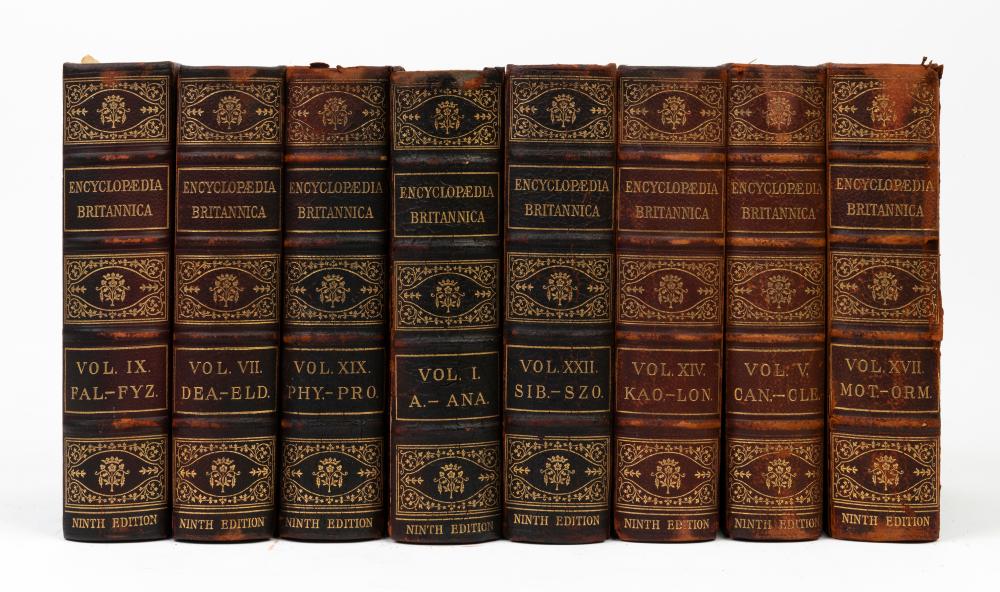 |
A set of antique Encyclopaedia Britannica: a Dictionary of Arts, Sciences, and General Literature, Ninth Edition, circa 1882 | Gibson's | 2024-03-03 | 421 | AUD 2,000 (price basis unavailable) |
| No auction photo supplied | Encyclopaedia Britannica | Lyon & Turnbull | 2026-06-16 | 139 | GBP 320 (price basis unavailable) |
| No auction photo supplied | Encyclopaedia Britannica. Or, A Dictionary of Arts, Sciences, 18 vols., 3rd ed., 1797 | Dominic Winter Auctions | 2026-03-04 | 97 | GBP 650 (price basis unavailable) |
| No auction photo supplied | [FLINDERS, Matthew (1774-1814)] Encyclopaedia Britannica; or, a dictionary | Christie's | 2021-12-15 | 102 | GBP 343,750 (price basis unavailable) |
How these auction records were verified
Each row retains its exact source URL, lot identity, retrieval time, collection-time access result, and immutable record hash. If an auction page is unavailable or challenge-protected, the retained evidence identity can still be inspected in the public comparable provenance record.
Disclosure: prices are shown as reported by auction houses and are provided for appraisal context. Learn more in our editorial policy.
Free instant estimate
Not sure if your encyclopedia set is worth selling? Let us take a look.
Upload photos, share the exact edition and volume count, and get a free first read. If it is worth a full appraisal, we will say so.
Free. No card needed. Takes about two minutes.
Decide whether the set is worth selling
The practical question is not only “What could it sell for?” It is also “Can I reach the right buyer without spending more on packing, shipping, and time than the set is likely to return?” A 24-volume set can become several heavy boxes. Local pickup often makes more sense for common editions.
| If your set looks like this | Best first move | Why |
|---|---|---|
| Early, complete, or unusually illustrated | Research exact sold lots or consult a book specialist | Edition-specific collector demand may justify the work |
| Common later set in clean matching bindings | Offer locally with clear dimensions and volume count | Decorative and nostalgic buyers avoid freight |
| Incomplete but with attractive plates or maps | Describe honestly; ask before breaking the set | Individual parts may interest buyers, but dismantling can erase set value |
| Moldy, wet, or badly deteriorated | Protect other books and ask a local disposal program | Health and contamination concerns outweigh likely resale value |
Do not price from active listings alone. Sellers can ask any amount. Look for sold records with the same edition, similar completeness, comparable binding, and a clear condition description. Keep currencies separate rather than mentally blending GBP, AUD, and USD.
Photograph the set so a buyer can judge it
Good photographs reduce uncertainty. Start with the full spine run, then show the title page, edition statement, volume sequence, top and bottom page edges, one typical interior spread, notable maps or plates, and the worst damage. Add a ruler or dimensions in the description rather than placing private paperwork in the frame.
For the free first read, photograph your encyclopedia set in daylight and keep every volume visible. Avoid filters. If the books are too heavy to move safely, photograph them on the shelf in overlapping groups and list the volume numbers separately.
- Full matching spine run
- Exact title and edition page
- First and last volume numbers
- Index, atlas, and supplements
- Representative maps or plates
- Binding corners and hinges
- Worst stain, tear, or loss
- Any provenance documents separately
Know which encyclopedia sets buyers notice
Buyer interest tends to gather around a reason. Early Britannica editions can matter as publishing history. Illustrated natural-history, art, technology, or regional sets can attract subject collectors. Fine bindings can appeal to library and decorative buyers. A complete World Book set may find a nostalgic local buyer even when it is not rare.
Provenance can transform the category, but it must be credible. A name written inside a cover is only a lead. The useful evidence is a documented connection that can be followed through records. Preserve the books and the paperwork together until a specialist has reviewed them.
If you are sorting more than encyclopedias, the Books, Paper, and Ephemera guides can help separate ordinary household books from items that deserve more research.
Frequently asked questions
Are 50-year-old encyclopedias worth anything?
Most encyclopedia sets from the 1960s through the 1980s have limited resale demand. A complete matching set in excellent condition may find a decorative or nostalgic buyer, but age alone does not create collector value.
Which encyclopedias are worth money?
The strongest candidates are early editions, complete sets with important illustrations or maps, special bindings, scarce specialist encyclopedias, and copies with documented association or ownership history.
Does anybody buy old encyclopedias?
Yes, but the buyer pool is selective. Rare-book collectors pursue particular editions, decorators may want visually coherent sets, and local buyers sometimes want World Book or Britannica sets for nostalgia or home libraries.
What should I do with a 30-year-old encyclopedia set?
Check completeness, edition, binding, and condition first. If there is no meaningful resale demand, offer the set locally, ask schools or theater groups, donate where accepted, or repurpose it rather than paying to ship it.
How much are old encyclopedias worth?
There is no dependable price based on age alone. Common later sets may have little resale value, while early or provenance-rich editions can sell for far more. Exact edition, completeness, condition, and buyer demand determine the useful comparison.
Search variations this guide answers
- Are old World Book encyclopedias worth anything?
- What is a 1970 World Book Encyclopedia set worth?
- Does anyone buy complete encyclopedia sets?
- Where can I sell old encyclopedias locally?
- Which editions of Encyclopaedia Britannica are collectible?
- Does a missing volume ruin an encyclopedia set’s value?
- Are leather-bound encyclopedias worth more?
- What should I do with encyclopedias nobody wants?
Use the edition, completeness, condition, and buyer-demand checks above before choosing a price or disposal option.
Need a local book specialist?
For a rare early edition, significant provenance, or a set that cannot be judged from photographs, compare qualified options in the antique appraiser directory.
Sources and method
The auction table uses exact lot records retained by Appraisily’s comparable-evidence pipeline. Prices remain in the auction record’s reported currency and are examples, not predictions. Search questions were informed by Appraisily Search Console and best-effort SERP evidence collected for this run.
Written by Appraisily Editorial Team. Reviewed by Appraisily Editorial Team. Auction evidence was checked for lot identity, date, house, currency, amount, retrieval record, and retained provenance before publication.