Direct answer first
Short answer: most old encyclopedia sets are modest in value, with exceptions
Free. No card needed. Photo upload takes about two minutes.
Need a signed keep-file? online antique appraisal services is the $59 report. Instant stays unsigned.
Most modern encyclopedia sets from the 1960s onward have low resale value unless they are complete, unusually complete in condition, and sold into a decorative or design-focused market. Truly stronger examples are earlier editions, museum-grade bindings, and rare subject sets that can still find collectors or institutions.
A World Book set sits with those ordinary sets, the same way a late Britannica does.
Before deciding what to do, check volume count and completeness first. One missing book can often reduce value by far more than condition issues alone, because buyers and dealers value immediate usability and completeness.
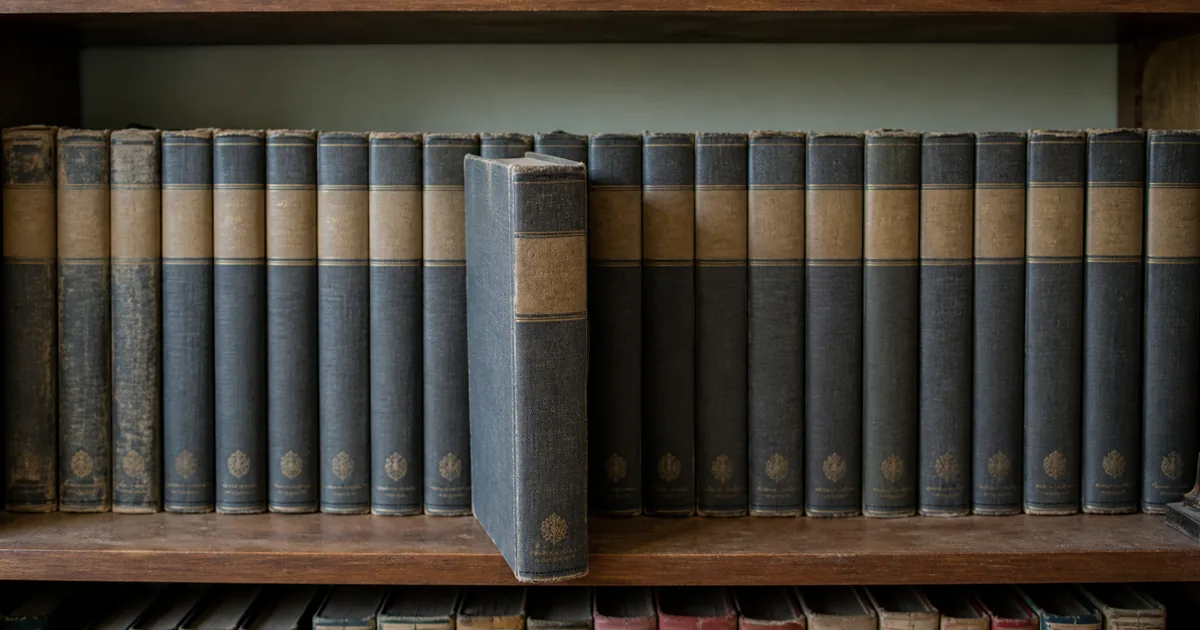
Page-specific auction evidence is shown only when exact, source-linked sale records pass the current provenance contract. Otherwise this guide displays an explicit no-evidence state. See Editorial policy.
What this guide covers
What actually drives value in old encyclopedias
Most value is set by four broad factors: completeness, condition, demand channel, and evidence.
- Completeness: full sets are significantly more desirable than partial runs, especially if original indexes, supplements, yearbooks, or companion material remain.
- Edition and publication context: major sets tied to major eras or institutions can hold better long-term value than generic modern sets.
- Condition and handling: warping, missing pages, water marks, and loose bindings are major drag factors.
- Demand channel: resale through a general used-book market is different from private collectors or institutional buyers.

Practical value ranges (guidance only)
Use this grid as an orientation point, not a guarantee. Each item must be evaluated on records, completeness, and condition.
| Set profile | Typical market context | Common buyer behavior |
|---|---|---|
| Mid-century mass-market world-book style sets | Most common profiles move slowly and often trade in the lower-value range. | Often sold locally, in lot form, or as décor-first listing. |
| Complete, early or rare reference runs with clean bindings | Can attract higher interest in niche collector channels. | Price sensitivity is driven by condition and completeness. |
| Illustrated or subject-specialty sets with provenance | Sometimes attract stronger curiosity if condition supports it. | Potentially slower but less crowded sale path. |
| Partial or mixed-era sets with missing volumes | Typically lower liquidity unless part of a broader thematic lot. | Best suited for quick local sales, donation, or repurposing. |
What to check before you decide
- Count all volumes and identify exactly which publications are missing.
- Photograph bindings, spine labels, and publisher marks.
- Inspect for mildew, water staining, binding tears, and loose or loose pages.
- List whether any volumes were repaired, rebound, or re-shelved with mixed sets.
- Confirm whether there are original inserts, maps, supplements, or updates.
- Estimate whether local pickup/delivery is realistic for a local buyer and size of lot.
That last point is practical: for heavy or bulky items, local sale can improve net outcome by reducing shipping cost and risk.
If most of your volumes are present and condition is strong, your set usually performs best when framed as a complete reference collection rather than a “miscellaneous books” lot.
How people usually sell old encyclopedias
- Estate sale route: clear for mixed lots and families with multiple household library items.
- Collector-focused route: strongest for documented, complete, and clean sets with evidence of provenance or special subject focus.
- Online listing route: works best with excellent photos, complete inventory details, and transparent condition notes.
- Alternative use: complete sets with limited resale demand can still retain aesthetic value in display contexts.
For many general readers, a free estimate first is the safest route to avoid overpricing or underpricing from incomplete facts.
Identification and documentation checklist
Use this short internal memo as you prepare photos:
- Publisher and imprint information from front and back matter.
- Publication year range shown on spine or title page.
- Volume list with a short missing-item count.
- Condition notes by severity: good / fair / poor.
- Any original ownership notes, library stamps, or provenance marks.
The clearer this record is, the easier it is to move from “storybook estimate” to reliable direction.
What should be your next move?
If you want a quick answer path, start with the free screener and then decide between local listing, donation, or specialist review.
If your set is complete and in good condition, specialist review can help define how to present it for stronger market positioning.
Upload photos for a free first lookWhat similar encyclopedia sets actually sold for
We did not find a verified, page-specific auction-comps set for this old encyclopedia set that met the current exact-match and source-provenance standard.
That absence is evidence, not a zero-value conclusion. Asking prices, broad category ranges, and sales for materially different objects are not substitutes for matched realized sales. Use the identification and condition guidance in this article, then narrow a future search with exact marks, model or variant, dimensions, materials, condition, completeness, and provenance.
Frequently asked questions
Are old encyclopedias usually worth anything?
Most common post-1920s sets have limited practical resale value in standard channels. Still, complete sets and stronger historical profiles can outperform general assumptions when properly documented and sold in suitable channels.
How much can a complete Britannica set be worth?
Values vary by era, condition, and completeness. Older or rarer reference runs can show a wider range than modern mainstream sets, so broad “flat” estimates are usually misleading.
What does a missing volume do to value?
Missing any core component usually reduces buyer confidence and often lowers practical resale quickly. In many cases, one or two missing books can change a lot from collectible to decorative or practical category.
Should I sell online or local?
Large, heavy sets are often best handled locally unless buyers are comfortable with freight handling and insurance. If shipping is expensive, local options frequently preserve more net proceeds.
What evidence should I provide to get a better review?
Start with a clean checklist: inventory photo set, missing-volumes list, binding and page-condition close-ups, and any provenance or labels.
Free first look
Not sure whether this old encyclopedia set needs an appraisal?
Photograph the whole item, maker or identifying marks, dimensions, materials, condition, repairs, and any provenance or documentation. The photo-based Screener can help identify the likely category and visible evidence gaps before you pay for documentation.
Upload photos for a free first lookFree. No card needed. The photo upload usually takes about two minutes.
The free first read is a separate photo-based Screener, not this educational article. Results usually appear within a few minutes; complex items can take longer. From photographs of your old encyclopedia set, it returns a preliminary category or identity read, visible evidence gaps, rough comparable market signals, and whether a human appraisal looks worthwhile; it is not a signed value conclusion. Material or construction can remain uncertain without direct examination, dimensions, provenance, or complete condition details. A written appraisal is useful when your old encyclopedia set needs documented specialist support for insurance, tax, an estate, authentication, litigation, or a consequential sale, but you may not need one.
A set that needs a keep-file belongs on online antique appraisal services. Instant is not the signed PDF.
Search variations people ask
- Are incomplete encyclopedias worth anything in 2026?
- How do missing encyclopedia volumes affect resale value?
- What is a complete encyclopedia set worth nowadays?
- Which old Britannica sets are most sought after by buyers?
- Is leather-binding a strong signal for encyclopedia value?
- How to document an encyclopedia lot for fair valuation
- Do illustration-heavy encyclopedias sell better than text-only sets?
- Free estimate for old encyclopedias before I ship anything?
References and related guidance
Take the next practical step
Use the free instant estimate if you want a quick, practical read before deciding a final sales or appraisal strategy.
Upload photos for a free first lookQuick next move
Unsure whether your set is valuable enough to list?
Get a free first read. No card needed.
Upload photos for a free first look View signed report sample