
Art Print Charles Russell Carsons Men: appraisal and value basics
Art Print Charles Russell Carsons Men research should start with identification, condition, provenance, and item-specific market evidence. Use this guide to compare the signals that matter before paying for a formal appraisal or deciding whether to sell.
Art Print Charles Russell Carsons Men
For collectors of Western art and antiques, few names resonate like Charles M. Russell. Among his most reprinted images is “Carson’s Men,” a dynamic scene evoking the era of scouts and mountain men on the Western frontier. If you own—or are considering buying—an art print of “Carson’s Men,” this guide will help you identify what you have, assess condition and originality, and understand market value.
What is “Carson’s Men”? Subject and origin
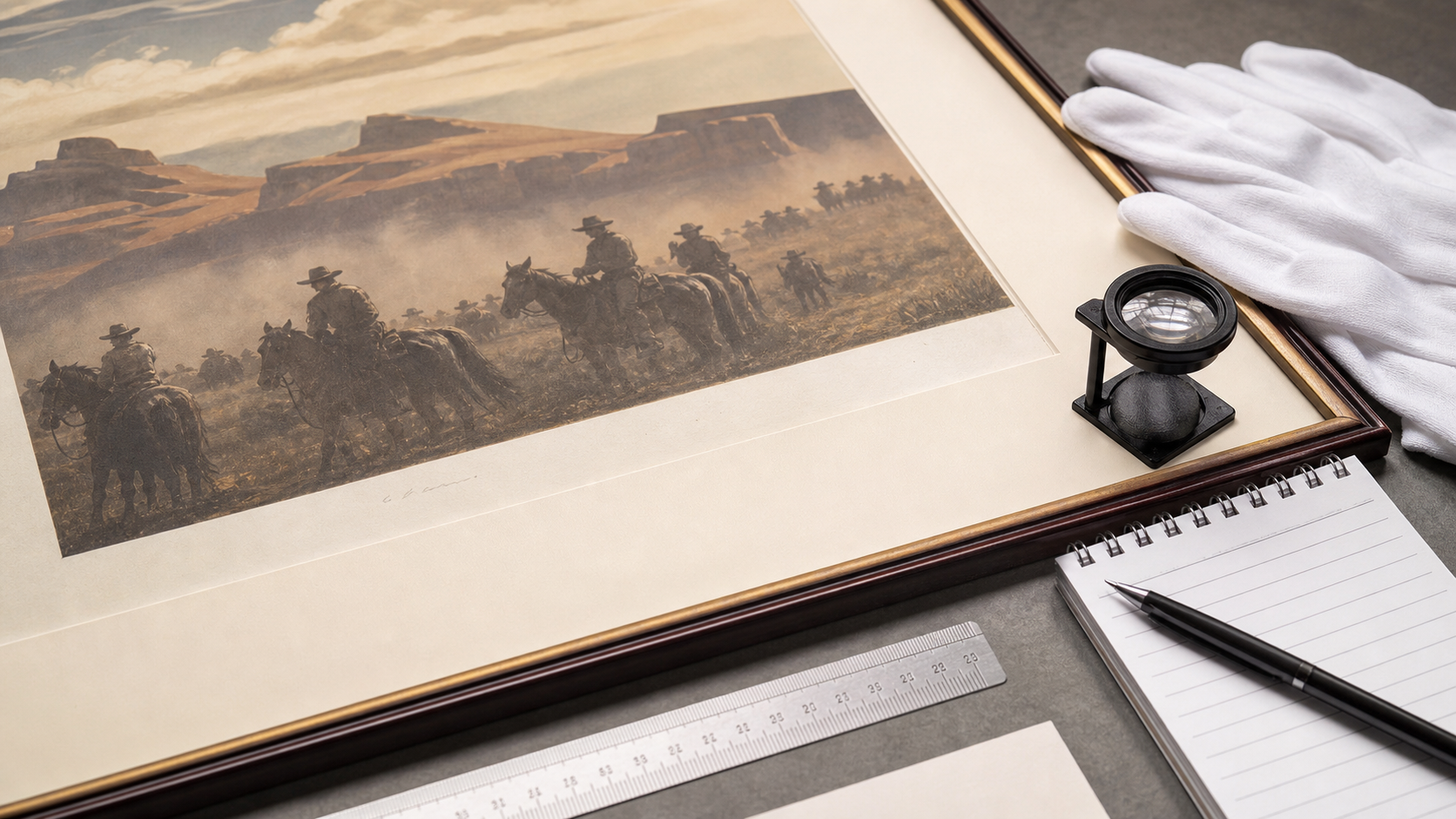
Charles Marion Russell (1864–1926) built his legacy painting the people, wildlife, and stories of the American West. “Carson’s Men” depicts a mounted party associated with the legendary frontiersman Kit Carson. Russell’s composition emphasizes movement, atmosphere, and the hard-won competence of men traversing rugged country. The original work is an oil painting from the 1910s, and like many of Russell’s most recognizable images, it was reproduced widely in the 20th century.
Understanding that the original is a museum-held oil is crucial for appraisal: what most collectors encounter is a reproduction print, not an original painting or artist-made print. Reproduction prints vary dramatically in quality, date, and value depending on printing method, publisher, and condition.
One hallmark of Russell’s work you will see within the image is his distinctive CMR buffalo skull monogram. Note that this monogram is part of the printed image in reproductions; it should never be taken as proof of a hand-signed print.
Common “Carson’s Men” print types you will encounter
Because “Carson’s Men” was produced and reprinted over decades, you’re likely to encounter several categories of prints. Knowing the differences helps you date and value your example.
Photogravure or collotype (early to mid-20th century)
- High-quality tonal process often used for art reproductions before WWII.
- Deep, rich blacks, smooth tonal gradations, and sometimes a subtle plate mark from the printing plate.
- Paper may be thicker, with a slight sheen. Caption and credit lines can appear in small serif type under the image.
Chromolithograph (late 19th to early 20th century; less common for this subject but possible)
- Multi-stone lithography with visible color layering.
- Colors may appear slightly grainy or stippled under magnification, but not in a uniform dot pattern like offset printing.
Calendar prints and commercial offset lithographs (1930s–1970s)
- Very common for Russell’s work, including “Carson’s Men.”
- Often issued by large firms (for example, calendar houses in St. Paul and elsewhere) and distributed in large numbers.
- Halftone dot pattern visible with a loupe; paper often thinner. You may see a printer’s credit or “Printed in U.S.A.” on the sheet or the calendar backing if it hasn’t been trimmed.
Poster and museum-shop reproductions (1970s–present)
- Open-edition offset prints marketed through museums and galleries.
- May carry a museum logo, exhibition title, or modern publisher credit in the lower margin.
Limited edition modern prints and giclées (late 20th century–present)
- Numbered editions (e.g., 123/950) sometimes issued by publishers or museums authorized by the Russell estate or holding museum.
- Typically signed in pencil by a representative (e.g., publisher, not the artist) or bear a blind stamp. Value is generally modest compared to early fine gravures, but higher than open-edition posters.
Hand-signed period prints by Charles M. Russell (rare)
- On occasion, period gravures or presentation prints were signed in pencil by Russell. These are scarce and carry a significant premium.
- A printed signature within the image area is not a hand signature.
How to identify your edition: step-by-step
Assessing “what you have” begins with a disciplined look at the object itself. Use a loupe (10x is ideal), good lighting, and clean hands or gloves.
- Look at the image surface under magnification
- Uniform rosette or dot pattern: offset lithograph (most common for mid-century calendars and posters).
- Smooth continuous tones, velvety blacks, no rosette: photogravure/collotype.
- Layered, slightly irregular color textures without rosettes: chromolithograph.
- Inspect the margins
- Title and credit lines: Many reproductions print “Carson’s Men” and a credit to Charles M. Russell below the image. Early gravures may include a publisher or printer line in small type.
- Blind stamps or embossed seals: Indicate a publisher, museum, or commemorative edition.
- Mat burn: A brown line surrounding the image from old acidic mats; impacts value.
- Trimming: If the margins are cut to the image edge, value typically drops, and identifying marks may have been removed.
- Check the paper
- Early gravures/collotypes: heavier, often with a slight platter texture; off-white due to age.
- Calendar stock: medium-weight, sometimes coated; may show remnants of adhesive or calendar back.
- Modern giclée: bright white, inkjet dot pattern (irregular microscopic speckle rather than rosette), often on matte cotton paper.
- Look for publishers’ marks
- Some mid-century prints carry printer credits in the lower margin or verso. Noting the exact wording helps date and classify the print.
- Calendar houses frequently included a small identification line that collectors overlook.
- Evaluate the signature
- Printed signature in the image: part of the reproduction, not a hand signature.
- Pencil signature below the image: Examine carefully. Genuine period signatures are rare and command a premium. Watch for mechanically reproduced “pencil lines” or signatures printed to mimic graphite.
- Measure sheet and image size
- Record both image and full sheet dimensions. Certain publishers used standard sheet sizes; size can help match known editions and confirm whether the print has been trimmed.
- Consider provenance
- Sales receipts, old framer labels, exhibition stickers, or estate paperwork can provide dates and context that support valuation.
Condition, conservation, and value impact
Condition accounts for a large share of a print’s market value. Two examples of the same edition can vary drastically in price.
Light damage and fading
- Long exposure to UV light can fade colors and flatten contrast, especially in offset lithographs and modern giclées. Compare protected margin areas to the exposed image for a telltale “tan line” shift.
Foxing and staining
- Rust-colored spots indicate foxing; overall yellowing (toning) is common with acidic mats. Professional deacidification and washing can sometimes improve appearance, but weigh cost vs. value.
Mat burn and adhesive residue
- Brown lines from old mats and glue stains from calendar mounts are common. These can be stabilized by a paper conservator.
Tears, creases, abrasions
- Even small edge tears reduce value. Folds through the image are serious; professional mending is possible but affects collectibility.
Trimming
- Loss of margins lowers value and may remove edition, publisher, or title information.
Conservation best practices:
- Reframe with acid-free, lignin-free mat and backing.
- Use UV-filtering glazing (acrylic or glass).
- Hinge mounts with Japanese paper and wheat paste rather than tapes.
- Avoid direct sunlight and damp areas.
Market values and comparables (what to expect)
Values for “Carson’s Men” prints cluster by type, age, and condition. Exact pricing fluctuates regionally and over time, but the following ranges are realistic benchmarks:
- Common mid-century offset lithographs and calendar prints (framed, good condition): typically a value that must be established from current, topic-matched sales.
- Early photogravure/collotype impressions (untrimmed margins, clean condition): a value that must be established from current, topic-matched sales with higher results for scarce publishers or exceptional states.
- Modern limited editions (numbered, with blind stamp; not hand-signed by Russell): a value that must be established from current, topic-matched sales depending on edition size and quality.
- Hand-signed period prints by Charles M. Russell: uncommon; a clean, documented example can bring a value that must be established from current, topic-matched sales+ depending on provenance and desirability.
- Exhibition posters and contemporary open-edition reproductions: a value that must be established from current, topic-matched sales.
Note: The original oil painting is a museum-quality work, far beyond the scope of a typical print market—think in the seven-figure range for comparable Russell oils, and not available except through institutional holdings or rare top-tier sales.
Factors that push value higher:
- Early printing method (photogravure or collotype).
- Untrimmed, wide margins with intact title and publisher lines.
- Clean paper with minimal foxing, toning, or burn.
- Scarcer publisher or documented provenance.
- Hand-signed by Russell (rare; document carefully).
Factors that depress value:
- Heavy fading, mat burn, foxing, or water damage.
- Trimming to the image with loss of margins.
- Later open-edition poster-quality prints.
- Non-archival mounting or adhesives that cannot be reversed easily.
Buying and selling tips for collectors
Buy the object, not the story
- Rely on physical evidence—paper, printing method, margins, and marks—rather than seller claims. Photographs of the margins and back are key.
Compare with known production traits
- Many Russell images circulated as calendar prints; look for telltale dot patterns and commercial paper. A loupe quickly separates offset products from gravures.
Mind the frame
- An old frame is not proof of age or quality. Conversely, a modern archival frame can add practical value by protecting the print.
Ask for measurements and close-ups
- Request image and sheet size, plus macro photos of the signature area, lower margin text, and any blind stamps.
Budget for conservation
- If a piece has mat burn or minor foxing, factor professional treatment into your total cost. A small investment can yield significant visual improvement.
Keep paperwork
- Retain invoices, old labels, or correspondence. Provenance adds confidence at resale.
Sell in the right venue
- Regional auction houses that specialize in Western art and antiques reach more target buyers than generalist platforms. For common posters, a local marketplace may suffice; for early gravures or signed pieces, consider specialists.
The historical and aesthetic context matters
Part of the appeal of “Carson’s Men” is its role in shaping the popular image of the Western frontier. Russell painted from lived experience in Montana and from stories gathered over decades. While “Carson’s Men” celebrates skill and grit, modern collectors should also recognize the complex histories behind such images—Indigenous presence, environmental change, and myth-making. This context doesn’t alter print value directly, but it deepens appreciation and can inform curatorial choices about how you present the work in your home or collection.
Practical checklist: “Carson’s Men” art print triage
- Identify the print process: dot pattern (offset) vs. continuous tone (gravure/collotype).
- Inspect margins: intact title/publisher lines? Blind stamps? Any trimming?
- Check for condition issues: foxing, mat burn, fading, tears, creases.
- Verify the “signature”: printed vs. genuine pencil. Be skeptical; document carefully.
- Record measurements: image and sheet sizes; note framing materials.
- Note publisher marks or labels: front margin or verso.
- Assess conservation needs and costs before purchase or sale.
- Gather provenance: receipts, framer labels, prior appraisals.
- Compare recent sales of the same print type and condition.
- Choose the right selling venue or insurer once value is established.
FAQ
Q: I see the CMR buffalo skull—does that mean my print is autographed? A: No. The CMR skull is Russell’s painted monogram and appears in the image of nearly all reproductions. A true autograph would be a pencil signature in the margin, separate from the image, and is rare.
Q: How can I tell if my print is an early photogravure? A: Use a loupe. Photogravures show continuous tones without a halftone rosette. Blacks look rich and velvety, and there may be a subtle plate impression around the image. Paper tends to be heavier and slightly off-white with age.
Q: Are calendar prints of “Carson’s Men” collectible? A: Yes, but they’re common. Clean, untrimmed examples with clear credit lines and minimal fading are more desirable. Expect modest values compared to early gravures or scarce editions.
Q: My print is numbered (e.g., 317/950). Does that make it valuable? A: Numbering indicates a limited edition, usually from a later publisher. These can be quality reproductions, but they generally carry mid-range value unless tied to a sought-after publisher, superb printing, or an additional feature like a blind stamp.
Q: Should I reframe my print? A: If it’s in acidic mats or regular glass, yes. Use acid-free materials and UV-filtering glazing to prevent further damage and help maintain value.
By focusing on printing method, margins, condition, and documentation, you can confidently identify and appraise a “Carson’s Men” print by Charles M. Russell—and buy or sell with fewer surprises.


