Polish 20th-Century Souvenir Spoon Guide

Identify and value a 20th-century Polish souvenir spoon by marks, metal, enamel, iconography, condition, maker, provenance, and comps.

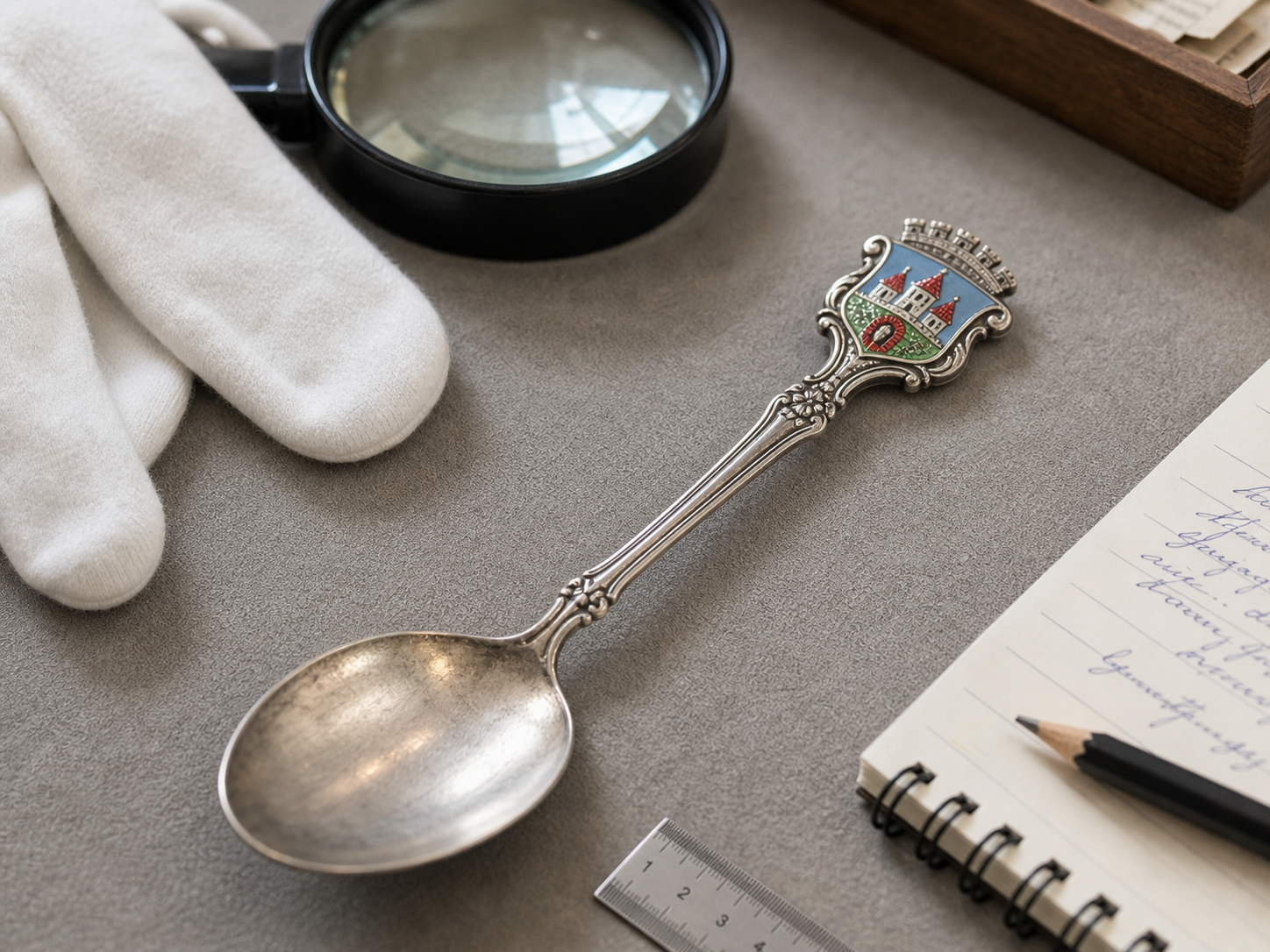
Polish 20th-century souvenir spoon arranged for appraisal review
Editorial reference image for a Polish 20th-century souvenir spoon appraisal; inspect marks, metal, enamel, iconography, condition, maker, provenance, and comparable sales.

Turn this research into action

Get a price-ready appraisal for your item

Answer three quick questions and we route you to the right specialist. Delivery timing is confirmed after the required item information is received.

Secure Stripe checkout · Full refund if we can’t help

Skip questions — start appraisal now

How We Research Valuation Data

Our appraisal guides are based on auction results, dealer pricing data, and professional appraiser insights. We may earn a commission when you use our free professional appraisal service. Learn about our editorial standards.

Get a Professional Appraisal

Unsure about your item’s value? Our certified experts provide fast, written appraisals you can trust.

  • Expert report with photos and comps
  • Fast turnaround
  • Fixed, upfront pricing
Start Your Appraisal

No obligation. Secure upload.

Note: We couldn’t find enough auction records that directly match Polish 20th-Century Souvenir Spoon Guide to publish a defensible price table. If you are valuing a specific item, include its maker, model, material, photos, and condition so the search can be narrowed.

What similar items actually sold for

To help ground this guide in real market activity, here are recent example auction comps from Appraisily’s internal database. These matched sales are market context only, not an object estimate or identification, and they do not guarantee a price for your specific a polish origin circa 20th century souvenir spoon.

Shown GBP range: GBP 270-GBP 442. Median of these 3 GBP examples: GBP 412.
Source-reported amounts. Buyer’s-premium treatment is stated in each row when known; otherwise it is unknown. Native currencies are not normalized.
Comparable What sold Auction house Date Lot Source-reported amount
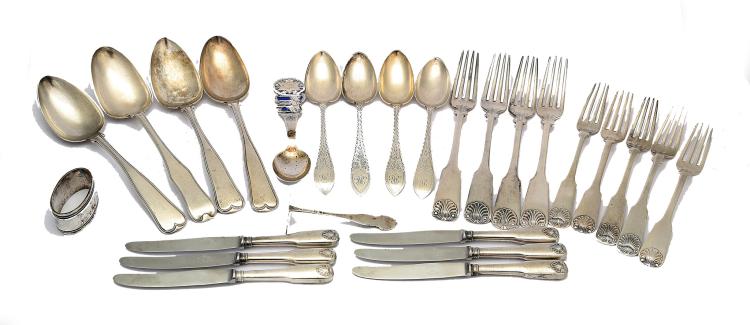
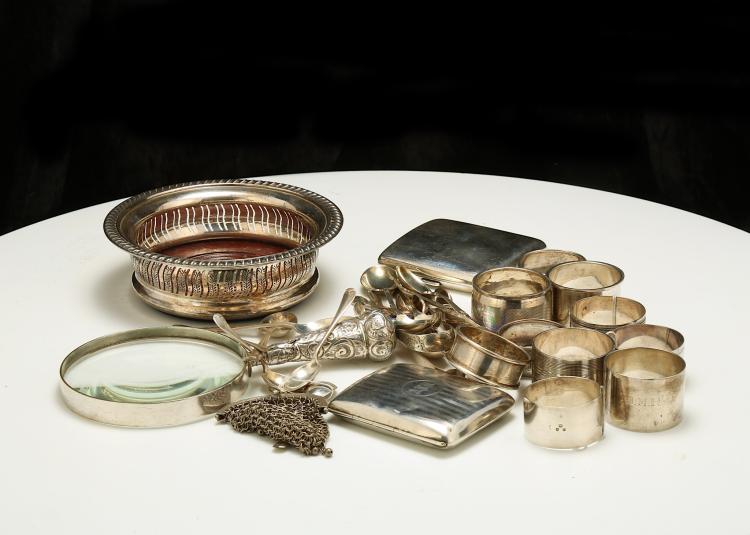
A mixed group of antique sterling silver items, including a cased pair of George V sauceboats, Sheffield 1936, by E Viners With loop handle and shaped rim,  length 14.5 cm/5.7 inches, a Elizabeth II wine coaster, Birmingham 1993, by Barker Ellis Silver Co, with pierced band, slant gadroon rim and turned wood base, diameter 14.5 cm/5.7 inches, an Edwardien silver-handled magnifier, London 1902, a continental cigarette case, with import marks for London 1897, another cigarette case, Birmingham 1918, a set of six coffee spoons, Sheffield 1964, by E Viners, three coffee spoons Sheffield 1925, three paris of sugar tongs, ten late 19th/early 20th century napkin rings, two souvenir spoons, a condiment spoon, a bright-engraved dessert forks and a small purse. (Qty) Weight of weighable silver – 946 grams/30.4 ozt £200-300 sold by Chiswick Auctions, lot 89 — auction record photograph A mixed group of antique sterling silver items, including a cased pair of George V sauceboats, Sheffield 1936, by E Viners With loop handle and shaped rim,  length 14.5 cm/5.7 inches, a Elizabeth II wine coaster, Birmingham 1993, by Barker Ellis Silver Co, with pierced band, slant gadroon rim and turned wood base, diameter 14.5 cm/5.7 inches, an Edwardien silver-handled magnifier, London 1902, a continental cigarette case, with import marks for London 1897, another cigarette case, Birmingham 1918, a set of six coffee spoons, Sheffield 1964, by E Viners, three coffee spoons Sheffield 1925, three paris of sugar tongs, ten late 19th/early 20th century napkin rings, two souvenir spoons, a condiment spoon, a bright-engraved dessert forks and a small purse. (Qty) Weight of weighable silver – 946 grams/30.4 ozt £200-300 Chiswick Auctions 2017-10-31 89 GBP 442 (buyer’s-premium treatment unknown)
A mixed group of Danish silver, including a part canteen of fiddle and shell flatware, Copenhaguen the dessert spoons 1923, the table forks 1925, the cake knives 1939, assay master Christian F.Heisse (1904-32) and Johannes Siegaard 1932-1960 Comprising: five table forks, six dessert forks and six cake knives, engraved with initials, five bright-engraved dessert spoons, Copenhagen 1907-13, assay master Christian F.Heisse, stamped R Jensen, engraved with initials, an acorn pattern fork, stamped Georg Jensen, circa 1950, four fiddle and thread pattern table spoons, Copenhagen 1948, a souvenir spoon, Copenhagen 1949, two table spoons, a napkin ring and a food pusher. (Qty) Weight excluding knives– 1212 grams/38.9 ozt sold by Chiswick Auctions, lot 175 — auction record photograph A mixed group of Danish silver, including a part canteen of fiddle and shell flatware, Copenhaguen the dessert spoons 1923, the table forks 1925, the cake knives 1939, assay master Christian F.Heisse (1904-32) and Johannes Siegaard 1932-1960 Comprising: five table forks, six dessert forks and six cake knives, engraved with initials, five bright-engraved dessert spoons, Copenhagen 1907-13, assay master Christian F.Heisse, stamped R Jensen, engraved with initials, an acorn pattern fork, stamped Georg Jensen, circa 1950, four fiddle and thread pattern table spoons, Copenhagen 1948, a souvenir spoon, Copenhagen 1949, two table spoons, a napkin ring and a food pusher. (Qty) Weight excluding knives– 1212 grams/38.9 ozt Chiswick Auctions 2018-02-20 175 GBP 412 (buyer’s-premium treatment unknown)
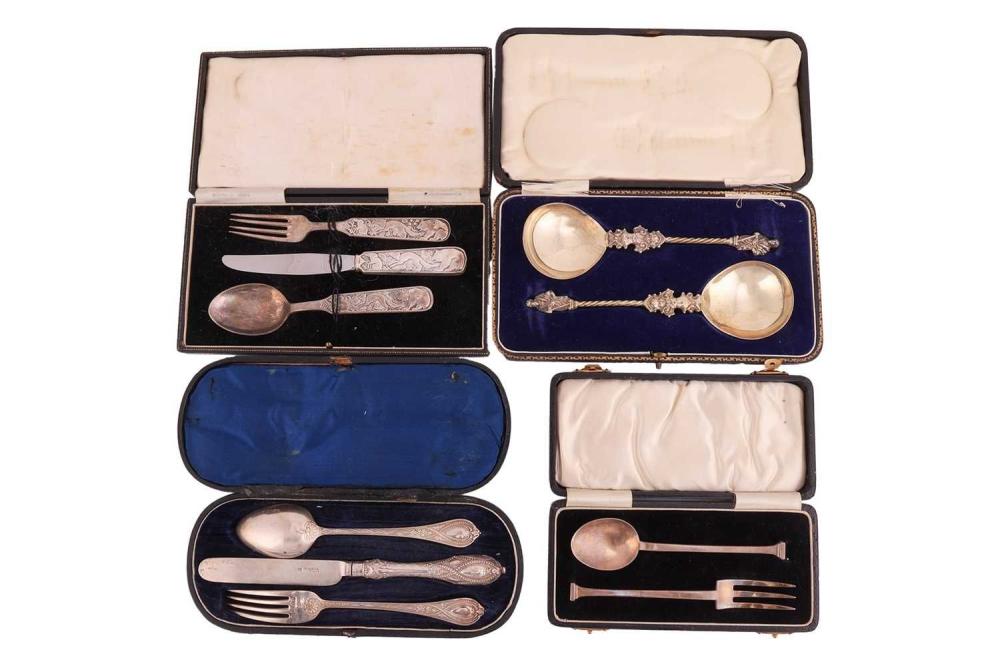
A David Anderson of Norway white metal three-piece Christening set of knife, fork and spoon cast with fox, bear and rabbit, a pair of early 20th century cast silver appostle (St.James) spoons, a cased "Doric" fork and spoon set, and a Victorian... sold by Dawsons Auctioneers, lot 399 — auction record photograph A David Anderson of Norway white metal three-piece Christening set of knife, fork and spoon cast with fox, bear and rabbit, a pair of early 20th century cast silver appostle (St.James) spoons, a cased "Doric" fork and spoon set, and a Victorian... Dawsons Auctioneers 2025-12-17 399 GBP 270 (buyer’s-premium treatment unknown)
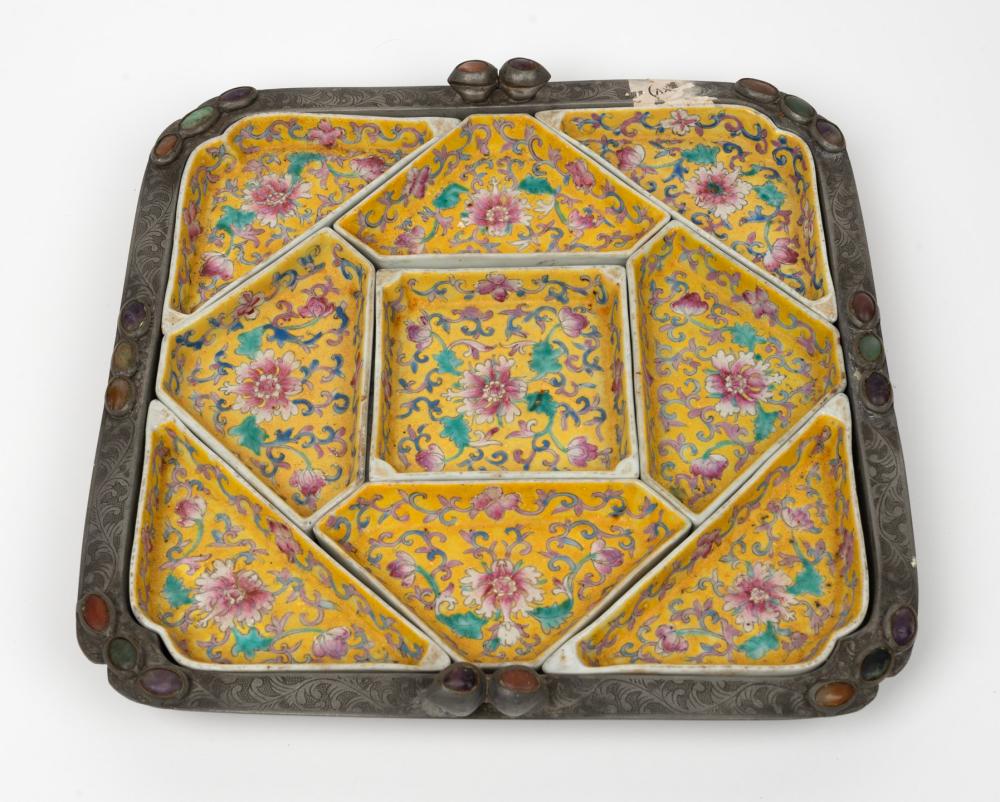
An antique Chinese porcelain savoury dish set with yellow ground in original pewter and polished stones surround, Qing Dynasty, 19th/20th century, 29cm wide. sold by Leski Auctions Pty Ltd, lot 301 — auction record photograph An antique Chinese porcelain savoury dish set with yellow ground in original pewter and polished stones surround, Qing Dynasty, 19th/20th century, 29cm wide. Leski Auctions Pty Ltd 2025-10-11 301 AUD 600 (buyer’s-premium treatment unknown)
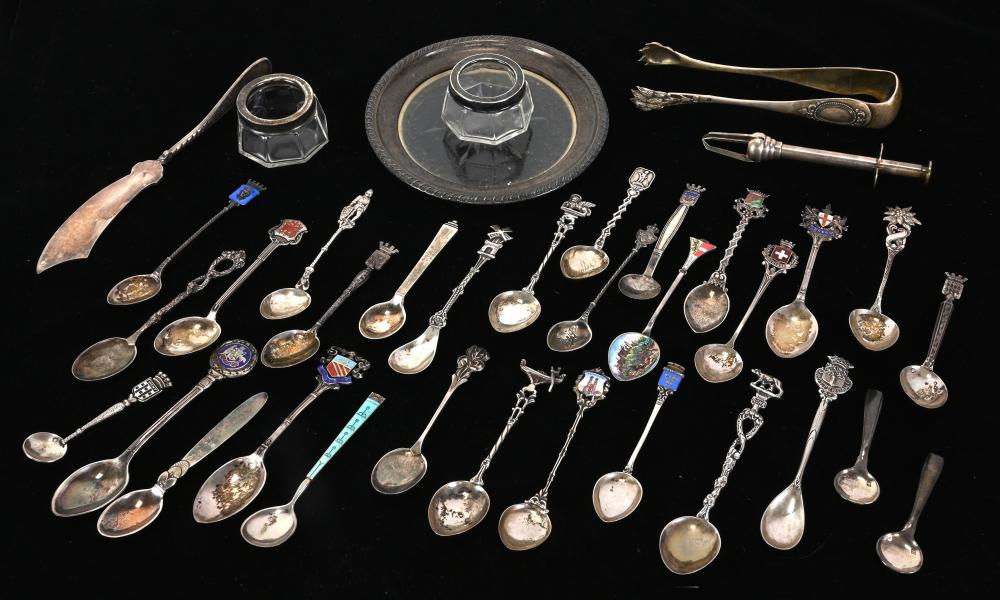
Vintage Sterling Silver Souvenir Spoon Estate Collection sold by Mebane Antique Auction, lot 24 — auction record photograph Vintage Sterling Silver Souvenir Spoon Estate Collection Mebane Antique Auction 2025-12-05 24 USD 290 (buyer’s-premium treatment unknown)
How these auction records were verified

Each row retains its exact source URL, lot identity, retrieval time, access result, and immutable record hash. Inspect the public comparable provenance record.

Disclosure: prices are shown as reported by auction houses and are provided for appraisal context. Learn more in our editorial policy.

Free instant estimate

Not sure if your item is worth appraising? Let us take a look.

Upload a photo, tell us what you know, and get a free first read. If a full appraisal makes sense, we will say so.

Step 1 of 2

Free. No card needed. Takes about two minutes.

A Polish Origin Circa 20th Century Souvenir Spoon

A modest souvenir spoon can be packed with history. For pieces of Polish origin from the 20th century, design, metallurgy, and markings reflect political change, industry, and tourism across a turbulent century. This guide gives a focused framework to identify, date, authenticate, and appraise a Polish souvenir spoon, with special attention to hallmarks and construction details valued by collectors and appraisers.

What Collectors Mean by “Polish Souvenir Spoon”

In collecting parlance, a Polish souvenir spoon is a small, usually decorative spoon commemorating a Polish city, region, landmark, or emblem, intended for tourists or as a keepsake. Common features include:

  • City crests and enamel shields (Warszawa/Warsaw mermaid, Kraków’s fortified gate, Gdańsk’s double crosses, Poznań’s goat crest, Lwów/Lviv and Wilno/Vilnius in prewar contexts)
  • National symbols (the White Eagle—Orzeł Biały—sometimes crowned, sometimes not)
  • Architectural or scenic bowls (Wawel Castle, Sukiennice/Cloth Hall, Gdańsk Crane, Tatra mountains, Zakopane folk motifs)
  • Figural finials (eagles, mermaids, highlanders/Górale, coats of arms), twisted stems, and gilt-washed bowls

Size varies from demitasse (9–11 cm) to teaspoon (12–14 cm) and dessert/serving sizes (16–18 cm). Materials span solid silver, silver-alloy standards, silver plate on nickel silver (alpacca), brass, and, from mid-century, stainless examples. Many incorporate colored enamel shields.

Production spans distinct phases:

  • Late 19th to WWI (Partition era): Territories under Russian, Austro-Hungarian, and German control; marks and styles follow those systems. Tourist demand rises for city views and national emblems.
  • Interwar (1918–1939): Independent Poland; patriotic motifs surge, crowned eagle reappears, quality souvenir trade expands. Warsaw and Kraków firms produce both plated and solid silver wares.
  • WWII and immediate post-war: Scarcer civilian production; later, state consolidation of firms.
  • PRL era (People’s Republic of Poland, 1945–1989): The state emblem loses the crown; export-oriented souvenirs increase, sometimes on plated or stainless blanks. Later 20th century sees mass-produced enamel-shield spoons for the diaspora and tourists.
  • Post-1989: Crown returns to the eagle; modern souvenirs proliferate, including reproductions of older motifs.

While some spoons were made abroad for sale in Poland (or for export markets), a substantial number were designed or assembled domestically by well-known Warsaw and regional firms.

Dating by Design and Iconography

Iconography can quickly narrow the time frame, especially for 20th-century Poland where emblems changed with politics.

  • The eagle’s crown:

    • Crowned White Eagle most commonly indicates interwar (1918–1939) or post-1989. If art deco lines and crisp hand-engraving appear alongside a crowned eagle, think interwar.
    • Uncrowned eagle suggests PRL era (roughly 1945–1989). If the shield’s typography is modern sans serif and the enamel colors flat and uniform, mid- to late-20th century is likely.
  • City names and borders:

    • Lwów (Polish) and Wilno (Polish) on prewar pieces; postwar Polish spoons rarely reference these cities as Polish locales (they are Lviv, Ukraine and Vilnius, Lithuania after border changes), but modern tourist spoons made outside Poland might still use heritage names.
    • “Warszawa,” “Kraków,” “Gdańsk,” “Poznań,” and “Zakopane” are persistent favorites. “Danzig” indicates German context or export.
  • Enamel shields and style:

    • Thick, fired enamel with slight unevenness and fine wire divisions (cloisonné) leans earlier and higher quality; thin, uniform, glossy enamel with printed-looking details tends to be later.
    • Twisted stems, cast figural finials, and bowls engraved with panoramic scenes are classic from roughly 1890–1930. Laser-precise engraving and etched fonts point to late 20th century onward.
  • Inscriptions:

    • “Pamiątka z …” or “Na pamiątkę” (“Souvenir from …” or “In remembrance”) appear across the century. Hand-cut script and serif lettering are earlier; machine-engraved sans-serif and all-caps often indicate later production.
    • English “POLAND” added to marks suggests export intent (commonly post-1960s).

Use iconography as a first pass, then confirm with metal and hallmarks.

Understanding metals is fundamental to both identification and valuation.

  • Solid silver and fineness:

    • In Central Europe, 800, 830, 835, and 900 fineness are common; Polish silver spoons often bear “800,” “830,” or “835.” A “900” is less common but seen on higher-quality export or earlier pieces.
    • The word “PRÓBA” (assay/standard) with a number can appear on Polish pieces. Historically, first standard ~.940, second ~.875, third ~.800; in practice, you’ll most often see numerical fineness or “PRÓBA” + number. The exact system evolved; use accompanying maker marks and office marks to triangulate.
    • Assay office and state marks vary by era. Expect different hallmarks for Partition-era pieces (e.g., Austrian Diana head with a number, German crescent and crown with “800/835,” Russian “84” zolotnik with kokoshnik head for items from Russian-ruled areas pre-1918). Interwar and later Polish marks include state marks and maker’s initials; these can be small and lightly struck.
  • Plated wares and base metals:

    • Alpacca/alpaka/alpakka (nickel silver) is common; look for “ALPAKA,” “ALPACCA,” “ALPAK,” sometimes with “METAL” or “NS” (nickel silver). These are frequently silver-plated, sometimes with “GALW.” (galwanicznie, electroplated) or “PLAQUÉ.”
    • Brass or bronze-toned base metals appear on lower-end souvenirs, often with simple enamels.
    • Stainless (“NIERDZEWNA” or simply “STAINLESS”) occurs on late 20th-century souvenirs.
  • Polish makers and trade names to watch:

    • Fraget (Bracia Fraget), Warsaw: Electroplate and higher-end tablewares; marks include “FRAGET,” “FRAGET W WARSZAWIE,” “PLAQUÉ,” sometimes “N” for nickel line. Popular pre-WWII tourist pieces may bear Fraget plate marks.
    • Norblin i Ska (with T. Werner), Warsaw: Large metalworks and electroplate; marks like “NORBLIN I SKA,” “NORBLIN,” occasionally “GALW.”
    • Henneberg (J.A. Henneberg), Warsaw: Plate and silver goods, similar trade marks.
    • HEFRA: Postwar consolidation of Warsaw silverware firms; “HEFRA” marks are common on PRL-era flatware and occasional souvenir items, usually plated or lower silver fineness.
    • Regional or smaller workshops may show initials within cartouches; cross-reference with Polish silver directories when possible.
  • Export and mixed-origin souvenirs:

    • A fair number of 20th-century spoons bearing Polish shields were produced in Germany or elsewhere for the tourist trade. German hallmarking (crescent moon and crown + “800/835/925”) alongside a Polish city shield is not unusual. The spoon is still of “Polish subject,” but origin is technically German.
    • Post-1960s export spoons may combine foreign blanks with locally applied enamel shields.

When reading marks, use a loupe and good light. Look for clusters: fineness, maker’s initials, state/assay symbol, and sometimes a town mark. On plated pieces, trade names are often more prominent than any fineness indicator.

Free instant estimate. No card needed. A specialist review is only the next step if the evidence supports it.
Get my free estimate

Takes about two minutes.

For Polish souvenir-spoon keywords, value depends on whether the object is a common plated travel spoon, a solid-silver city-crest spoon, or a scarcer interwar/partition-era example by a recognized maker. Record the exact fineness mark, maker, city iconography, enamel condition, weight, and whether the spoon sells alone or inside a mixed collector-spoon lot.

Authentication Tips and Common Pitfalls

When in doubt, compare the spoon’s marks and style to documented examples from known firms and assay systems. Consistency across features is key.

Care, Conservation, and Storage

A Practical Checklist for Appraising a Polish Souvenir Spoon

FAQ

Q: My spoon has “ALPAKA” and a city shield. Is it silver? A: No. “ALPAKA” (alpacca) is a nickel silver alloy, often silver-plated but not solid silver. Value depends on design, enamel, and maker rather than metal content.

Q: The eagle on the finial lacks a crown. Does that date it precisely? A: It suggests PRL-era (roughly 1945–1989), but confirm with marks and construction. Some modern reproductions also show uncrowned eagles to mimic “older” pieces.

Q: I see “FRAGET” and “PLAQUÉ.” Is that good quality? A: Fraget was a leading Warsaw maker of plated wares. Many pieces are well-made. It’s plated rather than solid silver, but recognized branding supports collectability.

Q: Can a spoon with a Polish shield and German hallmarks be considered Polish? A: The subject is Polish, but origin is German. Such mixed-origin souvenirs are common and collected, especially when quality is high.

Q: Should I remove tarnish from gilded bowls and over enamel? A: Avoid dips and abrasive polishes near gilding and enamel. Use a gentle cream polish on silver only, keeping clear of enamel and gilt surfaces, and wipe with a soft cloth.

By combining iconography, metals knowledge, and hallmark literacy, you can confidently place a Polish souvenir spoon within its historical context and market tier. The best examples unite clear provenance, strong design, and legible marks—small objects that carry a century of Central European history in the palm of your hand.

Choose your next step

Use the path that matches the decision you need to make about the item.

Not sure it is worth appraising?

Start with a lower-friction screen to understand the likely category, evidence, and next step.

Upload photos for a free first look

Want proof before paying?

See how a signed report documents photos, comparable evidence, condition notes, and value conclusions.

View signed report sample

Need a signed report?

Use this for insurance, estate, donation, resale, or documented value decisions.

Need documentation now? Start signed appraisal

Need local or specialist help?

Compare directory options when the work needs in-person review or a specialist near you.

Find local specialists

See what the report looks like

Sample reports show how photos, comparable evidence, condition notes, and a value conclusion are documented.

Get a Professional Appraisal

Unsure about your item’s value? Our certified experts provide fast, written appraisals you can trust.

  • Expert report with photos and comps
  • Fast turnaround
  • Fixed, upfront pricing
Start Your Appraisal

No obligation. Secure upload.

Continue your valuation journey

Find the right local specialist

Compare antique and art appraisers by location and specialty in one directory.

Antique & art specialists

Browse the Antique & Art Appraisers Directory

Choose a local specialist when the assignment needs in-person inspection or a specific credential.

Browse local specialists

Machine-readable summaries

Use these machine-friendly references for AI and crawler discovery of Appraisily content.

Ready for pricing guidance?

Start a secure online appraisal

Upload images and details. Certified specialists respond within 24 hours.

Upload photos for a free first look View signed report sample