
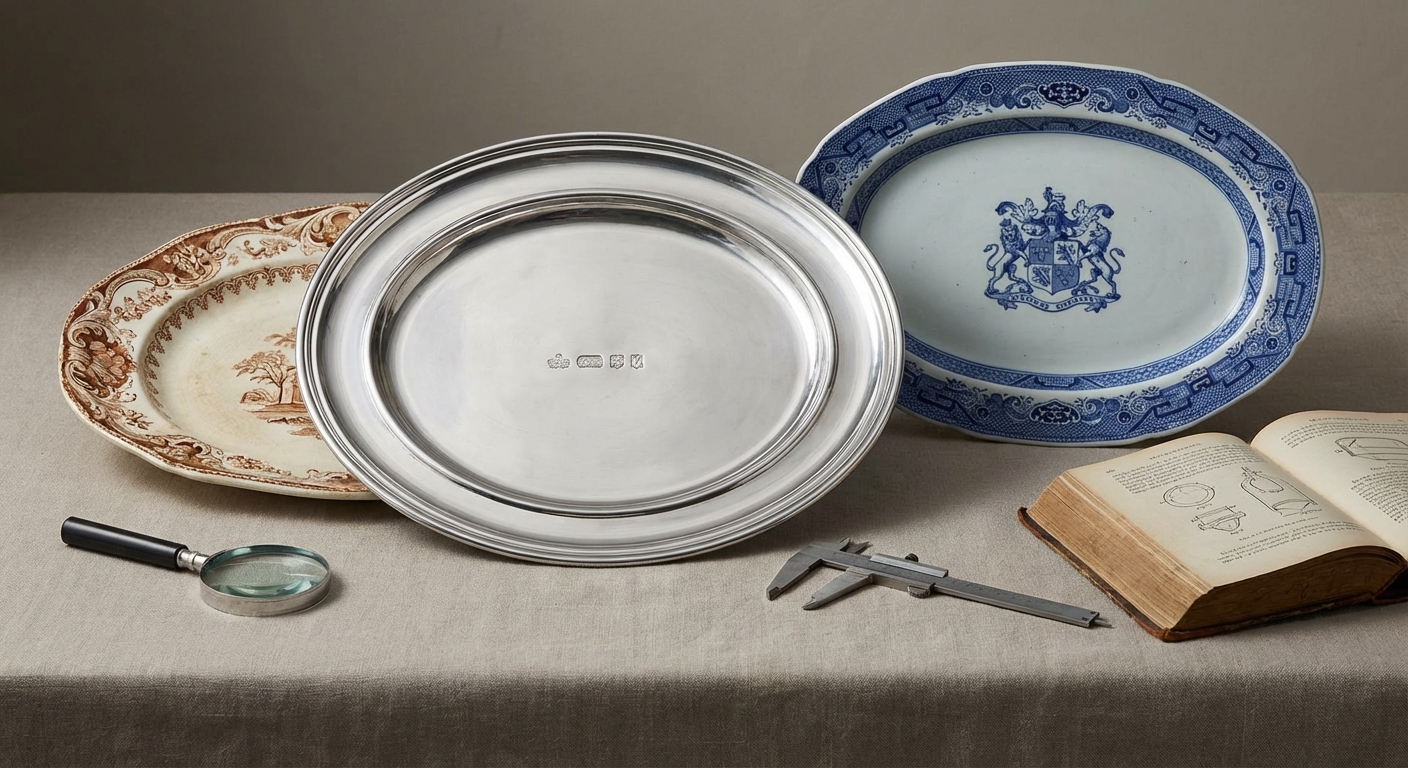
Unlocking the Worth of Timeless Elegance a Guide to Determining the Value of Antique Platters: appraisal and value basics
Unlocking the Worth of Timeless Elegance a Guide to Determining the Value of Antique Platters research should start with identification, condition, provenance, and item-specific market evidence. Use this guide to compare the signals that matter before paying for a formal appraisal or deciding whether to sell.
Antique platter appraisal checklist
Antique platters occupy a special place where utility meets artistry. They anchor dining tables, commemorate events, and showcase technical mastery in pottery, porcelain, silver, and pewter. For collectors and appraisers, their value is the sum of design, history, and market demand—yet it’s often the quiet details that make the biggest difference. This guide walks you through the essentials of identifying, appraising, and preserving antique platters with confidence.
What You’re Looking At: Forms, Materials, and Eras
Knowing what kind of platter you have accelerates every subsequent valuation step.
- Common forms
- Serving platters and chargers (round or oval)
- Meat platters with well and tree (juices channel to a reservoir)
- Fish platters (often long and narrow, sometimes with matching liner)
- Turkey platters (large ovals, especially popular seasonally)
- Materials
- Porcelain: hard, white, and often translucent at thin areas; high-fired; refined surface.
- Bone china: English-developed porcelain incorporating bone ash; strong, luminous.
- Earthenware/creamware/pearlware: more porous, heavier, less translucent; common in transferware.
- Stoneware: dense, non-porous; may be salt-glazed or decorated with slip.
- Silver: sterling (.925) with hallmarks; silverplate (EPNS/EP) is plated over base metal.
- Pewter: tin-based alloy; soft sheen; touch marks identify maker and quality.
- Period clues
- Late 18th–early 19th century: early transfer-printed earthenware, neoclassical and Regency shapes.
- Mid–late 19th century: Victorian exuberance, flow blue, Aesthetic Movement motifs.
- 18th–19th century porcelain: Meissen, Sèvres, Worcester; hand-painted and gilded work.
- Early 20th century: Art Nouveau/Art Deco lines, refined bone china, and well-marked factory wares.
Context matters. A massive 22-inch turkey platter in a scarce pattern carries a different market than a mid-size common pattern tray. Similarly, an 18th-century Chinese export armorial porcelain platter sits in a distinct tier from a late 19th-century mass-market transferware example.
The Value Equation: What Drives Price
Valuation is rarely one-factor. Think portfolio—several attributes interact to produce market worth.
- Maker/attribution: Recognized makers typically command premiums.
- Ceramics: Meissen, Sèvres, early Worcester, Spode, Minton, Wedgwood, Copeland, Doulton.
- Silver: Established silversmiths with clear hallmarks; notable firms or designers increase desirability.
- Pewter: Named makers with strong touch marks, particularly 18th century.
- Date and period: Earlier or stylistically important periods tend to rank higher, all else equal.
- Material quality: True porcelain or bone china versus earthenware; sterling versus plated metal.
- Pattern and decoration:
- Hand-painted and richly gilded pieces generally outpace transfer-printed wares.
- Scarce or historically significant patterns (armorial, commemorative, early American historical Staffordshire).
- Techniques: pâte-sur-pâte, raised pastillage, enamel work.
- Size and form: Very large platters are harder to produce and survive; they often earn premiums.
- Condition: Hairlines, chips, stains, and restoration can sharply reduce value; pristine examples earn multiples.
- Rarity: Limited production, discontinued patterns, or low survival rates amplify value.
- Provenance: Documented ownership, exhibition records, or inclusion in literature adds credibility and price.
- Regional demand and trends: American historical transferware often commands strong US interest; certain European wares find stronger European demand.
- Market timing: Seasonal spikes occur for holiday-related forms (turkey platters) and for decorating cycles.
Decoding Marks and Originality
Marks are gateways to maker, date, and origin—but they’re nuanced. Use them alongside construction and decoration analysis.
- Ceramic backstamps and marks
- Country of origin: Common from 1891 onward (after US import rules required it); “Made in …” becomes widespread in the early 20th century.
- British Registration: The diamond registration mark (1842–1883) encodes the date; “Rd No.” appears from 1884 onward.
- Company changes: “Ltd” in the corporate name usually signals late 19th/early 20th-century incorporation or later.
- Notable marks:
- Meissen: crossed swords (beware of later imitations; examine quality of paste, painting, and footrim).
- Sèvres: interlaced Ls with date letters for year; elaborate decorating standards.
- Worcester (Dr. Wall period): hand-painted crescent or other period marks; later Worcester has printed marks.
- Spode/Copeland, Minton, Wedgwood: printed factory marks, pattern names/numbers, and decorators’ marks often present.
- Pattern numbers and decorators’ marks: Help pinpoint date ranges and production tiers.
- Chinese reign marks: Frequently apocryphal on 19th–20th-century export wares; document via body, glaze, and decoration quality.
- Construction clues
- Porcelain translucency: Thin rims/centers glow under a small light; earthenware will not.
- Footrim and paste: Early hard-paste porcelain often has a clean, vitrified foot; soft-paste can show sugary fractures and softer edges.
- Transfer print vs hand painting: Transfer lines repeat and show dot matrices under magnification; hand-painting has brush-lay and micro-variation.
- Silver and plated marks
- Sterling hallmarks (UK): Standard mark (lion passant for sterling), town mark (e.g., London leopard’s head), date letter, and maker’s mark. Britannia standard and duty marks appear in certain periods.
- Continental purity: Numeric marks like “800” (continental silver) or “925” (sterling) are common; British sterling is typically indicated by hallmarks rather than “925” on older pieces.
- Plate identifiers: EP, EPNS, EPBM indicate electroplated base metal; these are not solid silver.
- Pewter marks
- Touch marks and quality marks identify maker and period. Early pewter can carry owner’s initials and X or crowned marks indicating grade.
- Beware of misleading marks
- Pseudo-marks imitating prestigious factories exist (especially Meissen and Sèvres).
- Modern reproductions sometimes carry decorative marks with no legal hallmarking structure.
- Cross-check: Marks must align with the observed body, glaze, decoration, and wear patterns.
Tip: A jeweler’s loupe and a UV lamp are invaluable. Under UV, many overpaints and fills fluoresce differently than original glaze, helping detect restorations.
Condition and Restoration: The Value Multiplier
Condition impacts price more than most novices expect. Document any issues clearly.
- Common ceramic issues
- Chips and nibbles (especially to rim and foot)
- Hairlines and cracks (look under raking light; tap test for dull sounds)
- Crazing and staining (tea/iron staining appears brown in crazing lines)
- Glaze wear, utensil marks, and scuffs
- Kiln dust/pinholes (original to manufacture; minor impact)
- Warping (slight warp common on early wares; judge severity)
- Restoration and conservation
- Overpaint, infill, and regilding: Professional work can be nearly invisible; use UV light and magnification.
- Old staple repairs: Historically interesting but usually lower value than unrestored, intact examples.
- Disclosure is essential; invisible repairs still affect fair market value.
- Silver and pewter condition
- Dents, deep scratches, and thinning from over-polishing reduce value.
- Monograms: Original armorials may enhance value; later added monograms are often neutral or negative, depending on buyer.
- Replating (for EPNS) has mixed impact—improves appearance but isn’t originality.
- Cleaning cautions
- Ceramics: Avoid bleach; it can embrittle and worsen crazing. Stains may respond to controlled soaks with a condition-specific range hydrogen peroxide (ventilation and protective gear recommended); test inconspicuously.
- Silver: Gentle polishing with non-abrasive compounds; avoid machine buffing. Some collectors prefer a light, even patina over high shine.
- Pewter: Clean lightly; over-polishing destroys age character and can erase marks.
As a rule, pristine condition with crisp decoration earns multiples of repaired or heavily worn examples, especially in rarer patterns and top-tier makers.
Rarity, Pattern, and Demand: Reading the Market
Scarcity means little without demand. Identify where collectors are focusing.
- Transferware tiers
- Blue Willow: beloved but broadly produced; top dollars reserved for early, large, finely printed, or unusual-maker examples.
- Flow blue: c. 1840–1900; earlier and intense, well-focused flow commands more interest than late, blurry mass-market versions.
- American historical Staffordshire: Scenes of US cities/landmarks from British potteries c. 1815–1840; strong US collector demand.
- Porcelain highlights
- 18th-century European porcelain: Meissen, Sèvres, early Worcester; hand-painted decoration and armorials are highly sought.
- Chinese export armorial: 18th-century family crests on porcelain platters are scarce and valuable.
- Minton pâte-sur-pâte and elaborate gilded services: Premium when large and in fine condition.
- Tin-glazed and faience
- English delftware and continental faience: Early, hand-painted, and often irregular; large platters are scarce survivors.
- Majolica and Aesthetic Movement
- Victorian majolica platters with bold relief motifs; condition (chips to high points) is a common limiting factor.
- Metalware
- Sterling silver platters from notable silversmiths or with presentation inscriptions can be significant.
- Pewter platters with early dates and strong touch marks are increasingly appreciated.
Keep an eye on cross-collecting: interiors trends can lift certain looks (e.g., Aesthetic Movement Japanesque patterns) and seasonal entertaining boosts demand for turkey and fish platters.
Pricing With Confidence: Methods and Practical Steps
Price is the intersection of reality and timing. Aim for evidence-backed numbers.
- Define the valuation purpose
- Fair market value: Price between willing buyer and seller, common for estate and donation.
- Retail replacement: Higher figure used for insurance; reflects dealer sourcing and preparation.
- Wholesale/liquidation: Lower, quick-sale pricing.
- Build comparables
- Match maker, pattern, size, material, and condition as closely as possible.
- Prioritize recent sales over asking prices; check multiple sources (auction results, reputable dealer outcomes, show sales).
- Adjust for condition: Deduct for hairlines, repairs, heavy wear; add for pristine boxes/provenance where relevant.
- Factor in size and set context
- Oversized platters (>18 inches) often command a premium; verify that the pattern is not common in that size.
- Single vs service: A platter that completes a sought-after service can fetch more to the right buyer.
- Consider timing and venue
- Specialty auctions or fairs expose pieces to targeted buyers; general venues may underperform.
- Seasonal spikes for large serving platters occur in Q4; exhibitions and anniversaries can move niche markets.
- When to call a specialist
- Unusual marks, high-style porcelain, armorial work, or early pewter merit expert consultation.
- For high-value pieces, a formal written appraisal and condition report is prudent.
Document everything—precise measurements, photos of front and back, marks, and any defects. Buyers and appraisers pay for certainty.
Quick Appraisal Checklist
- Identify material: porcelain/bone china vs earthenware/stoneware; sterling vs plated; pewter.
- Record all marks: factory backstamps, pattern names/numbers, hallmarks, touch marks.
- Measure size precisely: maximum length and width; note form (meat well, fish, charger).
- Inspect condition: chips, hairlines, crazing, stains, glaze wear; check under UV for restorations.
- Evaluate decoration: hand-painted vs transfer, level of gilding, armorials, special techniques.
- Assess rarity and demand: maker reputation, pattern scarcity, period significance, regional interest.
- Gather provenance: receipts, labels, family history, exhibition or literature references.
- Build comparables: recent sales of similar maker/pattern/size/condition; adjust for differences.
- Decide the valuation type: fair market vs retail replacement; choose venue and timing accordingly.
FAQ
Q: How can I quickly tell porcelain from earthenware? A: Hold a small light behind the rim; porcelain and bone china often show translucency, while earthenware remains opaque. Porcelain also tends to have a finer, glassier surface and a clearer “ring” when lightly tapped.
Q: Do hairlines always ruin value? A: Not always, but they reduce it. On scarce 18th-century porcelain or early delft, a tight, stable hairline may be tolerated. On common 19th- to 20th-century wares, hairlines can cut value dramatically.
Q: Is silverplate worth collecting? A: Quality silverplate (EPNS) by good makers can be decorative and useful, but it does not carry the intrinsic metal value of sterling. Desirability depends on design, maker, and condition. Collectors tend to pay premiums for sterling.
Q: What sizes are most desirable? A: Large platters—especially over 18 inches—are harder to find in excellent condition and often command premiums. That said, demand varies by pattern and period, and storage/display constraints can influence buyer behavior.
Q: Should I remove patina from metal platters? A: Generally, avoid aggressive polishing. A light, even patina is acceptable and sometimes preferred. For silver, use gentle polish sparingly; for pewter, minimal cleaning preserves original surface and marks.
With these frameworks and tools, you can separate the merely old from the genuinely special, articulate your findings, and price antique platters with clarity. Keep notes, compare carefully, and let the object’s material, marks, and condition guide your decision-making.


