Unlocking the Worth a Comprehensive Guide to Determining the Value of Your Antique Buffet with Mirror: appraisal and value basics
Unlocking the Worth a Comprehensive Guide to Determining the Value of Your Antique Buffet with Mirror research should start with identification, condition, provenance, and item-specific market evidence. Use this guide to compare the signals that matter before paying for a formal appraisal or deciding whether to sell.
Antique buffet with mirror appraisal checklist
An antique buffet with mirror—also called a mirrored sideboard or buffet-back—can be a showpiece and a meaningful asset. Determining its value requires more than a quick glance at age or wood type. Price is driven by a matrix of style, construction quality, originality, condition, maker, provenance, size, and current market demand. This guide walks you through the essentials of identification, dating, condition grading, market comparables, and practical steps to maximize value.
Know What You Have: Forms, Styles, and Woods
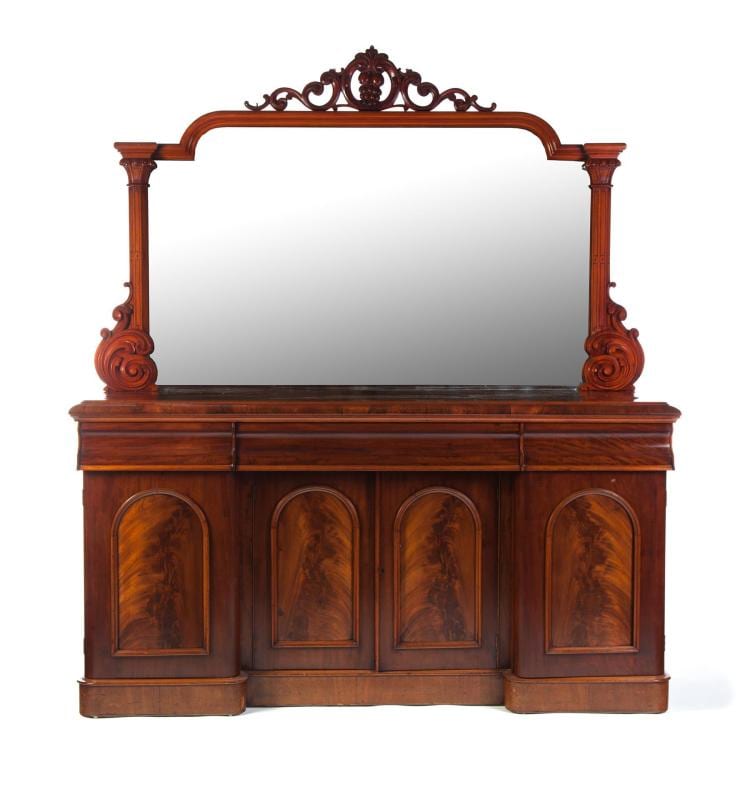
Buffets with mirrors proliferated from the mid-19th century through the early 20th century. The mirror often rises from a backboard or gallery and may include shelves, candle stands, or carved crests.
Common style families you’ll encounter:
- Renaissance Revival (c. 1860–1885): Bold proportions; carved masks, griffins, and foliate motifs; walnut and walnut veneers; often large mirrored backs with elaborate pediments.
- Eastlake/Aesthetic Movement (c. 1870–1890): Incised geometric carvings, ebonized details, asymmetry; usually walnut or cherry; mirrors framed with linear ornament rather than deep carving.
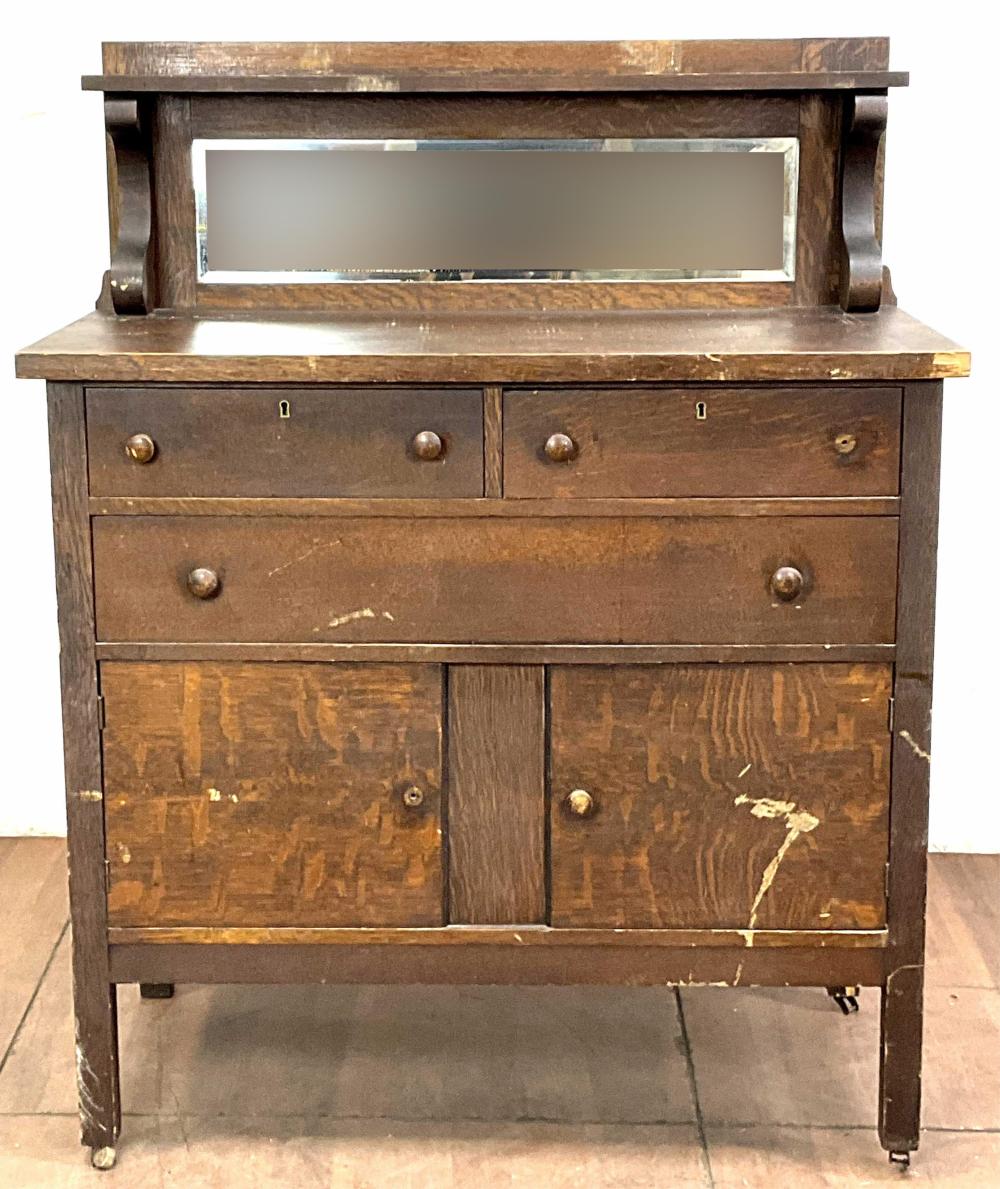
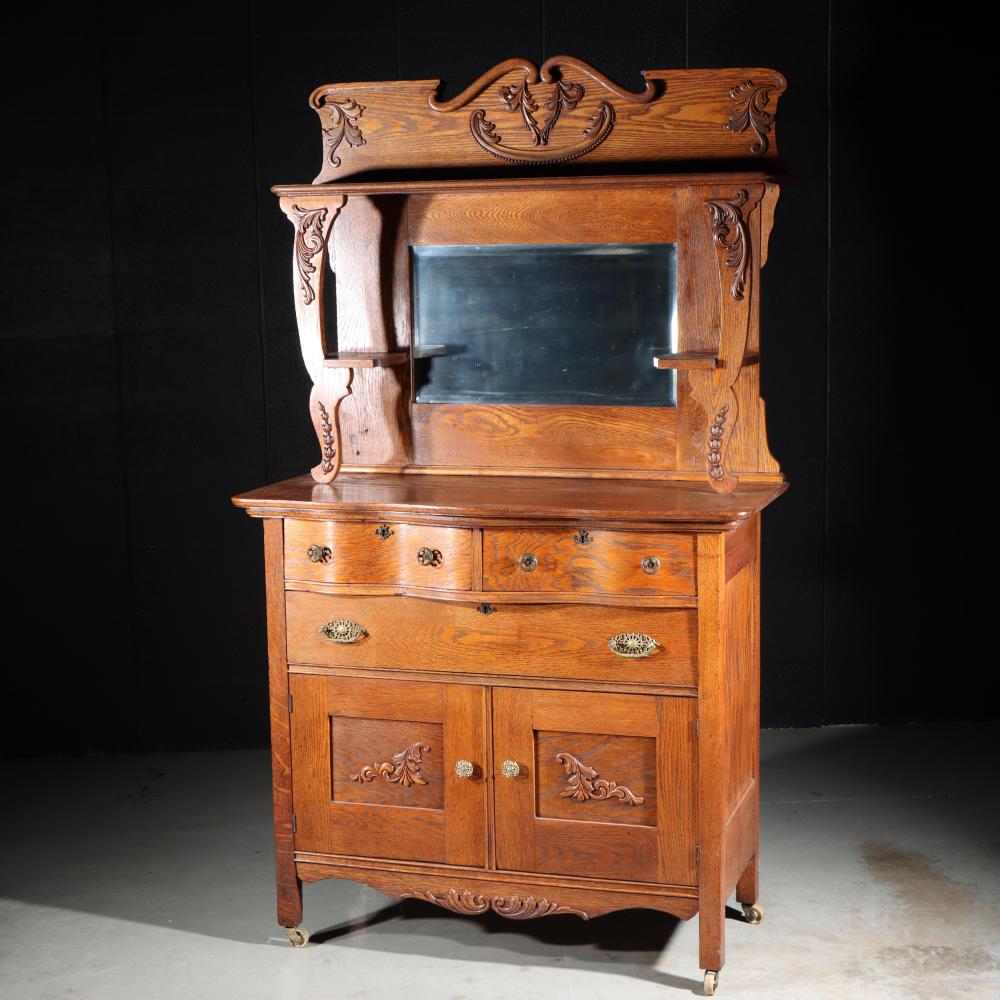
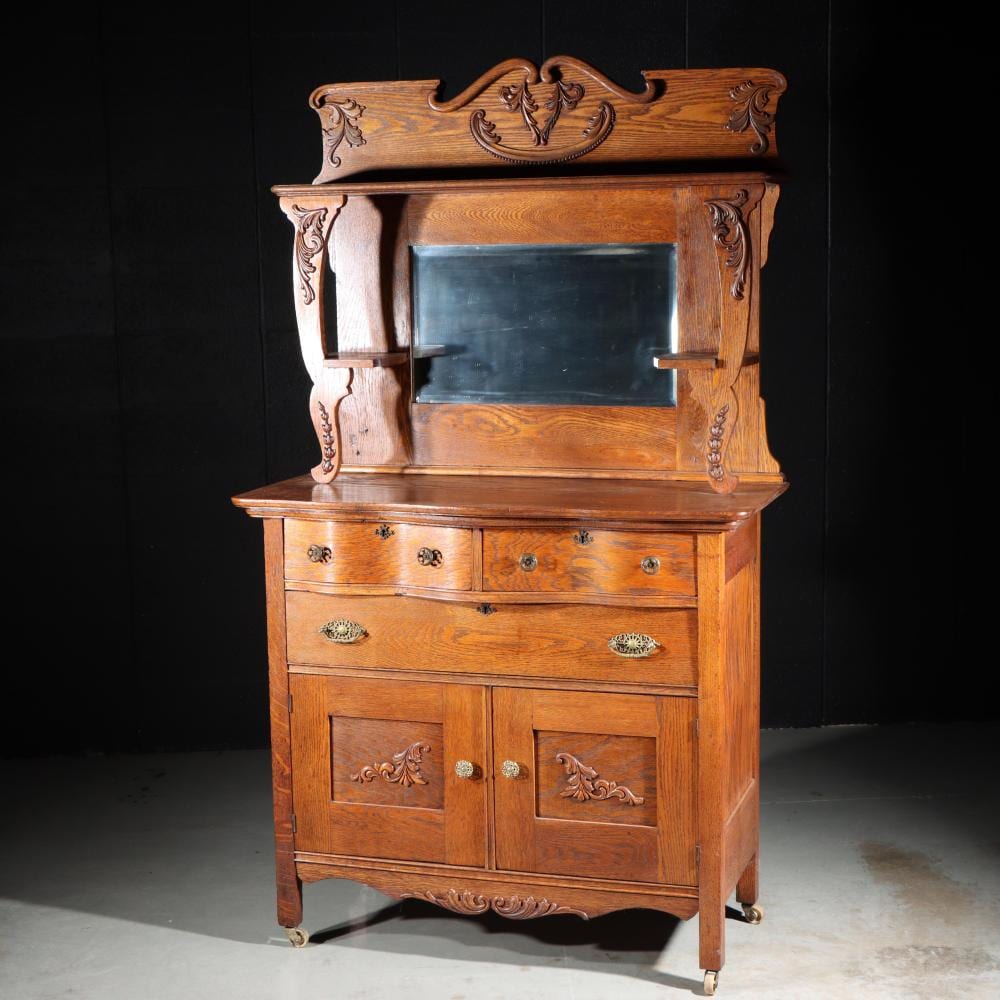
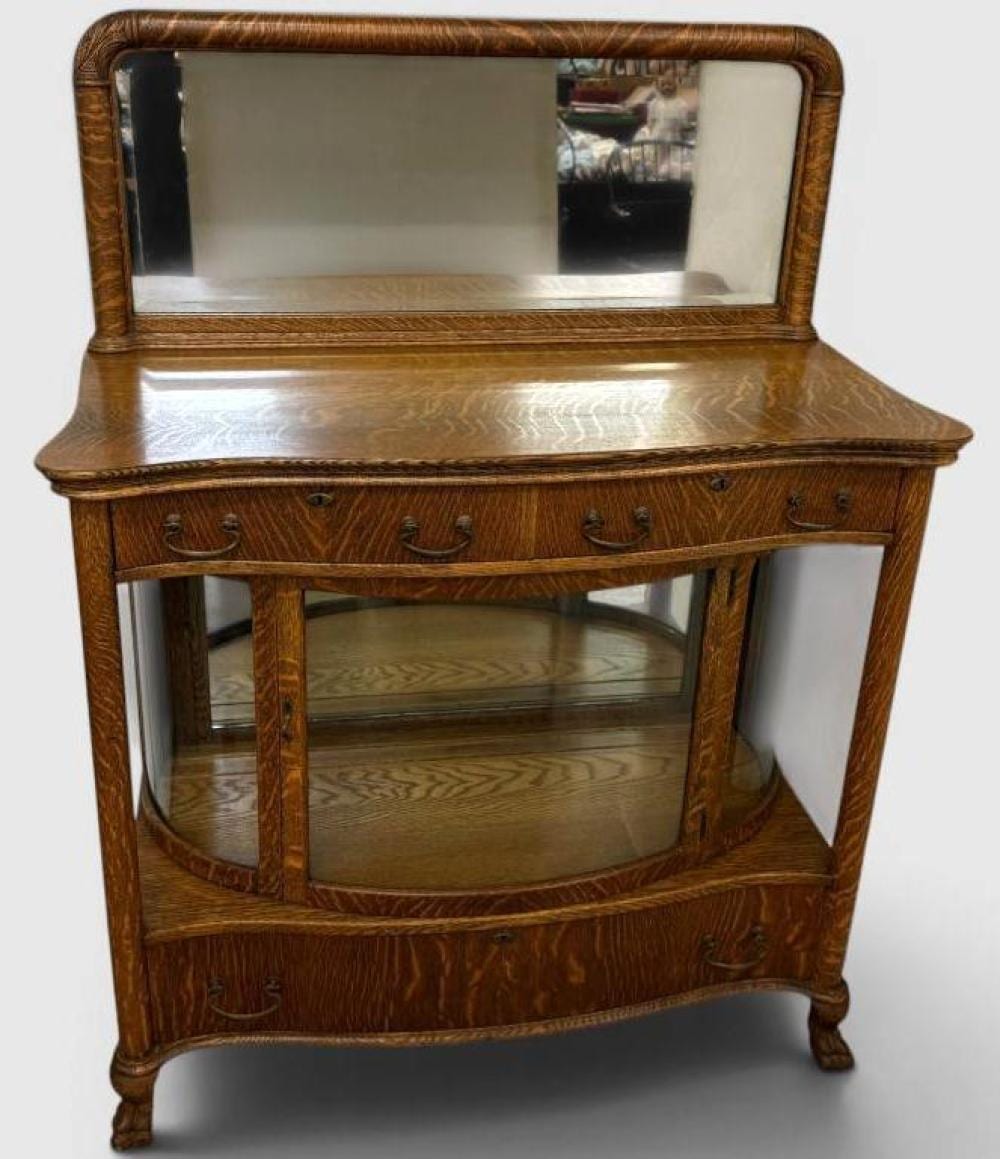
- Golden Oak/Victorian Oak (c. 1890–1910): Quarter-sawn oak with visible medullary rays; serpentine or bow fronts; tall mirrored backs with shelves; pressed or applied carvings.
- Art Nouveau (c. 1895–1914): Organic, whiplash lines; inlaid motifs; curvilinear mirror crowns; often walnut, mahogany, or mixed veneers.
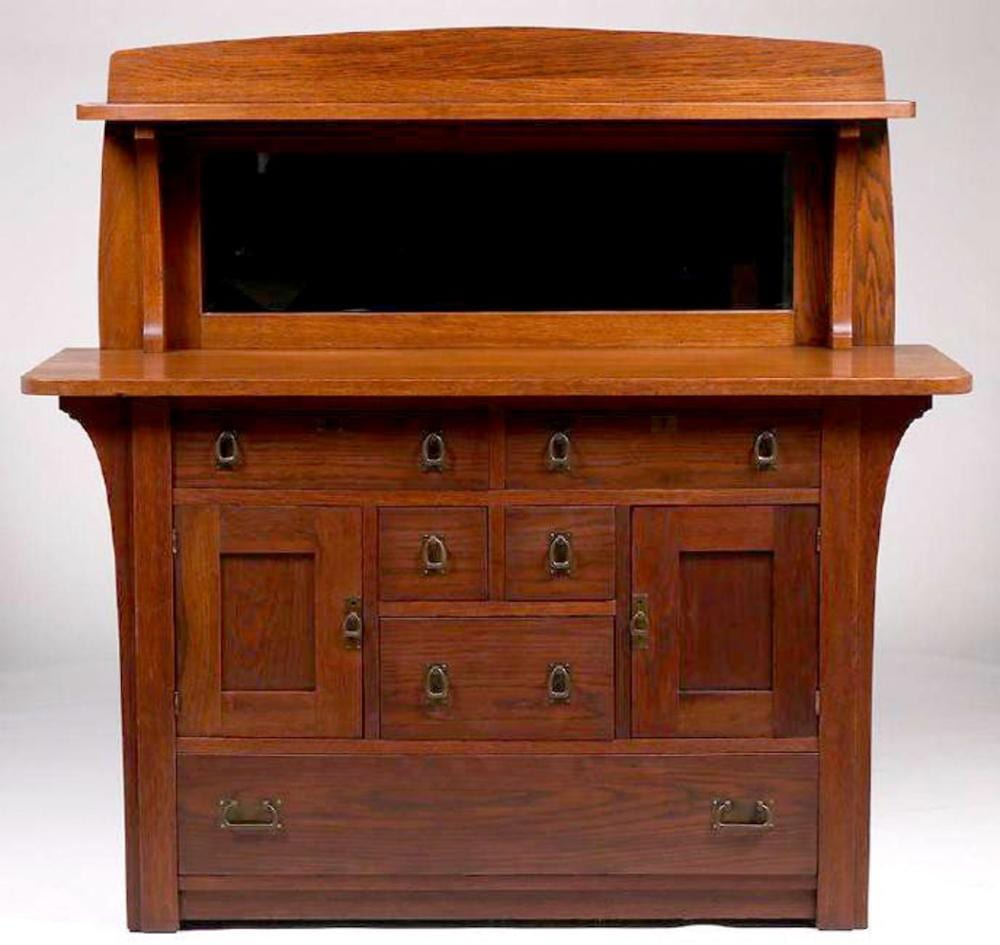
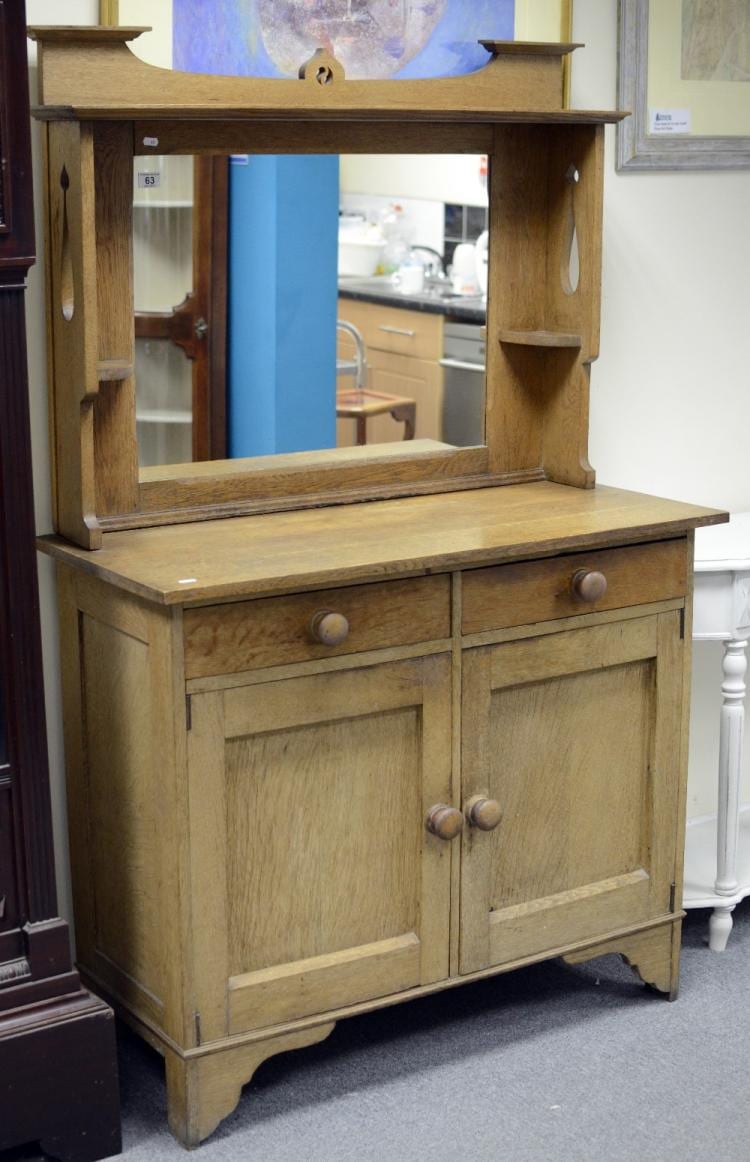
- Arts & Crafts/Mission (c. 1900–1920): Straight lines, honest joinery; quarter-sawn oak; mirrors are smaller, square, or absent—larger mirrored superstructures are uncommon.
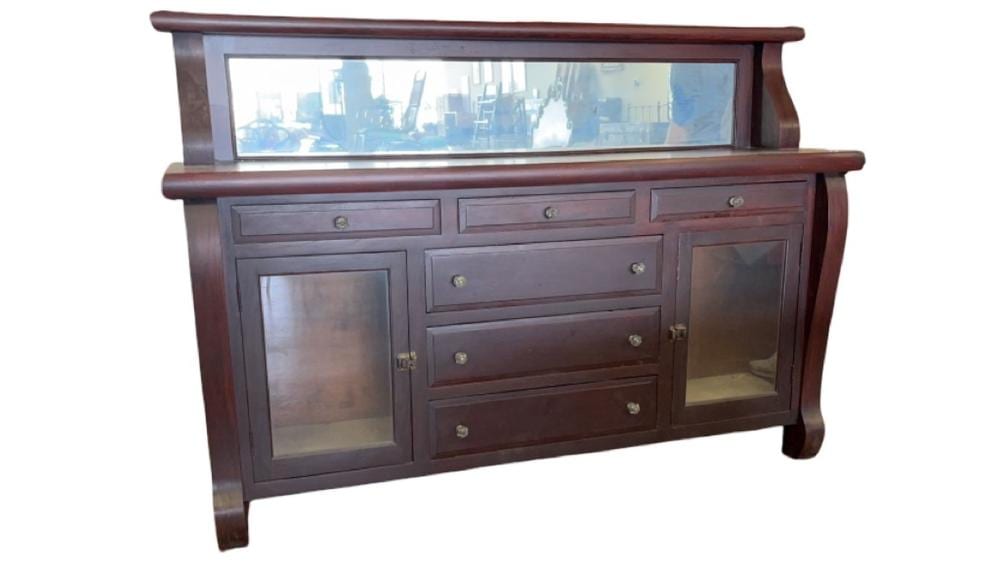
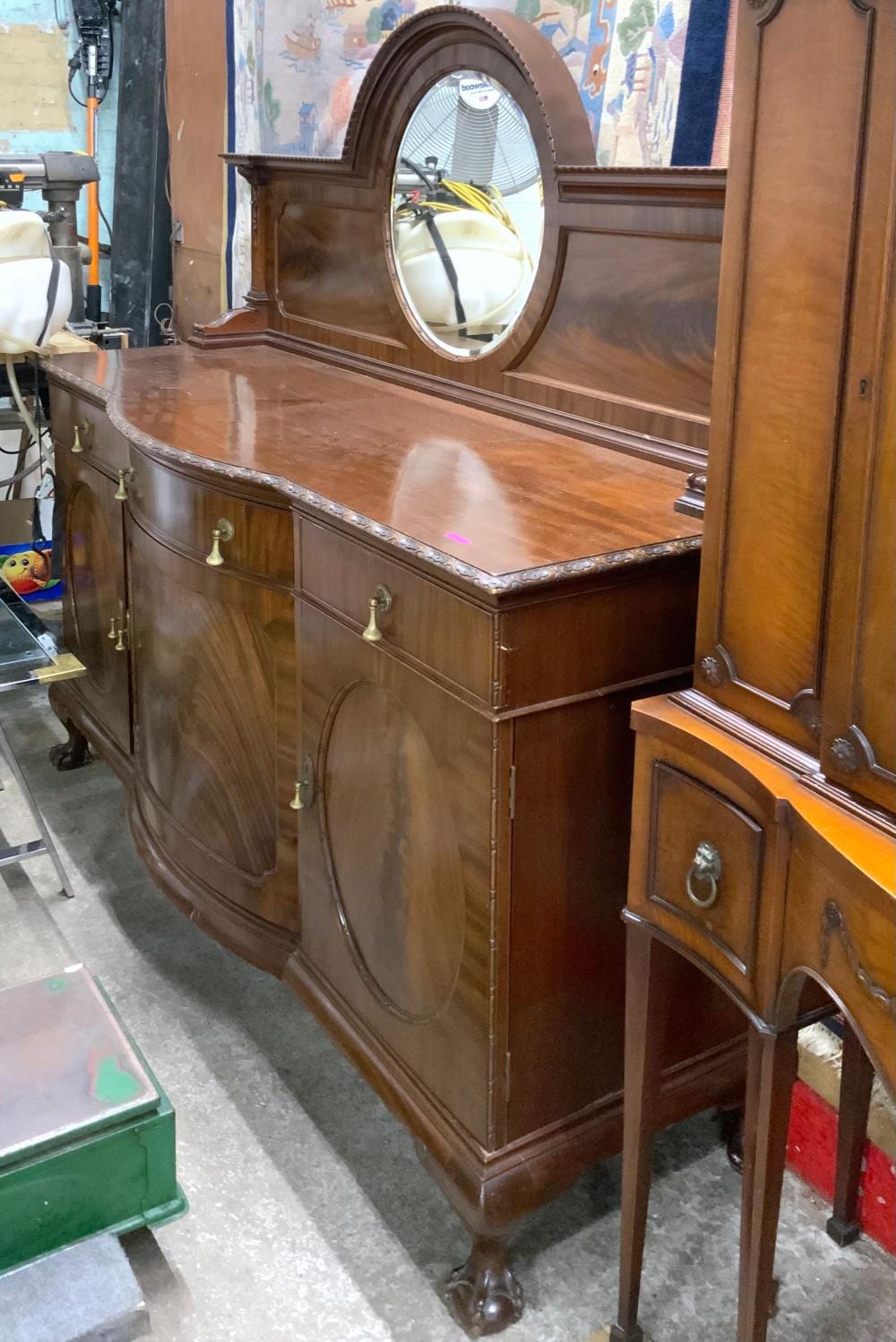
- Edwardian/Hepplewhite Revival (c. 1900–1920): Mahogany veneers, satinwood banding, shield or oval outlines; lower mirror splashbacks rather than towering backs; neoclassical brass pulls.
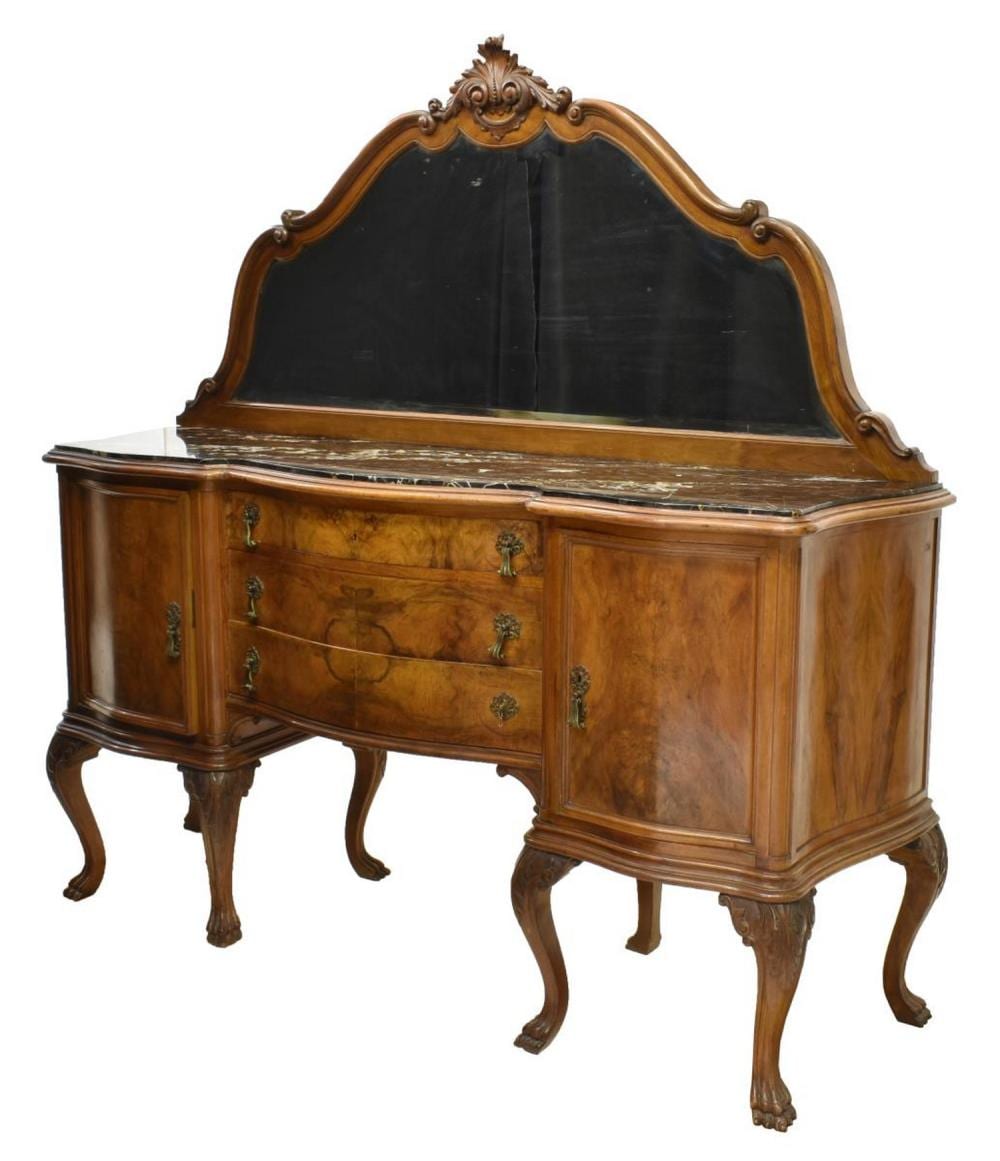
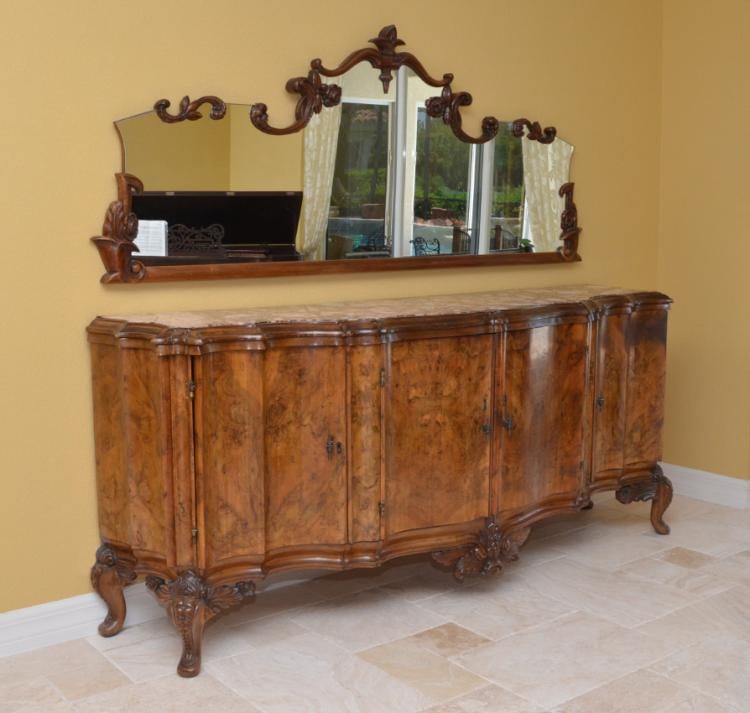
- French Provincial/Neo-Rococo revivals appear intermittently across the period, often with cabriole legs, cartouches, and curved mirror frames.
Woods and veneers:
- Oak: Common in late Victorian; quarter-sawn oak shows flake-like medullary rays.
- Walnut: Favored in mid-late 19th century; can be solid or veneered over pine/poplar.
- Mahogany: Popular c. 1890–1920 and in higher-end English/American pieces; often veneered with crossbanding.
- Secondary woods (inside drawers/backs): Poplar, pine, or oak depending on region and period. Consistency with period norms supports originality.
Terminology:
- Buffet/Sideboard: Interchangeable in many markets; “buffet” often implies heavier Victorian forms; “sideboard” used broadly.
- Credenza: In American usage, more often a lower, longer storage case without mirror.
- Gallery: The raised back section that holds the mirror and shelves.
Dating and Originality: Construction Clues That Matter
Correctly dating your piece—and confirming it hasn’t been heavily altered—underpins any valuation.
Joinery and tool marks:
- Hand-cut dovetails (irregular pins/tails) suggest mid-19th century or earlier, though skilled shops used hand techniques later.
- Machine-cut dovetails (uniform) became common after c. 1870–1890 depending on region.
- Saw marks: Straight, slightly uneven marks may indicate hand saw; uniform circular saw marks are later 19th century onward.
- Nails: Cut nails (rectangular shanks) dominate pre-1890; wire nails (round) become standard after c. 1890.
- Screws: Early screws have off-center slots and slightly irregular threads; modern Phillips-head screws signal later repairs.
Mirror diagnostics:
- Silvering vs. mercury: Most mirrored buffets from the 1870–1915 peak use chemically silvered glass, not mercury. Mercury-tin amalgam mirrors were phased out in the mid-19th century in many regions.
- Glass character: Slight waviness, bubbles, or seeds suggest early glass; crisp modern float glass is perfectly flat. Edge beveling was common on higher-grade mirrors c. 1880–1915.
- Backing: Old mirrors may have wood panel backing or early paper; modern replacements often have uniform fiberboard or shiny foil coloration. Desilvering (black “foxing”) at edges can be age-consistent, though uniform mirroring loss may also come from moisture damage.
Casework details:
- Drawer bottoms: Solid boards running front-to-back with chamfered edges set into grooves are consistent with 19th-century practice.
- Web frames and dust boards: Quality pieces include full dust boards between drawers; cheaper mass-market examples may omit them.
- Backboards: Tongue-and-groove or shiplap boards are age-consistent; a single modern plywood sheet suggests later replacement.
Hardware:
- Period brasses and locks matter. Pressed brass plates and machine-engraved pulls appear c. 1880–1910. Replacements (new shiny lacquered brass, Phillips screws) reduce value unless well-matched period hardware is used.
- Locks with original escutcheons and working keys add desirability; replacements should be disclosed.
Maker’s marks and labels:
- U.S. makers to look for include R.J. Horner (noted for figural carvings), Berkey & Gay, Doerr, Herter Brothers (rare and top tier), Pottier & Stymus (rare), and better Grand Rapids firms.
- English and continental: Gillows (exceptional), Maple & Co., Howard & Sons, and various French ébénistes; labels, stencils, cabinetmaker stamps, and pencil/chalk shop marks can be present on drawer bottoms or backboards.
- Retailer labels (department stores, catalogs) still contribute to provenance.
Finish and surface:
- Shellac predominates pre-1920; lacquer appears thereafter; polyurethane is modern. Alligatoring, French-polish sheen, and wear patterns consistent with use help indicate originality.
Condition and Originality: How They Shape Price
Condition is the largest adjustable variable in valuation. Buyers will pay premiums for originality and stability.
Key factors:
- Original mirror present and sound: A period mirror with minor age-consistent desilvering can be preferable to a modern replacement for collectors. Heavy loss or black streaking may push buyers to discount or replace.
- Veneer integrity: Bubbles, chips, and missing veneer on serpentine fronts or drawer faces reduce price; clean, tight veneers uplift value.
- Structural solidity: No racking, split panels, or loose joints. Re-glues are acceptable if done with appropriate adhesives and techniques.
- Finish: Original or sensitively conserved finishes are valued; aggressive sanding and glossy modern varnish typically lower collector interest but may help general-decor buyers.
- Completeness: Cresting elements, shelves, gallery supports, and original hardware present? Missing tops, shelves, or rebuilt superstructures depress value significantly.
- Odors and stains: Persistent mold/mildew and pet odors are material negatives; water rings and heat marks are typical but affect price.
- Scale: Extremely large buffets with towering mirrors can be less liquid because of modern space constraints, impacting realizable value.
Condition categories and impact (approximate):
- Excellent, original, minimal wear: Dealer retail premiums; auction strength strong.
- Very good, minor repairs, original mirror and hardware: Solid market interest; small discount.
- Good, refinished or replaced mirror/hardware: Usable, decorative; typically mid-market pricing.
- Fair/Poor, structural issues/missing parts: Project value; steep discount due to repair costs.
Reading the Market: Comparables, Channels, and Trends
Value is not only inherent—it’s contextual. Understanding where and how similar pieces sell is crucial.
Comparable sales:
- Prioritize sold prices, not asking prices. Retail dealer asks can be 1.5–3x auction hammer for comparable items because of guarantees, restoration, and overhead.
- Match like-with-like: Style/period, wood, size, level of carving, maker (if known), condition, and region. A carved Renaissance Revival walnut buffet is not market evidence-equivalent to a plain Golden Oak example.
Selling channels and effects on price:
- Local auction/estate sale: Faster sale, lower to mid prices; condition very important.
- Specialist auction: Best for named makers, exceptional carving, or rare designs; higher fees but better reach.
- Dealer consignment: Slower, retail-level pricing if piece is strong; fees/commission apply.
- Private sale/marketplace: Variable; depends on photography, description, and buyer base.
Regional and style trends:
- Overscaled Victorian oak has softened in many markets due to space limitations; decorative but common examples often fetch modest sums.
- Quality trumps age: Exceptional carving, rare forms, and named makers remain sought-after.
- Mission/Arts & Crafts with documented maker (e.g., Stickley) is strong; large mirrored backs in this style are less typical and should be vetted.
- French Art Nouveau and high-style Edwardian veneered sideboards with refined proportions are steady to strong when in excellent condition.
How the main styles compare, from least to most valuable (broad, condition- and region-dependent; dealer retail usually runs above auction for each):
- Common Golden Oak buffet with mirror, no maker, good condition: the most common and most affordable group.
- Eastlake/Aesthetic walnut, clean and original: usually a step above common oak.
- Carved Renaissance Revival with figural elements; attributed maker: higher again, depending on quality and provenance.
- High-style Art Nouveau or documented English cabinetmaker pieces: well above typical Victorian buffets.
- Named, top-tier American (e.g., R.J. Horner with griffins; Herter Brothers exceedingly rare): the top of the market; dealer prices significantly higher still, case-by-case.
These are not guarantees—use them to frame expectations while building a comp set tailored to your piece.
How to Estimate Value: A Step-by-Step Approach
- Identify style and period:
- Compare motifs, proportions, and construction to the style families above.
- Note wood species, veneer usage, and finish.
- Document construction:
- Photograph dovetails, drawer bottoms, backs, and hardware backs. Note nails/screws types.
- Record whether the mirror glass appears early and whether it is beveled.
- Assess condition and originality:
- List repairs, losses, veneer bubbles, finish quality, hardware swaps, and stability.
- Confirm whether the backboard and gallery are original and correctly attached.
- Check for marks or labels:
- Inspect drawer sides/bottoms, case backs, underside, and mirror frame for labels, stamps, or chalk numbers.
- Measure and map scale:
- Height (overall and to top of gallery), width, and depth. Very tall or extra-wide pieces may reduce liquidity.
- Build comparables:
- Collect 6–12 sold examples matching style, wood, scale, and condition; note venue and date of sale.
- Weight market evidence by proximity (regional sales) and recency (last 12–24 months).
- Determine channel and net proceeds:
- If selling, choose auction vs dealer vs private based on urgency, risk tolerance, and potential gross vs net.
- Adjust for restoration needs:
- Estimate repair/refinish costs and subtract from high comp scenarios.
- For collector-grade examples, prefer conservation over refinishing when feasible.
- Set a range, not a point:
- Present a realistic low-to-high estimate reflecting channel and condition.
Preservation, Restoration, and Value Optimization
Conservation-first:
- Gentle cleaning (mineral spirits test patches; avoid water saturation) and wax can revive original finishes without stripping.
- Re-glue loose joints with reversible adhesives where possible. Avoid polyurethane glues.
Mirror decisions:
- If the mirror is severely desilvered, period-appropriate resilvering or finding old glass of similar character preserves look better than installing modern float glass.
- For safety, securing the mirror in the frame with appropriate glazing points and backing is a must.
Veneer and finish:
- Steam and press minor veneer bubbles; professionally match missing veneer with period species and grain direction.
- Refinish only when surface is beyond conservation and value lies in decorative appeal rather than collectability.
Hardware:
- Source period hardware when replacing; avoid shiny modern brass. Age sympathetically or choose antique originals.
Documentation:
- Keep photos of labels, joinery, and before/after conservation. Written records support provenance and value assertions.
Staging and photography:
- Present with good lighting, neutral background, straight-on shots, and close-ups of details. Show scale with measurements.
Practical Checklist: Antique Buffet With Mirror
- Identify style family and approximate date (1860–1920 most common)
- Confirm wood species and veneer use; inspect secondary woods
- Examine joinery (dovetails), nails, screws, and backboards for age consistency
- Evaluate mirror: glass character, bevel, backing, and originality
- Verify completeness: crest, shelves, gallery supports, hardware, keys
- Grade condition: structural solidity, veneer/finsih, odors, water/heat marks
- Search for makers’ labels, stamps, serials, and retailer tags
- Measure height/width/depth; note if overscale for typical homes
- Photograph all angles, joinery, labels, and defects
- Compile 6–12 sold comparables matched on style, quality, and region
- Decide sell channel; estimate net after fees and restoration
- Set a realistic value range and disclose restorations to buyers
FAQ
Q: Does replacing the mirror reduce value? A: Often, yes. Collectors prefer original glass with minor age-appropriate imperfections. If safety or severe desilvering demands replacement, choose period glass or professional resilvering. Disclose the change.
Q: Is refinishing always a bad idea? A: Not always. For common, late Victorian oak pieces aimed at decor buyers, a quality refinish can improve salability. For rarer or named-maker examples, conservation of the original finish is usually better for value.
Q: How do I tell if my buffet is solid wood or veneer? A: Look at edges and grain continuity. Veneer will show a thin surface layer with a different secondary wood underneath at edges or chips. Drawer sides and interiors are good places to spot secondary woods versus face veneers.
Q: What’s the difference between insurance value and market value? A: Insurance (replacement) value reflects retail replacement cost from a dealer in a reasonable time frame; it is usually higher. Market value (fair market) is what a willing buyer would pay a willing seller under normal conditions, often closer to auction results.
Q: Are oversized buffets harder to sell? A: Generally, yes. Tall mirrored backs and wide cases can limit buyers due to ceiling heights and room sizes. Shipping costs also rise, which can depress realized prices compared to more moderate scales.
By understanding style, construction, originality, condition, and market behavior—and by documenting your piece thoroughly—you can credibly estimate the value of your antique buffet with mirror and choose the right path to preserve or sell it wisely.