Unlocking the Charm and Worth the Complete Guide to Antique Childs Rocking Chair Values: appraisal and value basics
Unlocking the Charm and Worth the Complete Guide to Antique Childs Rocking Chair Values research should start with identification, condition, provenance, and recent comparable sales. Use this guide to compare the signals that matter before paying for a formal appraisal or deciding whether to sell.
Antique childs rocking chair value checklist
Antique child’s rocking chairs blend affection and artistry in a way few objects do. They compress the craftsmanship of full-size chairs into diminutive forms, often with charming wear from generations of nursery use. For collectors and appraisers, these small rockers are more than sentimental; they’re a nuanced category where period, style, construction, and originality translate directly to value. This guide unpacks how to identify, evaluate, and price antique child’s rockers with confidence.
Defining the Category: What Counts as an Antique Child’s Rocker?
Before assigning value, be precise about what the object is.
- Antique vs. vintage: In most appraisal contexts, “antique” means 100+ years old; “vintage” often describes items 50–100 years old. Many child’s rockers from the late 19th and early 20th centuries now qualify as antique.
- Child’s vs. doll’s vs. salesman’s sample:
- Child’s rocker: Seat height typically 10–14 inches; built to be used by a young child.
- Doll’s or miniature: Seat height often under 8 inches; intended for dolls or as decorative miniatures.
- Salesman’s sample: Highly detailed, scaled-down working model used to sell full-size furniture; workmanship rivals or exceeds adult originals and can be significantly more valuable.
- Youth chairs and nursing rockers: Some youth chairs have rockers fitted to stretcher bases; some nursing rockers lack arms and sit low. Child’s rockers are purpose-built at child scale rather than cut-down variants.
- Construction matters: True period child’s rockers mirror adult joinery—mortise-and-tenon, hand-shaped components—rather than simplified toy construction.
If a “child’s” rocker appears to have truncated legs, filled mortises, or inconsistent proportions, it may be a later cut-down adult chair, which generally reduces value.
Identification: Age, Materials, and Styles
Accurate identification mixes reading the wood, the workmanship, and the design vocabulary.
Age and construction clues
- Joinery: Hand-cut mortise-and-tenon joints with wedges (especially in Windsors) suggest early to mid-19th century. Machine-made dowels proliferate after c. 1870.
- Saw marks: Straight, vertical pit-saw marks point to early 19th century; irregular hand-saw scratches are common. Circular saw marks (regular arcs) appear mid-19th century onward.
- Nails and screws: Hand-wrought or early cut nails indicate pre-1850 repairs; common wire nails arrive later 19th century. Hand-filed, off-center slot screws predate uniform machine screws.
- Tooling and surface: Subtle undulations from hand planes, secondary wood species (e.g., pine seats under painted finishes), and oxidized, alligatored shellac/varnish point to age.
- Finish: Original paint or stenciling, oxidized shellac, and genuine craquelure carry weight. Uniform polyurethane shines are modern.
Common woods and seats
- Woods: Maple and birch (painted New England chairs), oak (pressed-back, Mission), pine (seats, secondary), hickory (rustic), ash (Windsor spindles), beech (bentwood), and walnut (mid-19th). Quarter-sawn oak rays indicate Arts & Crafts.
- Seats: Split hickory bark, white oak or ash splints, rush, cane, sheet cane, plank seats, or upholstered pads. Original seat materials add value.
Recognizable styles and approximate dates
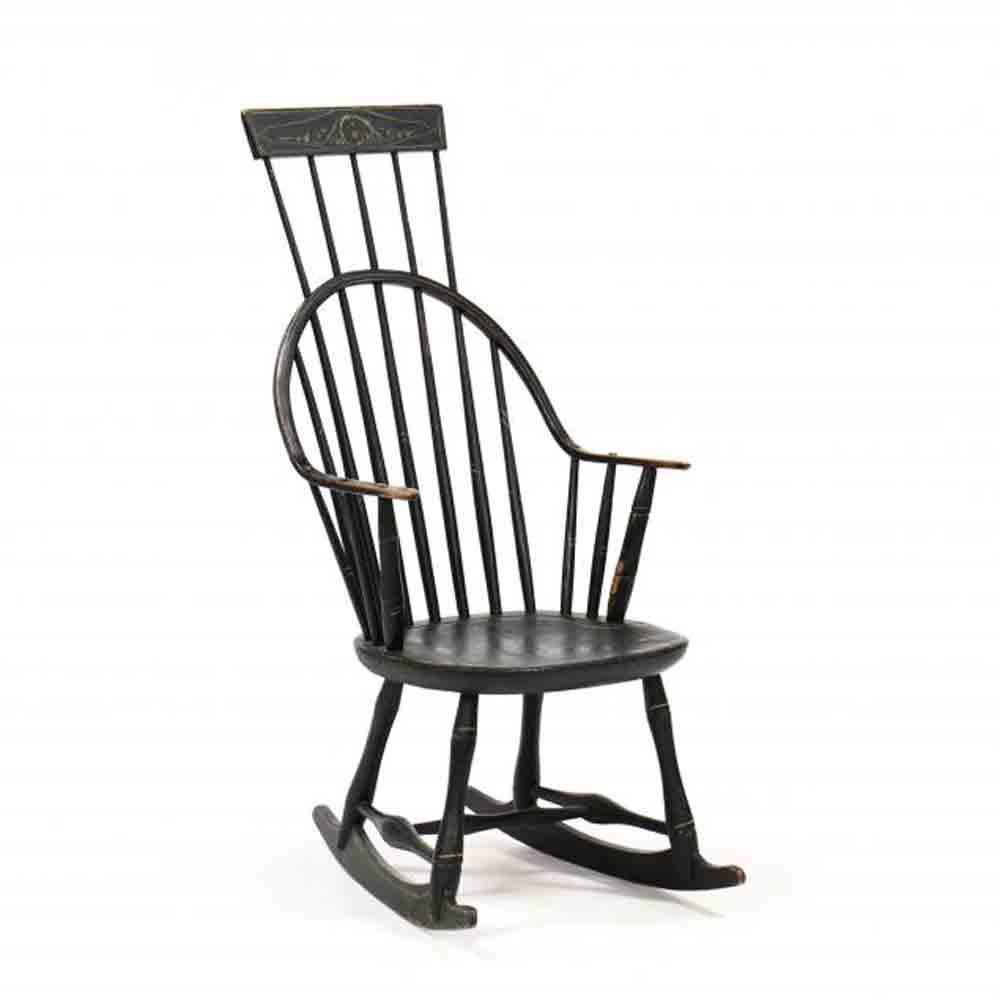
- Windsor (late 18th–mid-19th century): Bow-back, sack-back, or comb-back with turned legs and spindles, often painted. Through-tenoned legs peened over the seat are a hallmark.
- Hitchcock and paint-decorated (c. 1820–1840): Black or dark paint with gilt stenciling, sometimes signed/stenciled under the seat or on the crest rail.
- Spool-turned “Jenny Lind” (mid-19th): Rosettes and bead/spool turnings; often with cane or rush seats.
- Boston rocker (c. 1830–1860): Scrolled crest, painted or grain-painted, curved seat rails; child versions exist.
- Shaker ladder-back (mid-19th–late 19th): Tall slats, taped/rush seats, clean lines, pinned joints. Mount Lebanon, Hancock, and other communities produced small-scale examples.
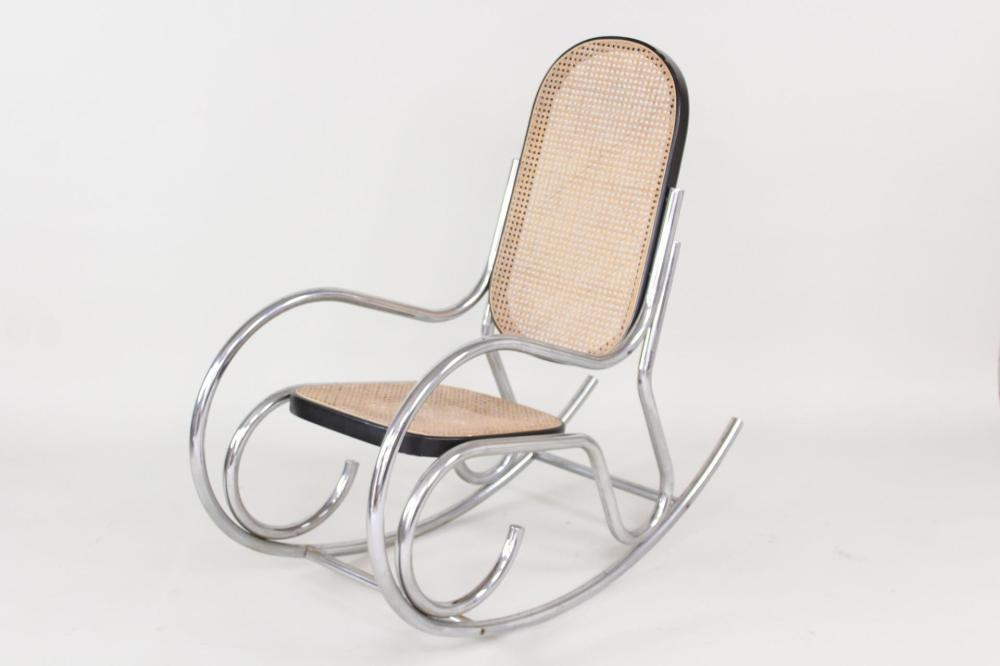
- Bentwood (Thonet and followers, c. 1870–1910): Steam-bent beech components, light and elegant; look for paper labels, heat brands, or impressed marks.
- Wicker/rattan (Heywood, Heywood-Wakefield, c. 1880–1920): Woven bodies, curvilinear arms; factory labels can persist under seats.
- Pressed-back oak (c. 1880–1910): Decorative machine-pressed motifs on crests and splats; robust runners.
- Arts & Crafts/Mission (c. 1900–1920): Straight lines, slats, quartersawn oak.
- Southern/Appalachian ladder-back (19th–early 20th): Split or bark seats, simple slats, sometimes maple or hickory posts, handmade runners.
- Colonial Revival (c. 1890–1930): Small-scale nods to Federal or early colonial forms with machine-made precision.
Labels and marks
- Thonet: Paper labels on underside or heat-branded “THONET.”
- Heywood/Heywood-Wakefield: Paper or metal tags; stamped numbers.
- Hitchcock and painted chair makers: Stenciled signatures in gold on black under the seat or crest.
- Retailer/dealer stencils: Regionally useful for provenance.
What Drives Value: A Practical Framework
Valuation is a function of type, demand, originality, condition, and venue. Use comparable sales but calibrate for condition and market context.
High-level drivers
- Desirability of form and maker: Scarcer, design-forward, or labeled examples command premiums.
- Original surface: Untouched original paint, stenciling, and finish can double or triple value versus stripped/refinished counterparts.
- Condition and completeness: Sound runners, tight joints, intact seat weaving, and unbroken spindles preserve value.
- Provenance: Documented ownership or institutional deaccession can add 10–30%.
- Scale: True child’s size is more valuable than doll size unless the doll chair is a salesman’s sample or folk-art masterpiece.
Indicative price ranges (typical retail/collector market, assuming honest age and decent condition)
- Early Windsor child’s rocker (good original paint): a value that must be established from current, topic-matched sales+
- Shaker child’s ladder-back (community-attributed): a value that must be established from current, topic-matched sales
- Hitchcock/stenciled child’s rocker (strong stenciling, signed): a value that must be established from current, topic-matched sales
- Boston rocker (child’s): a value that must be established from current, topic-matched sales
- Spool-turned “Jenny Lind” (child’s): a value that must be established from current, topic-matched sales
- Bentwood Thonet (labeled): a value that must be established from current, topic-matched sales; unlabeled or later: a value that must be established from current, topic-matched sales
- Wicker Heywood/Heywood-Wakefield (sound weave): a value that must be established from current, topic-matched sales; rare forms higher
- Arts & Crafts/Mission oak (quartersawn, labeled or attributable): a value that must be established from current, topic-matched sales
- Pressed-back oak (late Victorian): a value that must be established from current, topic-matched sales
- Southern/Appalachian ladder-back with original split/bark seat: a value that must be established from current, topic-matched sales
- Folk-painted or theorem-decorated one-offs: a value that must be established from current, topic-matched sales+
- Salesman’s sample rockers (finely made, documented): a value that must be established from current, topic-matched sales+
- Doll-sized chairs (typical): a value that must be established from current, topic-matched sales; exceptional or signed examples higher
Adjustments and multipliers
- Condition multiplier (rule-of-thumb):
- Pristine original: x1.0–1.2
- Honest wear, tight structure: x0.8–1.0
- Stable repairs (invisible): x0.7–0.9
- Visible repairs/replacements (runners, spindles): x0.4–0.7
- Major losses/overpaint/stripped: x0.2–0.5
- Venue impact:
- Regional auction/estate sale prices can be 20–40% below full retail.
- Dealer/retail pricing reflects restoration, curation, and overhead (often 1.5–2.5x auction hammer).
- Online marketplaces vary widely; shipping constraints temper prices for larger or fragile wicker.
Market context
- Trend sensitivity: Farmhouse/cottage-core decor boosts painted and ladder-back forms; mid-century minimalist rooms may favor Mission and bentwood lines.
- Geographic variance: New England and Mid-Atlantic often show stronger prices for Windsor, Hitchcock, and Shaker; Midwest and South can favor oak and ladder-backs.
Condition, Restoration, and Originality: What Helps, What Hurts
Condition assessment
- Structure: Rockers should sit flat; runners should be even and not excessively flattened. Check that the runners match and align with seat rake.
- Joints: Test for looseness at stretchers, legs, and back posts. Re-glued joints are acceptable if done cleanly with reversible adhesives; overspill and brads detract.
- Seat materials: Original cane/rush/splint seats add value. Competent reweaving is acceptable but reduces value versus original. Sheet cane stapled into a grooved frame is later than hand-caned holes.
- Surface: Original paint/stenciling is a premium feature. Overpaint, heavy stripping, or thick polyurethane reduces desirability. Dirt can be cleaned; original pigment cannot be replaced.
- Breaks and repairs: Cleanly repaired spindles and discreet patches are acceptable; plate repairs, metal straps, and visible screws are red flags.
- Odor and storage: Mildew or smoke smell indicates poor storage; can be mitigated but buyers hesitate.
Common pitfalls
- Cut-down adult chairs: Look for plugged mortises, shortened proportions, or a seat that seems too wide for the back height.
- Married parts: A base from one chair with a top from another lowers value; finish/color mismatches are a clue.
- Reproduction/decorative pieces: Mid-20th-century reproductions may have uniform machine parts, modern screws, and fresh finishes. They’re charming but usually worth less.
Restoration guidance
- Keep old surfaces: Resist stripping. Gentle conservation beats restoration for value retention.
- Reversible repairs: Use hide glue or conservation adhesives; document your work.
- Seat repairs: Professional rush/cane replacement is better than a sagging or broken seat; keep any original fragments and photos of the before state.
- Color-matched touch-up: Inpainting small losses can stabilize without deceiving; avoid wholesale repainting.
Safety note These chairs were built for 19th- and early 20th-century nurseries, not modern safety standards. If you plan functional use, test stability thoroughly—or enjoy the piece as a decorative artifact.
Quick Appraisal Checklist
- Measure the seat height and width to confirm child’s size (typically 10–14 inch seat height).
- Identify the style (Windsor, ladder-back, bentwood, wicker, pressed-back, Mission, etc.).
- Inspect joinery: through-tenons, wedges, pinned joints, or dowels—note hand vs. machine work.
- Examine the runners: matching, even wear, correct alignment, and period-appropriate shape.
- Check for labels/marks: underside of seat, crest rail, stretchers (Thonet, Heywood-Wakefield, Hitchcock, retailers).
- Evaluate the surface: original paint/stenciling or shellac; look for overpaint or stripping.
- Assess seat material: original cane/rush/splint vs. later replacement; check tightness.
- Test structural integrity: gentle rocking should reveal loose joints or creaks.
- Look for alterations: plugged holes, mismatched parts, cut-down legs, modern screws/nails.
- Document provenance: family history, photos in situ, dealer receipts.
- Photograph clearly: front, side, back, underside, details of labels and repairs.
- Compare to recent sales of similar style/age/condition; adjust for venue and geography.
Frequently Asked Questions
Q: How can I tell the difference between a child’s rocker, a doll chair, and a salesman’s sample? A: Measure and study workmanship. Doll chairs are typically under 8 inches seat height and often simplified. True child’s chairs are proportionally scaled with 10–14 inch seat heights and sturdy joinery. Salesman’s samples are miniature but exceptionally well-made, mirroring full-scale construction and finishes; they often carry maker marks and bring higher prices.
Q: Does refinishing always hurt value? A: Nearly always. Original paint, stenciling, and oxidized finishes are key value drivers. Gentle cleaning and conservation are preferred. Necessary structural repairs and professional seat rewoven work are acceptable; wholesale stripping and glossy modern finishes can cut value by half or more.
Q: What are the most valuable types of antique child’s rockers? A: Documented early Windsors with original paint, Shaker ladder-backs with community attribution, labeled Thonet bentwood examples, rare forms by Heywood-Wakefield, and finely made salesman’s samples. Strong folk painting, crisp Hitchcock stenciling, or remarkable provenance also push prices up.
Q: What’s the best way to estimate a fair price to sell? A: Assemble recent comparable sales of the same style and period, match condition closely, and then adjust for your venue. For quick local sale, price near the lower end of comp ranges; for retail or consignment with a specialist, target mid-to-upper comp ranges, accounting for commission. Always disclose repairs and provide good photos.
By approaching antique child’s rocking chairs with a clear taxonomy, careful eye, and disciplined comparables, you’ll unlock both their charm and their worth—preserving history in small scale while making informed valuation decisions.