Have one like this?
Upload a photo for a free check of what yours may be worth.
Lot description
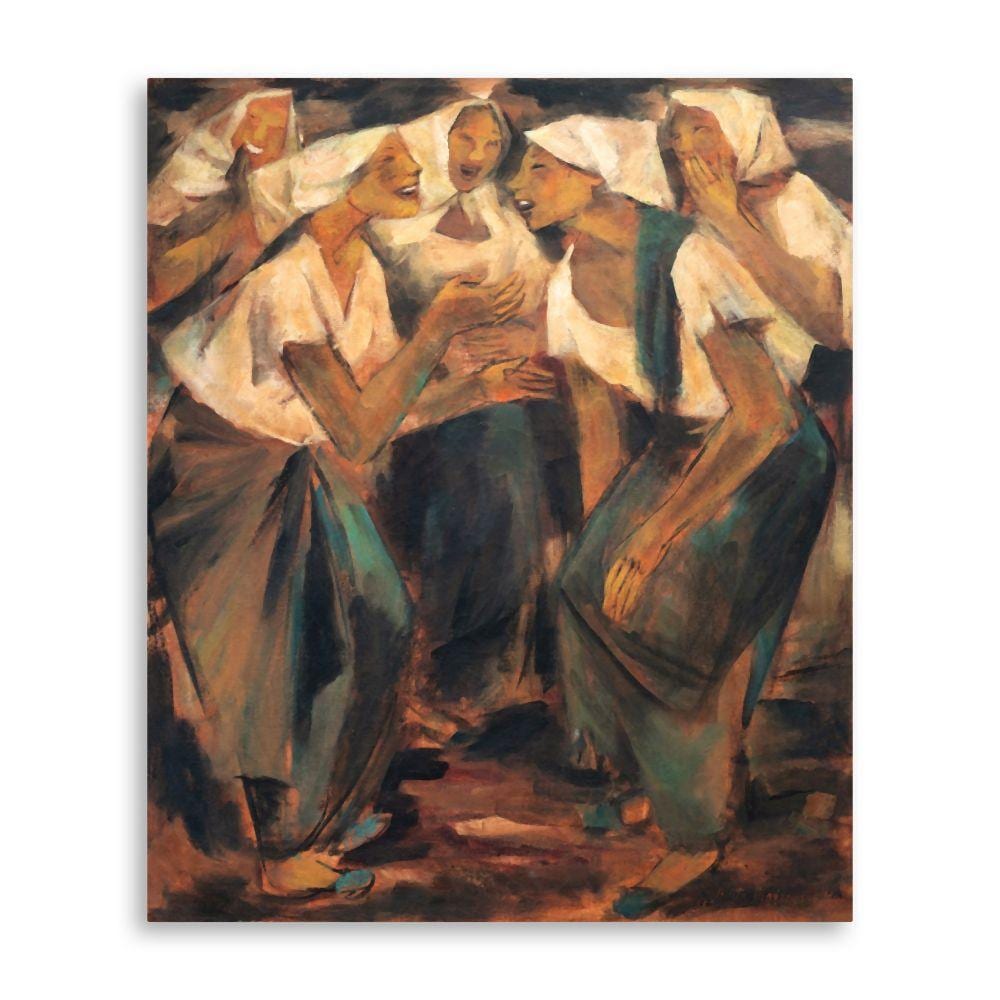
Five Senses signed and dated 1950 (upper left) oil on wood 13" x 10" (33 cm x 25 cm) PROVENANCE Private collection, USA LITERATURE "Judges' Choice." This Week, September 1950. Purita Kalaw-Ledesma Center. Kalaw-Ledesma, Purita and Amadis Ma. Guerrero. The Struggle for Philippine Art. Quezon City: Purita Kalaw-Ledesma and Vera-Reyes, Inc., 1974. Listed on page 181 as "2nd Prize, Five Senses, Anita Magsaysay- Ho" under the partial list of awards given by the Art Association of the Philippines in its exhibitions and competitions. Magsaysay-Ho, Anita and Alfredo R. Roces. Anita Magsaysay-Ho: In Praise of Women. Pasig: The Crucible Workshop, 2005. Title mentioned on page 38. EXHIBITED Manila Grand Opera House, Manila Grand Opera House Art Exhibition (Sponsored Jointly by the Art Association of the Philippines), Manila, 15 - 30 August 1950 AWARDED This painting was awarded the Second Prize at the Manila Grand Opera House Art Exhibition and Competition, held in August 1950 and cosponsored by the influential Art Association of the Philippines (AAP) Anita's first prize-winning masterpiece resurfaces Presented in this lot is an exceptional painting by Anita Magsaysay-Ho, recently resurfaced after being unseen by the public for over seven decades since its last showing in 1950. Titled Five Senses, the work was Anita's entry to the Manila Grand Opera House Art Exhibition, sponsored jointly by the then-nascent Art Association of the Philippines, held from 15 to 30 August 1950. Doubling as a competition, paintings in the exhibition were critiqued and evaluated by a panel of distinguished judges that included lawyer, diplomat, public servant, and art patron Jorge B. Vargas, newspaper maven who served as editor and editorial consultant for the influential The Manila Times, David Theodore Boguslav, Jacques Grosbois of the French global news agency Agence France-Presse, and Jack London of the French Ministry. Five Senses won the Second Prize at the said competition, only bested by Vicente Manansala's Barong-barong #1, a theme he pioneered in Philippine art. Most notably, Anita's second-prize nod for Five Senses was her first-ever major painting award. Hernando R. Ocampo, the High Priest of Philippine Modernism and its foremost stalwart, won Third Prize for his intriguing work, Dark Self. A report from the highly popular Sunday magazine This Week said of the winning entries: "Not so long ago, these paintings would not have made better than honorable mention (and one would have been cried down as lunatic) in any local art contest. A shift in patronage and viewpoint has since enabled modernists to win due recognition with works like these three, which won the first three prizes in the exhibition sponsored this last fortnight by the Opera House management." In fact, three of the honorable mentions in the competition went to the modernists: Anita's own Still Life, Cesar Legaspi's Symphony, and Manansala's Barong-barong #2. With the modernists' triumph in this exhibition-cumcompetition, dominating and bagging all the top three major prizes, they truly heralded a changing of the guard, the metamorphosis of the Filipino art landscape from the idyllic and romantic pastoral canvases of Amorsolo and his followers to that of the stylized, in which colors and forms are liberated and emotional and sensory gravitas are strengthened. The resurfacing of Anita's Five Senses is most important. The public had not seen it in over seventy years. It was also not featured or reproduced in the artist's major monographs; only a mention of its title serves as proof of its existence. Even Anita did not mention it in her all-important memoirs, and it was not included in her major retrospective at the Museum of Philippine Art in the late 1980s. Furthermore, seventy-six years ago, the modernist vanguards, the Neo-Realists, which included H.R. Ocampo, Manansala, and Legaspi, and who notably chose to express the harsh and unbridled reality of the times, had their first public exhibition at the Manila Hotel, sponsored by the Art Association of the Philippines, which shouldered the task of rebuilding and revitalizing Philippine art after the trauma of war. A little further back, seventy-eight years ago, the AAP held its first annual art exhibition and competition at the National Museum, temporarily located at Herran (now Pedro Gil) Street. In it rose triumphantly the "Thirteen Moderns," with Botong Francisco winning the coveted first prize for his masterpiece Kaingin. Demetrio Diego, Manansala, Legaspi, Diosdado Lorenzo, and H.R. Ocampo swept the second to sixth prizes, respectively. The great Fernando Amorsolo, one of the judges, even listed four moderns in his preferred winners of the six prizes, considering that he was the de facto leader of the conservative school. Newspapers and magazines of the time were quick to notice the modernists' landslide victory, with the Sunday Times Magazine writing that "the AAP show is the first substantial recognition of the Modernist group." Meanwhile, a heated rivalry between the conservatives and the modernists ensued in debates publicized in a series of articles in The Sunday Times Magazine and This Week, written by Guillermo Tolentino and Victorio Edades, who represented each camp. The intellectual hostilities between the two camps prompted the reading public to take a stand, with a majority still sympathetic to the conservatives. Nonetheless, a handful of writers and journalists, such as Magtanggul Asa, E. Aguilar Cruz, I.P. Soliongco, Carmen Guerrero-Nakpil, and Francisco Arcellana, defended the modernist cause. Subsequent AAP competitions would see a pattern of modernist victory. The 1950 AAP competition, on which Anita won her first major prize, further solidified the Filipino modernist's prestige and status within the country's art sphere. It ushered in a new era for the Filipino artist, not only to catch up with the rest of the world in art trends but also to aptly express the harshness and resilience of the period. Sure enough, the modernists were not just staging an artistic revolution within a practically barren, stagnant cultural landscape; they were also reinforcing the idea of the artist as a professional. They were well educated and earned master's degrees at prestigious art schools abroad, seeking artistic advancement and improvement to defend their status as artists better and steadfastly champion their ideals. Overall, Five Senses is a work that encapsulates a society attuned and alert to the changing times: the changing of the guards, the heralding of a new age. As this masterpiece earned Anita her first major painting prize, Five Senses captures a juncture in modern art's gradual acceptance. Not only that, but the work also powerfully symbolizes that women are as capable as their male counterparts, that they, too, can lead the battle for modernism's triumph, becoming the more powerful visual articulation of a nation enduring the wounds and carrying the hopes of the post-war world. Five Senses, embodying Anita's position as the foremost Filipina painter A year before Anita painted Five Senses, in 1949, she held her landmark Manila Hotel exhibition, where she unveiled to the Philippine public, for the very first time, the egg tempera paintings she had painted while studying at Michigan's Cranbrook Academy of Art. The exhibition was well-attended by Manila's who's who (about 200 of them graced the opening cocktails), and the works were deemed a breath of fresh air for their novelty and graceful appearance. "For the first time, awkward, angular figures, mostly women, were painted in egg tempera or oil...The exhibition was a sell-out," Purita Kalaw-Ledesma, AAP founder, reminisced in her introduction to the exhibition catalog of her amiga's retrospective at the MOPA in late 1988. Anita's impact was so palpable that Purita recalled in her 1955 master's thesis that "artists were delightfully surprised to see the variety of media used [oil, egg tempera, watercolor, casein, wax, photogram, and collage], and the varied effects and wealth of possibilities that each medium could accomplish." She also recalled that after the exhibition, artists became more eager to explore mediums that suited their style and character, and local materials, such as achuete and añel, were explored as a means to search for a native identity in painting and to seek various ways to achieve luminosity in painting, the latter of which Anita exemplified. I.P. Soliongco, one of the most brilliant men of letters of the time and editorial writer/columnist of the Manila Chronicle, even christened Anita as "one of our favorites," indicating she was a darling of both the press and the critics. Anita's win for Five Senses was only the second time that a woman placed in the top 2 in a major art competition in the country during the post-war era (the first being Lyd Arguilla in the AAP 3rd Semi-Annual in 1950). Her dominance would reach new heights with her historic First Prize win at the 1952 AAP 5th Annual Exhibition and Competition for her now iconic The Cooks. Five Senses, as an encapsulation of all things folk and Filipino Five Senses depicts three women, each associated with one of the five basic senses. The lady on the right smells a sampaguita, with an ear riveted to the gossip being whispered by the lady on the left, who is seen grasping freshly picked sampaguitas. The woman at the back snacks on what seems to be a pili nut. The three women's flashbulb eyes represent the sense of sight, keenly attuned to the tea being spilled. Through angular distortion and manipulation, the piece conjures a comical, lighthearted composition that seems to alleviate the trauma of the recent war. The subject of the painting is very Filipino, as it touches on the popular pastime of chismisan, or gossiping, the easiest way to stay up to date on the latest happenings in the barangay or community. As Anita's stylized paintings of women are culled from the memories of her blissful childhood summers in the idyllic environs of Zambales, the hometown of her parents, Don Ambrosio and Dona Amalia, folks chitchatting after a long day's toil or even in the midst of their toiling to ease the burden of labor inspired Anita to paint a mischievous tableau. Anita may also have eagerly wanted a tête-à-tête with a friend as a quick breather from her responsibilities as a housewife to a growing family with shipping magnate Robert Ho ("painting between babies," she once joked). Maybe Anita had Purita in mind, since she was one of her best friends since their teenage years and shared "a deep appreciation for the arts." "She has advised me many times regarding some of my problems," Anita warmly shared in her memoirs. In gossiping, all five senses are functioning: ears for hearing the inside scoop, eyes for intensified, and oftentimes over-thetop reactions, tongues and noses for nibbling and savoring snacks, and the sense of touch reserved for outrageous, campy reenactments of and feedback to the "intelligence report." In contemporary pop culture, gossipers are known colloquially as "marites," the name humorously attached to a nosy neighbor and said to be a contraction of the question, "Mare, ano'ng latest? (Sister, what's the latest?)." Anita herself also said in her interview with Cid Reyes that it is the peculiarity of the Filipina, especially when laughing and conversing, that she was most drawn to. “I like the Filipina because she makes gestures, she’s very articulate,” she shared. Five Senses can be viewed as a sister piece to Anita's own Laughter, an acrylic on wood painting also created in 1950, and now forms part of the core collection of Purita Kalaw- Ledesma, bequeathed to the Kalaw-Ledesma Foundation archives, library, and art collection. The women's eyes are humorously reminiscent of Anita's, as evidenced by an egg tempera self-portrait she painted in 1950. Painter-critic Alfredo Roces wrote in his monograph on Anita that this is a peculiarity of Anita's early works, writing that the females are "wide-eyed, the dilated pupil a spot of black on a sea of white, heightening drama and tension." Anita's roots in classical training From Zoltan Sepeshy—Anita's Cranbrook teacher who was educated in Budapest's Royal Academy of Art and then in Vienna's Academy of Fine Arts, and the author of the instructional volume Tempera Painting (1946) that Anita likely exhausted as a reference—she learned and mastered the unforgiving medium of egg tempera and "the need for imagination and free interpretation of lines and shapes to create interest and counterpoint in place of faithful rendering of anatomy," as articulated by Roces. Even though the style is modern, the overall composition is still rooted in classical training. In 1946, Anita studied at the Art Students League of New York, America's oldest independent art school, which also honed the talents of Norman Rockwell, Jackson Pollock, Mark Rothko, Georgia O'Keeffe, Roy Lichtenstein, Gertrude Vanderbilt Whitney, and Robert Rauschenberg. Anita was mentored by Kenneth Hayes Miller, the influential American painter and a stickler for the rules, who taught her "the compositional device of painting women in pairs," which Roces further described:"The interaction between two or more figures remains a Magsaysay-Ho forte." Notice that in this work, the two women in the foreground are depicted in direct engagement with one another. In contrast, the woman in the background, who appears more like a curious cat, serves as a unifying device, balancing and harmonizing the composition and completing a fundamental technique called the "triangle composition," widely popular among Renaissance painters. The woman in the background also serves as a unifying element in the painting, making the three figures look as tight-knit as possible to convey a sense of social cohesion and intimate companionship. The two women at the center are the motifs/foundation to which the viewer anchors their eyes towards the other elements in the painting. The eyes of the woman on the right, who seemingly possesses a piercing gaze towards the viewers, engage them directly in their gossip, as if an enticing invitation, making this painting as palpable and sensory as its title conveys. What makes this painting even more alluring is its luminosity. The veil of the woman in the background, which serves as the painting's "perfecting" device, also functions as a lighting device, juxtaposed with the relatively darker background and the brown tones of their skin, interweaving dark and light areas. Anita's own delicate sense of touch manifests in thinly applied paint using sable brushes, the same ones she used in her egg temperas. A luminous effect is achieved through glazing, mainly using browns (on the women's skin), greens, and pinks, unifying contrasting tones and exhibiting "glowing" layers, which Anita called "veils," as taught to her by Miller and inspired by Rembrandt. This technique allows light to bounce within the work and reflect from within. The warm, earthy tones contrasted with the lush, cool tones and coupled with the luminous effect evoke Anita's glowing memories of her happy childhood vacations in Zambales, where she witnessed and developed empathy for the womenfolk: their inherent pride and dignity both in their everyday lives and in their communal endeavors that sustain and nurture society, partaking in their joys, stories of resilience, and even interludes of comic relief. “She can stand on her own,” Anita said.