Lot description
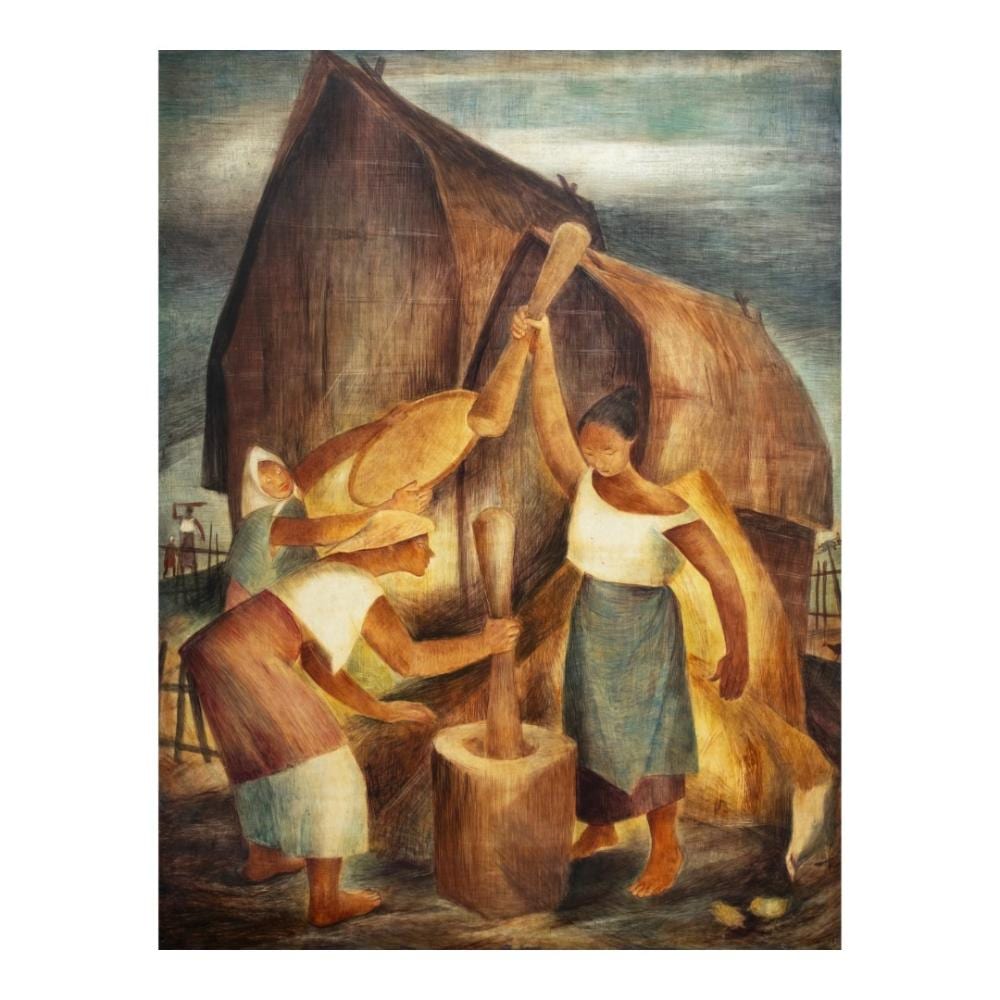
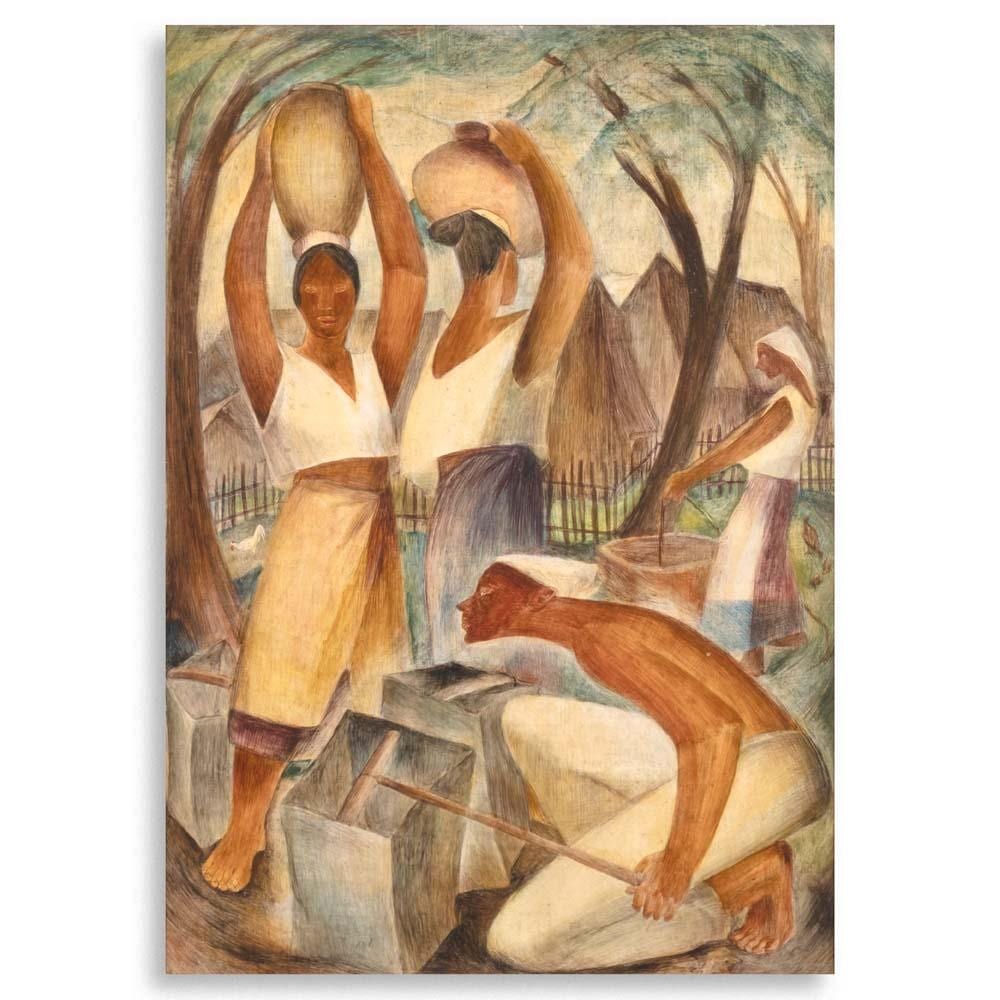
PROPERTY OF A DISTINGUISHED LADY Water Carriers / Taga-igib signed and dated 1947 (lower left) egg tempera on board 24" x 17" (61 cm x 43 cm) PROVENANCE Acquired directly from the Artist, ca. 1949 - 1950 LITERATURE "Versatile Artist: Painter of modern school turns back to the classic." The Sunday Times Magazine, 4 December 1949. Black-and-white illustration and painting description on page 30. Paras-Perez, Rod. Edades and the 13 Moderns. Published in conjunction with the exhibition of the same title at the Cultural Center of the Philippines. Manila: Cultural Center of the Philippines with the assistance of the National Commission for Culture and the Arts, 1995. Black-and-white illustration and painting description on page 78. Guillermo, Alice G. and Purita Kalaw-Ledesma. Anita Magsaysay-Ho: Isang Pag-Alaala (A Retrospective). Published on the occasion of the exhibition of the same title organized by the Metropolitan Museum of Manila. Manila: A. Magsaysay, Inc., 1988. Full-color illustration and painting description on page 39. Magsaysay-Ho, Anita. An Artist's Memoirs. Singapore: Anita Magsaysay-Ho and Tien Wah Press, 2000. Mentioned as by Anita as "Water Carriers" in the chapter "At Cranbrook" on page 100. Roces, Alfredo. Anita Magsaysay-Ho: In Praise of Women (With Annotations on Paintings by Anita Magsaysay-Ho). Pasig City: The Crucible Workshop, 2005. Full-color illustration and painting description on page 142. EXHIBITED Manila Hotel, Anita Magsaysay-Ho: Solo Exhibition, Manila, 26 November - December 1949 The Metropolitan Museum of Manila, Anita Magsaysay-Ho: Isang Pag-Alaala (A Retrospective), Manila, 15 December 1988 - 15 January 1989 Cultural Center of the Philippines, Edades and the 13 Moderns, Manila, 1995 Metropolitan Museum of Manila, Material Inspirations: Anita Magsaysay-Ho and Nena Saguil. Bonifacio Global City, Taguig, 9 November - 9 December 2024 The Cranbrook Anita Magsaysay-Ho The 'Water Carriers' At the Dawn of the Age of Egg Tempera by LISA GUERRERO NAKPIL The egg tempera works of Anita Magsaysay-Ho are the stuff of legend, elusive and rare, but also luminous and unforgettably beautiful. The magical egg tempera works were first born at the Cranbrook Academy of Art, described by the New York Times on the occasion of this avant-garde college’s 90th year, as “the utopian art school.” Modeled after the Bauhaus and created at approximately the same time as the equally famous Black Mountain College in North Carolina, Cranbrook however is the sole survivor of “the other early-20th-century experiments in modernism”, said the Times. As soon as World War II was over, Anita Magsaysay traveled to the United States to complete her education in the arts. The first stop was the Art Students League of New York; the second was Cranbrook which Anita described as the second “must” school to attend in her memoirs. Out of some 500 applicants, she was among the 100 that was invited to attend. Eliel Saarinen (1873- 1950) was the first director of the school. Cranbrook would offer courses that included architecture, ceramics, design, fiber, metals, painting, photography, printmaking and sculpture. (Charles and Ray Eames would meet each other at Cranbrook. Florence Knoll, Harry Bertoia and National Artist Jose Joya would be among Cranbrook’s graduates. Anita’s own teacher, both instructor and head of the painting department, was Zoltan Sepeshy (1898-1974.) Educated at the Royal Academy of Art in Budapest and the Fine Arts Academy in Vienna, Zoltan Sepeshy came to the United States in 1921 and to Cranbrook in 1931. He would eventually become the president of Cranbrook in 1946, at the time that Anita was enrolled. Cranbrook was a magical haven for artists. Its campus was designed by Saarinen and featured a reflecting pool surrounded by eight bronze statues. “There was an atrium, a Greek theater in the gardens, in front of which was a long pool,” reminisced Anita. Her room was “all white” and very modern, but it was the private studios for each student which were outstanding. “I would paint the whole day until 11:00 pm while listening to classical music playing in the gardens. The only breaks were for lunch and dinner.” It was in this atmosphere that she learned to paint using the Renaissance medium perfected by Raphael and taught to her by Sepeshy. It was a painstaking and time- consuming process that would yield astonishing results. Anita would reveal in her autobiography that ‘Water Carriers’, the work at hand, would be the third-ever egg tempera painting that she would create. A photograph exists, to be found in the biography, “Anita Magsaysay-Ho : Isang Pag-Alaala, A Retrospective” which shows the ‘Water Carriers’ at the point of its inception and the various stages it took to create it. Labeled “Artist’s Studio, Cranbrook Academy of Art, Bloomfield Hills, Michigan” it shows Anita wearing an artist’s smock over a checked shirt and twill trousers. To her left is a small boceto (study) of ‘Water Carriers’ and more instructively, to her right, the enlarged image on home-made carbon paper that she used to trace the figures onto the canvas, seen at the farthest end of the table. There are surviving notes describing the meticulous process to create the underpainting using this method. Afterwards, Anita would mix “5 values” for each color, using egg water and stirring the mix with black or blue, depending on the effect she wanted to produce. She would also prescribe the brushes needed — from fine sable to those for house paint —also rags and sponges, razor blades and sand paper. The cross-hatchings and striations add delicate textures and depth. It was a mysterious alchemy but instead of changing ordinary metal to gold, Anita would change egg yolks into magical works of art. Her mentor Sephesy had guided her to add more movement to her work, and the strong curves of the water carriers’ arms as they balance the clay jars on their heads create the requisite, brawny energy to do just that. A shirtless man prepares cans with a stick to carry the tins on his shoulder. A woman draws water from a well and in the distance, steeply-sloped thatch huts fill the distance past trees and a stick fence. The tableau is united by a simple palette of earth colors. Anita would confide in her memoirs that the Cranbrook experience would not only introduce the making of egg tempera paintings but was also “how she started painting women.” Both would define Anita’s career in art. Anita would become engaged to Robert Ho and married in a whirlwind romance in San Francisco after her first year in Cranbrook, cutting short this significant period in her career. It was only upon her return to Manila that she would take up the art of egg tempera again. The lustrous effects of egg tempera — combined with her lively, wholly original women figures — would make her the most famous woman artist in the country. And when she would win the grand prize at the prestigious Art Association of the Philippines’ competition with “The Cooks” in 1952, there was no mistaking the fact that she was also the best.