Lot description
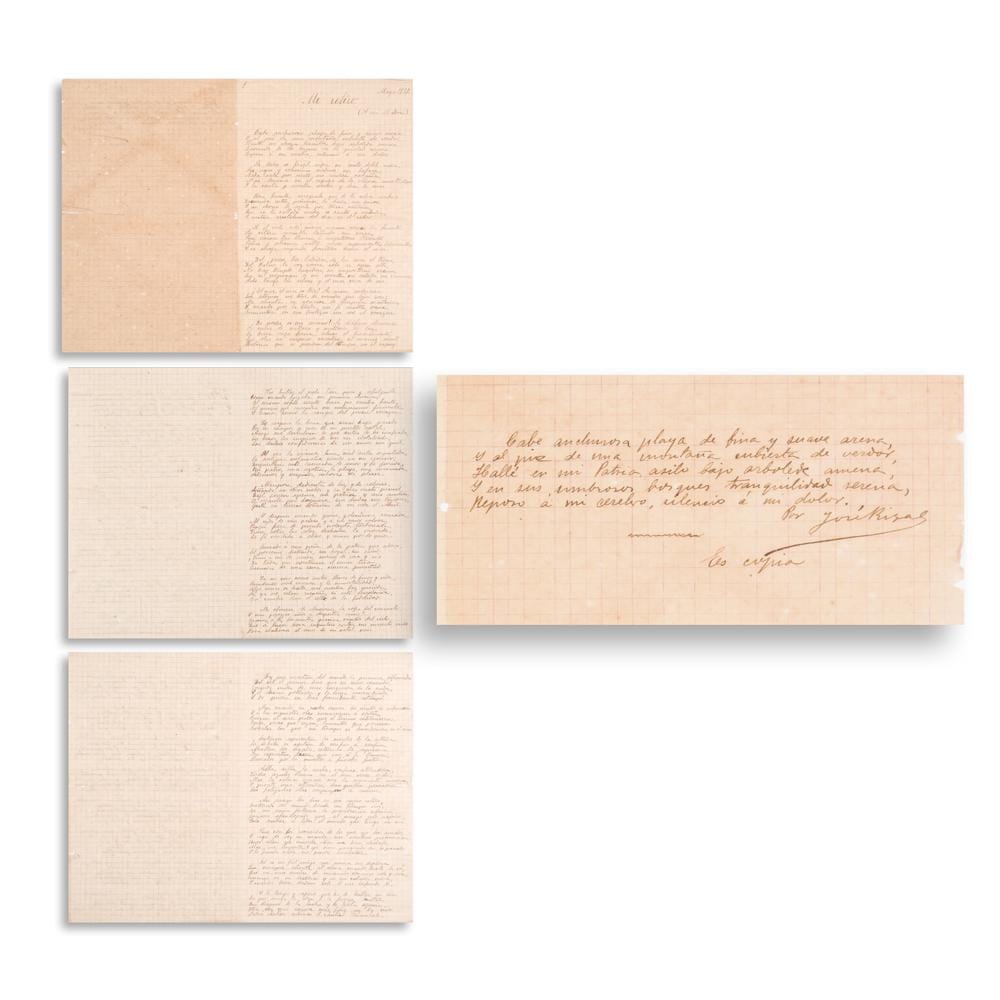
PROPERTY FROM THE COLLECTION OF TRINIDAD H. PARDO DE TAVERA Mi Retiro handwritten and signed by Jose Rizal himself ca. 1895 - 1896 two leaves of graph paper with four pages with handwriting enveloped addressed “Para Sr Dr Pardo, Calle Centeno, No. 7” (for Señor Doctor Pardo (de Tavera) Leaf 1: 8 1/4” x 10 1/4” (21 cm x 26 cm) Leaf 2: 8 1/4” x 10 1/4” (21 cm x 26 cm) Envelope: 4 1/2” x 5 3/4” (11 cm x 15 cm) WRITE UPRizal’s Mi Retiro His Message to the Filipino Nation by PROF. MICHAEL CHARLESTON “XIAO” BRIONES CHUA, PH.D. (CAND.) FILIPINO PUBLIC HISTORIAN Rizal moved to come home from Europe in 1892 and he knew when he arrived in Manila that he might be arrested or worse. He wrote two letters to his family and to the Filipino people to be opened after his death. He was, most of all, self-aware of his place in history and it was time to face his destiny. It is true that three days after he arrived, he organized La Liga Filipina — and he was arrested on 6 June 1892. The Spanish colonial government did not execute him, at least not yet. They had other plans. They exiled him to Dapitan, Zamboanga del Norte, which literally was the edge of the world. They wanted him to be isolated and battered until he surrendered his will to the whims of the colonizers. It was putting José Rizal in prison but without bars. But prison it was, and he did what he could to give life to the town. He became a single-man NGO who introduced, as Floro Quibyen noted: progressive education, social entrepreneurship and community development. In August 1893, his mother, Doña Teodora Alonso and his sister Maria joined him to live in Dapitan. He treated her eyesight and she was observed how much busier he actually had become. As noted by historians Gregorio and Sonia Zaide, his mother “regretted that he had neglected the Muses.” Before she left to go back for Manila in February 1895, she asked and encouraged her son to write poetry again. Rizal’s Mi Retiro His Message to the Filipino Nation by PROF. MICHAEL CHARLESTON “XIAO” BRIONES CHUA, PH.D. (CAND.) FILIPINO PUBLIC HISTORIAN Faith do I have, and I believe the day will shine When the Idea shall defeat brute force as well; And after the struggle and the lingering agony A voice more eloquent and happier than my own Will then know how to utter victory’s canticle. — Jose Rizal, Excerpt from Mi Retiro, October 1895. Tranlation by Nick Joaquin But it would take some time before he could fulfill her wishes. On 22 October 1895, Rizal sent the poem Mi Retiro to his mother along with another poem, Himno a Talisay, which would become a sort of anthem for his Dapitan pupils, “Though I have no letter from you, nevertheless I write you thus, sending you the enclosed poem that I promised you. Many months have already passed but I have not been able to correct it yet on account of my numerous tasks. Besides I follow the advice of Horace to let manuscripts sleep a long time in order to correct them better later.” Some might feel that the verses are only the lengthy musings — this is Rizal’s longest poem at 24 stanzas — of a lonely man, settled but never content. What makes this deeply personal poem relevant to our country today is because the author, our National Hero, still found in his hopeless situation the courage to dream of a better Philippines. Rizal believed that the Idea — of liberty and freedom, and of the equality of all men — was the Idea that would ultimately loosen the grip of the oppressors. Leon Ma. Guerrero, who himself was an excellent writer, wrote in one of the best biographies of Rizal, The First Filipino, “The verses for his mother, entitled - Mi Retiro are some of his best.” But what makes this poem important aside from its authorship, yet again, is the discourse, that surrounds it. Virgilio Almario, National Artist for Literature and the country’s foremost poet in his own right, examined Mi Retiro in his book “Rizal: Makata.” He asks that we look beyond the oversimplification that the poem is only about acceptance and finding joy in a limiting space. He suggests that we look at how Rizal used the word Retiro to express a myriad of meanings: it meant retirement from long duty, it also meant retreat from battle, but in a religious sense, it could also mean temporary respite from the frenzied hurly burly of the city life to reflect about life. It can also mean a look back to a life well-lived, a look back at the past and a physical return to once native or beloved land. In this we find the deeper and more relevant meanings of Mi Retiro. Rizal knew the fight was not yet over — and that somehow, the wheels of history would continue to turn. It can be argued, as it is argued by Almario, that Mi Retiro is a twin sister of Rizal’s Mi Ultimo Adios. And it would be wrong, as other experts say, that in bettering Mi Retiro’s standing would need to diminish Mi Ultimo Adios. The truth is both masterpieces are complementary and can best be appreciated if taken together. They are what constitutes Rizal’s long goodbye to the nation — and together pose an important message to all of us, its citizens. Mi Ultimo Adios’s last line answers the last premise of Mi Retiro, “Morir es descansar”—to die is to repose, to retreat, to rest. Rizal had found peace in dying, because the “Idea” had been brought forth. That Idea is ultimatly the Filipino Nation — a free Filipino nation. And he faced death courageously and valiantly, like all martyrs and heroes, because all the sadness and sacrifices were all worth it. Reflecting on the poem is like joining Rizal in his Mi Retiro as we also look back at his indubitable contributions to the birth of our nation. It is the perfect touchstone for its 125th year.