Lot description
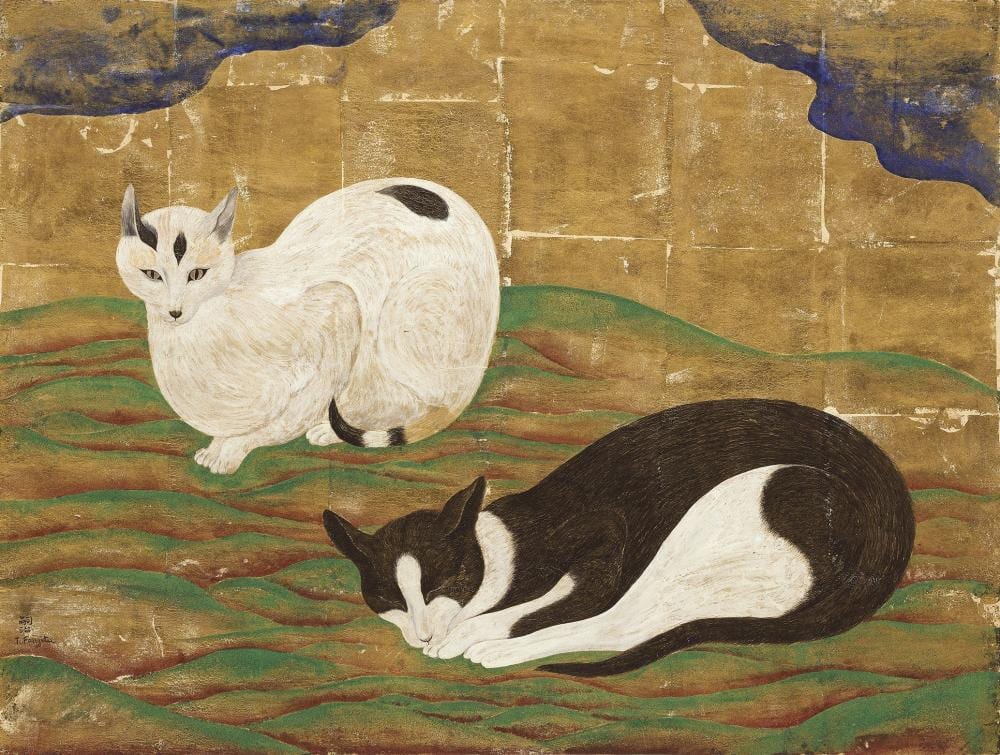
雙貓圖 Chats 簽名左下: 嗣治 T. Foujita 簽名畫背:藤田嗣治 T. Foujita於巴里 Signed lower left Tsuguharu in Kanjiand T. Foujita in English Signed on the reserve Tsuguharu Foujita in Kanjiand T. Foujita in English and inscribed in Paris in Kanji 身為巴黎畫派的代表人物之一,藤田嗣治的成就使他躋身20世紀日本藝術家翹楚,也是1920年代最成功的藝術家之一。1913年藤田嗣治甫達巴黎,當時的巴黎匯聚著各地的異國藝術家,不同的文化在繁華的巴黎相互激盪著,藤田為當時巴黎畫派帶來無限的東方色彩。但他在蒙帕納斯的生活十分困苦,直至1917年於波西街的紀庸畫廊舉行首次個展,以和洋式畫風很快的就在巴黎藝術圈成名。隔年藤田作品全數入選巴黎秋季沙龍,並和當時的畫家畢卡索、莫迪里安尼等人齊名。《雙貓圖》即是在此時完成的作品,也是最早以貓為主題的金箔畫作。由於第一次世界大戰的關係金箔取得不易,只有對畫家而言最重要的作品才會用上金箔。譬如藤田被東京新西洋美術館所收藏的作品《坐著的女人》及卡涅城堡博物館收藏的《蘇茜‧索利多爾肖像》也說明這件作品與這兩隻貓對藤田而言意義重大。 綽約多姿的慵懶之美 擅於描繪謬思女性之美之外,「貓」是藤田喜好的另 一大主題。貓與女人之間有著令他著迷的相似點,藤 田在多年創作生涯中以不同方式畫貓。此幅作品《雙 貓圖》以日本古代常用的金箔作畫,日式山水畫法描 繪背景,中間的兩隻貓以極細的工筆線條描繪貓毛, 活靈活現、躍然紙上,是藤田嗣治認為貓最美的型 態,結合了東方的墨韻與西方的水粉創作特色。左側 的貓名為Koneko代表感性,右側為Kiki代表慵懶美。 藤田不止一次在日記中寫道他喜歡貓,貓像女人,特 藤田嗣治與Koneko合影 Foujita with Koneko 別是像法國女人散發綽約多姿的慵懶自信美。 對西方人而言女性是美的代表,《雙貓圖》完整體現了女性的慵懶與敏感纖細之美與藤田對於東西方美學合壁的追求。藤田嗣治初到巴黎時作為東方藝術家於當時百花齊放的巴黎藝壇中繪畫風格獨樹一幟,這兩隻貓是他最早養的兩隻貓。也陪伴了藤田度過那段辛苦日子,1917年展覽成功後,1918年藤田即以金箔創作了這件作品。也代表Koneko與Kiki在其心中重要的地位。藤田還跟白貓Koneko照了許多照片,以及為牠創作版畫。直至1929年兩隻貓相繼離世後,再也沒有牠們出現在藤田作品當中。 Orientalism in Paris: The Art of Foujita de Paris, Léonard Tsuguharu Foujita was regarded as one of the top artists of the 20th century, and the most successful one in 1920. After relocating to Paris in 1913, he was surrounded by artists from all parts of the world, and was living in the melting pot of culture. After the first world war, Foujita introduced the beauty of oriental art to the Ecole de Paris. He led a life of destitute in Montparnasse until 1917 when he had his first solo exhibition at the Chéron Gallery with 17 aquarelle paintings. His works captured the eyes of Pablo Picasso. This shows Picasso's signs of appreciation towards the artist. In 1918, he visited Renoir and started incorporating oriental aesthetics into western art. The following year, all of his works were exhibited in the Salon d'Automne alongside, his fame continued to rise since then. Chats, offered in this sale, is a work from the period and is one of the first paintings of cats finished with gold leaf. Gold leaves were scarce after the war and would only be applied to the most important paintings of the artist. A Seated Woman, collection of the National Museum of Western Art, Tokyo, and Portrait de Suzy Solidor highlighted the significance of the two cats towards the artist. Sensual Beauty of Laziness Apart from women, cats are a prominent subject matter to Foujita. Cats and women captured the eyes and brush of Foujita throughout his artistic career. This work, Chats, was set in a background with gold leaf, composed with a Japanese landscape. Two cats were completed by incorporating western techniques to an oriental setting. A fine brush was used to depict the delicate hair of the cats, which was regarded as the finest way of expressing the beauty of the animal. Koneko, the cat on the left, symbolizes sensual beauty; while Kiki on the right represents graceful laziness. Expressed in his journal more than once, Foujita regarded cats with similar qualities as women, especially the confidence and beauty of laziness. Women as a symbol of beauty is prevalent in the Western ideology. Their beauty is depicted through laziness with sensual delicate figures. Using cats as a representation of women could be deciphered as the expression of sensitivity and laziness in Western art. The landscape setting represents the pursuit of oriental art, thus forming an incorporation of Western and Eastern techniques of art. These two cats were one of Foujita's earliest companions through his destitute life as an artist of the East when he first came to Paris. After his success at the exhibition in 1917, Foujita started using gold leaf, experimented on this work in 1918. The composition of Koneko and Kiki shows their significance to the artist. Several pictures were taken of Koneko, followed by numerous prints of the cat, until 1929 when the cats passed away, they never appeared in Foujita's works ever again.