Lot description
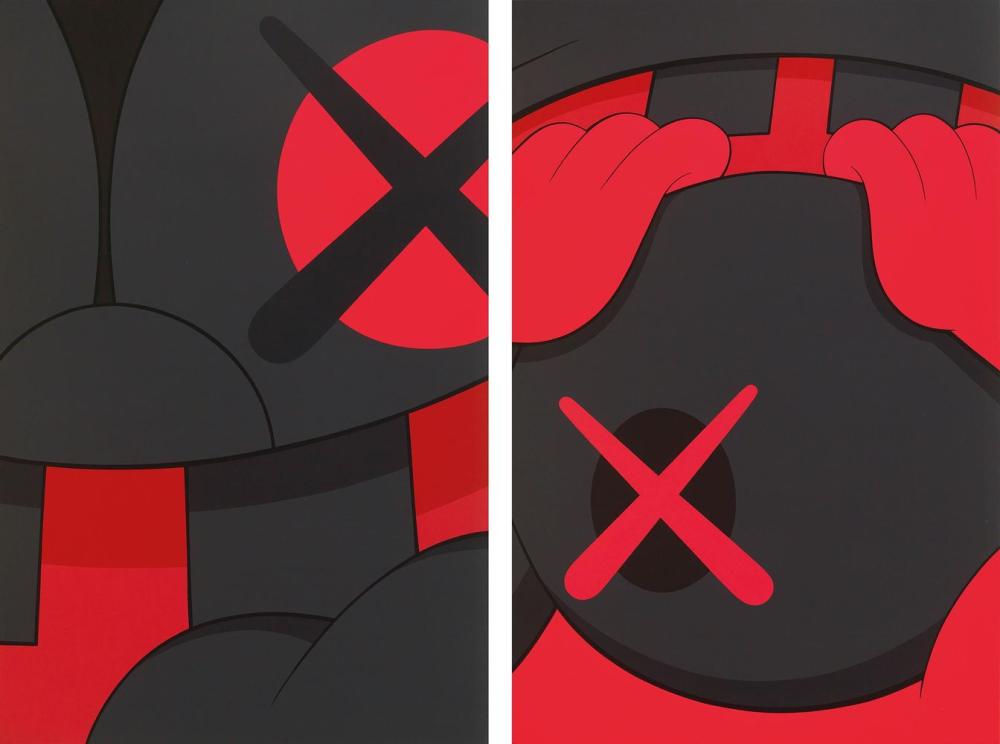
無題(雙聯幅) Untitled (Diptych) 簽名畫背:Kaws.. 13 Signed reverse Kaws.. and dated 13 of each canvas 20世紀的普普藝術引領風騷數十年,如今再度「瘋迷」世界,在21世紀的主流藝術市場中,這一群快速崛起的新收藏標的,街頭塗鴉、潮玩玩具等所謂「新普普藝術」,大篇幅占據新舊傳媒的版面。無論是美術原作,或是複數文創設計,在年輕世代藏家群組中關注度極高、最熱門的投資標的之一。 KAWS的本名是布萊恩.唐納利(Brian Donnely),1974年出生於美國紐澤西州的大男孩。1980年代好萊塢電影星際大戰、變形金剛風行、電視節目芝麻街、史奴比、加菲貓、辛普森家庭等卡通影集,這些虛擬角色伴隨布萊恩的童年時光,全球多數同代的孩子,幾乎受此美國流行文化影響。點點滴滴的成長印象,逐步拼圖出他幽默與想像力十足的幻想世界。 布萊恩從小喜愛滑板運動。後來從澤西市搬遷到紐約,藉由玩滑板,深度認識了曼哈頓,視野隨之不同。每個周末都去參加賽道滑板,布魯克林銀行的周邊最適合溜滑板,而附近正是紐約街頭塗鴉勝地,那些鮮豔圖案、酷炫的滑板圖案設計,以及張力十足的噴漆塗鴉,一一成為他在美術上的啟蒙。他最欣賞滑板設計師吉姆.菲利浦斯Jim Phillips,1980年代的知名作品《吶喊之手》(Screaming Hand)的經典圖案,默默地影響了布萊恩後來發展出的《死亡之手》(Hands of Death)作品。 1987年布萊恩對塗鴉產生興趣,隨意在筆記本上塗塗畫畫,因為就讀天主教學校,故意畫一些反宗教的東西,或是看起來酷酷的怪物。高中時期,他更加進階,改在牆壁塗鴉,年輕都愛到處Tag標籤自己的名字。然而塗鴉畢竟屬於非法的行為,不能用本名,於是布萊恩設計了四個字母KAWS,從此以KAWS之名闖蕩江湖。 第一次在大型告示牌上作畫,他挑選Captain Morgan(摩根船長)酒商的廣告,小心翼翼不去覆蓋原有的圖像,並精心搭配色彩,將KAWS字母和諧地融入廣告之中,他的塗鴉的實驗有層次與視覺美感。1995年Captain Morgan換上新的廣告看板出現時,他又再度畫了另一幅。兩件的攝影圖像紀錄已是回顧 KAWS大學時代塗鴉歷史的成名代表作。 其最早的街頭創作,多為牆壁、廣告看板和貨櫃車側面等大型版面,如1996年作於萬寶路(Marlboro)廣告看板上的塗鴉,其上已可見KAWS標誌性的交叉骷髏頭和XX眼。他設計出一個插有兩根交錯骨頭的骷顱頭、雙眼打叉、身體彎曲如蛇的圖案,取名為Bendy(彎彎,精蟲)。這個精蟲形象後來亂入街頭廣告,打開KAWS的知名度。 1996年KAWS向藝術家朋友Barry McGee學會開鎖技術,接下來幾年間多次把街上的廣告從玻璃櫃內取出,回工作室加工塗畫之後再擺回去,海報中出現了Bendy的圖案或局部骷顱頭面具。骷顱頭或精蟲的生死形象在全世界的解讀一致,別無懸念,藝術家覺得特別有意思。他將動畫創作剩餘的賽璐珞膠顏料cel animation paint運用於街頭海報的塗鴉,營造出類似塑膠感的效果。無縫似的加筆加料,隨著模特兒的姿態纏繞,產生出乎意料的趣味感。1990年代,他刻意挑選當年堪稱前衛性感,甚至帶有挑釁意味的廣告攝影,如Guess,Calvin Klein等品牌。 KAWS以其創意介入街頭海報,幽默惡搞的subvertising行為,賦予街頭塗鴉新的意義,他為精緻的、魅惑的模特兒肖像描繪加工,揶揄美國的反烏托邦,造成一股旋風,有些品牌後來主動找上他,請求為自家品牌廣告加工,這些海報作品後來成為藏家爭相收購的標的物。紐約街頭海報製作的數量約60-70件左右,後來在倫敦、巴黎複製惡搞廣告。KAWS被歸類於龐克文化的Brandalism(顛覆廣告),他結合了品牌Brand與破壞主義Vandalism,具有藝術性的深度與廣度。 後來1993年進入紐約曼哈頓的視覺藝術學院(School of Visual Art),知名塗鴉藝術家奇斯.哈林Keith Haring也是校友,當然他也是KAWS景仰的傳奇人物。KAWS不像其他的塗鴉前輩:Taki183, Futura,Basquiat (SAMO),Keith Haring,多潛伏在陰暗的地鐵站、陸橋下作畫,他偏愛明亮的公路旁的大型告示牌、貨櫃車廂,以及後來的公車站、電話亭的廣告箱等。這些都預示了多年後他在世界各大城市執行地景藝術的大計畫。 KAWS畢業後,曾在迪士尼動畫工作室Jumbo Pictures工作了三 年,其繪製動畫電視連續劇的經驗,為日後創作Kimpson、Skurfs、 KAWSBOB、BFF(Best Friends Forever)等卡通形象提供了靈感。 1997年KAWS受來自大學同學的邀請,第一次到日本旅行。透過滑板高手友人YOPPI江川芳文(Yoshifumi EgawaI,主持潮牌realmad HECTIC)的引薦,結識了幾位潮流圈名人設計師如長尾智明NIGO(猿人A Bathing Ape/ BAPE)、高橋盾JunTakahashi(UNDERCOVER)、岩永光Hikaru Iwanaga(賞金獵人Bounty Hunter)、瀧澤伸介Takizawa Shinsuke(NEIGHBORHOOD)等等。在這趟亞東的旅程中,HECTIC服飾向KAWS委託訂製玩具設計,交由Bounty Hunter製造共同合作,於是KAWS的第一件立體作品─玩具版本Companion(同伴)問世。Companion是KAWS最早創作的玩具形象,有著可識別的交叉骷髏頭和XX眼,並穿戴手套、短 褲和鞋子。 2006年KAWS和日本玩具商Medicom Toy在東京南青山區開了一間叫做OriginalFake的實體商店,建立了潮流事業的里程碑,依據他的藝術風格規劃設計,所有販售的商品都是KAWS藝術概念的延伸。KAWS將自身定位於一位藝術家、設計師以及生產者(artist, designer & producer)。他也和其他藝術家聯名設計不同版本的Companion,如空山基、設計師BAPE、家具公司Karimoku、玩具公司Medicom Toy合作,甚至有如醫學模型的半解剖版本,因製作工續較複雜,半剖版本的Companion玩具價格較高。值得玩味的,KAWS一系列的玩具名稱多半有朋友或陪伴的涵義:如Companion ⁄同伴 (1999)、Chum ⁄ 密友 (2002)、Accomplice ⁄ 共犯兔(2002)、The Twins ⁄ 雙胞胎(2006)、BFF ⁄ 最好的朋友 (2016)、Together ⁄ 一起擁抱 (2017)。 如同過去對廣告所作的干預一樣,KAWS也挪用《辛普森家庭》 (The Simpsons)、《藍色小精靈》(The Smurfs)、《海綿寶 寶》(SpongeBob SquarePants)等經典卡通形象。2000年左右, KAWS開始將這些卡通形象繪製於畫布上,這一批壓克力畫作也成為 了目前拍賣市場上最炙手可熱的作品之一。2010年至2014年期間,KAWS開始嘗試一系列抽象畫作,這些作品多半作於多畫板和圓形畫布上,有著焦慮和扭曲的卡通角色臉部特徵,和可識別的XX眼,並對圖像作抽象和碎片化的處理,如同迷彩圖案一般。 油畫創作的重新巔覆原本的卡通角色設定,KAWS的作品顯示出自我遏制和情緒疏離。當我們想要了解他的角色時,劃X的雙眼禁止情感的交流,主題雖然可愛幽默卻也保持慣有的情感冷酷,無論恐懼或貪婪都不顧,甚至拒絕溝通。藝術評論家認為,KAWS的畫作命題大致屬於自傳性的,有的題目很短、很活潑,淺顯易懂,若題目很長,則隱藏著他的精明算計和個人敘事。動畫用賽璐珞明膠顏料,還有卡通角色的暗示,大膽顛覆正常的透視感,極其平坦的上色,不顯筆觸肌理,還有獨特的色彩調色,有霓虹色、淡色和黑色,特別的勃艮第酒紅和紫色,營造豐富的構圖效果。神秘個人化的涵義,甚至帶有抽象形式的壯麗。 2008年起與法國知名畫商艾曼紐.貝浩登(Emmanuel Perrotin)正式合作。1968年出生的貝浩登,二十多歲時即成立自己的畫廊,多年來與知名藝術家合作,有村上隆、莫瑞吉奧.卡特蘭(Maurizio Cattelan)、KAWS、JR、還有新秀阿爾軒(Daniel Arsham)等。貝浩登畫廊除了巴黎總部,香港、上海、東京、首爾都設有據點,雙方合作的11年間完成九檔出色的展覽,吸引大量觀展人潮。 從2018年在紐約斯卡斯特德畫廊(Skarstedt Gallery)舉辦KAWS個展「失去」(Gone)後,2019年KAWS正式與貝浩登畫廊分手,改與皮爾.斯卡斯特德(Per Skarstedt)合作。斯卡斯特德畫廊代理有巴塞利茲(George Baselitz)、喬治.康多(George Condo)、理查.普林斯(Richard Prince)等多位重量級當代藝術家。財力與影響力當然更勝貝浩登。 Kaws的公共收藏包括聖地牙哥當代藝術博物館(Museum of Contemporary Art, San Diego)、布魯克林博物館(Brooklyn Museum)、沃斯堡現代藝術博物館(Modern Art Museum of Fort Worth)和底特律康博軟體總部大樓(One Campus Martius)。 KAWS最早的美學產物開始於街頭,屬於地下、反文化的,不像傳統藝術家走主流模式,而是採取個人化的玩家戰術,結合網路與部落格的視覺傳播頻道,叛逆挑戰規則,建立起一個當代的傳奇。 For several decades, pop art led the way in shaping the artistic landscape of the 20th century. Now, in the mainstream art market of the 21st century, a new pop art craze has emerged. Consisting of street graffiti, art toys etc., this new category of increasingly sought after art collections is often referred to as "New Pop Art", and rapidly spread to occupy all forms of media, both new and old. Regardless of whether its an original artwork, or electronic copies of digital designs, New Pop Art works have drawn large amounts of attention from the young generation of collectors, as well as become one of the most popular types of art to be purchased for investment purposes. KAWS's real name is Brian Donnelly. He was born in 1974 in New Jersey, USA. It was the characters from 1980s movies like Star Wars and Transformers, and television shows such as Sesame Street, Snoopy, Garfield, the Simpsons, and other such cartoons that accompanied Brian throughout his childhood. Almost all children from that era across the world were similarly influenced by American pop culture in some way. Little by little, these childhood impressions helped shape Brian's sense of humor and served as inspiration for a rich imaginary fantasy world. Brian loved skateboarding from a young age. When Brian later moved from Jersey City to New York, he got to broaden his horizons and gain a deeper understanding of Manhattan through skateboarding. Brian would go to the skate park every weekend. The areas surrounding Brooklyn Bank are great for skateboarding and nearby is a hotspot for New York street graffiti. The bright patterns, cool skateboard designs, and the bold spray paint graffiti all became his inspiration for art. He greatly admired the skateboard designer Jim Phillips. The classic pattern of the 1980 renowned work, Screaming Hand, quietly influenced Brian's later work, Hands of Death. In 1987, Brian became interested in graffiti, so he began to sketch casually in his notebooks. Because Brian attended a Catholic school, he would deliberately draw something anti-religious, or perhaps a rad-looking monster. In high school, he upped his game and started wall graffiti. Young people like to label their names within their works. However, since graffiti is illegal, they can't use their real names. So Brian designed the four-letter KAWS, which he has been using ever since. For his first work on a large billboard, he selected the advertisement of Captain Morgan, an alcohol manufacturer. Careful not to cover the original image, he meticulously coordinated the colors, harmoniously integrating KAWS letters into the advertisement, giving his graffiti experiment a layered and visual aesthetic. When Captain Morgan switched to a new advertising billboard in 1995, he painted it again. The two photographic image records have become famous masterpieces that are representative of KAWS's graffiti history during his college years. His earliest street art was mostly created across large surfaces, such as walls, billboards, and the sides of cargo trucks. KAWS made his iconic skull and bones and XX marks starting with the graffiti on the Marlboro advertising billboard in 1996. KAWS designed a skull with two crossed bones, a pair of XX eyes, and a curved body like a snake, named Bendy (bend, sperm). This sperm-like image later made its way into street advertising, setting up the popularity of KAWS. In 1996, KAWS learned locksmith skills from his artist friend Barry McGee. In the next few years, he would often take street advertisements out of their glass cabinets, and then go back to the studio to add graffiti before putting them back. The posters would have Bendy images or partially dirty skull masks. The life and death images of the skull and sperm are consistent throughout the world, so there is no confusion. The artist finds this to be particularly compelling. He applied the remaining cel animation paint of his animation work to the graffiti of street posters to create a plastic-like effect. The seamless addition of the brush and paint entwine with the model's posture to produce an unexpected sense of fun. In the 1990s, he deliberately chose advertising photography that was avant-garde or even provocative, such as Guess, Calvin Klein and other brands. KAWS inserts his creativity into street posters, utilizing humorous and spoofing subvertising behavior to bestow new meaning to street graffiti. He modified the exquisite and glamorous portraits of models, ridiculing the anti-utopia of the United States, creating quite a whirlwind. Some brands later took the initiative to find KAWS and request modifications for their own brand advertisements. These posters later became sought-after items for collectors. There were about 60-70 street posters produced in New York which were later replicated in London and Paris as spoofed advertisements. KAWS is classified as Brandalism in Punk culture. He incorporates his brand with Vandalism, embodying artistic depth and breadth. In 1993, he started studying at the School of Visual Art in Manhattan. The renowned graffiti artist Keith Haring is also an alumnus, and was also someone who KAWS looks up to. KAWS is not like his graffiti predecessors-Taki 183, Futura Basquiat (SAMO), and Keith Haring, who laid low and painted in dark subway stations and under land bridges. Instead, he preferred large billboards and container compartments along bright roads, and later advertising boxes for bus stops and phone booths. These all serve as a prelude to his grand plan of landscape art which he implemented in major cities in the world many years later. KAWS worked at the Disney animation studio Jumbo Pictures for three years after graduation. His experience making drawings for animated TV series provided inspirations for his well-liked cartoon characters in the future, including the Kimpson, Skurfs, KAWSBOB, and BFF(Best Friends Forever). In 1997, KAWS was invited by his college classmate to travel to Japan for the first time. Through the referral of Yoshifumi "YOPPI" Egawa (the founder of streetwear brand realmad HECTIC), KAWS got to meet several fashion circles celebrity designers such as "NIGO" Tomoaki Nagao (A Bathing Ape / BAPE), Jun Takahashi (UNDERCOVER), Hikaru Iwanaga (Bounty Hunter), and Takizawa Shinsuke (NEIGHBORHOOD). In this trip to the East, HECTIC apparel commissioned KAWS to produce custom toy designs in collaboration with Bounty Hunter. This led to the release of KAWS's first three-dimensional work-the toy figurine version of Companion. Companion was the earliest toy figure created by KAWS, with his highly recognizable skull and bones, and XX marks as eyes. The figures are also known for wearing gloves, shorts and shoes. In 2006, KAWS and Japanese toy dealer Medicom Toy opened a physical store called OriginalFake in the Minami-Aoyama district of Tokyo, setting a milestone in the trend industry. According to his artistic style, planning, and design, all goods sold are an extension of the KAWS art concept. KAWS positions himself as an artist, designer, and producer. He also co-designed different versions of Companion with other artists, such as Hajime Sorayama, designer BAPE, furniture company Karimoku, and toy company Medicom Toy. He even made a semi- anatomical version, much like a medical model. The semi-anatomical version of the Companion toy is more expensive due to the complexity of the production process. It's worth pondering how KAWS's series of toy names embody the meaning of friends or companions, e,g., Companion (1999), Chum (2002), Accomplice (2002), The Twins (2006), BFF (2016) and Together (2017). As in the past when he borrowed from commercials, KAWS has also borrowed from the imagery of his cartoon classics, such as the Simpsons, Smurfs, and SpongeBob SquarePants. Around the year 2000, KAWS began to paint these cartoon images on canvas, and these acrylic paintings have become some of the most sought-after works on the auction market. Between 2010 and 2014, KAWS began to experiment with a series of abstract paintings. Most of these works were made on multi-panel and tondo (circular) canvases, with anxious and distorted cartoon character facial features, and recognizable XX eyes. It is abstracted and fragmented, just like a camouflage pattern. KAWS's artwork displays self restraints and emotional detachment. Whenever we tried to understand his characters, the eyes crossed with Xs denied any exchange of emotion. The themes were cute and humorous, but yet emotionally reserved; regardless of fear or greed, and refused to communicate. According to art critics, KAWS's artwork themes are mostly self relatable. Some topics are short, lively, and simple; if the topics are long, it conceives his calculations and life story. Celluloid paint is used in animations and implications in the cartoon characters. The artwork boldly disturbs natural perspective with extremely plain coloring, smooth texture, and unique color palette-neon red, light and black, burgundy red, and purple, to establish a rich composition. It creates a mysterious personal indication, and even carries the grandeur of an impressionist. KAWS began his official partnership with prominent French art dealer Emmanuel Perrotin in 2008. Born in 1968, Perrotin started his art gallery in his early twenties. Over the years, he partnered with several renowned artists, including Takashi Murakami, Maurizio Cattelan, KAWS, JR and rising star Daniel Arsham. Other than the headquarter gallery located in Paris, Perrotin Gallery also has locations in Hong Kong, Shanghai, Tokyo and Seoul. Within the eleven years of KAWS and Perrotin partnership, they accomplished nine outstanding exhibitions which attracted tremendous amount of visitors. After holding the solo exhibition, Gone, at Skarstedt Gallery in New York in 2018, KAWS officially discontinued relations with Galerie Perrotin in 2019 to begin collaborating with Per Skarstedt. Skarstedt Gallery represented a number of heavyweight contemporary artists, such as George Baselitz, George Condo and Richard Prince. It was obvious that the financial strength and influence of Skarstedt Gallery were superior to that of Galerie Perrotin. Public collectors of the art of KAWS include Museum of Contemporary Art, San Diego, Brooklyn Museum, Modern Art Museum of Fort Worth and One Campus Martius. KAWS's earliest aesthetic products began on the streets, and belonged to the underground with an anti-cultural message. Unlike traditional artists following mainstream models, he adopted personalized player tactics that combined the visual communication channels of the Internet and blogs to challenge the rules, while simultaneously constructing a contemporary legend.