Lot description
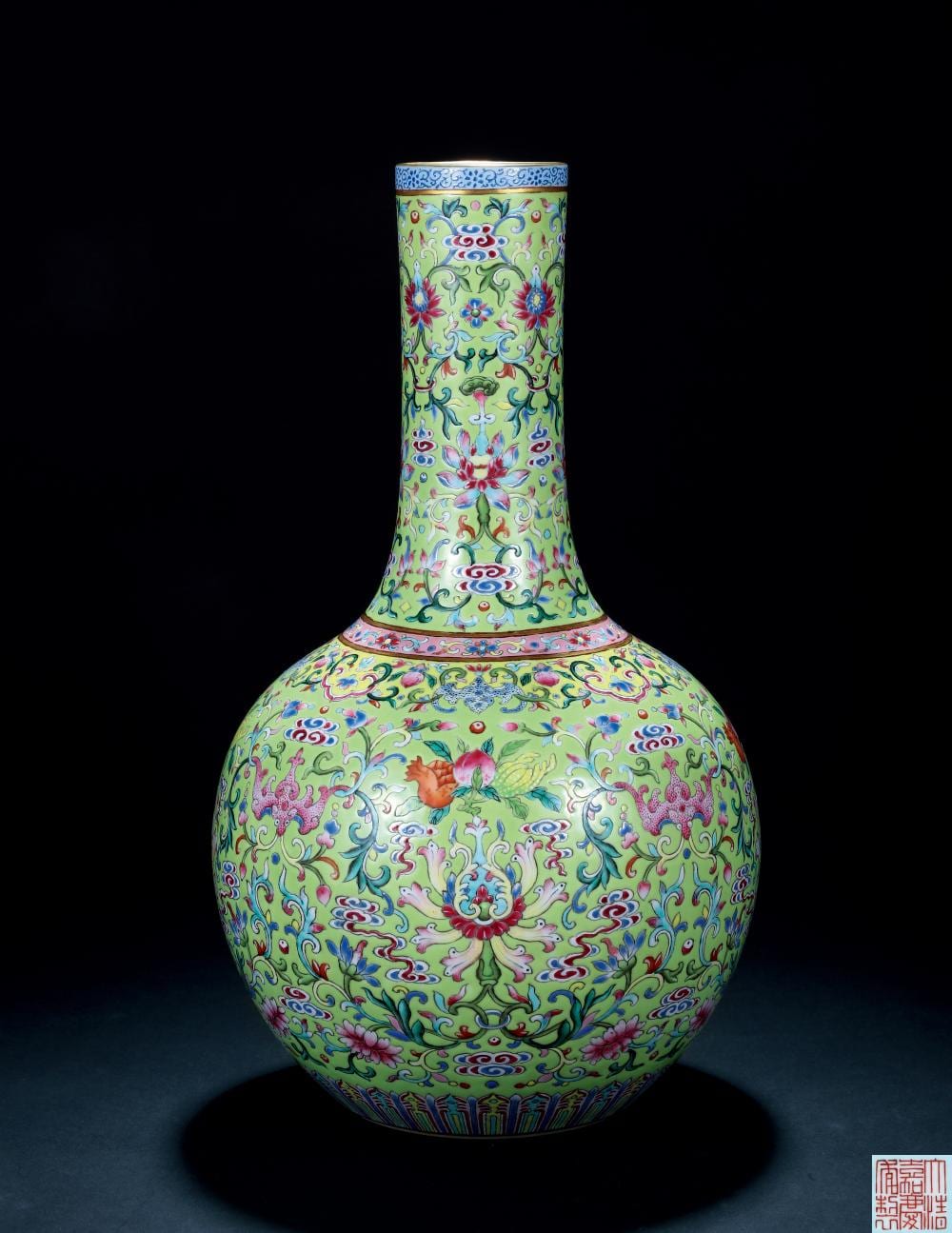
清嘉慶 粉彩纏枝蕃蓮紋三多天球瓶 PROVENANCE 1. Sotheby’s London, 15 December 1987, lot 201 2. Sotheby’s Hong Kong, 18 May 1988, lot 275 This vase is nicely potted with the spherical body rising to a tall cylindrical neck, painted in bright and colorful enamels. The exterior is densely decorated with large lotus blossoms emerging the 'three abundances' flanked by bats entwined with colorful foliate scrolls amidst cloud wisps. The shoulder is decorated with a yellow-ground collar of alternating ruyi and bats interspersed with peaches while the neck is painted with further lotus scrolling and auspicious chimes and jewels. The mouth is encircled with a band of blue scrollwork between gilt-painted borders and the foot is encircled with colorful lappets. The base is finely enameled in turquoise and inscribed with a six-character seal mark in iron red. This vase is striking for its exquisite painting in vivid enamels, and represents one of the classic styles developed at the Imperial kilns in Jingdezhen. The complex and auspicious design is particularly successful. Flowers and leaves are skillfully shaded in pastel tones, leaves are harmoniously entwined with bats, and the three fruits are painted with the skin showing signs of ripening. The surface of the vase is entirely decorated, and the overall effect is of opulence and luxury. Despite the abdication of the Qianlong Emperor and enthronement of Jiaqing in 1796, Qianlong continued to control the administration of the court and influence state affairs until his death in 1799. His active influence is reflected in the production of imperial porcelain wares at the Imperial kilns in Jingdezhen, Jiangxi province, where forms and designs devised in the preceding reign, such as the present vase, continued to be made. These vases emulated the elegant and stylish creations developed at the Imperial Enamel Workshop in Beijing. Vases belonging to this group share a number of features, including the iron-red seal mark. They are known in a variety of shapes, with or without handles, and display subtle variations in their designs. The present piece is particularly unusual in its depiction of the sanduo (‘three abundances’) motif emerging from lotus pistils. Such highly auspicious design of the pomegranate, peach and finger citron are symbolic of many sons, long life and blessings. The vase also features bats, which when painted upside down make the rebus ‘happiness is arriving’, and lingzhi, the immortality fungus, forming from lotuses at the neck. Related examples with lime-green ground are known. See a slightly smaller vase painted with peaches emerging from lotus and shou characters, from the T.Y. Chao collection, sold in Sotheby’s Hong Kong, 18th November 1986, lot 128; a pair modeled with a flared neck and with a similar design of lingzhi emerging from lotus, sold at Christie’s New York, 11th May 1981, lot 753 and again in Sotheby’s Hong Kong, 27th April 2003, lot 200; another sold at Christie’s New York, 11th May 1981, lot 753; and a further vase lacking the ruyi band at the neck, from the George Weishaupt Collection, illustrated in Gunhild Avitabile, Von Schatz der Drachen/From the Dragon's Treasure, London, 1987, pl. 23, was sold in Sotheby’s Hong Kong, 30th April 1996, lot 509. A variation of this motif is found on a pair of smaller vases with a flared neck and bat handles, sold in Sotheby’s London, 6th December 1994; and a vase with melons instead of peaches sold twice in Sotheby’s Hong Kong, 29th November 1979, lot 253, and 17th May 1988, lot 115. The motif of the ‘three abundances’ emerging from a lotus first appeared on Qianlong mark and period vases; see for example a globular vase painted on a turquoise-ground, illustrated in Taiji Shuichi, Shindai no Jiki/Porcelain of the Ch'ing Dynasty, Tokyo, 1976, pl. 55. Related auspicious motifs are also found on vases with other colored grounds; compare for example a yellow-ground vase of ovoid form, similarly painted with the lotus and lingzhi design at the neck, in the Huaihaitang Collection, included in the exhibition Ethereal Elegance. Porcelain Vases of the Imperial Qing, Art Museum, The Chinese University of Hong Kong, Hong Kong, 2007, cat. no. 135; and a turquoise-ground version sold at Christie’s Hong Kong, 30th October 1995, lot 763. 「大清乾隆年製」 來源 1. 倫敦蘇富比,1987年12月15日,編號201 2. 香港蘇富比,1988年5月18日,編號275 本品直口,長頸,球形腹,下承內挖式圈足,口沿及足底描金,凸顯本品之華麗與高貴,器底及內口施松石綠釉,釉面光潤如翠,外壁通體以綠地粉彩為飾,頸部飾如意祥雲及纏枝番蓮紋;腹部飾纏枝西番蓮福壽三多紋;肩、脛部分飾黃地如意福壽紋及變形蓮瓣紋。底部書「大清嘉慶年製」六字三行礬紅篆書款。通體紋飾勾描細膩,設色豐富,填彩精准而富有層次感,雖繁復華麗,但佈局井然有序,繁而不亂,可謂極盡御窯瓷繪之能事。 「蝠」與「福」諧音,蝙蝠與壽桃、纏枝蓮組合有「福壽連綿」或「福壽綿長」之寓意。三多紋是清代乾嘉時期十分流行的瓷器裝飾圖案,典出《莊子.外篇.天地》:「堯觀於華封,華封人祝曰:『使聖人壽,使聖人福,使聖人多男子。』」民間則以佛手柑與福字諧音而寓意「福」,以蟠桃多壽而諧意「壽」,以石榴多子而諧意「多男子」,稱為「福壽三多」或「華封三祝」,表現多福多壽多子的頌禱。本品所繪三多生於番蓮花朵之中,故而又有「連生三多」之意味,此種描繪手法極為少見,為本品一大特色。對於吉祥瑞意的追求是歷代瓷器裝飾的永恆主題。清代乾隆時期,對這種瑞意的追求甚至達到了無可復加的地步,可謂飾必有意,意必吉祥。如《清宮瓷器檔案.奏折文稿》中載:「乾隆十二年十二月二十一日內務府大臣三具奏呈,旨:……該監督年節進貢偶爾隨意用洋彩,吉言新式之類,不在此限,欽此。」可見乾隆皇帝對「洋彩之花樣,吉言新式」瓷器作品之喜愛。 天球瓶是明永樂、宣德時期景德鎮御窯據西亞同類型金屬器皿而創造的瓷器新器形,因球腹碩大,像從天而降,故而得名。天球瓶一經誕生便成為經典陳設器,被後世所追慕。清代雍乾之際,御窯除了承命竭力摹制永宣青花天球瓶外,又根據宮廷審美需求,新創青花釉里紅、單色釉、粉彩、鬥彩等多個品種、不同尺寸的天球瓶。其中色地洋彩天球瓶是最為經典和等級最高的品種之一。 嘉慶一朝,景德鎮御窯廠已無專司其事的督陶官,由地方官監管,御窯瓷器的製作處於守成的狀態。其式樣、圖案等均承襲前朝舊制,不敢僭越,甚至在嘉慶早期御窯生產的器物仍落「太上皇」乾隆年號款識,瓷器風格和制瓷工藝仍保持了較高的水準,故有「乾、嘉窯」之說。但嘉慶時期,清王朝的綜合國力正處於下降狀態,御窯廠的規模、瓷器的品種和生產數量上均已大為縮減。據內務府廣儲司卷燒造瓷器條所記,嘉慶四年(1799年),將每年燒造官窯款項,由一萬兩銀改為七千餘兩,不久又減為五千兩。嘉慶十一年(1806年)十一月,又奉旨「自明年為始,九江關呈進大運瓷器,著減半燒造。」但作為燒造難度和生產成本較高的綠地洋彩纏枝西番蓮福壽三多紋天球瓶,於嘉慶時期得以保存並繼續生產,足見宮廷對此類「洋彩之花樣,吉言新式」器物之喜愛。此外查閱公私收藏資料可以發現,目前所見的嘉慶色地洋彩器,綠地作品數量尤多,說明此種顏色頗受嘉慶皇帝喜愛。 本品遵照欽定瓷器之樣式,承襲前朝審美之緒余,照「洋彩之花樣,吉言新式」,結合窯工之巧思創作而成。從器型、紋飾、款識等判斷,本品應屬嘉慶早期之器物,其風格與製作工藝仍保持極高水準,毫不遜色於前朝同類器物。此外,相較於乾隆時期色地粉彩天球瓶而言,本品之瓶頸更為修長,至腹部略為收束,彰顯球腹之渾圓,宏偉穩健中又透露著幾分纖秀和靈動之感,裝飾華麗,所繪「蓮生三多」紋樣頗為少見,寓意吉祥,實為一件不可多得的嘉慶御窯精品佳作。 洋彩是十八世紀清宮與西洋文化交流而產生的藝術珍品,它是清代宮廷對運用西洋繪畫技法描繪彩瓷的正式名稱。《清宮內務府造辦處活計檔》、《清宮陳設檔》等文獻中多稱作「磁胎洋彩」或「洋彩」。而色地洋彩天球瓶新創於乾隆時期,據《造辦處各作成做活記清檔》記載,乾隆二年(1737年)十月十三日,傳旨:「……冬青釉拱花大漢尊、嘉窯青穿枝蓮八寶雙環大尊、嘉窯青龍穿枝蓮天球尊,此三樣尊照洋彩黃地洋花宮碗上花樣燒造些。」此外,乾隆三年(1738年)六月二十五日奉旨燒制一大批摹古瓷器中亦有「宣窯放大天球瓶一件」、「宣窯放大青龍天球瓶一件」之名目。如類似本品釉色之作,《清宮瓷器檔案•貢檔進單》中有「乾隆四十九年,交寧壽宮翡翠地洋彩天球尊成對」的記載。