Lot description
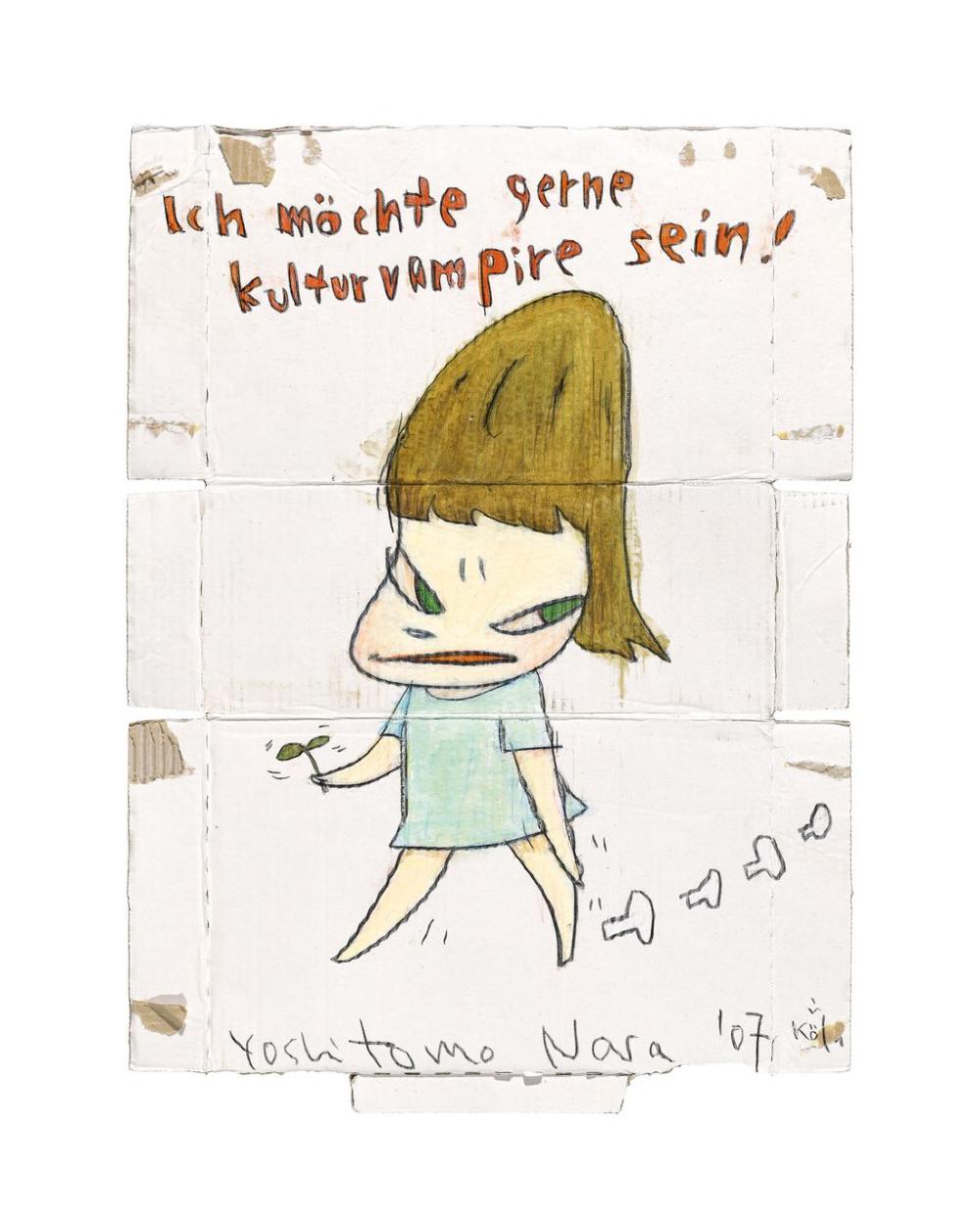
無題(我想成為一個文化吸血鬼!) Untitled (Ich möchte gerne Kulturvampire sein!) 簽名下方:Yoshitomo Nara 07 Köln Signed lower center Yoshitomo Nara, dated 07 and inscribed Köln 奈良美智筆下的小女孩,會出現在很多個場景或是一個孤獨的空白之上——也會是一間掛滿作品的房間裡。他把自己的手稿集中在一個小屋子裡,像極了他大學時曾住過的房間,不僅大小接近,就連畫釘在牆上的方式也沒有改變。在他各地的展覽中,廳內中央都保留了這樣一間小屋子,並逐漸成為他展覽的標誌。每一件創作從個人層面出發,畫中反叛又寂寞的年幼主角彷佛是奈良美智的自我投射。主角對外界不妥協的態度,是抵禦外間的一種無可奈何的表現。趣致的人物造型吸引著觀眾的視線,令人聯想到日本的可愛文化。 奈良美智出生在日本青森縣西部的弘前市,「1959年12月5日的早晨,我來到了這個星球。」在這裡他的兒童和青少年時代,是「緩慢而親切」的。童年生活被蘋果樹包圍,與自然對話。與自然對話其實就是與自己對話,孤獨的種子因為孤寂的小鎮生活開始發芽。 叛逆青年奈良美智在讀了一年大學之後,就任性地將下一學年的學費用來歐洲旅行。從巴黎機場出發,他先後去了比利時、荷蘭、德國、奧地利、瑞士、義大利、法國、西班牙和葡萄牙。獨自歐洲旅行之後,花完了學費的奈良美智當然無法再在武藏野大學繼續念下去了,於是經過入學考試,他成為了學費相對便宜一些的愛知縣公立藝術大學的新生。 1983年,24歲的奈良美智再次窮遊歐洲。1988年5月奈良美智站上了名古屋的月臺,即將啟程前往德國,正式求學德國杜塞道夫藝術學院。波依斯、基弗、李希特、白南准等藝術大師皆畢業於此。奈良美智在德國一待就是12年,雖然在德國遇到了不少有趣的人,但他還是會用「孤獨」來形容那段時光。 到德國之後的奈良美智,畫作中的那個小女孩,永遠都是一幅略帶敵意的面孔,此件《我想成為一個文化吸血鬼》正值2007年在科隆所創作。那時的奈良美智彷彿回到了兒時的小鎮生活,永遠站在一片寧靜的純色背景中,小心翼翼地觀察著周遭的一切。「內省」成為他繪畫中越來越明顯的特徵。穿淡藍連衣裙的孩童有著誇張的頭部和弱小的身軀,一雙忿怒的大眼晴緊盯著前方,眼神流露著懷疑和不信任。小女孩步履匆匆,眼神犀利地與觀者對抗著,手中的兩葉草第一片代表「信仰」,第二片代表「希望」。而頭頂的德文標題「Ich möchte gerne Kulturvampire sein!(我想成為一個文化吸血鬼)」,又諷刺地表達出藝術家人在他鄉因為語言不通而感到的無奈與自嘲。奈良美智創作出一個矛盾的混合體,一個擁有反叛個性和天真外表的小女孩形象。一種飄浮在一層文化隔膜上的童真的叛逆感,也正是成型於這個時期,鑄就了後來大家所熟知的小女孩形象,從他那時的畫作中讀出來屬於奈良美智的個人氣質。 從杜塞道夫時代起,奈良美智的風格漸漸走向成熟。他先後收到了來自阿姆斯特丹和科隆畫廊的展覽邀請。從杜塞道夫藝術學院畢業後,他順理成章地搬到了科隆的工作室。在科隆工作室,奈良美智終於開始認真審視自己「藝術家」的身份了,作品在世界各地發表,在藝術界慢慢站穩了腳跟。不羈、自省、天真,奈良美智認為作為當代人需要具備的品質,在他的畫中無所保留。 The little girls portrayed by Yoshitomo Nara may appear in multiple scenes, a solitary void, or in a room hung with scads of paintings. He gathers his manuscripts in a small room, one that bears a striking resemblance to the room he lived in during college - with close affinities not only in size, but even in the way the paintings are nailed to the walls. In his exhibitions worldwide, there is always a small room like this sitting at the center of the hall. This has gradually become the trademark of his exhibitions. Created from a personal perspective, the rebellious and lonesome young figures in his paintings appear to be a self-projection of Yoshitomo Nara. Their uncompromising attitude toward the outside world exhibits a sense of frustration and helplessness in their efforts to resist. Evocative of the Japanese culture of cuteness, their adorable appearances capture the attention and interest of viewers. Yoshitomo Nara was born in Hirosaki, the west side of Aomori Prefecture, Japan. “On the morning of December 5, 1959, I descended upon this planet.” Here he spent his “slow-paced and down-to-earth” childhood and adolescence. Surrounded by apple trees in his childhood years, he constantly had conversations with nature. Through this, he was actually conversing with himself. The seeds of loneliness began to sprout during his days in this secluded town. After his freshman year in college, Yoshitomo Nara - an unruly, selfwilled young man - used the tuition fees meant for his sophomore year on his trip to Europe. From Paris Airport, he toured across Belgium, the Netherlands, Germany, Austria, Switzerland, Italy, France, Spain and Portugal. Having spent all his money on this solo trip in Europe, Yoshitomo Nara was unable to continue his studies at Musashino University. Therefore, he took the college entrance exams and became a freshman at Aichi Prefectural University of the Arts, a public school with relatively lower tuition fees. In 1983, at the age of 24, Yoshitomo Nara went on another budget trip to Europe. In May 1988, he set off from Nagoya Station for Germany to begin formal study at Düsseldorf Art Academy - the same school numerous master artists, such as Joseph Beuys, Anselm Kiefer, Gerhard Richter, and Nam June Paik, attended. Over twelve years in Germany, Yoshitomo Nara met quite a few interesting people. Yet, he still describes those days as a “lonely” period. The little girls portrayed by Yoshitomo Nara during his days in Germany always take on a slightly hostile expression. Ich möchte gerne Kulturvampire sein! (I Want to Be a Culture Vampire) was created in Cologne in 2007. As if returning to his childhood small-town life, the figures Nara portrayed during this period always stand against a pure color backdrop of serenity, vigilantly observing everything around them. By then, “introspection” had become an increasingly marked feature of his paintings. Characterized by an exaggerated head and a puny body, the child in a pale blue dress stares into the front with a pair of angry eyes that express doubt and mistrust. With hurried steps, the little girl confronts the viewers with piercing eyes. The two leaves of the two-leaf clover in her hand represent “faith” and “hope”, respectively. Above her head hovers the German phrase, “Ich möchte gerne Kulturvampire sein! (I want to be a culture vampire),” as a sarcastic, selfdeprecating expression of the helplessness he felt when encountering language barriers in a foreign land. Yoshitomo Nara creates a hybrid of contradictions - a little girl that has both an innocent appearance and a rebellious personality. It was during this period that the juxtaposition of innocence and rebellion over a cultural gap took shape, which gave birth to his iconic little girl image. This lot communicates the idiosyncratic temperament of Yoshitomo Nara. From the Düsseldorf period onward, Yoshitomo Nara gradually matured in his artistic style. He received a succession of invitations to exhibit his creations at galleries in Amsterdam and Cologne. After graduating from Düsseldorf Art Academy, he moved to his studio in Cologne. There, Yoshitomo Nara began to take his “artist” identity seriously. By showcasing his artworks around the world, he has steadily established himself on the global stage of art. Defiance, introspection, and innocence – the qualities Yoshitomo Nara deems indispensable for modern people, unreservedly manifest themselves in his paintings.