Lot description
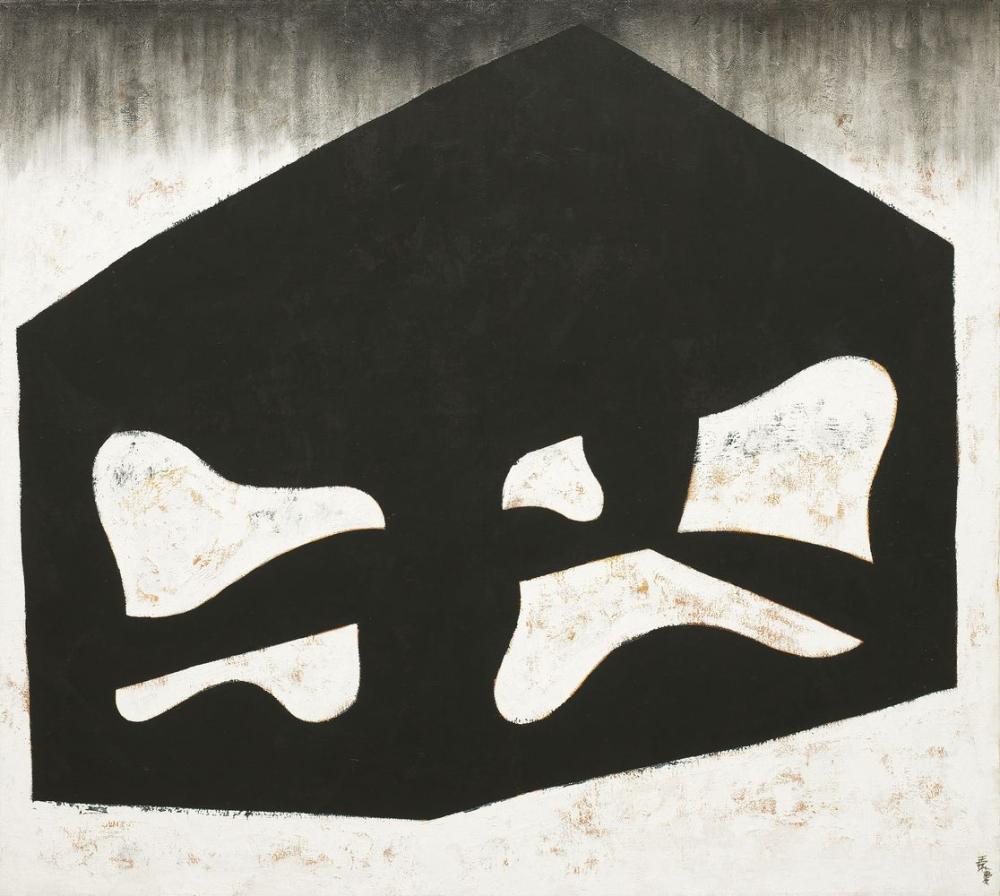
坐具肖像 Portrait of Stool 簽名右下:王懷慶 Signed lower right Wang Huaiqing in Chinese 王懷慶現任北京畫院一級畫師,中國美術家協會會員,與中國油畫學會理事。曾獲1984年北京市美展甲等獎、1991年《大明風度》「91年中國油畫年展」金獎、1992第10屆上野之森美術館大獎展、2003年中國廣東美術館「第二屆全國畫院雙年展」學術獎等獎項。2012年於台北市立美術館舉辦「一生萬:王懷慶藝術展」,2014年於台北耿畫廊舉辦「大都-王懷慶個展」,2015至2016年於日本兵庫縣立美術館舉辦「出山:王懷慶」,2021年於中國北京清華大學藝術博物館舉辦「縱橫-王懷慶藝術展」等。作品典藏於上海美術館、中國美術館和北京市美術家協會。 王懷慶師承華人藝術大師吳冠中,卻發展出與吳冠中迥然不同的創作面貌。王懷慶的作品深沉含蓄,寧靜優雅之中充滿視覺的張力。中國著名藝術評論家賈方舟曾如此評論王懷慶的創作:「若從哲學的角度審視,王懷慶走的是一條極高明而道中庸的路。在平面處理中見空間的深度,在具象表現中見抽象精神,在感性錯覺中見理性原則,在西方的表現技巧中見東方的文化內涵。中國傳統藝術一向注重結構,建築的空間佈局、繪畫的置陳步勢、書法的間架結構、篆刻的分朱佈白,直至民間剪紙的平面鏤空...無一不從結構著眼。在王懷慶的作品中,這些傳統因素經過創造性的現代轉化,構成了自己風格的主要成分。」 王懷慶從民族的工藝經典取材。力求創造具有個人風味的現代風貌新經典。完成於1999年的《坐具肖像》,乃是王懷慶本人頗為滿意的作品。畫中一隻造型古樸的大凳子登上主角,老家具的形體變形為幾何圖案,化成方中帶圓、圓中有方的中國古典形式。而物件物在畫布上幾乎頂天立地,宛如一張國劇的臉譜般,簡樸的個體遺世獨立,坐具兀自地述說著自我。墨色取代了古凳原有的木質顏色,讓人忘卻它原本的功能性,轉為純然的形式結構,十足地具有極簡抽像美感。然而,在其斑駁的背景空間裡,古凳仍傳達的一種思古幽情。王懷慶向來擅長畫面的置陳布勢,給人一種劇場式聯想。他在畫作中所呈現時間的凝視,一個人物離場後的舞台空間。角色們曾經的粉墨登場,舞台上曾經上演的精彩故事,皆留給觀者自己言說。 為何要選擇明式家具作為描寫的物件?王懷慶如此回答:「特別想畫一幅畫來把這種有生命的東西和這種對象,沒有生命的東西,給它的主角和它的次角做一個倒置,有時候覺得人的生命不管多輝煌,多奢靡,全都是比較脆弱的,有時候還不如一個家具更永恆,更長久,物很近,人很遠,就這種物是人非的一種情緒吧。」1990年後,明式家具等古老家私幾乎躍為這位北京藝術家畫中的主角。有時它們是拉長、變形的極簡結構,有時呈現崩離、拆解的組件,有種悵然若失、繁華不再的感覺,表達物是人非的悲戚,與對文化傳統斷裂的危機感。 《坐具肖像》一作中的黑色架構,如碑體法書的斧鑿痕跡,氣勢十足;另外一方面則描寫如窗花剪紙般的構圖,令人玩味。一張被藝術家放大的古凳坐具,牽引出中國文人的起居、生活的文化想像空間,也寄寓著當代藝術家對發揚民族藝術的情懷。 Wang Huaiqing holds the position of a First Class Painter at the Beijing Painting Academy. He is a member of the Chinese Artists Association and serves as a director of the China Oil Painting Factory. He has received the Beijing Art Exhibition First Award 1984, the 1st Annual Exhibition of Chinese Oil Painting Gold Medal in 1991, the 10th Ueno Royal Museum Grand Prize Exhibition in 1992, the 2nd Chinese Art Academies Biennale Academic Award in 2003 and so on. Throughout his career, Wang Huaiqing has had several notable exhibitions. "One to All: the Art of Wang Huaiqing" at the Taipei Fine Arts Museum in 2012, "The Capital" at Tina Keng Gallery in Taipei in 2014, "Out of the Mountain" at Hyogo Prefectural Museum of Art in Japan from 2015 to 2016, "Vertical・Horizontal" at Tsinghua University Art Museum in Beijing in 2021, just to name a few. His artworks are part of the collections at prestigious institutions such as the Shanghai Art Museum, the National Art Museum of China, and the China Artists Association. Wang Huaiqing's teacher was the Chinese master artist Wu Guanzhong, but the creative style he developed was completely different from that of his teacher. There's a sense of the profound in his works, filling the tranquility and elegance with visual tension. The renowned Chinese art critic Jia Fangzhou made this comment about Wang Huaiqing's works: "When examined from a philosophical perspective, Wang Huaiqing has chosen to travel on an extremely rarefied and exact path. In the treatment of planes, we see the depth of space; within the expression, figurative abstractionism can be found; in the sensual illusions, principles of reason and; in the Western techniques of expression and the cultural sensitivities of the East. Traditional Chinese art has always emphasized the structure. From the spatial layout of the building, the composition of the painting, the framework of calligraphy, the contrast between ink and space of seal scripts through to the hollow spaces of the common paper-cut and more, all approach the subject matter with an eye to its structure. In Wang Huaiqing's work, these traditional elements have been given a creative modern transformation to become the main themes of his own style." In this restless world, the artist creates a quiet corner of reminiscence. Wang gets his materials from the folk crafts, and makes a modern classic work of his own style. "Portrait of Stool" finished in 1999, is one of Wang's favorites. The main character is a simple old stool. The shape of this old piece of furniture is distorted into geometric patterns, a coexistent form of round and square. The lonely counterpart looks like the face painted in the Chinese Opera-easy but independent; it tells its own story. Replacing the original wooden color, the ink color turns its functionality into a pure structure with a minimal abstract beauty. Yet, in that mottled background, the stool conveys a reminiscent atmosphere. Wang is always good at composing a picture, which gives the beholder an association of stage. He presents a time gaze and an empty stage in his paintings; he lets the beholders become ill in the stories which are once performed on stage. Why does he choose the Ming-style furniture as his characters? Wang answered, "I want to paint something which reverses the order of life and a lifeless object as well as the main and the subordinate characters. Sometimes, I feel that no matter how glorious and luxurious a person once lived, life itself is still very fragile. Very often, it cannot last longer than a piece of furniture. I just feel that a lifeless object is closer to me than a human being." After 1990, the Ming-style furniture has become the main character in the paintings of the artist from Beijing. His furniture sometimes presents a simple and distorted shape, and sometimes it just falls apart and gives a feeling of loneliness and loss. The black structure in "Portrait of Stool" contains the power of the stele-style calligraphy. Its silhouette-like composition also narrates a profound meaning. An ancient stool enlarged by the artist brings out an imaginary space of the life of a Chinese intellectual. It also inhabits the passion of a contemporary artist to present the culture of his nation to the world.