Lot description
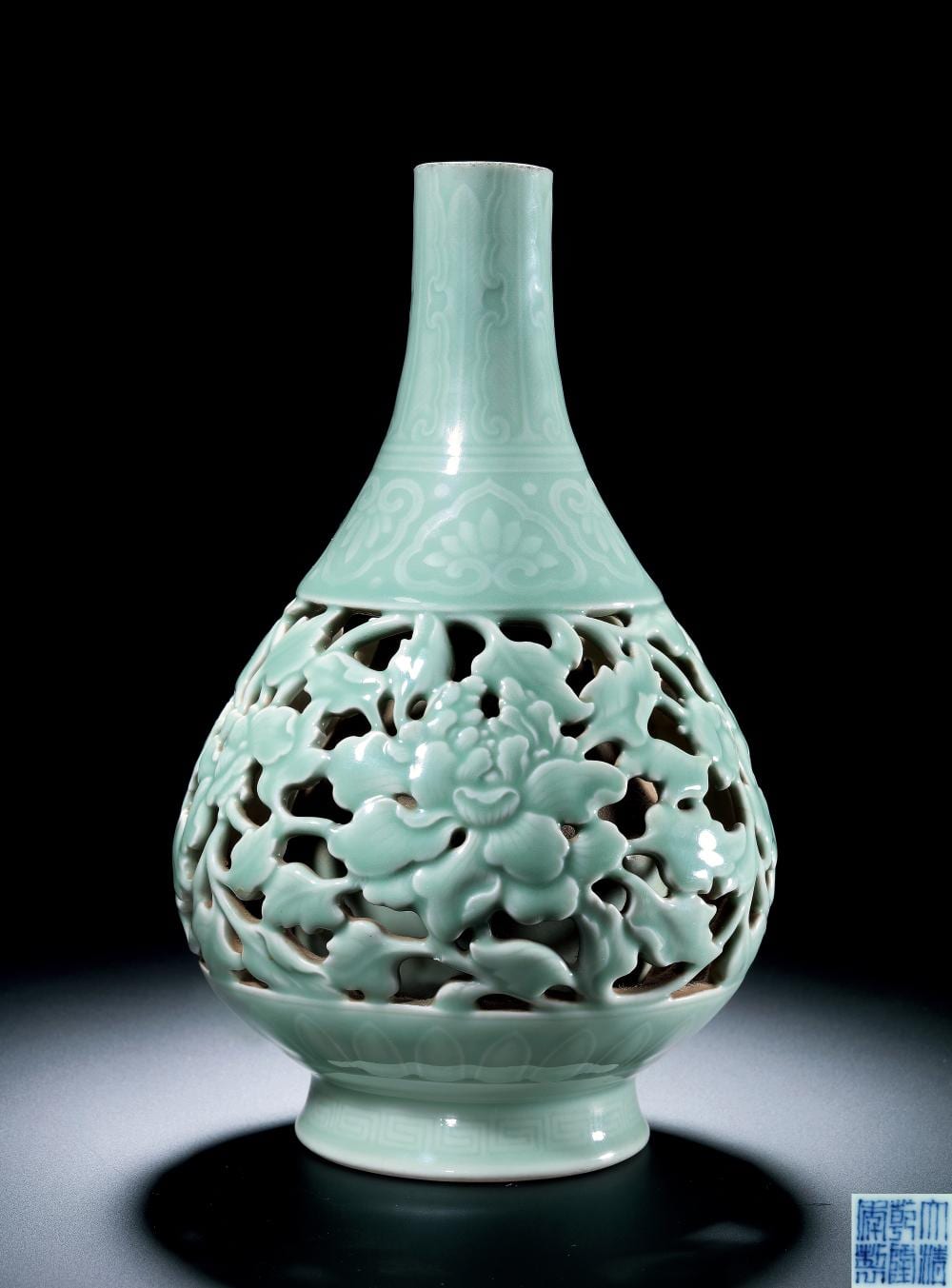
清乾隆 粉青釉鏤空纏枝牡丹紋長頸套瓶 PROVENANCE 1. Collection of John Jacob de Pass, Middleton Hall, Norfolk, England, acquired in Shanghai in the 1890s, and hence by descent to the present owner 2. Sotheby's Hong Kong, 8 April 2011, lot 3024 The bottle vase is elegantly potted with a gently swelling belly sweeping up to a truncated cylindrical neck and is masterfully engineered with a deftly reticulated band of three large peonies with lush petals encircled by scrolling leaves subtly incised with veining. The openwork areas reveal a plain integral vase beneath, all below a finely carved low-relief band of upright plantain leaves collaring the cylindrical neck. Each detached ruyi head around the shoulder contains a stylised lotus flower. All patterns are supported on a carved lotus petal band skirting the base and a low foot is incised with a key-fret band, all beneath a glassy tea-green celadon glaze pooling in the recesses creating layers of depth. The base is marked with a six-character reign mark in underglaze blue. It is extremely rare to see this kind of reticulated vase in good condition. There are two currently in Shanghai Museum and the Palace Museum in Beijing, illustrated in Zhongguo taoci quanji, vol. 15, Shanghai, 2000, pl. 85; one from the Ten-views Ling-bi Rock Retreat collection, sold in Sotheby's Hong Kong, 8 April 2009, lot 1603 and Poly Beijing, 4 December 2019, lot 5766. Also a related one applied with famille-rose and gilt decoration now resides in the Palace Museum in Beijing. The inspiration for this vase came from a much earlier, 15th century, Longquan example; see a remarkably close copy of a Longquan piece in the Samuel P. Harn Museum of Art, University of Florida, Gainesville, Florida, sold in Sotheby's New York rooms, 22/23rd September 2004, lot 205. There is mentioning of openwork vases imitating Longquan ware in two Qing court records dated to 1742 and 1743. Tang Ying, superintendent at the Imperial Kilns at Jingdezhen, submitted a memorial to the Qianlong emperor recording his presentation to the court of a total of nine 'layered openwork' and interlocking vases. See Liao Pao Show's introduction in the exhibition catalogue Stunning Decorative Porcelains from the Ch'ien-lung Reign, National Palace Museum, Taipei, 2008, pp. 27. The present vase clearly bears the signature of Tang Ying's craftsmanship for its elegant restricted decorative scheme. 款識:「大清乾隆年製」 來源 1. 英國藏家John Jacob de Pass舊藏,於1890年代購自上海,此後家族傳承 2. 香港蘇富比,2011年4月8日,編號3024 此瓶頸直而修長,器腹飽滿且秀逸,頸部模印蕉葉紋輔以如意紋,腹部以鏤空工藝手法裝飾「纏枝牡丹」環繞瓶體,尺幅充盈令人瞠目結舌。牡丹花頭立體感明顯,花瓣層次繁密,前後掩映各具姿態。數朵牡丹仰俯向背亦呈天然之韻,其間穿枝過梗,枝繁葉茂充滿生機。鏤空密佈,層次錯落,仍無零亂之感,反而有種秩序感深藏其中。刀法藏鋒近乎圓雕,可與木器中「過橋玲瓏」相媲美。底部整施青釉,正中落「大清乾隆年製」六字三行篆書款識,為標準乾隆早期寫法。 本品為英國藏家John Jacob de Pass收藏,他熱衷於中國文化,早年頻繁旅遊於中國各地,藉此搜羅各式各樣的中國藝術品,他龐大的個人收藏於1923年離世後隨即流出於市場。 此種鏤空套瓶並非乾隆朝所創,早在南宋時期官窯就已經燒製,其歷史可謂久矣。從出土的南宋官窯器物觀察,瓶體內有中空立柱與瓶頸相接,以防燒製時出現劇烈變形。元代時期龍泉窯也燒造同類器物,瓶內立柱已不在設置,可見燒造技術完全嫺熟。清宮藏有元代龍泉窯鏤空膽瓶,乾隆皇帝可能因為這件原件,遂而才有摹製之作問世。 鏤雕是清代瓷器裝飾技法之一,又稱鏤空、透雕,紋樣有全鏤與半鏤之分,如本品穿透器壁的稱之為全鏤、通花。其技法是在坯體未幹之時,將裝飾花紋雕透,然後施釉入窯燒造,此裝飾技法始見於新石器時代的陶器上,在長期發展中工藝日趨複雜,至乾隆時不僅紋飾繁密,工藝技術要求也較高,且創燒出雕鏤玲瓏等新品種,達鬼斧神工之境。由於鏤雕是通過胎體的空洞表現紋樣,故鏤空部位需精心設計,設計不合理在燒造時會造成器物變形。從傳世的乾隆鏤雕器物來看,整體鏤空者鏤孔佈滿器身,孔與孔邊框互藉以尋求力度平衡,使之成形且穩固,此種工藝反映了工匠極高的技術水準與創新思維的奇巧。 此技藝僅在乾隆一朝流行並被發揮至難以媲美之境,至清中期以後,雖仍有鏤空器物燒造,但紋飾逐漸簡單,僅為局部鏤空,燒造難度及成器精美程度遠落後於乾隆器物。 此瓶內部仍用瓶膽支撐,這並非工藝退步,而是朝著有內畫裝飾且能轉動套瓶的進發之舉。乾隆八年四月二十一日,唐英在《恭進奉發及新擬瓷器折》中:「今自三月初二日開工之後,奴才在廠攢造得奉發各色錦地四團山水膳碗、杯盤並六方青龍花瓶等件外,奴才又新擬得夾層玲瓏、交泰等瓶共九種,謹恭折送京呈進。其新擬各種系奴才愚昧之見,自行創造,恐未合適,且工料不無過費,故未敢多造。伏祈皇上教導改正,以便欽遵,再行成對燒造」。通過文獻可以看出在乾隆八年方才有數種套瓶解運進京,在此之前應有相當漫長的研製過程,其開端之作應該在乾隆稍早時期完成。 審視本品瓶底款識的整體書寫手法,為典型乾隆早期官窯風格,故應屬於唐英所先鋒創燒之品種。其釉水瑩潤,胎質細膩,多層印花清晰,鏤空刀法嫺熟,畫面飄逸俊朗,均為乾隆前期供御內廷之作所特有,也可視此瓶為奏摺內數種鏤空套瓶的發軔之作。乾隆中後期之後,隨著內膽及彩釉加飾的運用,加配繁複突出的耳柄等,使其宋瓷原器的工藝神韻便已不知所蹤了。 鏤空牡丹纏枝花卉套瓶保存困難,存世完整之例寥寥可數,上海博物館及北京故宮博物館分別收藏一例;另見北美十面靈璧山居舊藏,早年為英國古董商Marchant寶蓄,售於香港蘇富比,2009年4月8日,編號1603,及後以人民幣6900萬元再售於北京保利,2019年12月4日,編號5766。