What is an old wooden sled worth?
Most old wooden sleds sell for modest sums. The 31 auction sales in the table below range from $6 to $1,800, with a median of $50. A cast-iron and wood Flexible Flyer No. 55 sits near the median; the top of the table is a painted sled with the bust of a Native American. What decides value is the maker (early Flexible Flyers marked “S.L. Allen & Co.”, Paris Manufacturing “Speedaway” models, Champion, Lightning Guider), the age, original paint and decals, and condition. Sleds made before 1920 usually bring more. A repaint or heavy restoration usually lowers the price, so check your sled before you clean or fix anything.
Which old sleds sell low and which sell high
Antique and vintage wooden sleds span a wide price range, and several factors decide where a particular sled lands on it:
- Common vintage decorative sleds: the most affordable group
- Well-known brands in good condition: a clear step up
- Rare models or exceptional examples: the top of the market
According to collectors and auction data, primitive handmade sleds from the 1800s and early branded sleds like Flexible Flyer models from the early 1900s often command the highest prices, especially when they retain original paint, decals, or unusual features.
What decides an old wooden sled’s value
Manufacturer and Brand History
Brand recognition plays a crucial role in determining value. Some of the most sought-after manufacturers include:
- Flexible Flyer: Founded by Samuel Leeds Allen in 1889, these sleds are perhaps the most recognizable and collectible. Early models with the “S.L. Allen & Co.” markings are especially valuable.
- Paris Manufacturing Company: Founded in 1861, Paris sleds including the “Speedaway” models are highly collectible.
- Champion: These sleds were popular competitors to Flexible Flyer and can command good prices when in excellent condition.
- Lightning Guider: Made by the Standard Manufacturing Company of Pennsylvania, these are also desirable to collectors.
Primitive, handmade sleds that predate mass manufacturing can be especially valuable if their craftsmanship and historical significance can be documented.
Condition Assessment
Sled Condition Evaluation Checklist
Use this checklist to assess your wooden sled's condition
- Original paint and decals intact
- Minimal rust on runners and hardware
- No major cracks or repairs to the wood
- Original hardware and components present
- Steering mechanism works (if applicable)
- Wood is solid with no rot or severe warping
- Original rope or handle present
Condition significantly impacts value, with unrestored sleds in excellent original condition commanding the highest prices. Key condition factors include:
- Original paint and decals: Sleds with intact original decoration are worth significantly more than those that have been repainted.
- Metal components: Runners and hardware should have minimal rust and maintain their functionality.
- Structural integrity: The wooden parts should be free from major cracks, repairs, or replacements.
Remember that for collectible sleds, improper restoration can actually decrease value. Collectors typically prefer original condition, even with some wear, over poorly executed restorations.
Age and Historical Significance
Age alone doesn’t always determine value, but it is an important factor:
- Pre-1880s primitive sleds: These handcrafted sleds, often made locally by craftsmen or families, can be highly valuable due to their age and historical significance.
- 1890s-1920s manufactured sleds: This represents the early era of commercial sled production, with models from this period generally commanding higher prices.
- 1930s-1950s sleds: Mid-century sleds are still collectible but typically less valuable unless in exceptional condition or representing a rare model.
- Post-1960s sleds: Generally considered “vintage” rather than antique, these more modern sleds typically have lower collector value but still appeal to decorators.
Flexible Flyer, farm and painted sleds
Sled types collectors look for
What sets each type of sled apart
Flexible Flyer Style Sleds
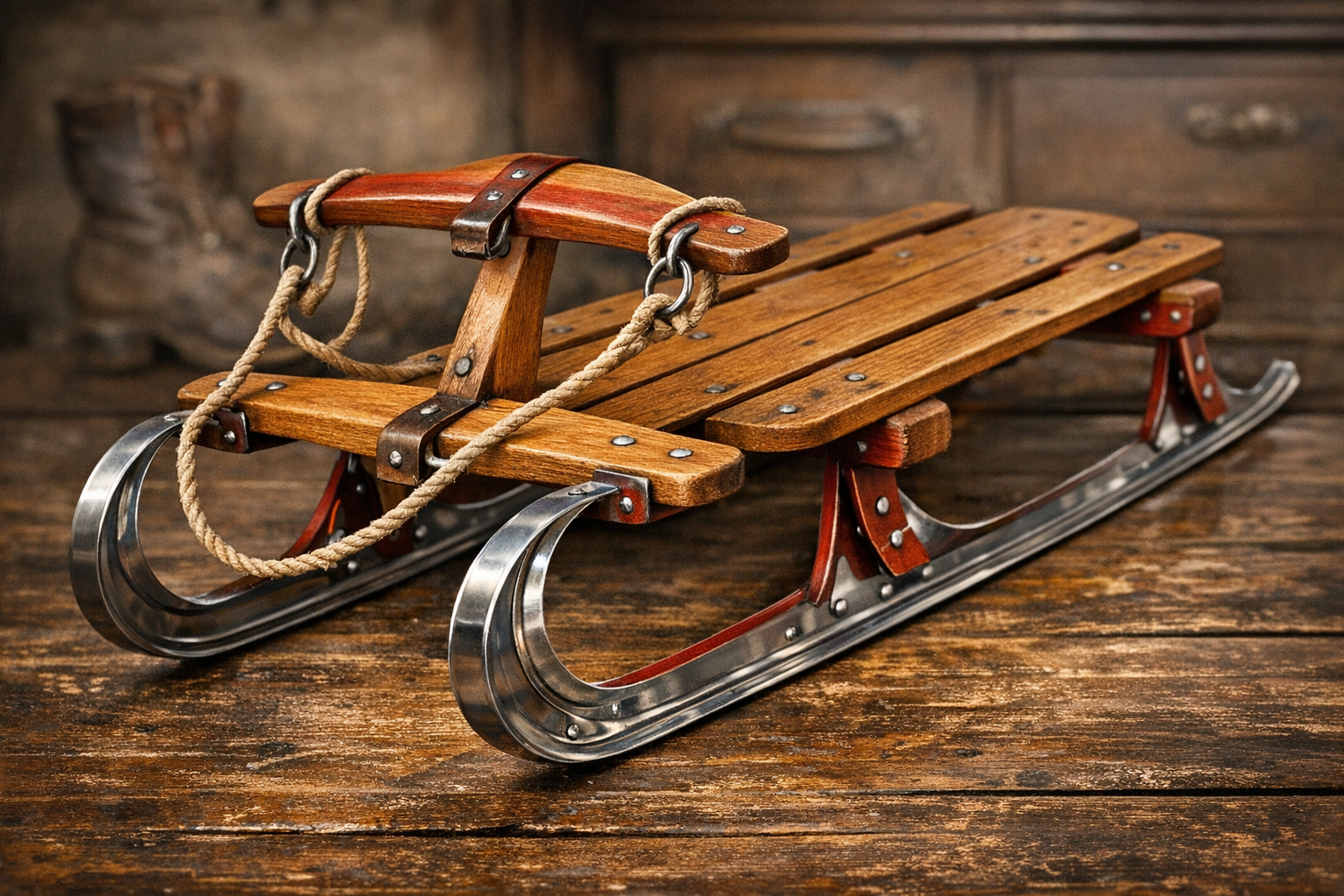
These iconic sleds with their steerable runners represent perhaps the most recognizable type of antique sled. Key features include:
- Eagle logo or “Flexible Flyer” branding
- Metal runners that can be steered with a T-bar or rope
- Wooden slats forming the riding surface
- Introduced in 1889, with design improvements over the decades
The earliest models, especially those with “S.L. Allen & Co.” markings, are typically the most valuable. Serial numbers can help date these sleds accurately.
Primitive/Farm Sleds
These handcrafted sleds pre-date mass production and offer unique historical value:
- Often built by local craftsmen or as family projects
- Typically feature wooden runners (sometimes metal-reinforced)
- More rustic construction with pegged or simple joinery
- Usually designed for utility rather than recreation
- Can date back to the early 1800s or even earlier
Well-preserved examples with documented history can be extremely valuable to collectors of American primitives and farm implements.
Decorative Painted Sleds
Some sleds were decorated with elaborate painted designs that can significantly enhance their value:
- Often feature winter scenes, company logos, or geometric patterns
- More common on children’s sleds and smaller models
- Hand-painted examples are particularly valuable
- Original paint in good condition is crucial to value
Sleds with unique or elaborate artwork, especially when the paint remains vibrant and intact, can command premium prices regardless of the manufacturer.
Evolution of Wooden Sleds in America
- 1800-1850
Early Handcrafted Era
Primitive sleds were built by local craftsmen and families using available materials. These utilitarian designs featured wooden runners occasionally reinforced with metal strips.
- 1889
Flexible Flyer Introduction
Samuel Leeds Allen patented the Flexible Flyer sled, featuring steerable metal runners that revolutionized recreational sledding and began the era of mass-produced sleds.
- 1900-1920
Golden Age of Wooden Sleds
Multiple manufacturers entered the market with their own designs, including Paris Manufacturing Company, Champion, and others. This period saw the height of wooden sled production.
- 1930-1950
Mid-Century Popularity
Wooden sleds remained popular family Christmas gifts. Designs became more streamlined, and many featured decorative elements like painted scenes or decals.
- 1960s-Present
Transition to Collectibles
As plastic sleds gained popularity, wooden sled production declined. Vintage wooden sleds transitioned from utilitarian objects to collectibles and decorative items.
Antique sled identification: markings and dating
Manufacturer Markings and Logos
Most commercially manufactured sleds have identifying marks:
- Flexible Flyer: Look for the eagle logo and “Flexible Flyer” name, typically on the top slat. Early models may have “S.L. Allen & Co.” markings.
- Paris Manufacturing Company: Often marked with “Paris, Maine” and may include model names like “Speedaway.”
- Champion: Look for the Champion name, often with a shield logo.
- Lightning Guider: Produced by Standard Manufacturing Company, these typically have the name on the top slat.
Serial Numbers and Dating
Some manufacturers, particularly Flexible Flyer, used serial numbers that can help date the sled:
- Early Flexible Flyer sleds (pre-1930s) often have serial numbers stamped into the metal components
- The design of the steering mechanism and runner style can indicate the era
- Hardware types (square-head bolts vs. round) can provide dating clues
- The typography and design of decals changed over time
For primitive sleds without markings, construction techniques, material analysis, and joinery methods can help approximate the age. If your sled has no maker’s name, you can upload photos of the top, the runners and the underside for a free check.
Where to sell an old wooden sled
Online Marketplaces
Online platforms provide the widest reach for both buyers and sellers:
- eBay: Offers the largest audience with numerous vintage sleds ranging from decorative pieces to rare collector’s items
- Etsy: Good for decorative vintage sleds, especially those with aesthetic appeal
- 1stDibs: Focuses on higher-end antiques, including rare and exceptional sleds
- Chairish: Specializes in vintage and antique items with curated sled offerings
Physical Locations
For hands-on inspection and negotiation:
- Antique Shops: Particularly in northern states and ski resort areas
- Flea Markets: Especially winter and holiday-themed events
- Estate Sales: Can yield unexpected finds, often at more reasonable prices
- Antique Shows: Specialty shows often feature vendors with vintage winter sports equipment
Auction Houses
For rare or exceptionally valuable sleds:
- Regional Auction Houses: Often feature local items including vintage sleds
- Specialized Sports Memorabilia Auctions: May include vintage winter sports equipment
- Online Auctions: Many traditional auction houses now offer online bidding
Restore or leave as is: what keeps the value
The Case for Preservation
For collector-grade sleds, preservation is typically preferred:
- Original condition premium: Sleds with original paint, decals, and patina typically command higher prices among serious collectors
- Historical integrity: Unaltered sleds provide documented historical documentation of manufacturing techniques and designs
- Patina value: The natural aging of wood and metal develops a desirable patina that cannot be authentically replicated
When Restoration Makes Sense
In some cases, careful restoration might be appropriate:
- Structural repairs: Fixing broken components that affect functionality, especially if done using period-appropriate techniques
- Decorative sleds: If the sled is primarily for display purposes rather than collector value
- Partial restoration: Gently cleaning and preserving existing finishes without attempting to return to “like new” condition
Professional Restoration Tips
If you decide restoration is appropriate:
- Research thoroughly: Understand what the sled would have looked like originally
- Document everything: Take photos before, during, and after restoration
- Use appropriate materials: Period-correct paints, hardware, and techniques
- Know when to stop: Avoid over-restoration that removes all signs of age and use
- Consider professional help: For valuable sleds, professional restoration may be worth the cost
Decorative sleds vs. collector sleds
Decorative Appeal
Many vintage sleds are purchased primarily for their decorative value:
- Holiday decor: Sleds are popular as Christmas decorations, often adorned with greenery, lights, or gifts
- Rustic interior design: They complement farmhouse, cabin, and country-style decor
- Outdoor displays: Weather-resistant sleds can create winter vignettes on porches and in gardens
- Repurposing: Some buyers convert sleds into shelves, coffee tables, or wall hangings
For decorative purposes, condition and documented details may be less important than overall aesthetic appeal and structural integrity.
Collector Considerations
Serious collectors approach sleds differently:
- Originality premium: Original condition, manufacturer markings, and documented provenance are crucial
- Completeness: All original components should be present and unaltered
- Historical significance: Connection to notable events, people, or manufacturing milestones increases value
Collectors typically focus on sleds made before 1940, with special interest in pre-1920 examples with documented history.
Common Questions About Old Wooden Sled Values
How can I tell if my wooden sled is valuable?
- Manufacturer markings from desirable brands like Flexible Flyer, Paris Manufacturing, or Champion
- Early dating (pre-1920s sleds are typically more valuable)
- Original paint, decals, and finish in good condition
- Unusual features, rare models, or documented historical significance
- All original components including hardware, steering mechanisms, and rope pulls
What is the most valuable type of antique wooden sled?
Rare, documented primitive sleds from the early 1800s can also command premium prices, particularly if they have unusual design features or documented historical significance. Custom-ordered sleds or those with elaborate hand-painted decorations represent another high-value category.
In exceptional cases, sleds with documented connections to historical events or famous owners can reach even higher values at specialty auctions.Is it better to restore an old wooden sled or leave it as is?
If you’re considering restoration:
- For sleds with collector value: Minimal intervention is best—gentle cleaning, stabilization of loose parts, and conservation rather than restoration
- For decorative sleds: More extensive restoration may be appropriate if the sled isn’t rare or historically significant
Where can I sell my old wooden sled for the best price?
- Specialty auctions: For rare or exceptional sleds, consignment to an auction house specializing in Americana or sporting collectibles
- Direct to collectors: Online collector forums and specialty groups dedicated to winter sports memorabilia
- High-end online platforms: Sites like 1stDibs or Chairish for quality antique sleds
- General marketplaces: eBay or Etsy can reach a wide audience, though fees may apply
How old does a wooden sled need to be to be considered antique?
However, in practical collector terms:
- Antique: Pre-1920s sleds (100+ years old)
- Vintage: 1920s-1960s sleds (50-100 years old)
- Modern: Post-1960s sleds (less than 50 years old)
External Resources for Vintage Sled Collectors
eBay Antique Sled Collection
Browse eBay's extensive collection of antique sleds for sale, with prices ranging from affordable decorative pieces to rare collector's items.
LoveToKnow Antique Sled Values Guide
Comprehensive guide exploring the value and charm of antique sleds, with information on identifying valuable features and price ranges.
1stDibs Antique Sled Valuation Q&A
Expert answers about old wooden sled values with insights into what factors determine prices in today's market.
Chairish Vintage Sleds Marketplace
Curated selection of high-quality vintage and antique sleds with verified descriptions and condition reports.
Etsy Antique Wooden Sled Market
Discover unique antique and vintage wooden sleds from independent sellers, with options ranging from affordable to premium collector's pieces.
Summary
Old wooden sleds occupy a special place in American collectibles, combining nostalgia, craftsmanship, and historical significance. While not every vintage sled is a valuable treasure, understanding the factors that influence value can help you make informed decisions about buying, selling, or preserving these winter artifacts.
For collectors and dealers, knowledge of manufacturers, dating techniques, and condition assessment is essential for identifying truly valuable examples.
Whether displayed on a wall, staged with holiday decorations, or carefully preserved in a collection, vintage wooden sleds continue to captivate with their timeless appeal and connection to simpler winter pleasures.
What similar items actually sold for
Real auction sales of items like your wooden sled. Open a sale to see the original listing.
Shown USD range: USD 6-USD 1,800. Median of these 31 USD examples: USD 50.
| Comparable | What sold | Auction house | Date | Lot | Source-reported amount |
|---|---|---|---|---|---|
 |
Cast-Iron & Wood Flexible Flyer No. 55 Snow Sled | North American Auction Company | 2024-03-23 | 546 | USD 75 |
 |
Antique Sled | Apple Tree Auction Center | 2026-04-22 | 5013 | USD 6 |
 |
Antique hand painted runner sled | Schultz Auctioneers | 2026-03-21 | 1487 | USD 100 |
 |
DECORATED CHILD'S SLED | Meander Auctions by Hollie Davis and Andrew Richmond | 2026-04-18 | 165 | USD 90 |
 |
Painted sled, bust of a Native American Indian | Pook & Pook Inc. | 2021-04-23 | 167 | USD 1,800 |
 |
Antique Davos-Style Wooden Sled | Atlee Raber Auctioneer | 2026-06-22 | 13 | USD 35 |
 |
Peter Ompir Signed Folk Art Painted Sled. | Direct Auction Galleries, Inc. | 2026-01-17 | 454 | USD 140 |
 |
Early Wood Painted "Hustler" Sled | Keystone Auctions LLC | 2026-06-07 | 230A | USD 60 |
 |
AMERICAN PAINT-DECORATED CHILD'S CRADLE / SLED | Jeffrey S. Evans & Associates | 2023-03-04 | 2313 | USD 49 |
 |
SMALL WOODEN SLED WITH PAINTED DECORATION 19th Century Length 26". | Eldred's | 2026-04-09 | 3509 | USD 150 |
 |
W.H.A. YOUNG AMERICA HAND-PAINTED VINTAGE SLED | Morphy Auctions | 2025-12-11 | 2356 | USD 275 |
 |
A Painted and Wrought-Iron Mounted Wood Sled | Hindman | 2019-10-15 | 646 | USD 188 |
 |
Flexible Flyer 1936 Mickey Mouse #90-J, Mfg S. L. | Wehrly's Auction Service | 2024-11-12 | 419 | USD 160 |
 |
Aero Thrill Coaster Sled | Gray's Auctioneers | 2025-05-28 | 143 | USD 300 |
 |
Mid Century Sno-Ler Childrens Folding Snow Sled | Paul Arsenault Auctioneers | 2025-06-14 | 35 | USD 30 |
 |
American Victorian Childs Snow Sled Swan Carriage | Mebane Antique Auction | 2026-04-24 | 41 | USD 180 |
 |
SUPER STEERING FLEXIBLE FLYER No. 51J Vintage Sled | The Benefit Shop Foundation Inc. | 2025-06-18 | 513 | USD 20 |
 |
Oak Child's Sled** 20 in. (50.8 cm.) | Apple Tree Auction Center | 2026-03-19 | 5739 | USD 225 |
 |
Kalamazoo Sled Company B and B Cab Convertible Child's Push-Sled and Stroller | Atlee Raber Auctioneer | 2026-06-01 | 180 | USD 80 |
 |
SUPER STEERING FLEXIBLE FLYER USA 51J Vintage Sled | The Benefit Shop Foundation Inc. | 2025-06-18 | 506 | USD 15 |
 |
Antique Sled** 35 in. (88.9 cm.) | Apple Tree Auction Center | 2026-02-10 | 5159 | USD 22 |
 |
Antique Painted Wood & Wrought Iron Child Sled | Atlee Raber Auctioneer | 2026-07-06 | 14 | USD 50 |
 |
Vtg SL Allen Flxbl Flyer Yankee Clipper Sled USA3f | The Benefit Shop Foundation Inc. | 2025-10-22 | 84 | USD 80 |
 |
Vintage Flexible Flyer Sled 45 x 12 in. (114.3 x 30.5 cm.) | Apple Tree Auction Center | 2026-03-19 | 5794 | USD 18 |
 |
Antique Wood & Metal Sleigh Snow Sled 47in | The Benefit Shop Foundation Inc. | 2025-10-22 | 130 | USD 50 |
 |
Lightning Guider Antique Sled** | Apple Tree Auction Center | 2026-04-27 | 2149 | USD 13 |
 |
Antique Wood & Metal Sleigh Snow Sled 49in | The Benefit Shop Foundation Inc. | 2025-10-22 | 131 | USD 30 |
 |
Vintage Flexible Flyer Sled No. 55J 55 x 24 in. (139.7 x 61 cm.) | Apple Tree Auction Center | 2026-03-19 | 5795 | USD 32 |
 |
Early Antique Sled** 43 in. (109.2 cm.) | Apple Tree Auction Center | 2026-04-27 | 2121 | USD 17 |
 |
Flexible Flyer Vintage Sled** 55 x 18 x 6 in. (139.7 x 45.7 x 15.2 cm.) | Apple Tree Auction Center | 2026-04-27 | 2117 | USD 25 |
 |
Airline Junior Oak Sled, Flexible Flyer** 6 x 52 x 21 in. (15.2 x 132.1 x 53.3 cm.) | Apple Tree Auction Center | 2025-10-20 | 5348 | USD 22 |
How these auction records were verified
These sales are market context, not an object estimate.
Each row retains its exact source URL, lot identity, retrieval time, access result, and immutable record hash. Live source access was blocked; the exact record matched Appraisily's immutable pipeline provenance. Inspect the public comparable provenance record.
Free photo check
Not sure if your item is worth appraising? Let us take a look.
Upload a photo, tell us what you know, and get a free photo check. If a full appraisal makes sense, we will say so.
Free. No card needed. Takes about two minutes.
Get old wooden sleds appraised
Upload photos of maker marks, runners, steering, paint, decals, hardware, underside, cracks, repairs, and condition notes.
- Signed report with photos and market context
- Delivered within 24 hours of receiving your photos
- Fixed, upfront pricing
No obligation. Secure upload.
Find a local antique or art appraiser
Ready for pricing guidance?
Start a secure online appraisal
Upload images and details. Delivered within 24 hours of receiving your photos.
Upload photos for a free first look View signed report sample