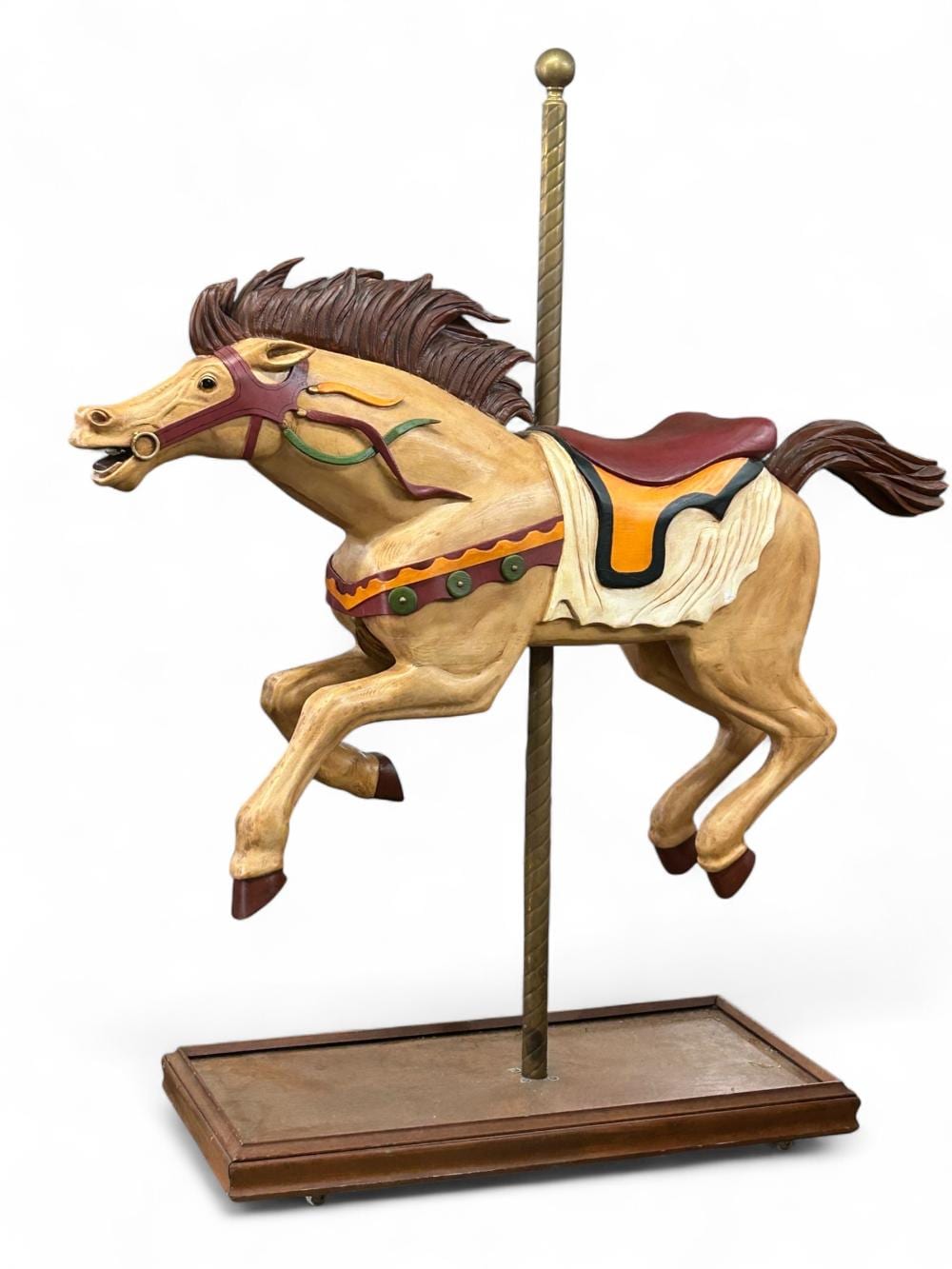
Unlocking the Worth of Nostalgia a Collectors Guide to Antique Carousel Horse Values: appraisal and value basics
Unlocking the Worth of Nostalgia a Collectors Guide to Antique Carousel Horse Values research should start with identification, condition, provenance, and item-specific market evidence. Use this guide to compare the signals that matter before paying for a formal appraisal or deciding whether to sell.
Antique carousel horse appraisal checklist
For many collectors, a single carousel horse unlocks a whole fairground’s worth of memory—calliope music, lights, and the thrill of motion. That emotional pull fuels a robust market, but nostalgia alone doesn’t dictate price. Antique carousel horse values are built on a specific mix of maker, style, pose, carving details, condition (especially paint), provenance, and market timing.
This guide cuts through romance to the practical: how to identify period carvings, what differentiates a modest Herschell stander from a six‑figure Illions lead horse, and how to evaluate originality and restoration. If you collect, insure, sell, or simply want to understand these “moving sculptures,” you’ll find clear criteria here and a realistic picture of how the market tiers compare.
The Market At A Glance: What Drives Value
The most active market segment is the “Golden Age” of American carousels, roughly 1880–1930. Horses from this period were hand‑carved in wood, often hollow‑bodied, and finished in gesso, paint, and occasionally gold leaf and glass jewels. Within that era:
- Entry‑level antiques: simpler “Country Fair” or Allan Herschell/Herschell‑Spillman standers in good restored condition.
- Mid‑tier: more ornate outside‑row horses by Herschell‑Spillman, Parker, and some Philadelphia Toboggan Company (PTC) examples; higher for documented provenance or exceptional carving.
- Upper tier: strong Philadelphia school (Dentzel, PTC, Daniel Muller) and finer Coney Island carvers (Charles Carmel, Charles Looff) with complex trappings.
- Top tier: documented lead or outside‑row horses by Marcus Illions, Stein & Goldstein, Carmel, or top Dentzel—especially with original paint and park provenance. Exceptional menagerie animals (lions, tigers, goats) can exceed comparable horses.
Prices compress or widen with originality and originality. Original paint (“park paint”) and documented, continuous provenance to a specific carousel can double or triple value relative to a stripped or heavily repainted example. Conversely, later reproductions (fiberglass, resin, or modern carvings) often trade for a fraction of antique values, even when visually impressive.
Supply matters. Many carousels were dismantled mid‑century; a portion of the best carvings are now in institutions. When a notable example resurfaces with fresh provenance, competition among collectors and decorators can be intense.
Maker and Style: Reading the Carver’s Hand
Attribution is foundational. Because makers rarely signed their horses, identification relies on patterns of carving, construction, and details.
Major schools and markers:
Coney Island school (New York): Dramatic motion and exuberant ornament. Think flowing manes, expressive eyes, lavish trappings, and jewel work.
- Marcus Illions & Sons: High‑drama silhouettes, deeply undercut carving, dynamic prancers and jumpers, abundant glass jewels.
- Charles Carmel: Elegant heads, full rounded eyes, crisp, refined manes; often intricate blankets and canteens.
- Stein & Goldstein: Powerful musculature, robust heads, massive manes; often heavily jeweled.
- Charles Looff: Earlier works show stylized, sometimes asymmetric manes and decorative tack; West and East Coast presence.
Philadelphia school (Pennsylvania): Sculptural realism and balanced form.
- Gustav Dentzel and the Dentzel Company: Naturalistic animals, including sought‑after menagerie; smooth, flowing musculature and detailed trappings.
- Daniel Muller (associated with Dentzel and later PTC): Anatomical precision, classical heads, subtle expression, and disciplined ornament.
- Philadelphia Toboggan Company (PTC): Consistent, high‑quality carving, strong “show” horses for outside rows; often excellent proportions and symmetry.
Country Fair style (Midwest): Built for traveling shows—sturdier, plainer, and more uniform.
- Herschell‑Spillman / Allan Herschell: Simplified trappings, shallower carving, standers more common than jumpers, strong market for clean originals.
Typical materials include basswood or poplar, sometimes pine, with gesso and layered paint. Construction clues to period work:
- Hollow bodies composed of joined halves; seams often visible under paint.
- A center pole hole through the body; jumpers show bracket and rod attachments.
- Original glass eyes (not molded resin) and horsehair tails (later replaced tails are common but noted in condition).
- Tool marks and crisp hand carving in undercuts; not uniform or molded surfaces.
Learning the “hand” of each carver—mane treatment, ears, nostrils, knee joints, blanket edges—sharpens attribution and thus value.
Pose, Position, and Ornament: Nuances That Add Dollars
Not all horses on a carousel are equal. A few terms can instantly shift the valuation conversation:
- Pose:
- Stander: All four feet on the ground; generally lower value than prancers and jumpers from the same maker.
- Prancer: Front legs raised; conveys motion and energy; typically more desirable.
- Jumper: All four legs off the ground, hung on jumping mechanisms; often commands premiums.
- Row position:
- Outside row (visible perimeter): Largest, most elaborately carved. Outside‑row and especially the “lead horse” are the most valuable in a given set.
- Inside rows: Smaller scale, simpler trappings to save weight; priced lower.
- “Romance side”:
- The side facing the audience from the carousel platform. It’s often more fully carved; the off side may be simpler. Heavier carving on both sides suggests a higher‑end piece.
- Ornament:
- Armor, eagle heads, fish‑scale blankets, canteens, pistol holsters, flags, drapery folds, and lavish jewels add value—if original.
- Scale:
- Larger bodies with sweeping profiles and deeply undercut manes are prized.
Menagerie note: While this guide focuses on horses, lions, tigers, goats, and deer by top shops frequently outsell horses by the same makers due to rarity and dramatic presence.
Condition, Paint, and Restoration
Condition is the biggest swing factor after maker and pose. The market distinguishes between conserved originality and decorative restoration.
- Original paint: Multiple historic layers (“park paint”), aged gesso, and stable patina can double or triple value. Look for:
- Alligatored surfaces, oxidized varnish, and scattered losses consistent with age.
- Palette typical of the maker and era; mineral‑based pigments beneath later layers.
- In‑the‑period glass jewels with ripple, bubbles, or uneven foiling.
- Provenance photos showing the horse on a specific carousel.
- Overpaint and stripping:
- Heavy overpaint can be acceptable if it stabilizes the surface and respects original detail, but it reduces value relative to stable original paint.
- Stripped to bare wood for a “decorator finish” is the steepest penalty; detail is sometimes sanded away. Expect value to drop sharply vs. comparable original paint.
- Repairs and losses:
- Broken legs, ears, and tails are common. Skillful, documented structural repairs are acceptable; cruder fixes (metal plates, excessive filler) detract.
- Replacement jewels, stirrups, and reins are typical. Original hardware is a plus.
- Wood integrity: Check for rot, insect damage, or delamination along seams; these are costly to address.
- Professional conservation versus repaint:
- Conservation aims to stabilize and reveal original surfaces with minimal loss—rewarded by the market.
- Full modern repaint in bright decorator colors is valued less by collectors but may appeal to designers; this creates two distinct buyer pools and price outcomes.
How condition shifts value in practice:
- A Herschell stander with original paint and clean provenance sells well above the same model fully stripped and decorator‑repainted.
- An Illions outside‑row jumper with original jewels and park paint sits at the top of the market, with documentation deciding how high it goes; an Illions of similar form with a modern repaint and uncertain history brings far less.
Quick Checklist Before You Buy
- Confirm construction: Hollow wooden body, center pole hole, evidence of original mounting hardware; avoid cast resin or fiberglass.
- Attribute the maker: Compare mane, head, trappings, and musculature to known patterns (Illions, Carmel, Looff, Dentzel, Muller, PTC, Herschell‑Spillman).
- Identify pose and row: Outside‑row jumpers and lead horses carry premiums; document scale and stance.
- Assess paint layers: Favor stable original or sensitively conserved surfaces; beware freshly stripped or heavy decorator repaints.
- Inspect condition: Look for structural stability, quality of repairs, original jewels/hardware, and intact carving detail.
- Verify provenance: Ask for carousel origin, deaccession paperwork, old photos, or dealer/auction history.
- Measure and weigh practicalities: Size, stand requirements, door clearance, and safe display location.
- Get comparables: Check recent auction results for same maker/pose/paint tier to calibrate your offer.
- Plan for conservation and shipping: Budget for professional packing and any needed stabilization.
FAQ: Antique Carousel Horse Values
How can I tell if a carousel horse is truly antique and not a reproduction?
- Start with material and construction. Documented Golden Age horses are hand‑carved wood, usually hollow‑bodied with a seam, gesso layers, and a center pole hole. Glass eyes (not molded), horsehair tails, and tool‑mark undercuts are encouraging signs. Reproductions are often solid resin or fiberglass with uniform surfaces, no layered paint history, and screw patterns inconsistent with period mounting. Style also helps: if carving is overly smooth, symmetrical, and lacks undercut depth, be skeptical. When in doubt, seek a specialist appraisal.
Is original paint always better than restoration?
- For collectors, yes—stable original paint is the gold standard. Prices can be dramatically higher for documented original surfaces. However, if paint is actively failing, conservation may be essential to stabilize it. Full decorative repaints lower collector value but may broaden interior design appeal. Align the finish with your goals: investment‑grade collecting favors original or sensitively conserved paint.
Which makers command the highest prices?
- Among horses, top results often come from Coney Island carvers—Marcus Illions, Stein & Goldstein, and Charles Carmel—especially outside‑row jumpers with lavish jewels. From the Philadelphia school, Dentzel, Daniel Muller, and strong PTC carvings also achieve high prices, particularly with provenance. Menagerie animals by Dentzel and others sometimes surpass horses. Herschell‑Spillman and Allan Herschell, while popular and accessible, sit at lower price tiers due to simpler carving.
What does “lead horse” mean, and why is it valuable?
- The lead horse is the signature outside‑row figure, typically the most ornate and often positioned near the band organ. Lead horses are larger, with exceptional carving, armor, or elaborate trappings. They are rarer within a set, and their showcase status attracts competitive bidding—hence the premium.
How should I insure and care for a carousel horse?
- Insure at current replacement value based on recent comparables for the same maker, pose, and paint tier; update every few years. For care, avoid direct sunlight and high humidity; dust gently with a soft brush. Never strip or aggressively clean; consult a conservator for flaking paint or loose gesso. Use a stable, purpose‑built stand and avoid high‑traffic placement that risks impact.
Final thought: Antique carousel horse values reward knowledge. Learn the carvers, recognize poses and row significance, train your eye for paint and patina, and favor documented provenance. When nostalgia meets informed judgment, you’ll ride away with both beauty and value.


