Unlocking the Worth of Elegance Estimating Your Antique Clawfoot Tubs Value: appraisal and value basics
Unlocking the Worth of Elegance Estimating Your Antique Clawfoot Tubs Value research should start with identification, condition, provenance, and item-specific market evidence. Use this guide to compare the signals that matter before paying for a formal appraisal or deciding whether to sell.
Antique clawfoot tub appraisal checklist
Few antique fixtures carry the romance and staying power of a cast‑iron clawfoot tub. They anchor rooms, dictate style, and if chosen wisely, hold or grow in value. Whether you’re an appraiser, dealer, or collector planning a sale or restoration, a disciplined approach will help you price with confidence. This guide breaks down market dynamics, how to identify era and maker, condition grading, and the features that push prices up or down—ending with a concise checklist you can use in the field.
Read the Market: What Sells and Why
Antique clawfoot tub values hinge on demand, supply, and logistics as much as aesthetics. Understanding the market currents keeps your estimates realistic.
- Core demand: Design-forward homeowners, boutique hotels, and period restorers seek documented tubs as focal pieces. Demand tends to be strong for 60–66 inch models that balance presence with practicality, especially with classic ball‑and‑claw feet.
- Supply: Salvage yards, estate renovations, and architectural recyclers supply a steady but finite stream. Original porcelain interiors in strong condition are scarcer each year, commanding premiums.
- Price tiers (typical US market ranges vary by region):
- Common, unrestored 54–60 inch cast‑iron tubs with worn but usable porcelain: often low hundreds to around a value that must be established from current, topic-matched sales.
- Clean originals with minimal enamel wear and complete period feet/hardware: roughly mid hundreds to low thousands.
- Professionally refinished interiors/exteriors or rare sizes/makers: about a value that must be established from current, topic-matched sales+ depending on quality and provenance.
- Exceptional examples (large 72 inch, copper or nickel-plated exteriors, top makers, or kiln‑reporcelainized): can reach many thousands.
- Logistics cut both ways: Tubs weigh ~250–500+ lb. Local pickup widens the buyer pool; long‑distance freight can add hundreds and depress net proceeds. Easy access (no tight stair runs) boosts saleability.
- Design trends: Neutral exteriors (white, soft gray) and nickel or unlacquered brass hardware remain durable choices. Trendy exterior colors can help sell locally but may narrow the buyer base at appraisal time.
Bottom line: value lives at the intersection of attribution evidence, condition, completeness, size, and how easy the tub is to buy and install.
Identify Era, Maker, and Model
Establishing what you have is step one. Maker and era influence desirability, quality, and price.
- Common eras:
- Late 19th century (c. 1880s–1900): Early US and UK clawfoots, heavier castings, deep wells, often no overflow. Feet can be ornate (lion paw).
- Early 20th century (c. 1900–1930s): Widespread production. Many tubs gain standardized drains and more uniform feet styles.
- Major makers to know (North America):
- Standard Sanitary Mfg. Co. (later American Standard, post‑1929 merger): Abundant, solid quality; marks can read “STANDARD,” “S.S.M.C.,” or later “AMERICAN STANDARD.”
- Kohler: Often marked “KOHLER.” Good casting consistency; sought after for brand recognition.
- Crane: Marked “CRANE.” Clean lines; period hardware is well regarded.
- J. L. Mott Iron Works: High‑end, earlier pieces can command a premium, especially ornate examples.
- Regional foundries: Various smaller foundries produced tubs; research local histories for attribution.
- Where to find marks:
- Underside of the tub (look near the drain end or mid‑body) for cast‑in logos, size codes, and date stamps.
- Inside the roll rim or on the exterior skirt for faint cast or stamped marks.
- Feet often have cast numbers; matching numbers on feet and body indicate an original set.
- Reproduction vs. antique:
- Magnet test: True antique cast iron is strongly magnetic; acrylic/fiberglass reproductions are light and non‑magnetic.
- Weight and wall thickness: Cast‑iron tubs feel massively heavy; the rim edge appears thick and cool to the touch. Repros often have seam lines or hollow sounds.
- Hardware holes: Early antique freestanding tubs commonly lacked deck faucet holes; supply lines mounted from the floor or wall.
Documentation helps. Photograph marks as you find them and note any provenance (source property, architectural salvage receipts). The right maker and era can add a condition-specific range to value, sometimes more for early or rare forms.
Condition and Restoration: How Value Moves
Condition is the most powerful driver after size and completeness. Grade interiors and exteriors separately, then factor restoration.
- Interior porcelain (enamel) grading:
- Excellent: Glossy, uniform, no chips; light wear. Highest value.
- Very good: Minimal abrasion, a few small chips or stains; easily cleanable.
- Good/usable: Noticeable wear, scattered chips, mild crazing, light pitting; still serviceable with cleaning or touch‑ups.
- Fair/poor: Extensive enamel loss, deep pitting, rust blooms, heavy staining or etching; likely needs professional refinishing.
- Exterior condition:
- Original paint with even patina or neatly repainted exteriors are acceptable. Active rust or heavy blistering reduces appeal but is repairable.
- Feet and attachments:
- Full, original, stylistically matching set strongly preferred. Missing or mismatched feet can reduce value substantially. Replacement feet exist, but fit and style must match.
- Restoration types and impact:
- Professional on‑site refinishing (“reglazing” with sprayed coatings such as acrylic urethane): Improves appearance and usability; adds value over a deteriorated interior but generally less than pristine original porcelain. Longevity depends on prep and materials.
- Factory re‑porcelainizing (strip to bare iron and re‑fire enamel in a kiln): Rare, costly, and yields a near‑original finish. Can command significant premiums when documented.
- DIY coatings or brush paints: Usually hurt value unless removed and redone professionally.
- Nickel plating of feet/exterior: Can elevate value if tastefully done and period‑appropriate. Overly glossy or anachronistic finishes may narrow the buyer pool.
- Repairs to watch:
- Welding or grinding on the cast body is uncommon and can be a red flag. Chips can be filled; deep rust pits near the drain should be carefully evaluated.
- Overspray or drips on porcelain or feet signal poor workmanship.
Conservatively grade what you see. Original, excellent porcelain is the gold standard; professional, well‑documented restoration comes next.
Features That Drive Premiums
Some characteristics consistently add (or subtract) value.
- Size:
- 60 inch and 66 inch tubs suit most bathrooms and attract the broadest demand.
- 54 inch “apartment” models can sell briskly in tight markets, but deep soaking comfort is limited.
- 72 inch or oversized tubs are rare and dramatic; they command premiums but require space and robust floors.
- Depth and profile:
- High‑back or slipper forms often carry a premium over double‑ended or flat‑rim styles when the interior is generous and comfortable.
- Foot style:
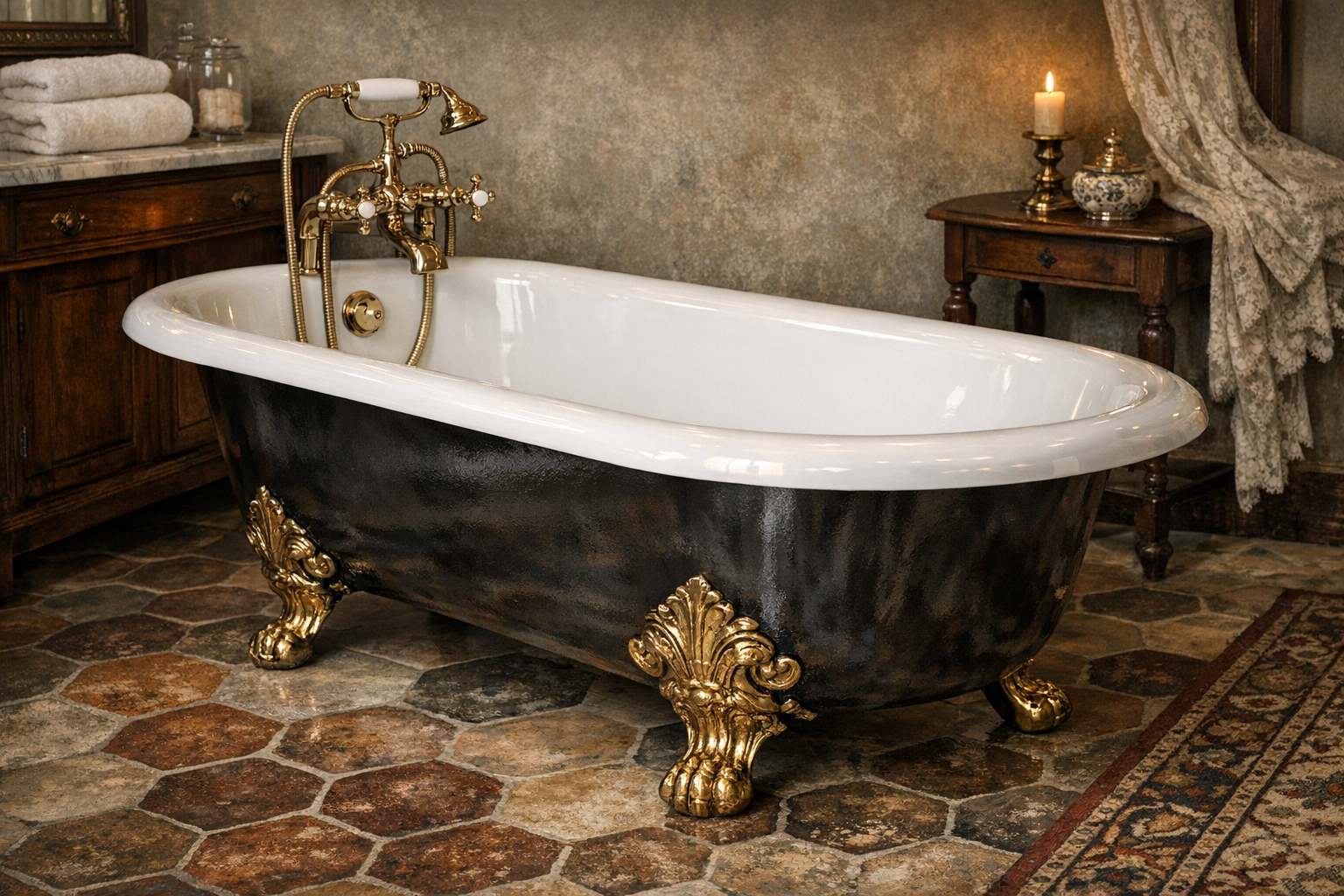
- Ball‑and‑claw is classic and safe. Lion paw, scroll/imperial, and other sculptural feet can lift prices, especially in earlier tubs.
- Materials:
- Cast‑iron porcelain enamel is standard and most desirable for originality and durability.
- Copper tubs (true antique) are rare and can be highly valuable; confirm material, thickness, and age—many “copper look” pieces are modern.
- Drain and overflow:
- Many antiques lack an overflow; ensure the buyer understands local code requirements. Clean, corrosion‑free drains and intact threads enhance value.
- Hardware and completeness:
- Original exposed supply lines, period faucet, and drain assemblies in nickel or brass finish can add several hundred dollars to the package value.
- Missing hardware isn’t fatal, but replacement costs should be figured into the price.
- Matching numbers and provenance:
- Feet numbered to the tub, verified maker/date marks, and provenance from a notable property can add meaningful premiums.
- Installation fit:
- Standard drain sizing and compatibility with modern traps/supplies reduce friction and increase appeal.
Each positive feature stacks. A 66 inch slipper tub with superb original porcelain, matching lion‑paw feet, and documented Kohler or Mott attribution is an upper‑tier example in most markets.
Estimating Value and Choosing a Selling Strategy
Use a structured approach to convert observations into a number you can stand behind.
- Establish comparables
- Compile recent sales of similar size, form, maker, and condition. Weight local results more heavily to account for freight realities. Note asking vs. achieved prices if possible.
- Adjust for condition
- Start from a mid‑market comparison and adjust:
- Excellent original porcelain: a condition-specific range
- Professional high‑quality refinish: a condition-specific range over a “fair/pitted” baseline; still typically a condition-specific range versus excellent original.
- Poor interior needing work: a condition-specific range
- Missing or mismatched feet: a condition-specific range depending on availability of replacements and fit.
- Adjust for features
- Size premium: a condition-specific range for 66–72 inch, a condition-specific range for 54 inch (unless small‑space markets).
- Desirable foot style or high‑back form: a condition-specific range
- Original period hardware present and serviceable: a condition-specific range
- Provenance or rare maker: a condition-specific range
- Factor logistics
- Limited access, upper floors, or required professional rigging: buyers discount. Apply a condition-specific range or plan to offer delivery.
- If you can offer local delivery with proper equipment, you may recover some of that discount.
- Choose a selling venue
- Local architectural salvage or consignment: Lower effort, fees apply; pricing often moderate.
- Direct regional sale (classifieds, dealer networks): Strong if you can manage transport and buyer vetting.
- Specialty auctions: Suitable for rare, documented, or exceptional condition pieces; fees offset by national exposure.
- Design trade channels: Stage and sell with a complete hardware package to fetch a premium.
- Present professionally
- Provide maker marks photos, dimensions (L × W × rim height × interior depth), weight estimate, detailed condition notes, and any restoration documentation.
- Clean thoroughly; stage with the correct feet orientation; protect porcelain during handling.
Pricing note: It’s better to come to market slightly above your target with justification and complete documentation than to underprice and invite doubt. Be ready to explain how you arrived at your figure.
Quick Appraisal Checklist
Use this field checklist to size up a tub in minutes.
- Magnet test on body and feet; confirm cast iron.
- Measure: overall length (54/60/66/72 in), width, rim height, and interior depth at back.
- Identify form: standard roll rim, double‑ended, slipper/high‑back.
- Inspect marks: underside cast logos, date codes; photograph all marks. Check feet for matching numbers.
- Grade interior porcelain: gloss, chips, stains, crazing, pitting; note any rust at drain/overflow.
- Check exterior: paint condition, rust, dents; verify sound iron (tap test for dull thuds).
- Verify feet: complete set, secure fit, correct style; note any replacements.
- Hardware: faucet holes (if any), supply orientation, drain size/threads, overflow presence; list what’s included.
- Test stability: set on a flat surface; confirm no rocking; feet sockets are solid.
- Logistics: access path, stair turns, door widths; estimate weight and transport needs.
- Documentation: provenance, restoration invoices, maker research.
FAQ
Q: How can I tell if my tub’s finish is original porcelain? A: Original porcelain is kiln‑fired, glassy, and integrated with the iron. It typically shows crisp transitions at the rim with no “orange peel” texture. Sprayed refinishes may look slightly plasticky, with subtle peel or masked edges. Look for refinisher stickers under the rim and examine chips; original chips are often sharp‑edged with black iron visible beneath.
Q: Do refinished tubs sell for as much as pristine originals? A: Usually not. A high‑quality professional refinish can outperform a heavily worn original, but pristine original porcelain remains the benchmark and often sells higher. Documented factory re‑porcelainizing, while rare, can rival or exceed original values.
Q: My tub is missing one foot. How badly does that hurt value? A: Expect a noticeable hit—often a condition-specific range—because finding a matching foot that fits and sits level takes effort. If you source a correct, well‑fitting replacement, provide photos and notes to narrow the discount.
Q: Are 54 inch tubs less valuable? A: They can be, due to comfort and proportion limitations, but in dense urban markets with small bathrooms, demand for 54 inch models can be strong. Condition and completeness still dominate pricing.
Q: Do I need an overflow to install an antique tub? A: Many antiques have no overflow. Local codes vary; some allow tubs without overflows when paired with appropriate drains and fittings. Buyers should confirm code requirements before purchase to avoid surprises.
With a clear identification, honest condition grading, and straightforward market logic, you can unlock the true worth of your clawfoot tub—and present an appraisal that stands up to scrutiny.