Unlocking the Worth a Collectors Guide to the Value of Old Whiskey Jugs: appraisal and value basics
Unlocking the Worth a Collectors Guide to the Value of Old Whiskey Jugs research should start with identification, condition, provenance, and item-specific market evidence. Use this guide to compare the signals that matter before paying for a formal appraisal or deciding whether to sell.
Old whiskey jug appraisal checklist
Antique whiskey jugs sit at a crossroad of Americana, British pub culture, and industrial ceramic history. Whether salt-glazed stoneware with bold cobalt script, two-tone “brown-top” shoulder jugs used in U.S. distilleries, or British transfer-printed pubware for Scotch houses, the market rewards attribution evidence, condition, and eye appeal. This guide distills the key factors appraisers and collectors use to determine value, complete with price bands, maker notes, and practical steps to avoid costly mistakes.
What Makes A Whiskey Jug Valuable
Value is usually a sum of seven drivers:
Age and period: Most collectible American stoneware whiskey jugs date from c. 1850–1915; British and Irish pub jugs often span c. 1880–1930, with postwar promotional decanters surging again mid-20th century. Earlier typically commands more, with exceptions for iconic branding.
Maker and region: Named potters or potteries (e.g., White’s Utica, E & L P Norton, Cowden & Wilcox, Red Wing, Uhl, Robinson Ransbottom; in the U.K., Doulton Lambeth/Royal Doulton, Bourne Denby, Port Dundas, Buchan Portobello) can multiply value. Southern U.S. alkaline-glazed and Edgefield-area outputs, and certain Western advertising examples (e.g., San Francisco houses), can be especially strong.
Decoration and typography: Hand-brushed cobalt foliate or pictorial decoration, rich slip bands, crisp stenciling, or early transfer prints standout. Pictorial cobalt (e.g., deer, eagles, elaborate flourishes) and unusually large, well-spaced typefaces add premium.
Capacity and form: One-gallon and two-gallon jugs are common; larger (3–5 gallon) advertising examples and miniature sample jugs often command more. Beehive and ovoid forms appeal; double-handled or unusual spouts and shoulders can elevate interest.
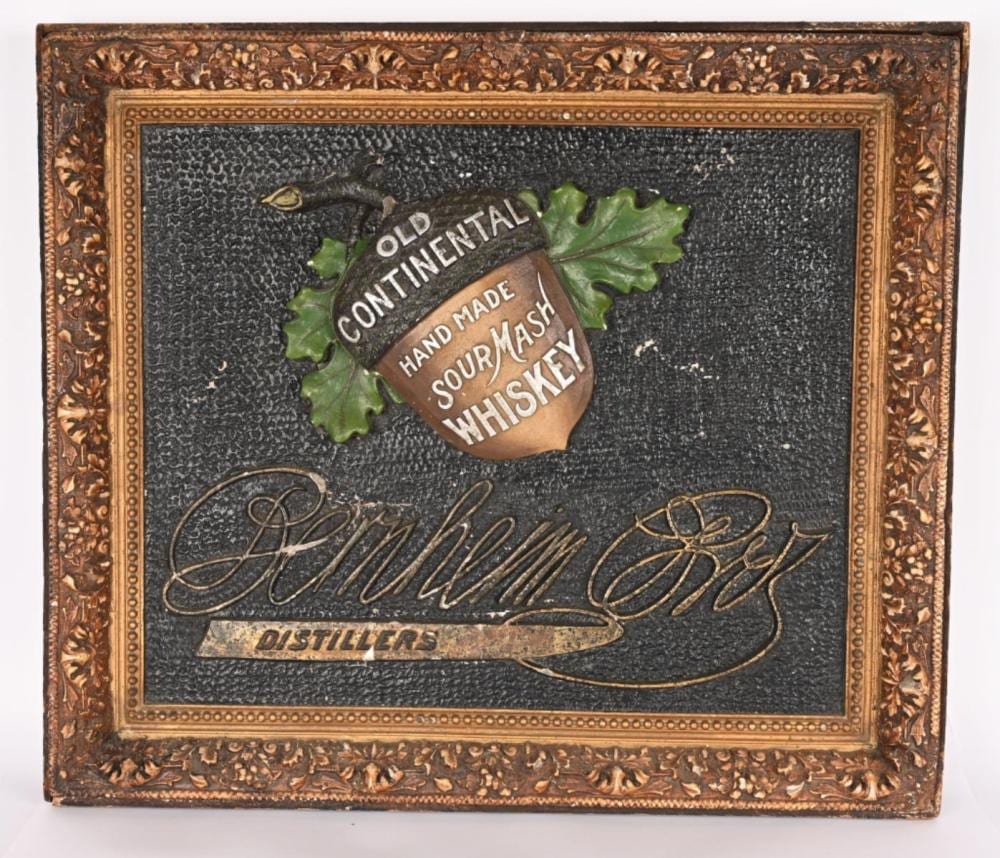
Branding and locality: Named distillery or merchant advertising—especially regional (small-town general stores, saloons, or short-lived brands)—adds desirability. Well-known bourbon houses (Old Crow, I.W. Harper, Taylor & Williams, W.H. McBrayer) or Western firms (e.g., Hotaling) can outperform generic.
Condition and originality: Chips, hairlines, spider cracks, base flakes, glaze loss, and drilled holes (for lamps) reduce value. Professional restorations, while sometimes stabilizing, typically decrease value compared with original condition.
Provenance and rarity: Documented history, known collections, or publication references support confidence. Unusual colorways, unique fonts, or scarce potters drive scarcity premiums.
Identifying Types, Materials, And Makers
Knowing what you’re holding begins with materials and manufacturing clues.
American stoneware whiskey jugs (c. 1850–1915)
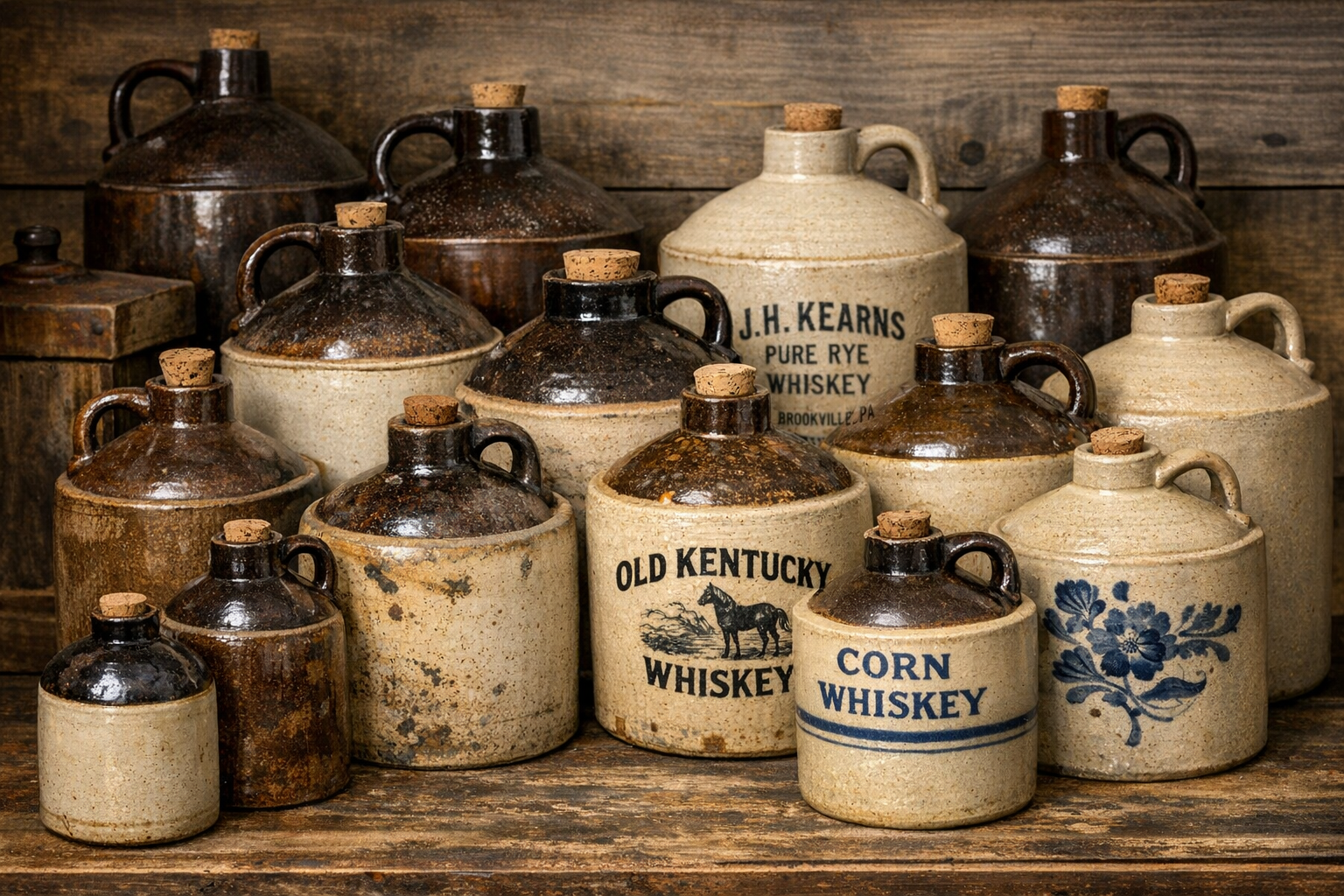
- Bodies: Salt-glazed gray stoneware, often with Albany slip brown-tops or later Bristol white glazes.
- Decoration: Cobalt slip-trailed script or stenciled advertising, sometimes capacity marks incised or brushed in cobalt.
- Forms: Ovoid early forms; later shouldered “brown-top” jug; capacities from ½ gallon to 5 gallons.
- Makers to watch: White’s Utica (NY), E & L P Norton (Bennington/Bennington-area, VT), F. B. Norton, Cowden & Wilcox (PA), Red Wing (MN), Uhl (IN), Monmouth and Western Stoneware (IL), Robinson Ransbottom (OH). Southern alkaline-glazed traditions (Edgefield District, SC/GA) and occasional face or figural jugs intersect whiskey storage but are a specialized category.
British, Irish, and Commonwealth pubware (c. 1880–1930; later promos mid-20th century)
- Bodies: Salt-glazed or stoneware bodies with underglaze transfer prints; later earthenware or vitrified jugs with printed advertising.
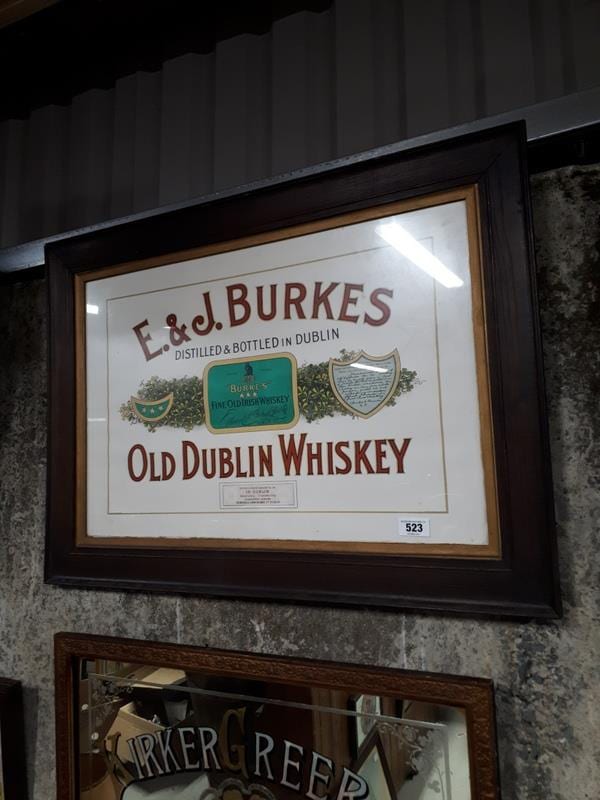
- Brands: Dewar’s, Haig & Haig, Teacher’s, Buchanan’s “Black & White,” Johnnie Walker; also regional grocers/wine merchants.
- Makers: Doulton Lambeth/Royal Doulton (London), Bourne Denby (Derbyshire), Port Dundas (Glasgow), Buchan (Portobello), Wade (Staffordshire; many mid-century promos).
- Forms: Bar-top pouring jugs, bellied pub jugs, two-tone “Scotch” jugs, and figural decanters (mid-20th century).
Australian and Canadian examples
- Australian stoneware with printed advertising from Bendigo Pottery and Fowler (Sydney) appears with local spirits/merchants.
- Canadian advertising jugs tied to early distilling/merchants (e.g., Seagram-related or regional wholesalers) are less common but desired.
Material cues:
- Salt glaze: Orange-peel texture under raking light.
- Albany slip: Deep chocolate brown, usually on the upper shoulder/neck.
- Bristol glaze: Smooth creamy white leadless glaze often paired with brown tops in later U.S. jugs.
- Transfer printing: Dark, detailed motifs with “bleed” into the glaze on period pieces; often underglaze.
Reading Marks, Stencils, And Advertising
The wording and execution of advertising are critical.
Merchant vs. distillery: Jugs marked for small-town grocers or saloons can be rarer than major brands. Verify place names and period spellings (e.g., abbreviations like “Ky.” for Kentucky).
Execution tells:
- Stencils and cobalt script should show slight irregularities, feathering at edges, and natural pooling into the glaze.
- Transfer prints on period pubware often exhibit minute breaks from the transfer process, not laser-sharp edges.
Pottery marks:
- Stamped or impressed: “WHITE’S UTICA,” “E & L P NORTON,” “COWDEN & WILCOX,” “RED WING,” “UHL,” “WESTERN STONEWARE,” “ROBINSON RANSBOTTOM.”
- British: “DOULTON LAMBETH,” “ROYAL DOULTON,” “DENBY,” “PORT DUNDAS,” “BUCHAN PORTOBELLO,” later “WADE.”
- Some advertising jugs carry only the merchant/brand; absence of a pottery mark is common and not disqualifying.
Capacity and numerals: Painted or incised “1,” “2,” “3,” “5” with or without “GALLON.” Crisp, out-of-period fonts are a red flag.
Provenance marks: Pencil or ink collection numbers on base or an old label can be helpful—photograph before removing.
Condition And Restoration: How Much Does It Matter?
Condition is a top-three value driver. Appraise under strong daylight and raking light.
Common issues:
- Lip chips and base flakes: Expect minor wear on utilitarian pieces; small flakes may reduce value modestly.
- Hairlines and spider cracks: Hairlines can halve value; structural cracks or starbursts can reduce by a condition-specific range.
- Glaze pops, kiln kisses, in-the-making flaws: Often tolerated when minor; disclosure is key.
- Stain and “barn dirt”: Cleanable, but avoid aggressive methods.
Restoration detection:
- Look for mismatched sheen, over-smooth areas, or painted fills.
- Use a blacklight: Many modern fillers fluoresce differently than the surrounding glaze.
- Tap test: A dull thud can indicate a repair; compare to a known-sound example.
- Under magnification: Overpaint brush strokes and edges around chips can reveal work.
Value impact (broad guidance):
- Minor rubs/scuffs: a condition-specific range reduction.
- Small, stable rim chip professionally touched in: a condition-specific range.
- Hairline through body/handle: a condition-specific range.
- Major restoration (neck rebuild, large fill): a condition-specific range depending on rarity.
- Exception: Museum-level rarities with professional restoration can still command strong results.
Care tips:
- Hand clean with mild soap; avoid soaking, harsh abrasives, or dishwashers.
- Use felt pads under heavy jugs; keep out of direct sun and extreme temperature swings.
Price Ranges And Market Examples
Every market is local, but these bands help calibrate expectations:
- Common U.S. brown-top shoulder jugs (unmarked merchant, 1 gallon): a value that must be established from current, topic-matched sales in average condition; a value that must be established from current, topic-matched sales if cleaner and visually strong.
- U.S. stenciled/advertising stoneware for local merchants (1–2 gallon): a value that must be established from current, topic-matched sales; regionally important or crisp, large-type examples: a value that must be established from current, topic-matched sales.
- Cobalt-decorated (script or pictorial) mid/late 19th century: Basic script a value that must be established from current, topic-matched sales; elaborate pictorial or noted potters a value that must be established from current, topic-matched sales+. Large capacity or exceptional motifs can exceed these.
- Red Wing and related Midwest makers with large logos or targets (2–5 gallon): a value that must be established from current, topic-matched sales; scarce stampings or unusual forms: a value that must be established from current, topic-matched sales+.
- Western U.S. advertising (e.g., San Francisco wholesalers): a value that must be established from current, topic-matched sales; rare brands or mint condition higher.
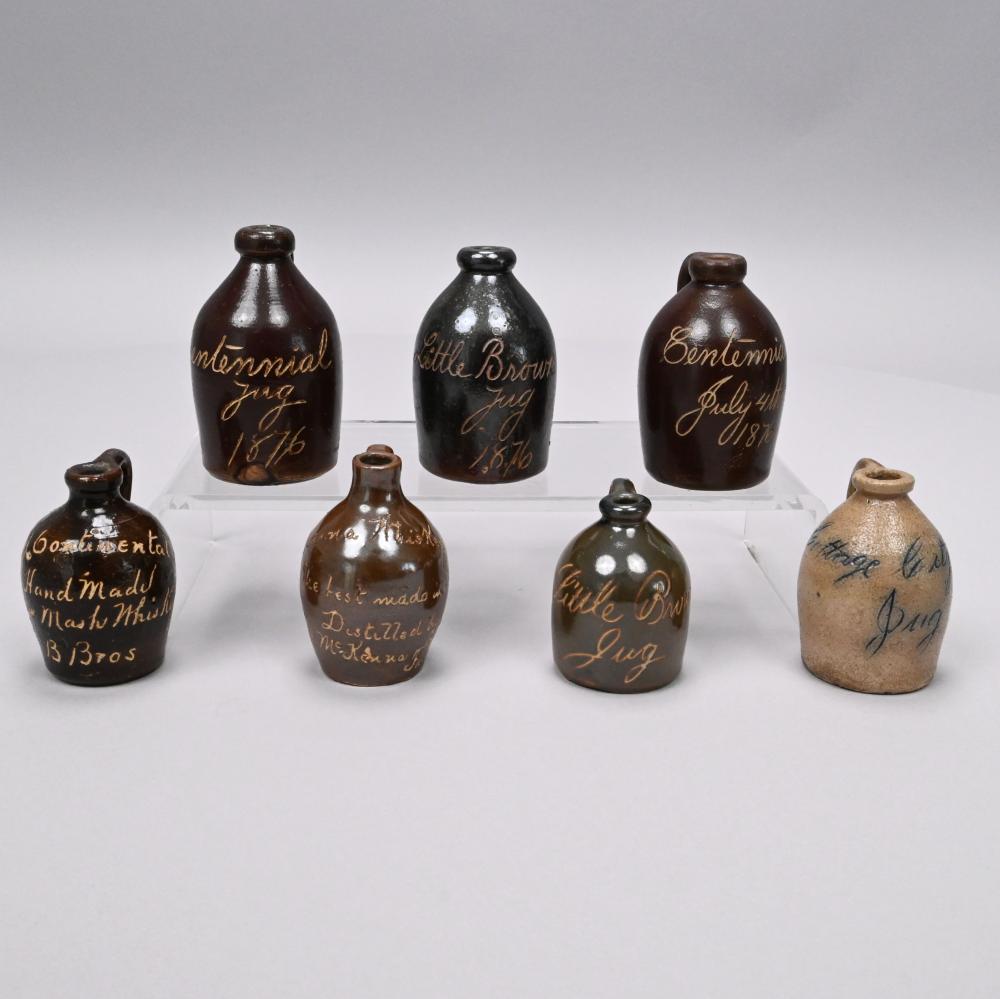
- Miniature/sample advertising jugs: a value that must be established from current, topic-matched sales; particularly tiny or unusual brand examples can climb further.
- British pub jugs (Doulton/Denby/Port Dundas with Scotch brands): a value that must be established from current, topic-matched sales; standout graphics or early Lambeth work: a value that must be established from current, topic-matched sales+.
- Wade and mid-20th-century promotional decanters: Common forms a value that must be established from current, topic-matched sales; scarce figural or limited issues: a value that must be established from current, topic-matched sales+.
- Southern alkaline/Edgefield-related or face jugs: A specialized field; typical whiskey-use forms vary widely. Notable face jugs can bring a value that must be established from current, topic-matched sales+, but ensure expert attribution review.
Condition caveat: Deduct for flaws as noted. A a value that must be established from current, topic-matched sales advertising jug with a long hairline might trade at a value that must be established from current, topic-matched sales.
Seasonality and venue:
- Regional stoneware often excels near its origin. Country auctions and estate sales may yield lower buy-ins; national auctions and specialist shows can realize top results.
- Online marketplaces broaden exposure but demand meticulous photography, measurements, and condition notes.
Buying, Selling, And Timing The Market
For buyers:
- Buy the best you can in your niche—superior typography, strong cobalt, and clean surfaces hold value.
- Specialize by region (e.g., Kentucky bourbon houses, New England potters, Scottish brands) to build expertise and networks.
- Verify originality of advertising; learn period fonts and printing quirks.
For sellers:
- Clean lightly; don’t over-restore. Honest, well-lit photos (front, back, base, handle, lip, close-ups of marks) increase confidence.
- Provide exact height and capacity; note any restorations or hairlines plainly.
- Consider local/regional auctioneers for place-specific brands; broader platforms for blue-chip potters or international pubware.
Timing:
- Q4 gift season and late winter show calendars can be favorable. Market interest is currently strong for named potters, local advertising, and unusual forms, with soft demand for generic, damaged examples.
Spotting Reproductions And Problem Pieces
Fakes exist, especially in advertising jugs.
Red flags:
- Decals sitting on top of the glaze, with edges you can feel; modern inks with too-clean lines.
- Fonts that postdate the era; inconsistent abbreviations or ZIP codes/phone numbers on “antique” ads.
- Clay color and weight that feel wrong—lightweight earthenware passed off as stoneware.
- Artificial “barn” staining that rubs off; uniformly distributed wear with no natural high-point rubs.
- Ground and repolished bases to remove damage or add fake wear.
Safer signs:
- Advertising under the glaze with slight bleed; oxidation specks in transfers.
- Honest base wear at the outer ring, glaze pooling in recesses, and tool marks consistent with wheel-thrown or jiggered production.
- Provenance notes, period photos, or inclusion in older collections.
Rapid Appraisal Checklist
- Identify material: salt-glazed stoneware, Albany/Bristol glaze, or transfer-printed pubware.
- Measure capacity and height; note form (beehive, ovoid, shoulder).
- Document all marks: pottery stamps, capacity numbers, merchant/distillery names, locations.
- Assess decoration: hand-brushed cobalt, stencil, or transfer print; rate sharpness and aesthetics.
- Check condition: rim/base chips, hairlines, glaze flakes, repairs; use raking light and blacklight.
- Photograph thoroughly: front, back, base, lip, handle, close-ups of marks and flaws.
- Research locality: merchant/distillery history and regional pottery traditions.
- Compare to recent sales of the same maker/region and similar condition.
- Adjust value for condition; deduct for restoration proportional to severity.
- Consider venue: sell regionally for local brands; nationally for blue-chip makers.
- Beware fakes: test for underglaze vs. overglaze decoration; scrutinize fonts and wear.
- Keep notes: provenance, acquisition date, and cost for future appraisals.
Short FAQ
Q: Are brown-top shoulder jugs always whiskey-related? A: Not always. The classic brown-top stoneware jug stored many liquids (molasses, vinegar, cider). Advertising, capacity marks, and locality help confirm whiskey use. Value comes from decoration/branding more than assumed contents.
Q: How much does a hairline crack reduce value? A: Often a condition-specific range depending on length, visibility, and rarity. A scarce, highly desirable jug can tolerate more reduction than a common example, but hairlines are still significant.
Q: Do unmarked jugs have value? A: Yes. Unmarked but well-decorated or strongly stenciled jugs can outperform marked yet plain examples. However, identifiable potters and merchants add confidence and usually stronger prices.
Q: What’s the difference between transfer print and decal? A: Period transfer prints are applied under or within the glaze and show slight breaks or bleed; decals often sit on top of the glaze with crisp edges you can feel. Under magnification, modern decals reveal dot patterns and cleaner edges.
Q: Are mid-20th-century promotional whisky jugs collectible? A: Selectively. Common Wade or similar promos bring modest sums (a value that must be established from current, topic-matched sales), but limited figural forms, top brands, or excellent graphics can reach a few hundred dollars. Earlier Doulton/Denby pubware generally commands more.
With a careful eye for material, marks, and typography—and a disciplined approach to condition—you can separate the merely old from the truly valuable. Use the checklist, study your regional makers, and let rarity and aesthetics guide your bids and appraisals.
![AMERICAN WHISKEY LABELS, MAJOR COLLECTION ~ 500 PCS [166469] sold by Holabird Western Americana, lot 2494 — auction record photograph](https://assets.appraisily.com/comps/auction-lots/180435003/thumb/d6fbb5fea7525ab3612c19da024817ff2052612f2d73201f3b7568295fba75c9.jpg)
![Reno Saloon, J. Barra Prop., Tonopah, Nev Clay Whiskey Jug [197034] sold by Holabird Western Americana, lot 1034 — auction record photograph](https://assets.appraisily.com/comps/auction-lots/196691847/thumb/h19286-l404250456.jpg)