Unlocking the Secrets to Antique Mirror Value Expert Tips for Collectors: appraisal and value basics
Unlocking the Secrets to Antique Mirror Value Expert Tips for Collectors research should start with identification, condition, provenance, and item-specific market evidence. Use this guide to compare the signals that matter before paying for a formal appraisal or deciding whether to sell.
Antique mirror value checklist
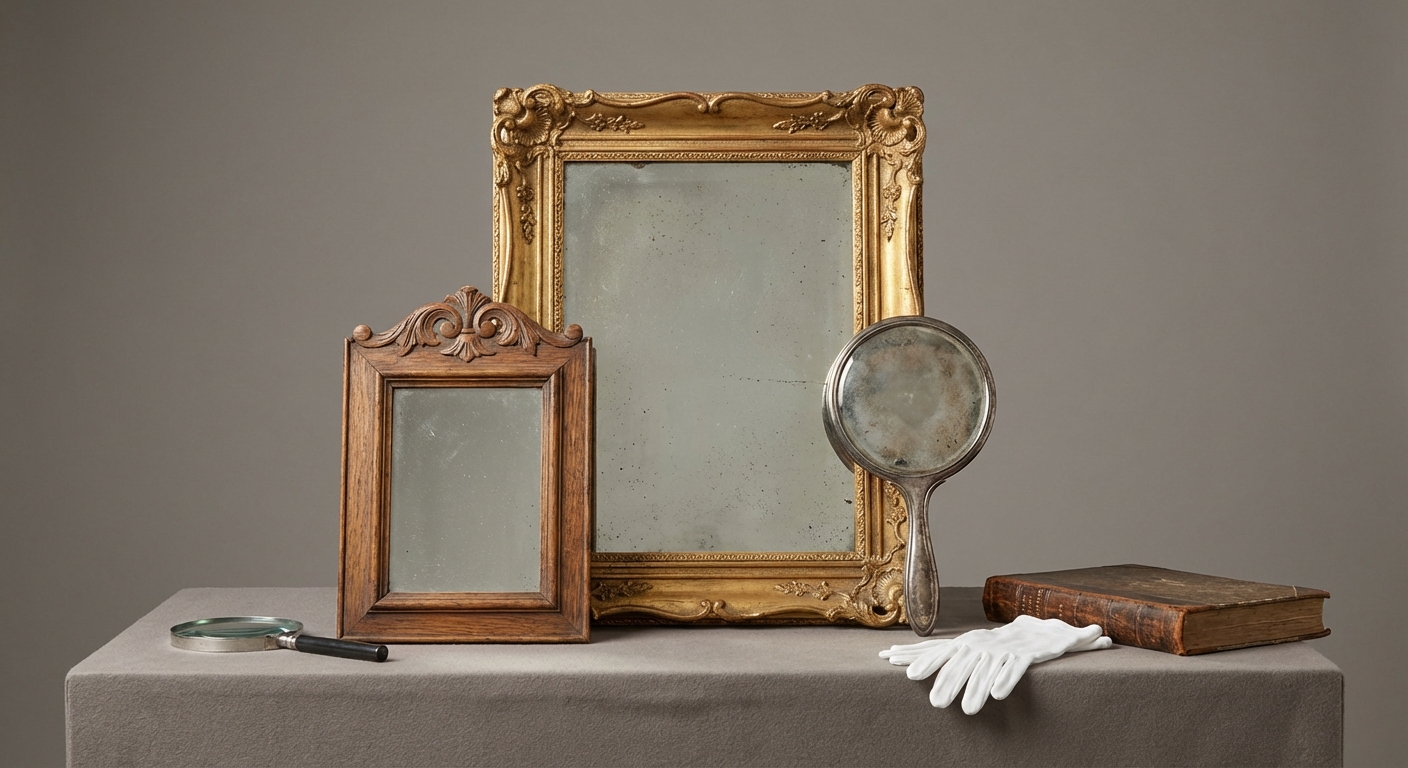
Antique mirrors are more than reflective surfaces—they’re historical artifacts that document changing technologies, tastes, and trade routes. Understanding how to date, document, and evaluate them lets you buy, sell, and insure with confidence. This guide distills an appraiser’s approach into practical, field-tested steps that you can use at home or at the preview table.
Dating Antique Mirrors: Start With The Glass
Appraisers begin with the plate, not the frame. The glass reveals when—and sometimes where—the mirror could have been made.
- Pre-1835: Mercury-tin amalgam backing. European mirrors from the 17th to early 19th centuries often used mercury on the back of glass. Under raking light, the reflection can appear slightly colder or grayer than modern silvering. Deterioration looks like crystalline black or dark patches in irregular patterns—not the uniform “mist” of modern artificial antiquing. At raw, chipped edges, a granular, metallic look is possible.
- 1835 onward: Silvered glass. The chemical silvering process (popularized by Liebig) took hold through the 1840s–1860s. Silvered plates reflect warmer and brighter. Desilvering tends to show as cloudy edges that fade toward the center.
- Plate size and seams. Early mirror plates were small and expensive. Eighteenth‑century mirrors often use multiple plates joined with vertical seams or hidden by frame elements. Single, large plates become common as rolled plate glass scales up after mid‑19th century.
- Surface character. Earlier glass (crown or cylinder) often shows “ropey” waves when you move your head, with occasional seed bubbles. Machine‑polished rolled plate (c. 1850+) reads flatter, but the back may show faint straight grinder marks.
- Bevels. Hand-beveled edges (common from the late 18th century onward) are irregular in width and polish, with the bevel not perfectly uniform. Machine bevels on 20th‑century mirrors are remarkably even.
- Convex vs. flat. True Regency/Empire convex mirrors (c. 1780–1830) are sought after. The curvature should be subtle and the plate relatively heavy. Most “convex” reproductions use thin, uniformly curved plates with bright, uniform silvering.
Two cautions:
- Do not scrape, burnish, or chemically test the back. You can destroy value or release mercury residues.
- A replaced plate is common and not a deal‑breaker, but you must factor it into value.
Frames and Styles: What the Case Tells You
Frames carry the stylistic language that helps narrow date, origin, and desirability. Look at carving quality, materials, joinery, and ornament.
- Baroque (c. 1650–1710): Bold scrolls, strapwork, heavy pierced crestings; in northern Europe, oyster veneer panels. Deeply carved wood, water gilding on bole. Originals command strong prices in good condition.
- Rococo (c. 1730–1770): Asymmetrical rocailles, C‑scrolls, shells, and floral garlands. Hand-carving should feel crisp; gesso and compo (composition) appear late in the period.
- Neoclassical/Georgian/Federal (c. 1760–1820): Straighter lines, husk swags, urns, and pilasters. In America, Federal girandoles and overmantels often feature eagles, laurel wreaths, and reeded columns. French Louis XVI pieces emphasize beading and ribbon bows; trumeau mirrors pair a painted or carved panel above a plate.
- Regency/Empire (c. 1800–1830): Convex mirrors with ebonized or gilt frames, ball moldings, and eagle crestings in Britain and the U.S.; French Empire uses classical motifs, palmettes, and ormolu mounts.
- Victorian revivals (c. 1837–1901): Gothic, Rococo, and Renaissance revivals. Composition ornament dominates; gilding is often oil‑gilded and less lustrous than earlier water gilding.
- Arts & Crafts and Art Nouveau (c. 1880–1910): Honest oak with pegged joints; sinuous organic lines; hammered copper or brass details.
- Art Deco (c. 1920s–30s): Geometric silhouettes, scalloped tops, sand‑etched patterns, and dramatic beveled panels.
Construction clues:
- Joinery: Early backs use wide single boards; hand‑wrought nails (rose heads) predominate pre‑1800; square‑cut nails c. 1790–1880; wire nails after c. 1890. Hand‑cut screws have off‑center slots and tapered shafts.
- Ornament: Carved wood shows tool chatter and undercutting. Composition (pressed gesso) appears from late 18th century; it shrinks and forms hairline networks of cracks. Resin or plaster reproductions feel uniformly smooth and lack wood grain where you’d expect it.
- Gilding: Water gilding (prevalent through the 18th century) can be burnished to a mirror shine; you may see red or yellow bole where edges are worn. Oil gilding (19th century onward) is more matte and uniform. Bright modern gold paint is a red flag.
Regional traits:
- English Georgian/Regency emphasizes refinement and proportion; American Federal often bolder with patriotic motifs; French Louis periods are high-style with sophisticated ornament; Scandinavian frames can show lighter palettes and painted finishes.
Condition, Alterations, and Restoration
Condition is where values swing the most. Be brutally honest and note both structural and cosmetic issues.
- Original vs. replaced plate: An early mirror with its original mercury-backed plate, even with attractive, stable spotting, is generally more valuable than one with a bright modern replacement. A replaced plate can materially affect value on early examples; the impact is usually less on later pieces where function matters more.
- Regilding: Tasteful, professional in‑kind regilding that blends with original surfaces is acceptable in many markets but still a deduction. Over-restored frames with heavy repainting or bronze powders lose historic character compared to untouched patina.
- Losses and repairs: Missing crestings, replaced finials, filled chips, and patched corners matter. Crisp, old repairs (period or early 20th century) are less damaging than obvious modern fills. Loose joints, warping, or woodworm compromises structural integrity and wall safety—factor in stabilization costs.
- Altered scale: Cut‑down pier mirrors or enlarged trumeaux (to fit later interiors) are common. Dimensions that don’t match standard period proportions or interrupted moldings indicate alteration. Expect meaningful value reductions; in rare cases, superb craftsmanship can mitigate.
- Artificial “aging”: Spray‑on “foxing,” uniformly misty desilvering, or decorative scuffs over modern gold paint signal reproduction. Real age is irregular and accumulates at high‑contact points and water‑exposed edges, not evenly across the surface.
When in doubt, prioritize originality, sound structure, and pleasing, honest patina.
Provenance, Rarity, and Scale: The Multipliers
Three elements can move a mirror from “nice decorative” to “serious collectible.”
- Provenance: Documented history, inventory labels, maker stamps or paper labels, archival photographs in situ, or sales receipts from reputable historic dealers can materially support attribution and buyer confidence.
- Rarity and design quality: Unusual formats (large trumeaux with original paintings, pier mirrors with intact matching consoles, pairs of Regency convex girandoles) command premiums. Exceptional carving, untouched water gilding, and original glass elevate results dramatically.
- Scale: Size matters, but only in proportion. Tall overmantels and pier mirrors (7–10 feet) suited to grand rooms bring strong prices in the right market; overly large examples may be harder to place in smaller homes. Pairs multiply desirability.
Market realities:
- Taste cycles: Federal eagles and Regency convex mirrors remain popular; high‑style French neoclassical is steadier than heavy Victorian rococo in many regions. Art Deco and Modernist mirrors have renewed demand for clean lines and quality bevels.
- Geography: A New York or London retail replacement value can exceed a regional fair market value by a wide margin. Shipping and installation costs affect what buyers will pay.
Ballpark price bands (highly variable by market and condition):
- Authentic Regency/Empire convex mirror (eagle crest, good gilding): a value that must be established from current, topic-matched sales; exceptional or large examples higher.
- French Louis XVI trumeau with original painting and plate: a value that must be established from current, topic-matched sales+ depending on quality and size.
- American Federal girandole with original gilding and plate: a value that must be established from current, topic-matched sales; labeled or attributed examples higher.
- Victorian giltwood overmantel, decorative quality: a value that must be established from current, topic-matched sales; best London‑made or unusually large examples higher.
- Art Deco beveled wall mirror, quality glass/etching: a value that must be established from current, topic-matched sales; rare designer pieces exceed this.
Use these as orientation, not quotes. Always adjust for originality and condition.
How Appraisers Build a Value
A defensible value rests on identification, condition grading, appropriate comparables, and the defined market level.
- Identify and authenticate:
- Determine period/style and likely origin from glass and frame construction.
- Note all labels, stamps, and tool marks; photograph backboards, nail types, and edges.
- Grade condition:
- Separate structural issues (loose joints, warping) from cosmetic ones (foxing, small losses).
- Document plate originality and any conservation work with dates if known.
- Choose the market and purpose:
- Fair Market Value (private sale/auction, willing buyer/seller).
- Retail Replacement Value (insurance; what it would cost to replace at a reputable dealer).
- Liquidation Value (forced sale).
- Research comparables:
- Look for sold examples matching period, size, materials, originality, and condition.
- Adjust for differences in original plate, untouched gilding, pair status, replaced plate, heavy regilding, and documented provenance without treating fixed percentages as universal.
- Synthesize:
- Weigh the strongest and weakest attributes and arrive at a range, then pick a point based on current demand in your region.
Collector’s Quick Checklist
- Glass first: waves, bubbles, seams, bevel quality—original mercury vs. later silvering.
- Backboards and fasteners: wide boards, hand‑wrought or cut nails suggest age; wire nails/Phillips screws suggest later work.
- Carving vs. composition: crisp tool marks and undercutting indicate carving; uniform compo or resin often signals later manufacture.
- Gilding type: water gilding (burnished, bole visible) vs. dull gold paint.
- Original vs. replaced plate: note edge oxidation patterns and fit within the rabbet.
- Dimensions and proportions: watch for cut‑downs or expanded frames.
- Condition: check for loose joints, worm, losses, unstable flaking.
- Provenance: labels, stamps, old photos, invoices.
- Pairs and sets: higher desirability—keep together when possible.
- Safety: heavy mirrors need proper cleats and wall anchors; never hang from a single old screw eye.
FAQ
Q: How can I tell mercury‑backed glass from modern silvering without damaging it? A: Look at the reflection tone (mercury reads slightly cooler), the pattern of deterioration (irregular crystalline black patches vs. even edge mist), and the plate’s edge under magnification. Avoid scraping. In ambiguous cases, professional conservators can assess non‑invasively.
Q: Is foxing (spotting) good or bad for value? A: Stable, attractive foxing on an original early plate is often desirable and can support value by signaling authenticity. Active flaking or haze that obscures the image is negative. On later mirrors, heavy foxing is usually a detractor.
Q: Should I re‑silver an old mirror? A: Generally no for 18th‑ and early 19th‑century mirrors; you’ll erase historical character and reduce value. For later mass‑produced mirrors where function matters more (e.g., early 20th century), re‑silvering can be acceptable. Seek advice before intervening.
Q: What’s the safest way to clean and hang an antique mirror? A: Dust frames with a soft brush; avoid water on gilding. Clean glass sparingly with distilled water and a microfiber cloth, keeping moisture off the frame. Hang with a properly rated French cleat or two heavy‑duty D‑rings into studs or masonry; avoid old wire.
Q: Are reproductions ever worthwhile? A: Quality reproductions can be fine decorative choices, but they should be priced accordingly. Tell‑tales include resin frames, bright gold paint, uniform “antiqued” plates, and modern hardware. Always buy what you love—but don’t pay period prices for modern pieces.
With a practiced eye for glass, honest condition assessment, and a disciplined approach to comparables, you can decode antique mirror value with confidence—whether you’re standing in a dealer’s showroom, scrolling an online catalog, or updating your insurance schedule.