Unlocking the Secrets of Antique Mason Jar Values a Collectors Guide to Rare Finds and Treasured Keepsakes: appraisal and value basics
Unlocking the Secrets of Antique Mason Jar Values a Collectors Guide to Rare Finds and Treasured Keepsakes research should start with identification, condition, provenance, and item-specific market evidence. Use this guide to compare the signals that matter before paying for a formal appraisal or deciding whether to sell.
Antique Mason jar value checklist
Antique Mason jars may look humble, but the right mold, color, and closure can turn a pantry staple into a four-figure prize. Whether you appraise, buy-and-sell, or curate a specialized collection, understanding how to read glass, embossing, and closures is the key to separating common kitchen glass from scarce historical artifacts.
Below, you’ll find a structured guide to dating jars, assessing value-driving traits, recognizing rare variants, and avoiding costly pitfalls.
What Drives Value In Antique Mason Jars
Seasoned collectors and appraisers generally weigh five value pillars:
- Maker and mark: The embossing on the face and the marks on the base (and even the lid) often point to a specific manufacturer and era.
- Color: Glass color ranges from common aquas and clears to scarce ambers, greens, and cobalt blues. Color can move a jar from a market-dependent range.
- Closure type and completeness: Original, period-correct closures—zinc caps with porcelain liners, glass lids with yoke clamps, Lightning bails—boost value significantly.
- Age and method of manufacture: Early, mouth-blown jars with ground lips tend to be more desirable than later, fully machine-made examples (though rare machine-made colors and variants can be valuable).
- Condition and rarity: Chips, cracks, and “sick glass” depress value. Conversely, mold errors, unusual embossing, and oddball sizes can command premiums.
Keep in mind: There’s a large spread between “decorative” and “advanced collector.” A common jar that’s perfect for farmhouse decor may be a a value that must be established from current, topic-matched sales piece; to a Mason specialist, only a handful of variants truly move the needle.
Identifying Makers, Marks, And Timelines
While hundreds of firms made fruit jars, a handful dominate the market.
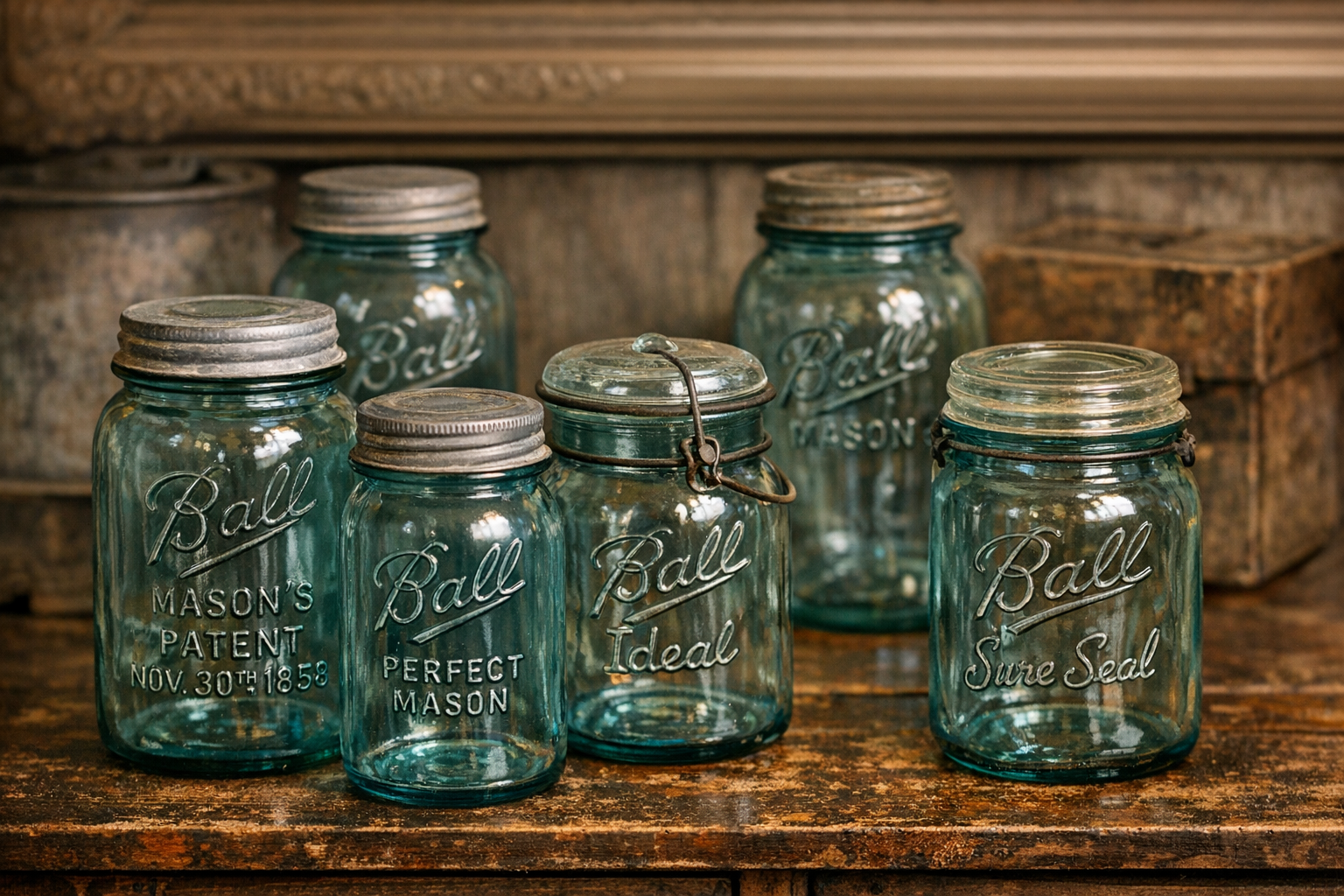
- Ball: The best-known name. Ball’s script logo evolved over decades and helps date jars. Early script styles (often called the “3-L” script by collectors because the loop in the “a” resembles an extra “l”) appear roughly late-1890s to early 1910s. The familiar script with an underscore appears in the 1910s–early 1920s; later script (no underscore, cleaner lines) continues through mid-20th century. Ball Perfect Mason jars debut circa 1913 and run for decades with countless mold variations.
- Kerr: Known for “Kerr Self Sealing” embossing. Many Kerr jars are machine-made clear glass from the 1910s onward, with variations in script and layout that help date them.
- Atlas / Hazel-Atlas: Atlas E-Z Seal (with a glass lid and wire bail) and Atlas Strong Shoulder Mason are common, mostly early-to-mid 20th century.
- Consolidated Fruit Jar Co. (CFJCo): Controlled the Mason patent and licensed many makers. Jars embossed “CFJCo” (and “MASON’S PATENT NOV 30TH 1858”) include scarce color variants prized by advanced collectors.
- Hero Glass/”Hero’s Cross”: The cross-in-shield mark is associated with Hero; some early 1858-style jars bear this and can be desirable.
- Putnam / Lightning: “LIGHTNING” jars use wire-bail glass-lid closures; many have “PUTNAM” and a number embossed, which are mold numbers, not dates.
Quick dating cues:
- Embossing spelling and layout: Variations in “MASON’S PATENT NOV 30TH 1858” (including misspellings, reversed letters, or different line breaks) correspond to specific manufacturers and eras.
- Ground lip vs. smooth lip: A ground, gritty-feeling rim usually indicates mouth-blown production (often pre-1910s). Smooth, fire-polished rims typically signal machine-made jars.
- Seams: Mouth-blown jars show seams that stop before the lip; fully machine-made jars often have seams continuing through the lip.
- Base and mold numbers: Numbers are typically mold identifiers, not years. Don’t confuse a “13” on the base with 1913.
Note: Fruit jars are not pontiled like earlier bottles; a true pontil scar is generally a red flag for “marriage” or misidentification.
Colors, Rarity, And The “Wow Factor”
Glass color drives value. A short collector’s color scale (left = common, right = scarce):
- Clear/colorless → aqua/blue-aqua (“Ball blue”) → light green → strong apple/emerald greens → amber (honey to dark) → cobalt/sapphire blue.
- Oddball shades like olive, citron, and teal can spike interest.
Typical value patterns:
- Common aqua Ball Perfect Mason quarts: often a value that must be established from current, topic-matched sales in clean condition.
- Clear machine-made jars (Ball, Kerr, Atlas): usually a value that must be established from current, topic-matched sales unless early, unusual, or mint with scarce closures.
- Amber jars: depending on maker and embossing, a value that must be established from current, topic-matched sales+ is common; deep, even amber can be more; early 1858-embossed ambers by reputable makers can go much higher.
- Cobalt blue jars: some of the most coveted. Expect several hundred to a value that must be established from current, topic-matched sales for the right embossing in clean condition.
- Greens beyond pale aqua (apple, emerald, olive): often a value that must be established from current, topic-matched sales; the detail (maker, embossing, closure, size) makes the difference.
- Amethyst/purple: True manganese-decolorized glass can solarize violet with long UV exposure. However, artificially irradiated jars have a deep, uniform purple that many collectors discount. Natural light lavender can add modest value; obviously irradiated “purpled” jars usually do not.
Watch for color “tells”:
- Streaky or “off” shades and unusually uniform deep purples can indicate irradiation.
- Black glass (very dark amber or green) appears nearly opaque; genuine examples exist but confirm embossing and manufacturing method before assigning big values.
Closures, Lids, And Completeness
Collectors pay up for jars with their correct, period closures—and the value can swing dramatically.
Common closure types:
- Zinc screw caps with porcelain liners: Often embossed “Boyd’s Genuine Porcelain Lined Cap.” The lids themselves aren’t rare, but the correct pairing matters, and condition (no corrosion, intact liner) adds value. Early jars often have ground lips to accept these caps.
- Glass lids with yoke/clamp: Seen on “Improved,” “Globe,” and other early jar lines. A complete set—jar, correct glass lid, and the original style clamp—fetches more.
- Lightning/bail closures: A glass lid held by a wire bail and rubber ring. “PUTNAM” and mold numbers on the base are common; original wire/clamp and a correct-style lid lift value.
- Wax sealers: Early fruit jars with a groove or channel in the lip filled with wax to seal a domed lid. Intact examples with original tin or glass inserts are desirable.
Completeness checklist for closures:
- Correct type for the embossing and era.
- Matching patina: a shiny modern replacement cap on a late-19th-century jar stands out.
- Intact liners and gaskets: Original milk-glass liners unchipped; vintage rubber gaskets can be brittle but still add authenticity.
Expect premium percentages:
- Correct, scarce closure can add 10–50% versus jar-only.
- On specialized jars (e.g., midget 1858s with original bands), the closure can be the difference between a value that must be established from current, topic-matched sales and a value that must be established from current, topic-matched sales.
Condition, Authenticity, And Cleaning
Condition grading for jars echoes other bottle categories but with fruit-jar nuances:
- Chips: Pay close attention to the rim/lip, base edge, and around the mouth where caps bite. “Flea bites” are tiny nicks; larger rim chips are serious.
- Cracks and bruises: Flash cracks (stress lines) around the mouth are common deal-breakers on better jars.
- Haze and “sick glass”: Interior etching from contents or groundwater looks cloudy and resists ordinary cleaning. Professional tumbling can improve appearance but may slightly soften embossing and high-point detail. Heavy sickness usually caps value.
- Manufacturing marks: Bubbles, straw marks, and light whittle are factory features and not damage. Whittle (a wavy texture) can even add charm.
- Wear: Honest base wear is normal. Overly “fresh” bases on a jar with other signs of age can signal heavy polishing.
Authenticity and reproduction flags:
- “MASON’S PATENT NOV 30TH 1858” jars have been widely reproduced. Look for modern machine characteristics, ultra-uniform glass, suspiciously perfect embossing, or unexpected country-of-origin marks on the base.
- Purpled jars via irradiation: A deep, uniform grape color, especially on jars that shouldn’t purple naturally, often indicates man-made alteration; most advanced collectors discount them.
- Married closures: The wrong period lid reduces value, even when functional.
A Rarity Short List: Names And Variants To Know
Market appetites shift, but the following remain desirable and often bring strong prices when damage-free:
- Cobalt blue Mason’s Patent 1858 variants: Particularly those attributable to CFJCo or other documented makers; clean examples can soar to four figures.
- Amber or strong green Ball jars: True, even amber Ball Perfect Mason in pint/quart sizes are sought, with many trading in the mid-hundreds if clean and correct.
- Midget 1858 jars: Small-mouth “midget” fruit jars (roughly 2-inch cap) with original bands and correct lids are collectible; scarce colors punch above their weight.
- Hero cross 1858 jars: Early and well-embossed pieces with the cross-in-shield mark can bring strong mid-to-high hundreds depending on color and condition.
- Putnam Lightning in amber/olive: Wire-bail jars with PUTNAM and lower mold numbers in strong colors often sell in the a value that must be established from current, topic-matched sales+ range; rarer shades go higher.
- Canadian specialties: Beaver, Crown, and Gem jars (Dominion Glass and predecessors) appear in appealing shades; scarce colors and pristine examples bring premiums.
Remember: Embossing details, letter size, and layout variations can transform a “common” listing into a standout. Advanced collectors often seek specific mold quirks or error embossing.
Pricing Reality: What To Expect And How To Sell
While every market is local, these ballpark ranges help frame expectations for clean, damage-free jars:
- Ball Perfect Mason (aqua) quart: a value that must be established from current, topic-matched sales; pint: a value that must be established from current, topic-matched sales; half-gallon: a value that must be established from current, topic-matched sales.
- Clear, machine-made common brands (Kerr, Atlas, Ball): a value that must be established from current, topic-matched sales with occasional premiums for strong embossing or mint closures.
- Amber jars (non-repro, correct closure): a value that must be established from current, topic-matched sales+; more for early/rare embossings and deep, even color.
- Cobalt jars with desirable embossing: a value that must be established from current, topic-matched sales+ depending on maker, size, and condition.
- Early 1858-embossed jars with documented makers in rare colors: low hundreds to low thousands.
Selling tips:
- Photograph embossing straight-on, the lip, base, and the closure disassembled. Include a light-in-hand shot to show color and any haze.
- Note exact measurements (height and mouth size), capacity (half-pint/pint/quart/half-gallon), and whether the lid/closure is correct and original.
- Don’t overclean. Gentle washing is fine; disclose if a jar has been professionally tumbled.
Buying tips:
- Handle the lip first—rim damage is the most common deal-killer.
- Learn a few maker timelines (Ball, CFJCo, Atlas) and train your eye on color under neutral light.
- When in doubt, treat mold numbers as identifiers, not dates.
A Practical Field Checklist
Use this concise checklist when evaluating a Mason jar in the wild:
- Maker and embossing
- Exact wording and line breaks
- Maker marks (Ball script era, CFJCo, Hero cross, PUTNAM numbers)
- Manufacturing clues
- Ground vs. smooth lip
- Mold seams to/through lip
- Base marks/numbers (note but don’t date by them)
- Color
- Identify under neutral light
- Watch for unnatural deep purple (potential irradiation)
- Closure completeness
- Correct type for jar/era
- Original or period-appropriate cap, liner, lid, and clamp/bail
- Condition
- Lip and base chips, cracks, bruises
- Interior haze/etching (“sick glass”)
- Honest wear vs. heavy polishing
- Rarity cues
- Unusual sizes (midget, half-pint, half-gallon)
- Error embossing, scarce color, notable maker variants
- Documentation
- Measurements, clear photos, and any provenance
FAQ
Q: Do mold numbers on the base indicate the year my jar was made? A: No. Base numbers are typically mold identifiers used for quality control. They rarely, if ever, correspond to a production year.
Q: Are purple (amethyst) jars valuable? A: Light natural amethyst from manganese glass can add interest, but deep, uniform purple from artificial irradiation is generally discounted by advanced collectors. Value depends far more on maker, embossing, closure, and condition.
Q: How should I clean antique Mason jars without hurting value? A: Start with warm water, mild soap, and a soft brush. Avoid abrasives and harsh acids. Professional tumbling can reduce haze, but disclose it; heavy polishing that rounds edges or blurs embossing is a negative.
Q: What’s the quickest way to spot a reproduction? A: Look for ultra-crisp, modern machine surfaces paired with historically early embossing, unusual weight, suspiciously perfect clarity, or inappropriate country-of-origin marks. Many repros also pair poorly matched closures.
Q: Do original lids really matter? A: Yes. A period-correct zinc cap with intact porcelain liner or the proper glass/clamp closure often boosts value 10–50%. On scarce jars (especially midget 1858s), the correct closure is critical.
—
Antique Mason jars reward careful eyes and patient hands. Once you learn to read embossing styles, maker marks, color nuances, and closures, you’ll quickly separate decorative kitchen glass from historically significant—and sometimes surprisingly valuable—keepsakes.