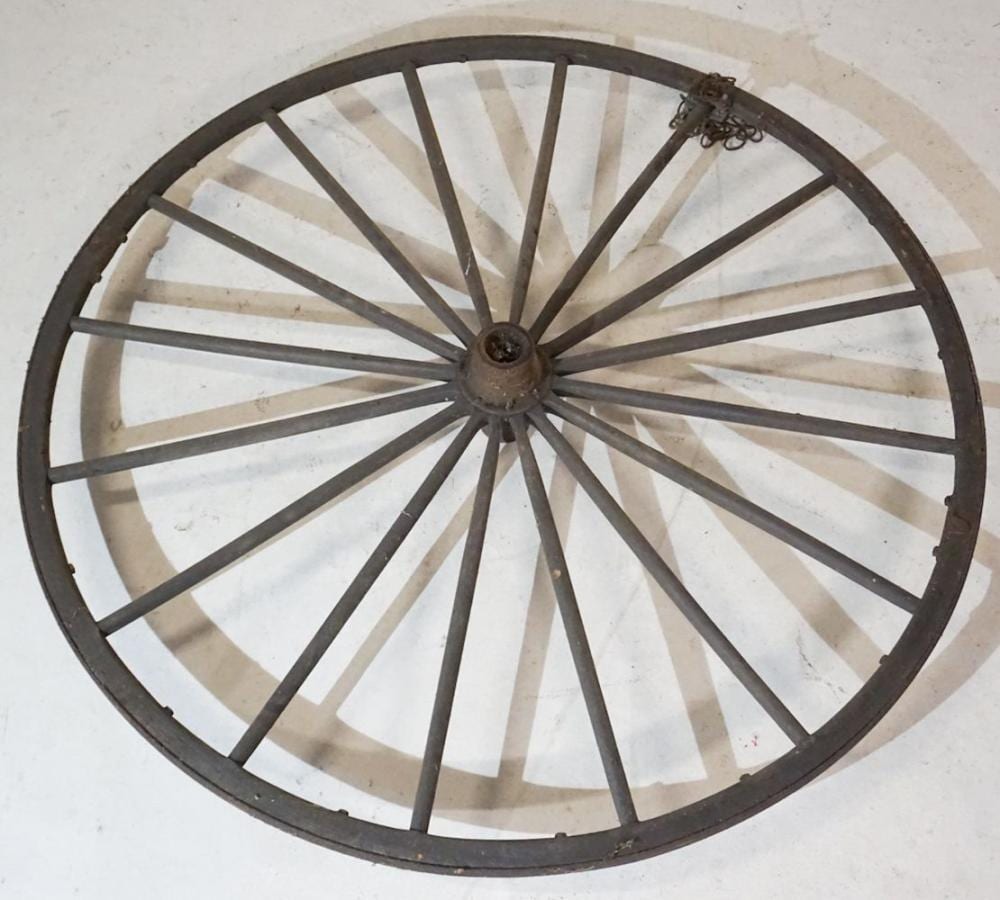
What is an antique wagon wheel worth?
Most single antique wagon wheels sell for modest sums. The five recorded auction sales on this page ran from $50 to $500, with a median of $80; the $500 sale was a lot of seven small wagon wheels. A farm wagon wheel typically has 12 spokes, usually hickory, set in an elm or maple hub; carriage and buggy wheels are lighter and often have more spokes. Size, paint, maker and pairing decide value. Large 48–56 inch rear wheels outperform smaller front wheels, original paint or pinstriping draws serious collector interest, a legible Studebaker or Schuttler mark adds a premium, and matched pairs outperform single wheels.
Decor piece or collector’s wheel
Antique wagon wheels sit at the crossroads of folk craft, transportation history, and rustic design. Whether you’re appraising for insurance, considering a purchase, or preparing a sale, understanding what separates a decorative prop from a museum-worthy artifact is the key to unlocking value.
Who buys old wagon wheels and typical prices
Demand for wagon wheels is supported by two distinct buyer groups, each valuing different attributes:
- Decor and event buyers: wedding venues, restaurants, and homeowners seeking rustic elements. They prioritize large size, symmetry, and surface appeal (patina, original paint) over strict historical significance.
- Historical collectors and museums: they value rarity, provenance, completeness, original finishes, and wheelwright craftsmanship. Authentic period features and maker markings matter most.
Current trends and realities:
- Availability: The easy pickings are largely gone. Many barns and sheds were cleared from 2000–2020, thinning the supply of untouched examples. Fresh-to-market sets with original axles command strong premiums.
- Regional pricing: Prices run higher where supply is thin (coastal urban markets) and lower in regions with agricultural heritage (Upper Midwest, Great Plains). Shipping costs for 48–56 inch wheels can equal or exceed the purchase price, influencing where buyers source inventory.
- Size sells: Large rear wagon wheels (48–56 inches in diameter) typically outperform smaller front wheels, all else equal. Stagecoach and Conestoga-size wheels can be especially desirable.
- Condition drives the top: Wheels that retain original paint, pinstriping, or a legible maker’s name on the hub band or hub boxing draw serious collector interest.
- Matching pairs and complete sets still move quickly.
Indicative retail ranges (per wheel, subject to condition and region):
- Common farm wagon wheels (36–44 in.): $100–300
- Large farm or freight wagon rears (48–56 in.): $200–600
- Exceptional Conestoga/freight wagon wheels with provenance: $800–2,500+
- Small buggy/carriage wheels (28–36 in.): $50–250
- Matched pairs/sets with axle and hubs: $1,200–4,000+ as ensembles
Parts, spoke counts, types and makers
Knowing the parts and types will help you appraise confidently.
Core anatomy:
- Hub: The central block that houses the axle. Traditionally elm (tough and shock-resistant) or maple, banded in iron. Many wheels contain a metal “boxing” liner where the axle rides.
- Spokes: Usually hickory for strength and flexibility. Farm wheels typically carry 12 spokes; high-quality carriages may have more.
- Felloes (rims): Curved wood sections forming the circumference, typically 8–12 segments. Felloes are jointed and secured by the tire.
- Tire: The iron band shrunk hot around the felloes to compress and lock the wheel tight. Look for the scarf joint where the tire ends meet.
Dishing and handedness:
- Most wooden wheels are “dished,” forming a shallow cone. Right and left wheels dish opposite ways. A correctly oriented pair matters for authenticity and function.
Hub styles:
- Wooden hub with iron bands: Common on 19th- and early 20th-century farm and freight wagons.
- Sarven hub (patented 1858): A composite hub with a cast-iron core and wooden shell, often marked “Sarven Patent.” Seen on higher-grade vehicles and carriages.
- Boxings: Cast-iron or steel liners in the hub bore that reduce wear; their condition is a strong indicator of use and serviceability.
Makers and marks to know:
- Studebaker (South Bend, IN)
- Peter Schuttler (Chicago, IL)
- Bain, Mitchell, Fish Bros., Winona, Owensboro, and Milburn
- Regional shops in Pennsylvania and Ohio that produced Conestoga and freight wagon components
Look for:
- Stamped or cast maker’s names on hub bands, hubs, or boxings
- Patent marks (e.g., Sarven, Moyer, Archibald)
- Original pinstriping and paint schemes from known wagon makers
Types and uses:
- Farm wagons: Workhorses with relatively wide tires (1.5–3 in.) for fields and roads.
- Freight/Conestoga wagons: Massive wheels, broad tires for heavy loads. The rear wheels can exceed 54 inches.
- Carriages and buggies: Lighter wheels, narrower tires, more spokes, and often finer workmanship.
- Military and stage: Specialized wheels with robust construction and pronounced dish.
How to date a wagon wheel and spot reproductions
Separating 19th-century wheels from later replacements or reproductions involves reading tool marks, hardware, and wear.
Dating indicators:
- Tooling marks: Hand-hewn spokes and hubs indicate early, shop-made work (pre–1850s). Circular saw marks (arched crescents) arrive mid-19th century; straight band-saw marks are later.
- Iron vs steel: Earlier tires often show wrought iron characteristics; later examples use rolled steel. The scarf joint on a tire may reveal forge work typical of 19th-century manufacture.
- Hardware: Square nuts/bolts and slotted screws are earlier; Phillips-head screws scream modern. Metric hardware indicates contemporary replacements.
- Paint and varnish: Multiple layers with aged craquelure suggest long service. Stenciled maker names beneath grime are a major plus.
Authenticity red flags (reproductions/assembled decor):
- Perfectly uniform parts with little differential wear (spokes, hub, and felloes all “new” alike)
- Plywood hubs, laminated woods, or softwoods used in hubs
- Modern screws or lag bolts showing bright plating
- Artificial distressing: scratches without ingrained dirt; uniform “worm holes” that repeat in pattern
- Wheels bored through hubs for lamp wiring or mounted with decorative brackets lacking period logic
Provenance:
- Documentation from farm sales, estate records, or a known collection adds value.
- Matching sets with original axle trees and hounds are rarer and more desirable than single wheels.
What raises or lowers a wheel’s value
Collectors and decorators weigh condition differently, but these factors consistently move the needle:
- Structural integrity:
- Tight joints: Spoke-to-hub and felloe joints should be snug. Excessive wobble or visible gaps reduce value.
- Hub boxing: Ovalized or flogged-out boxings show heavy use; a round, tight bore brings a premium.
- Tire fit: A tire that has crept or loosened (common after long dry storage) can be re-set by a specialist, but the cost affects resale.
- Surface and originality:
- Original paint, pinstriping, and visible stenciling can double value over stripped or over-varnished examples.
- Honest patina is preferable to aggressive cleaning. Avoid power-washing, which raises grain and can loosen joints.
- Completeness and matching:
- Matched pairs and full sets outperform orphans. Left/right handedness should be correct.
- Associated components (axle, skeins, hubs, and even the tongue) add context and value.
- Size and type:
- Large rear wheels, stagecoach or Conestoga sizes, and specialized military patterns are more desirable.
- Damage and repairs:
- Checks and shrinkage cracks are normal in old wood. Clean, stable checks are acceptable; active rot, insect tunnels, and oil-saturated hubs are liabilities.
- Replaced felloes, hub plugs, or mixed woods should be disclosed. Sensitive conservation is preferable to wholesale replacement.
- Evidence of heat or fire:
- Burn marks around the tire area can mean a re-tiring job or accidental scorching; evaluate carefully. Professionally re-tired wheels remain collectible when disclosed.
Use vs display:
- Functional use in a working wagon demands expert inspection and, often, professional rebuilding. For decor, cosmetic condition matters more than mechanical tolerances.
Wagon wheel prices by size and type
When setting a price or estimate, triangulate across these variables:
- Object type and size:
- 48–56 in. rear wagon wheels in sound, original condition commonly trade in the $250–600 range per wheel in many U.S. markets.
- Standard farm fronts (36–44 in.) often sell for $100–300 each.
- Carriage and buggy wheels vary widely based on maker and finish: $50–250 is typical, with higher prices for named coachbuilders with fine paint.
- Provenance and maker:
- A wheel with a legible Studebaker, Schuttler, or similar mark commands a premium, especially if part of a matched set.
- Conestoga/freight wheels with solid documentation can reach into the low thousands apiece for exceptional examples.
- Finish:
- Original pinstriping or stencil: +50–150% over a similar unpainted wheel.
- Over-cleaned or polyurethaned examples: often -20–30% due to loss of historic surface.
- Regional adjustments:
- Add 10–30% in areas where shipping a large wheel would be costly or where supply is thin.
- Channel:
- Local estate auctions may yield bargains; retail architectural salvage shops charge higher, reflecting curation and storage costs.
- Online sales must factor freight. Crating and LTL freight for a 52-inch wheel can add $200–500+, narrowing the buyer pool.
For appraisals, document exact measurements (diameter to the tire edge, hub length and diameter, tire width), spoke count, materials, and any marks. Clear photos of the hub, tire seam, and any paint remnants are essential for establishing comps. If you’re not sure what kind of wheel you have, you can upload photos of the hub, tire seam and any paint for a free check.
Checklist for inspecting a wagon wheel
Use this concise checklist on-site to assess a wheel quickly and accurately:
- Verify type and size:
- Measure diameter, tire width, spoke count; note dish and left/right orientation.
- Inspect structure:
- Test spoke tightness by gentle lateral pressure.
- Check the hub boxing for roundness and wear; look for cracks radiating from the hub.
- Locate the tire’s scarf joint; confirm the tire sits tight to the felloes all around.
- Identify materials and marks:
- Note wood species where visible: elm/maple hub, hickory spokes, oak/hickory felloes are typical.
- Examine hub bands and boxings for stamped maker names or patent marks.
- Evaluate surface:
- Look for original paint or pinstriping; avoid scraping. Photograph under raking light.
- Distinguish dirt and oxidation from active rot or insect damage.
- Screen for modern alterations:
- Watch for Phillips screws, plywood hubs, bright zinc hardware, and uniform “antique” staining.
- Assess pairing and provenance:
- If presented as a pair or set, confirm matching dimensions, dish orientation, and finish.
- Record any story or documentation; photograph labels, brands, or stencils.
- Consider logistics:
- Note weight and accessibility for removal.
- Estimate packing and freight if selling online.
- Decide on care:
- For dry, thirsty wood, plan a light conservation approach (e.g., reversible wax or boiled linseed oil diluted), not a glossy topcoat.
- Avoid high-pressure washing or soaking.
FAQ
Q: How can I safely clean an antique wagon wheel without hurting its value? A: Start dry: soft brush and vacuum. Then use a damp (not wet) microfiber cloth with mild pH-neutral soap on stubborn grime. Stop if original paint appears. Avoid power washing, bleach, and polyurethane. Finish with a light microcrystalline wax if needed.
Q: Are cracks in hubs or felloes a deal-breaker? A: Not necessarily. Stable age checks are common. Deep structural splits at the hub or loose spokes affect value and safety. For function, consult a wheelwright; for decor, disclose and stabilize with reversible methods.
Q: How do I tell if my wheel is a matched pair with correct handedness? A: Stand each wheel upright and sight the dish: one should dish left, the other right. Diameters, tire widths, and spoke counts should match. Surface tone and paint remnants should be consistent across the pair.
Q: Can old wheels be made roadworthy again? A: Sometimes, with professional rebuilding (new boxings, re-tiring, tightened joints). Costs can exceed decorative value. For display, leave as-is with light conservation; for use, prioritize safety over originality.
Q: What features indicate top-tier, collector-grade wheels? A: Named maker marks, original paint/pinstriping, documented provenance, large sizes (freight or coach), tight structure with minimal wear, and correct matched sets with original axles or hounds. These are the wheels that set record prices.


