Get the useful answer first
An Occupied Japan tea set can be collectible, but the mark alone does not establish a high value. “Made in Occupied Japan” ties export context to the short period when civilian trade resumed after World War II and before the occupation ended. It does not identify a factory, prove hand painting, or guarantee buyer demand.
The practical question is not simply whether the set is old. It is whether buyers care about this maker, pattern, form, decoration, and level of completeness.
Five-minute value triage
- Count the core pieces: teapot, lid, sugar bowl, creamer, cups, saucers, and serving pieces.
- Record all base wording: country wording, factory or importer name, pattern number, and any paper label.
- Separate hand work from transfer decoration: visible brush variation and raised enamel can add interest when the work is good.
- Map condition: hairlines, rim chips, handle repairs, replaced lids, staining, and gold loss.
- Judge the form: a coherent service with a strong teapot usually tells a better market story than a box of mixed cups.
Start with what the wording can prove
The Mizuta Museum of Art dates civilian exports labeled “Made in Occupied Japan” from the resumption of trade in 1947 through 1952. The museum notes that Western-style tableware was among the goods produced for overseas buyers, particularly in the United States. That makes the wording historically useful: it points to a specific export context rather than a broad “mid-century” guess.
Keep the conclusion narrow. The wording is a country-and-period clue, not a maker attribution. A set may also carry an importer, factory, pattern, or decorative-studio name. Those added identifiers can be more important to value because they let a buyer connect the set to a recognized production line or a scarce pattern.
What the label supports
- A short postwar export context
- Japanese manufacture for an overseas market
- A useful starting point for catalog research
What it does not settle
- The exact factory or decorator
- Whether decoration is entirely hand painted
- Whether every piece began as one matched service
- The current sale value
A typical estate-sale situation is straightforward: a family finds a floral service labeled only by country and period. The set becomes more interesting when the piece count is coherent, the decoration is consistent, and the teapot still has its correct lid. If those details do not line up, the date clue remains real but the commercial case weakens.
Count the set before estimating it
Completeness changes the number faster than most owners expect. A teapot, creamer, covered sugar bowl, and six matching cup-and-saucer pairs read as a service. Six saucers, four cups, and an unrelated pot read as replacement stock. Both can sell, but they serve different buyers.
Use this completeness hierarchy
- Core service intact: the matching pot, correct lid, creamer, sugar bowl, cups, and saucers are present.
- Usable partial service: the main serving pieces survive, but the cup count is uneven or a few saucers are missing.
- Replacement group: individual pieces are attractive but no longer form a convincing service.
Condition is not one score. A tiny glaze speck from manufacture is not the same as a later rim chip. Gold wear can be acceptable on a decorative period set, while a repaired handle or a hairline running from the teapot rim can materially reduce confidence. A replaced lid is especially important because the silhouette, fit, and decoration are central to the set’s appeal.
Let decoration quality do real work
Hand painting can help, but only when the execution supports it. Buyers respond to controlled brushwork, balanced gilding, consistent scenes, raised enamel, and a design that carries across the service. “Hand painted” is not a value formula. Weak work, heavy wear, or a common floral pattern may still leave the set in decorative territory.
Export quality matters too. Thin, well-potted forms, clean joins, a lid that seats properly, and decoration aligned to the shape usually make a stronger case than thick bodies, awkward handles, or inconsistent finishing. These observations do not authenticate the set; they explain why two sets from the same broad period can attract different demand.
What similar items actually sold for
To help ground this guide in real market activity, here are recent example auction comps from Appraisily’s internal database. These matched sales are market context only, not an object estimate or identification, and they do not guarantee a price for your specific tea set.
Shown USD range: USD 5-USD 150. Median of these 3 USD examples: USD 10.
| Comparable | What sold | Auction house | Date | Lot | Source-reported amount |
|---|---|---|---|---|---|
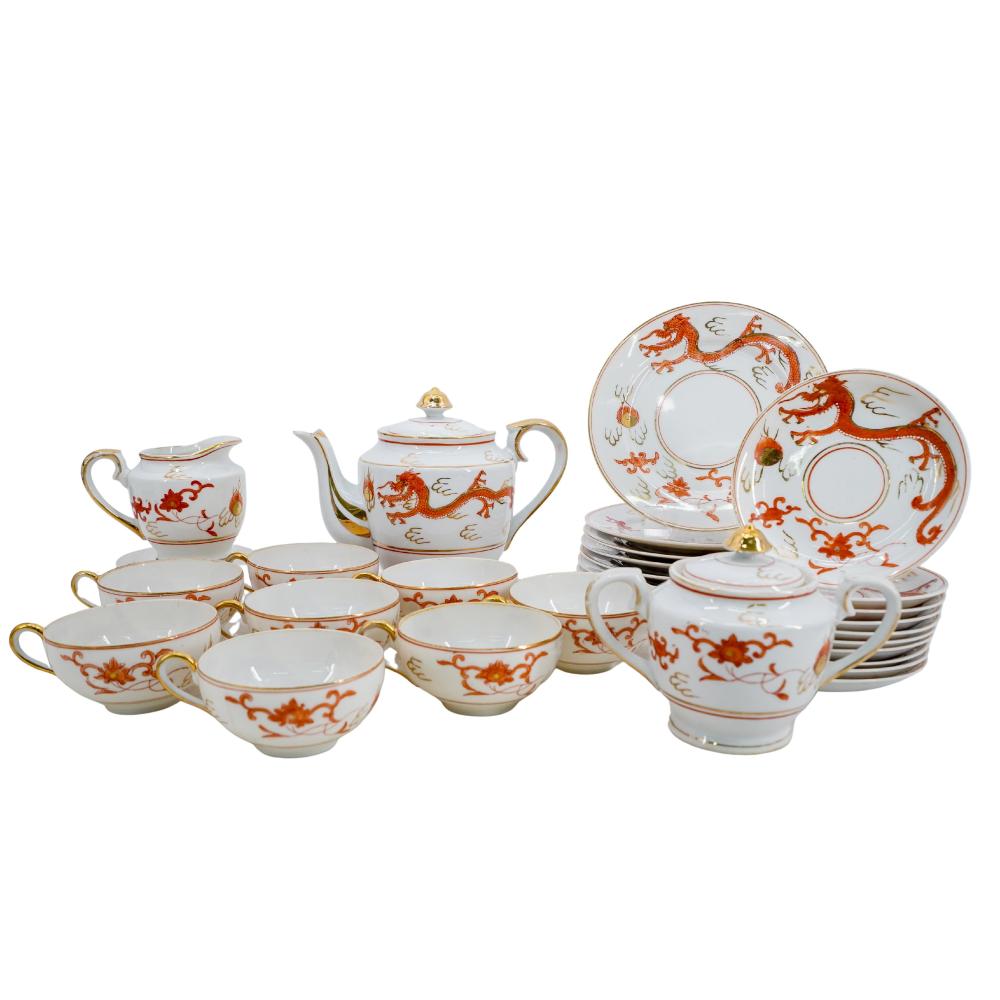 |
(29 Pc) Occupied Japan Porcelain Dragon Tea Set | Akiba Galleries | 2025-01-14 | 314 | USD 150 (buyer’s-premium treatment unknown) |
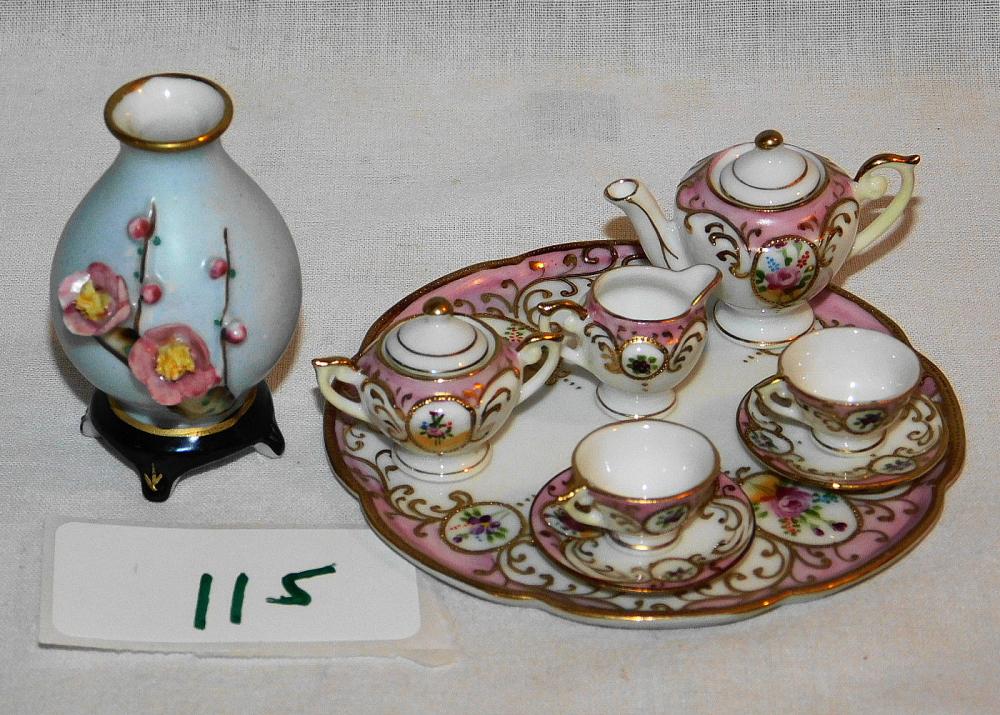 |
VINTAGE OCCUPIED JAPAN PORCELAIN CHILD'S TEA SET AND VASE | Diefenderfer Auction Company | 2023-11-24 | 115 | USD 5 (buyer’s-premium treatment unknown) |
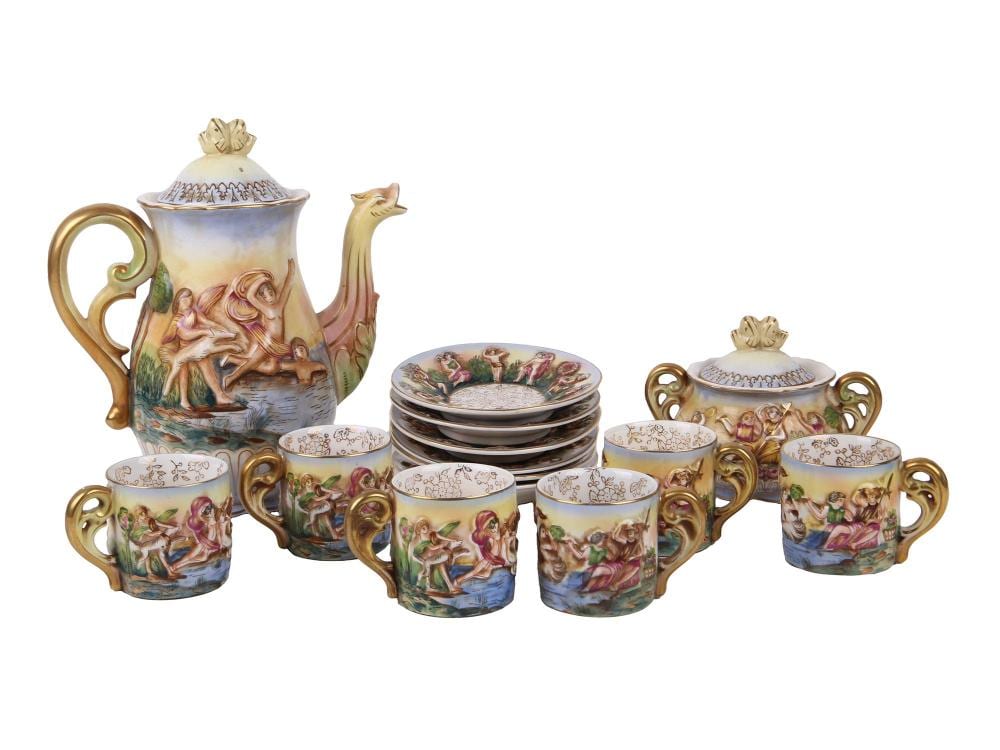 |
GREEK NYMPHS VINTAGE TEA SET SGK OCCUPIED JAPAN | Antique Arena Inc | 2022-03-26 | 180 | USD 10 (buyer’s-premium treatment unknown) |
How these auction records were verified
Each row retains its exact source URL, lot identity, retrieval time, access result, and immutable record hash. Inspect the public comparable provenance record.
Disclosure: prices are shown as reported by auction houses and are provided for appraisal context. Learn more in our editorial policy.
The upper result in this adjacent proof set was a 14-piece Japanese Satsuma porcelain tea set sold by EJ’S Auction & Appraisal on October 11, 2025, lot 1214, for USD 1,200. The retained record does not describe it as Occupied Japan, so use it to understand demand for a substantial decorated Japanese service—not as a direct value claim for a marked postwar set.
Free instant estimate
Want a first read on your tea set?
Upload clear photos, tell us the piece count, and get a free first read. If the evidence supports a full appraisal, we will say so.
Free. No card needed. Takes about two minutes.
Match the set to the buyers who want it
Occupied Japan has a collector following because the wording captures a narrow historical moment. Tea-set demand is more selective. Some buyers collect the period label, some collect a named maker or importer, and others simply want a decorative vintage service. The strongest set gives more than one group a reason to care.
Demand tends to strengthen when
- The service is complete or nearly complete.
- The teapot has a distinctive, balanced form.
- Decoration is consistent and visually strong.
- A recognized maker, importer, or pattern is present.
- Damage is minor and accurately disclosed.
Demand tends to soften when
- The group is assembled from mismatched pieces.
- The lid is missing, replaced, or poorly fitted.
- There are multiple hairlines or handle repairs.
- Gold and enamel loss disrupt the design.
- The only selling point is the country wording.
Reproduction clues matter because added or misleading wording can distort the story. Treat any unusually fresh stamp, inconsistent decoration, or mixed group as a reason to slow down. Without reviewed documentary evidence, a written description cannot settle authenticity. Clear photos, dimensions, and the full set context are the right next evidence.
Build a value file in ten minutes
A useful valuation file is short and specific. It lets an appraiser or buyer understand the service without guessing what is outside the frame.
- Take one full-group photo. Arrange every piece so the count is obvious.
- Add four functional views. Include the teapot profile, lid off, spout, and handle joins.
- Photograph the underside wording. Include at least one sharp, straight-on base view and any separate factory or importer name.
- Write the piece count. List cups and saucers separately; note every missing lid.
- Measure the teapot. Height and widest dimension help distinguish miniature, demitasse, and full-size services.
- Map damage. Name the exact piece and location instead of writing “good for age.”
- Keep provenance modest. Record who owned it and when, but separate family history from facts visible on the object.
This is also the best defense against an optimistic asking price. When a listing does not show the complete group, base wording, lid fit, and damage, it is not a clean comparable.
Choose the right kind of value
“What is it worth?” has several valid answers. Use the one that matches the decision.
| Value context | What it answers | Best evidence |
|---|---|---|
| Auction expectation | What a competitive public sale might produce | Recent, closely matched realized lots |
| Dealer or retail asking price | What a seller may request with time and presentation | Comparable inventory plus sell-through context |
| Estate or equitable-distribution value | A documented value for a defined date and purpose | Qualified methodology and appropriate market level |
| Insurance replacement value | What replacement with a comparable object may cost | Retail availability, scarcity, and documentation |
Do not compare an auction result directly with an optimistic retail listing and call the difference appreciation. They measure different markets, with different fees, timing, and buyer protections.
Know when a written appraisal earns its cost
Many ordinary sets do not need a formal report. A free first read may be enough to identify the likely category, flag missing evidence, and decide whether deeper research is sensible.
A written appraisal becomes more useful when the service has a recognized maker, an unusual form, high-quality hand work, strong provenance, or a formal insurance, estate, donation, or division purpose. It is also useful when the mark, style, and family history point in different directions and the value decision matters.
If the set is incomplete, heavily damaged, and commercially common, honest screening may save more money than a full report. That is a useful result too.
Questions owners ask most
Does “Made in Occupied Japan” automatically make a tea set valuable?
No. It supports a narrow export-period context. Maker, decoration, completeness, condition, form, and demand determine how buyers respond.
Is an incomplete set still collectible?
Yes. A strong teapot, unusual pattern, or useful replacement pieces can still attract buyers. Missing core pieces usually limit whole-set demand, so market it accurately as a partial service.
What damage matters most?
Hairlines, rim chips, replaced lids, handle repairs, staining, and heavy gold loss matter most because they affect both display and use. State each issue by piece and location.
What if the set has period wording but no maker name?
The dating clue still helps, but the burden shifts to form, decoration quality, completeness, condition, and close market matches. Do not assign a famous maker from resemblance alone.
Should I sell the set together or piece by piece?
Keep a coherent, attractive service together first. Individual selling makes more sense when the set is badly incomplete or when replacement buyers actively seek a scarce pattern.
Search variations this guide answers
- How much is a Made in Occupied Japan tea set worth?
- Does an Occupied Japan mark increase tea-set value?
- What makes an Occupied Japan tea service collectible?
- How does a missing teapot lid affect value?
- Are hand-painted Occupied Japan tea sets worth more?
- Where can I get an Occupied Japan tea set appraised?
- Should I sell an incomplete Japanese tea set separately?
- What photos are needed to value a vintage tea set?
References and evidence notes
- Mizuta Museum of Art: Made in Occupied Japan 2—Western tableware.
- Australian War Memorial: “Occupied Japan” dinner plate collection record.
- Auction rows below or above retain exact lot identity, source access status, and immutable provenance. Adjacent Japanese tea-set results are not represented as Occupied Japan examples.