Noritake china value quick checks
Start with the pattern name or number, backstamp, era, country mark, place-setting count, serving pieces, replacements, chips, crazing, gold loss, provenance, and recent comparable sales. Compare nearby guides for how much china is worth, pottery and porcelain marks, and porcelain reproductions before pricing or appraising the set.
Free. No card needed. Photo upload takes about two minutes.
What Determines the Value of Noritake China?
Noritake is one of the most widely produced porcelain brands in history, and its pieces span the full value spectrum. In November 2025, a 29-piece Noritake set sold at a JD Estate Sales auction for just $18. A few months earlier, a 32-piece Frank Lloyd Wright–designed Noritake Imperial Hotel set realized $3,276 at auction. The same brand, a world apart in price.
The difference comes down to three factors: era (read from the backmark), pattern rarity, and condition. This guide walks you through each one, with recent auction comps and a framework for deciding whether a professional appraisal is worth the investment.
Noritake Backmark Decoder: Read the Era on the Underside
Every piece of Noritake china carries a backmark — a stamped or printed identifier on the underside that reveals roughly when and where it was made. Over 400 distinct backstamps are documented, and many overlap across eras, so treat them as range indicators rather than precise dates.
Key Eras at a Glance
- Pre-1921 — "Nippon": The McKinley Tariff Act required country-of-origin labeling. Pieces marked "Nippon" are the oldest and most valuable. Hand-painted Azalea, Tree in the Meadow, and Pattern 175 date from this era.
- 1921–WWII — "Japan" / "Made in Japan": After the tariff changed to require English country names, marks shifted. The iconic M-in-Wreath (Morimura) and Maruki symbols appear here.
- 1948–1952 — "Occupied Japan": Post-WWII production under Allied occupation. Quality was inconsistent; these pieces are collectible but not usually high-value.
- 1952–1960s — "Noritake" / "Noritake Japan": Post-occupation rebranding. Rose China marks appear during this transition.
- 1963–Present — "Noritake Co., Ltd.": Modern production with the lamp logo and, later, the bone-china urn-in-wreath mark.
Most Valuable Noritake China Patterns (With Recent Comps)
Pattern identity is the single biggest driver of value after era. Below are the patterns that consistently achieve three- and four-figure prices at auction and on the secondary market.
1. Frank Lloyd Wright Imperial Hotel Dinnerware
Designed in collaboration with Noritake for Tokyo's Imperial Hotel around 1925, this is the crown jewel of Noritake collecting. The asymmetrical overlapping-circle motif — a dominant red center with yellow band and pastel blue/green accents, finished with 18-karat gold logo — is instantly recognizable. A 40-piece Tiffany & Co. retail version sold for $5,000 through Toomey & Co. in March 2019. A separate Wright auction in June 2019 saw an Imperial Hotel grouping realize $13,000. Most recently, a 32-piece set sold for $3,276 (approximately $512 per place setting) in 2023. In our own valuer-agent database, a Frank Lloyd Wright Imperial Hotel comp realized $2,100 through Toomey & Co. Auctioneers.
2. Azalea (Pattern 1915–1930)
Pink azalea flowers on white porcelain with gold-trimmed edges and handles. Originally sold exclusively through the Larkin Company catalog, this pattern is the most widely recognized valuable Noritake design. The rarest forms include the bulbous vase, pancake jug, ashtray, and the 15-piece child's set. Recent auction results: a 13-piece Azalea set's teapot sold for $45 (Florida Estate Sales, April 2021), while assembled hand-painted Azalea sets have realized $290, $325, and $425 through Matthew Bullock Auctioneers in recent sales. A complete service can reach several hundred dollars per place setting.
3. Foxboro (Discontinued 2001)
A wide cobalt blue band around a scalloped rim, accented with gold trim and small bird decorations. Discontinued in 2001, Foxboro has appreciated steadily. A mint-condition five-piece setting sold on eBay for $365 in 2024. Full place settings are scarce, making this a pattern worth holding rather than selling piecemeal.
4. 20056 Black and Gold (c. 1924)
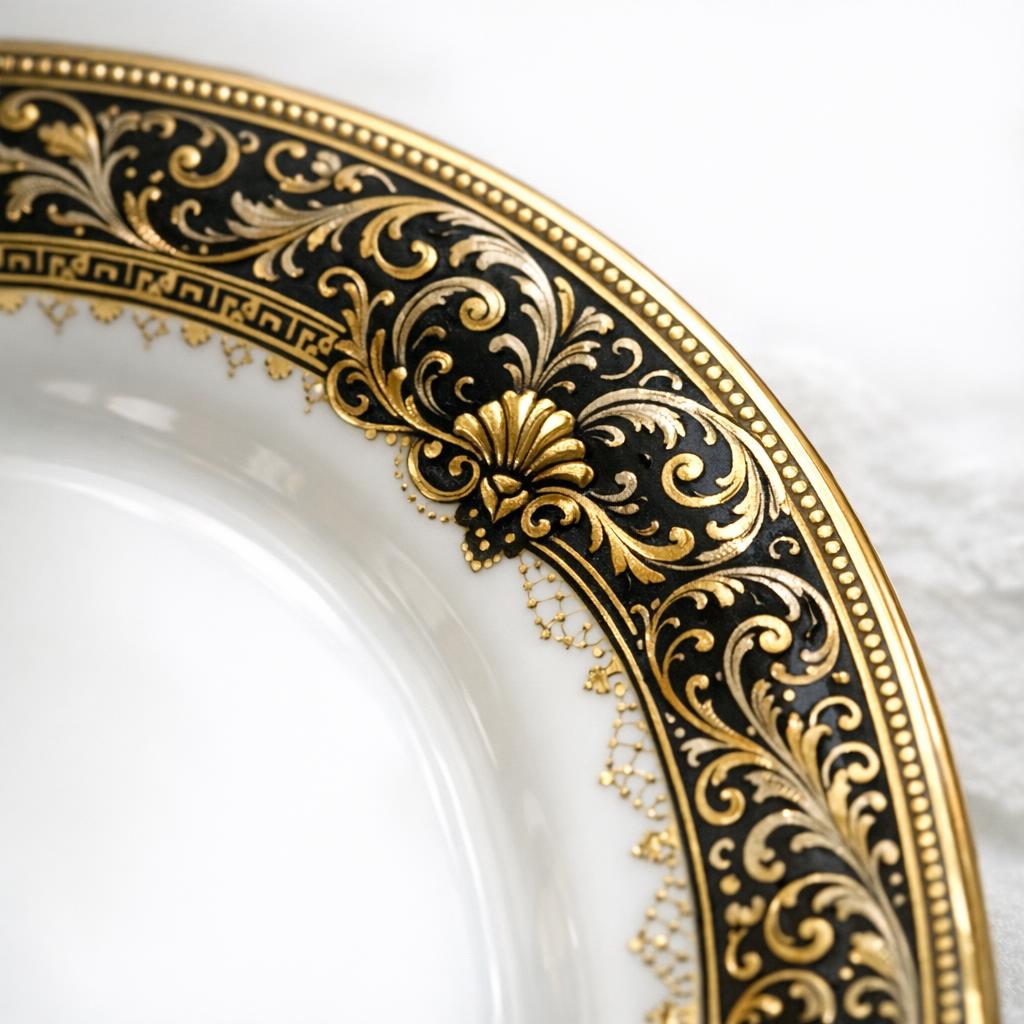
Ornate black scrollwork with gold detailing on a delicate white base — a design from Noritake's golden age. A set of eight place settings sold for $1,500 in 2024 (roughly $188 per setting). Individual saucers from this pattern retail around $10, but the full set is where the value lives. The pattern's age and limited surviving supply keep prices firm.
5. Fitzgerald (1990s)
An emerald green band with gold accents on a clean white ground. Simple but elegant, this 1990s pattern is harder to find in good condition than its age would suggest. A covered vegetable dish sold for $360 at auction in 2024. Replacements.com lists five-piece sets around $170. Service for 14 sold for $1,800 in 2024 (~$129 per setting for the related Hemingway pattern, which shares a similar design language).
6. Lusterware (1920s–Post-Depression)
Metallic oxide overglaze creating an iridescent, rainbow-like finish in orange, blue, white, and gold. Applied across various tableware and decorative objects. A 15-piece vintage Lusterware punch bowl set sold for $260 through Akiba Antiques in July 2021. Individual cups and serving pieces in iridescent amber/gold finish are especially collectible.
7. Other Notable Patterns
Tree in the Meadow (early 20th century): Hand-painted scene of a tree beside a house and lake. A 21-piece tea set sold for $40 through Keystone Auctions in February 2020 — showing that even well-known patterns can be undervalued without proper identification. Pattern 175 / "Christmas Ball" (c. 1906): Raised gold scrolling enamel with floral ball motifs, produced for roughly 90 years. Widely available but desirable for holiday table settings.
What similar items actually sold for
To help ground this guide in real market activity, here are recent example auction comps from Appraisily’s internal database. These matched sales are market context only, not an object estimate or identification, and they do not guarantee a price for your specific noritake china.
Shown USD range: USD 10-USD 150. Median of these 9 USD examples: USD 35.
| Comparable | What sold | Auction house | Date | Lot | Source-reported amount |
|---|---|---|---|---|---|
 |
Noritake China Canton Pattern Plate Set, 5027Source blocked; provenance matched | R & R Auction INC | 2026-04-11 | 75101 | USD 10 (buyer’s-premium treatment unknown) |
 |
Noritake China Amenity PatternSource blocked; provenance matched | Kaminski Auctions | 2024-02-18 | 153 | USD 100 (buyer’s-premium treatment unknown) |
 |
Noritake China, Allison, 5313. Ten trios, cups, saucers and plates, a lidded sugar bowl, the milk jug and a lidded teapot totalled thirty-three pieces.Source blocked; provenance matched | Because Auctions | 2023-08-06 | 256 | AUD 10 (buyer’s-premium treatment unknown) |
 |
NORITAKE ALICIA PATTERN CHINA SETSource blocked; provenance matched | Converse Auctions | 2022-09-30 | 621 | USD 10 (buyer’s-premium treatment unknown) |
 |
Noritake china No 175, Japanese made, hand painted detail incl, plates, bowls, serving dish, 21 x pieces in total. Largest plate is 26.5cm Dia.Source blocked; provenance matched | Bargain Hunt Auctions | 2024-05-16 | 2714 | AUD 50 (buyer’s-premium treatment unknown) |
 |
42pc Porcelain Noritake Fine China CollectionSource blocked; provenance matched | Monarch Auction and Estate Services | 2024-03-03 | 150 | USD 40 (buyer’s-premium treatment unknown) |
 |
Noritake China SetSource blocked; provenance matched | Gulfcoast Coin and Jewelry | 2024-04-13 | 229 | USD 35 (buyer’s-premium treatment unknown) |
 |
NORITAKE HORIZON BANDED PORCELAIN CHINA DINNERWARESource blocked; provenance matched | DejaVu Estate Sales & Auctions | 2026-06-04 | 513L | USD 150 (buyer’s-premium treatment unknown) |
 |
A Noritake china tea service.Source blocked; provenance matched | E J Ainger | 2026-04-22 | 877 | AUD 5 (buyer’s-premium treatment unknown) |
 |
Noritake China Dinnerware “Canton”Source blocked; provenance matched | Apple Tree Auction Center | 2024-01-03 | 1035 | USD 45 (buyer’s-premium treatment unknown) |
 |
NORITAKE CHINA ROMANCE PATTERN FOR 8Source blocked; provenance matched | Converse Auctions | 2022-12-30 | 636 | USD 20 (buyer’s-premium treatment unknown) |
 |
Noritake China SetSource blocked; provenance matched | Gulfcoast Coin and Jewelry | 2023-09-16 | 246A | USD 25 (buyer’s-premium treatment unknown) |
How these auction records were verified
Each row retains its exact source URL, lot identity, retrieval time, access result, and immutable record hash. Live source access was blocked; the exact record matched Appraisily's immutable pipeline provenance. Inspect the public comparable provenance record.
Disclosure: prices are shown as reported by auction houses and are provided for appraisal context. Learn more in our editorial policy.
How Condition Affects Noritake China Value
Condition is the multiplier — or divisor — on every price range above. Here is how damage impacts value in practice:
- Chips on rims or handles: −40% to −70% from mint value. Buyers routinely pass on chipped pieces unless the pattern is exceptionally rare. A $500 Azalea plate with a rim chip may fetch $150–$250 at best.
- Crazing (glaze crack network): −10% to −40%, depending on severity and whether stains have penetrated the cracks. Light crazing on a common pattern is often acceptable; heavy crazing on a premium pattern is a significant deduction.
- Stains or gold wear: −15% to −30%. Gold trim that has worn through from decades of dishwashing is a common issue. Faded patterns on transfer-printed designs are a red flag for collectors.
- Cracks or repairs: −60% to −90%. Professionally restored pieces may retain value to dedicated collectors, but the general market treats cracks as near-total value loss.
Pro tip: Serving pieces (punch bowls, platters, vegetable dishes, teapots) are inherently rarer than everyday dinner plates and teacups, so they hold value better even with minor condition issues. A damaged 20056 punch bowl still sold for approximately $450, while a mint saucer from the same pattern retails for about $10.
When to Get this Noritake china appraised
Not every Noritake set needs a $150–$300 professional appraisal. Use this decision framework:
Professional Appraisal Is Worth It When:
- The backmark reads "Nippon" or shows a pre-WWII symbol (M-in-Wreath, Maruki).
- You can identify the pattern as Azalea, FLW Imperial Hotel, 20056 Black and Gold, or another premium design.
- You need insurance documentation, estate settlement, or charitable donation substantiation.
- You are considering selling at auction and want a reserve price estimate from a specialist.
DIY or AI Estimate May Suffice When:
- The backmark is post-1960s and the pattern is common (many modern Noritake patterns retail for $25–$50 per five-piece setting).
- You are pricing for an estate sale or casual resale — cross-reference Replacements.com for retail and eBay sold listings for actual market prices.
- The set has visible damage that places it firmly in the low-value tier regardless of pattern.
Our free AI value estimator can give you a ballpark range in seconds. If that range exceeds $500 for your set, consider upgrading to a full professional appraisal for documentation and insurance purposes.
Noritake China in Today's Market: Auction vs. Resale Reality Check
There is a massive gap between what Noritake china retails for and what it actually sells for. Understanding this spread prevents both overvaluation and underselling.
| Channel | Typical Price Realization | Best For |
|---|---|---|
| Auction house (Sotheby's, Toomey's) | $500–$13,000 for premium lots | Rare patterns, complete sets, documented provenance |
| Regional auctioneer (Matthew Bullock, Akiba) | $260–$650 per lot | Mid-range patterns in good condition |
| eBay / Mercari (sold listings) | $25–$365 per set | Common patterns, individual pieces, quick sales |
| Estate sale / liquidation | $5–$50 per lot | Bulk disposals, damaged pieces, unknown patterns |
| Replacements.com (retail asking) | $10–$512 per setting | Insurance values, replacement pieces |
The 29-piece Noritake set that sold for $18 at JD Estate Sales in November 2025 illustrates the low end: unknown pattern, likely common design, possibly mixed condition. That same set, if identified as a premium pattern in mint condition, could retail for $1,500+ through Replacements. Identification is the difference between $18 and $1,500.
Free instant estimate
Not sure if your item is worth appraising? Let us take a look.
Upload a photo, tell us what you know, and get a free first read. If a full appraisal makes sense, we will say so.
Free. No card needed. Takes about two minutes.
Valuing Complete Sets vs. Individual Pieces
A complete Noritake set is worth far more than the sum of its individual pieces — but "complete" means different things to different buyers.
- Full place setting (5-piece): dinner plate, salad plate, bread plate, cup, and saucer. This is the standard unit for pricing.
- Service for 4/6/8/12: Multiply the place setting by the number of settings. Complete services command a 20–40% premium over buying individual pieces separately.
- Serving pieces add-on: Platters, tureens, punch bowls, and vegetable dishes are scarce and can add $100–$500+ to a set's total value.
If your set is missing pieces, identify which ones before selling. A set of 8 dinner plates without cups or saucers will sell at a steep per-piece discount. Filling gaps through Replacements.com or eBay may be more profitable than selling incomplete.
Know What Your Noritake China Is Worth
Whether it's a single Azalea teacup or a 40-piece Imperial Hotel service, a professional appraisal gives you a defensible value for insurance, sale, or donation. Start with our free AI estimate, or go straight to a certified specialist.
- USPAP-compliant appraisals accepted by insurers and the IRS
- Pattern identification from photos and backmark descriptions
- Written report delivered within 24 hours
Or get a free AI value range in seconds — no account required.
References & Sourcing
Auction comps in this article were sourced from the Appraisily valuer-agent database (covering Invaluable, Toomey & Co., Matthew Bullock Auctioneers, Akiba Galleries, and other houses), Replacements.com retail listings, and publicly reported auction results from 2019–2026. Backmark identification guidance draws on the Early Noritake China: An Identification and Value Guide to Tableware Patterns (Alden Richardson, 1987) and the LoveToKnow Noritake value guide. Our editorial standards require at least two independent sources for each price claim. Read more about our process at our Editorial Policy.
Search Variations Collectors Ask
Readers often Google these related questions — each is addressed in the guide above:
- How much is a Noritake Azalea china set worth today?
- How to identify Noritake china by the backmark stamp?
- What does "Nippon" on the bottom of china mean for value?
- Is Noritake Occupied Japan china valuable or collectible?
- Where to sell Noritake china sets for the best price?
- How to tell if Noritake china is hand-painted or transfer-printed?
- Noritake Frank Lloyd Wright Imperial Hotel dinnerware value
- What pattern is my Noritake china — how do I identify it?
Each question above is answered in the valuation guide, pattern section, or backmark decoder above.