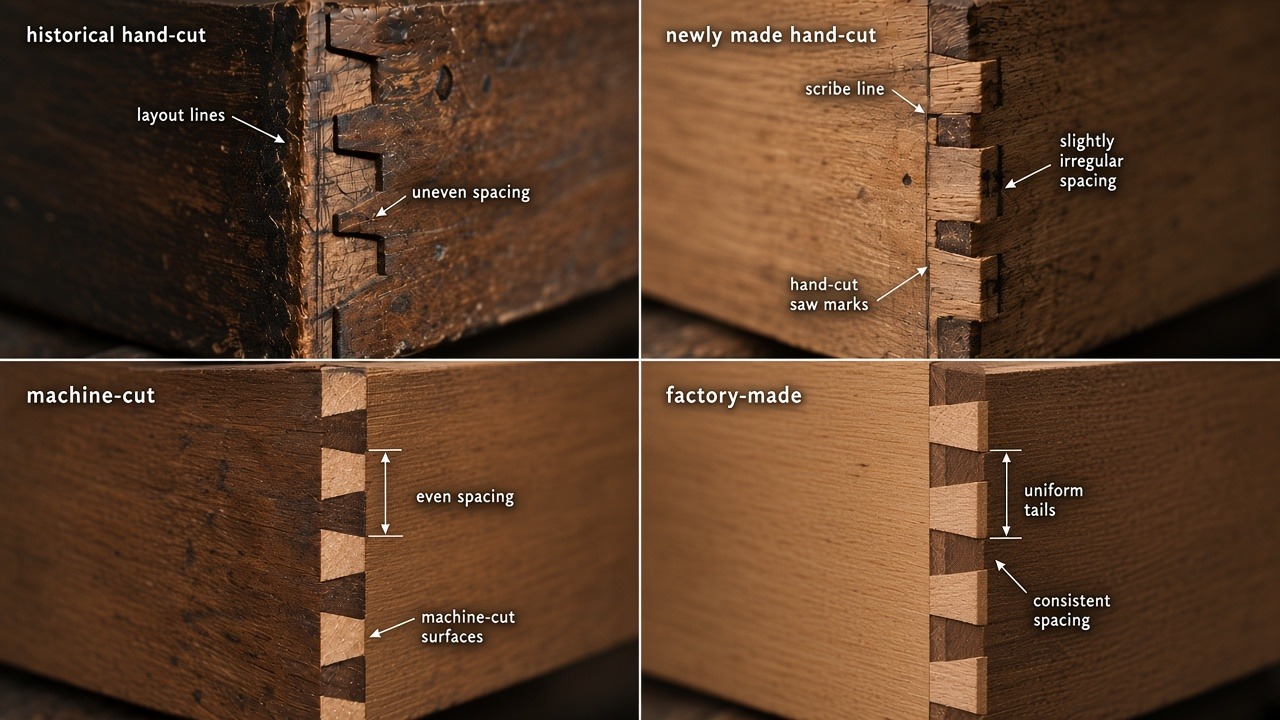
Compare documented historical and newly made hand-cut dovetails with machine-cut examples. Spacing, layout lines, and saw cuts are observations, not a date.
Historical hand-cut, newly made hand-cut, machine-cut, and factory-made dovetails. Labels mark spacing, layout lines, and saw cuts.
Look at spacing, layout lines, and saw cuts
Hand-cut dovetails often show uneven spacing, a scribe or layout line, and saw cuts that stop short of a perfect machine edge. Machine-cut and factory-made dovetails tend toward even spacing and uniform tails. Those are descriptions of how the joint was cut.
A new hand-cut joint can look irregular
The newly made hand-cut example in this gallery also has slightly irregular spacing and visible saw marks. Irregularity records a hand process. It does not, by itself, assign a century. Use the comparison to describe what you see, then keep dating to marks, hardware, materials, and documented history.
Not sure whether this piece of furniture needs an appraisal?
Photograph the drawer corner, the bottom, the back, and the woods you can see. The photo-based Screener can sort the visible evidence before you pay for documentation.