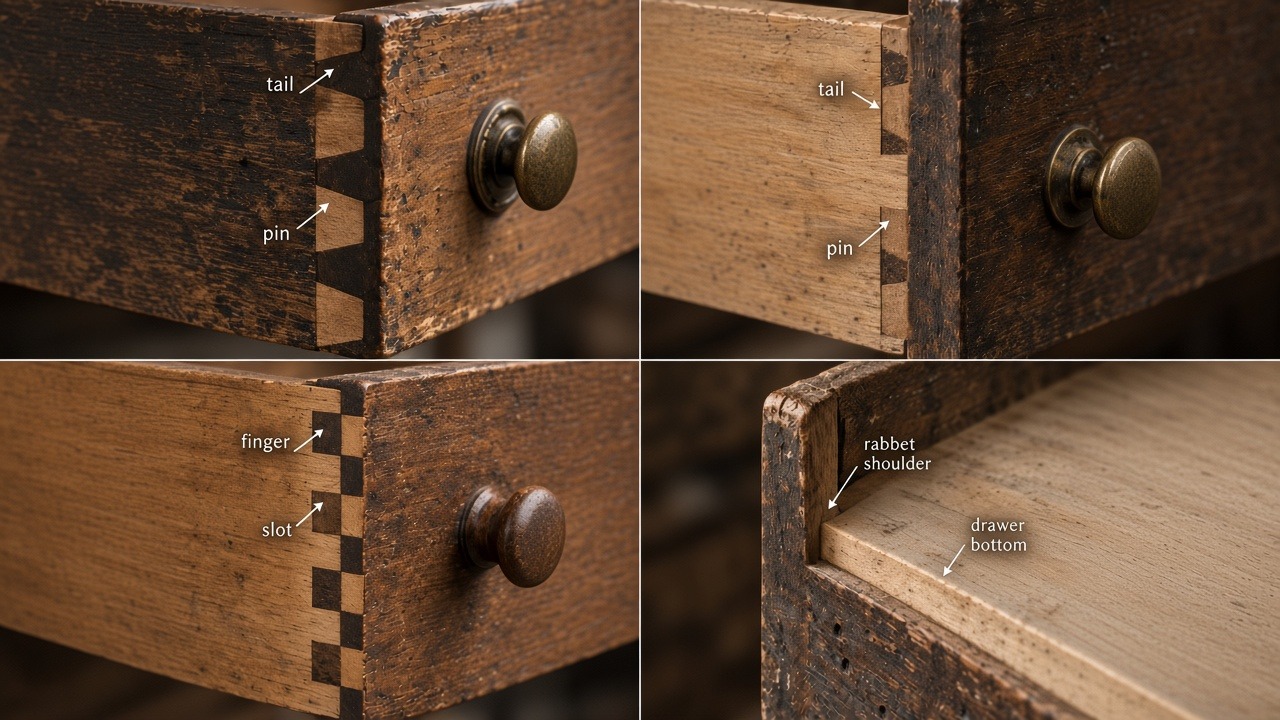
Compare through dovetails, half-blind dovetails, finger joints, and rabbeted drawer corners from the side, with the arrows on the interlocking shapes.
Through dovetail, half-blind dovetail, finger joint, and rabbet. The arrows sit on the pin, tail, finger, slot, and rabbet shoulder.
Open the drawer and look at the corner
The drawer front is the part made to be seen. The joint that holds the drawer together is on the side, where the front meets the side board. Photograph that corner with the drawer partly open so the interlocking shapes are visible.
Four joints in one comparison
A through dovetail shows both the pin and the tail on the end of the boards. A half-blind dovetail hides the tail behind the drawer front; the pin is what you see on the side. A finger joint is a row of square fingers and slots, not a wedge. A rabbet is a shoulder cut into the front, with the drawer bottom sitting beside it rather than a set of interlocking pins.
Name the shape you can see. A neat front does not tell you which of these joints is behind it.
Not sure whether this piece of furniture needs an appraisal?
Photograph the drawer corner, the bottom, the back, and the woods you can see. The photo-based Screener can sort the visible evidence before you pay for documentation.