
Identify Antique Furniture: appraisal and value basics
Identify Antique Furniture research should start with identification, condition, provenance, and recent comparable sales. Use this guide to compare the signals that matter before paying for a formal appraisal or deciding whether to sell.
Introduction to Identifying Antique Furniture
Key Facts About Antique Furniture
Examining Construction Techniques
Joinery Methods
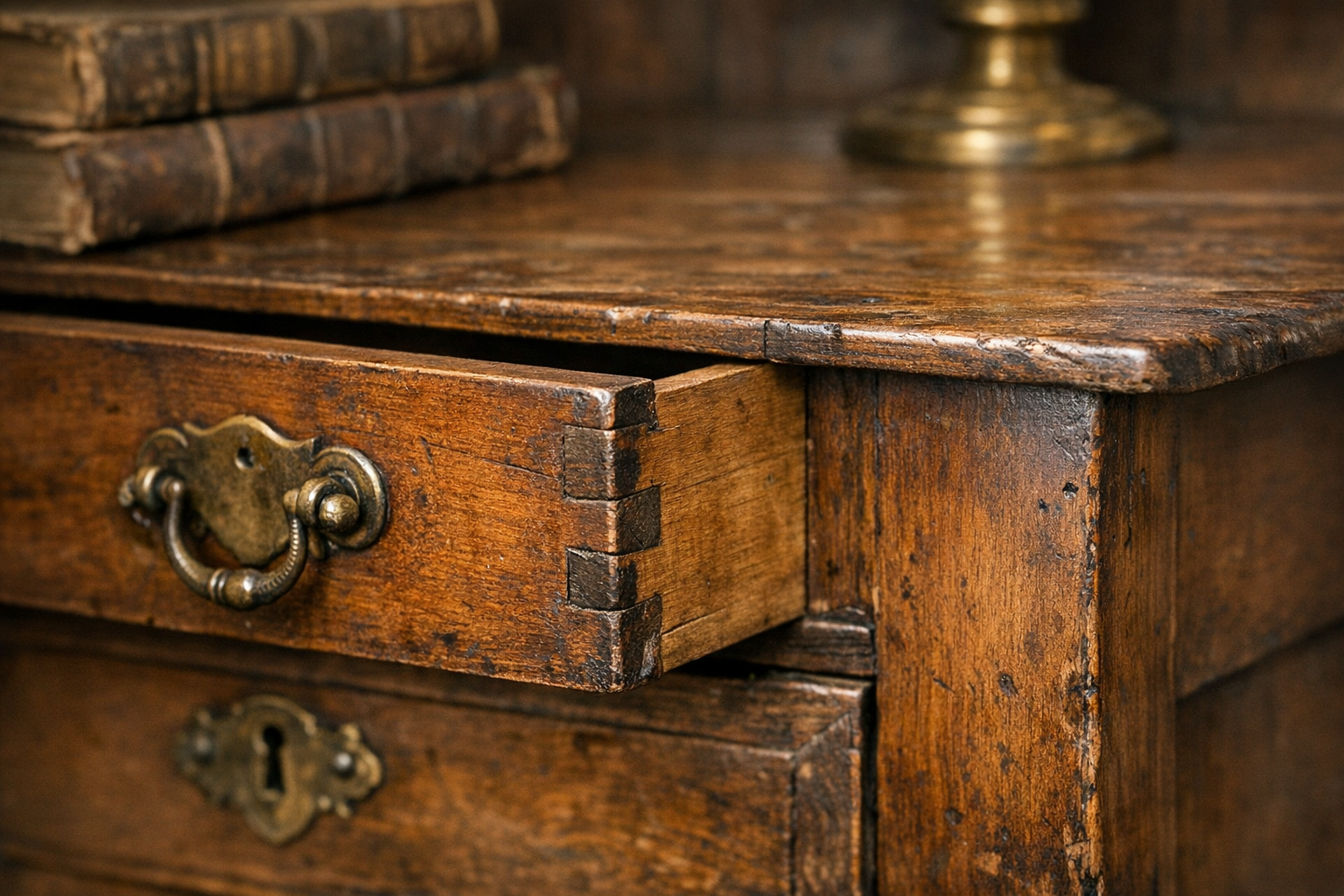
Joinery—the way wood pieces are connected—is perhaps the most important indicator of age. Before the industrial revolution, furniture was crafted entirely by hand, creating distinctive characteristics:
- Dovetail Joints: Examine drawer construction carefully. Hand-cut dovetails (pre-1860s) are slightly uneven with fewer joints. Machine-cut dovetails (post-1860s) appear perfectly uniform.
- Mortise and Tenon Joints: Common in chair and table construction, these joints were hand-cut until the late 19th century.
- Pegged or Doweled Joints: Wooden pegs instead of nails often indicate pre-industrial construction.
Wood and Materials Analysis
Primary and Secondary Woods
Antique furniture often features different woods for different parts:
- Primary Woods: Visible areas typically used higher-quality woods like mahogany, walnut, or cherry
- Secondary Woods: Hidden areas (drawer bottoms, backing) often used less expensive woods like pine, poplar, or oak
As explained by The Hoarde, “You can often tell the difference between an antique and a reproduction by checking the back, underneath or drawer interiors to see if a secondary type of wood was used.”
Wood Aging Signs
Authentic antique wood displays certain characteristics:
- Patina: Natural aging produces a warm glow that’s difficult to reproduce
- Oxidation: Wood darkens over time, especially in areas exposed to light
- Wear Patterns: Look for honest wear in appropriate places (chair arms, drawer handles)
Antique Wood Authentication Checklist
Check applicable characteristics when examining a potential antique
- Uneven patina consistent with age and use
- Secondary wood differs from primary visible wood
- Natural shrinkage and slight warping present
- Oxidation darker on exposed surfaces
- Evidence of hand-planing on undersides
Hardware and Metalwork Examination
Hardware Evolution Timeline
Evolution of Furniture Hardware
- Pre-1700s
Handmade Hardware
Hand-forged nails and hinges with irregular shapes and hammer marks. Look for rose-head nails with faceted heads.
- 1700-1800
Cut Nails Emerge
Square cut nails replaced forged nails. Early machine-made hinges appear but still show irregularities.
- 1800-1880
Transitional Period
Mix of handmade and machine-made elements. Early manufactured screws appear with off-center, handmade slots.
- 1880-1920
Industrial Hardware
Uniform machine-made screws, hinges, and pulls. Round wire nails begin to replace cut nails.
- Post-1920
Modern Hardware
Fully standardized hardware with perfect machine precision. Phillips-head screws appear in the 1930s.
According to Homes Direct 365, “One way of identifying real antique wooden furniture is to check the maker’s mark. These are usually hidden as the makers didn’t want to spoil the aesthetics of the piece.”
Identifying Furniture Styles and Periods
Major Antique Furniture Periods
Antique Furniture Style Periods
Key design eras and their identifying characteristics
The Antique Trader recommends looking for specific design elements: “Look for Gothic arches, Chinese fretwork, columns, capitals, C-scrolls, S-scrolls, ribbons, flowers, leaves, scallop shells, gadrooning” to identify specific styles.
For a more comprehensive understanding of antique furniture styles, M.S. Rau’s guide provides detailed information on identifying characteristics of antique furniture by period.
Examining Maker's Marks and Labels
Where to Look for Maker’s Marks
Furniture makers often placed their marks in inconspicuous locations:
- Inside or underneath drawers
- On the back of a piece
- Underneath table tops
- On the back of headboards
- Inside cabinet doors
Types of Maker’s Identifications
- Stamped Marks: Usually include maker’s name, location, or registration numbers
- Paper Labels: More common after 1850, though most have deteriorated over time
- Brass Plaques: Found on higher-end furniture
- Chalk/Pencil Markings: Sometimes include dates or craftsman numbers
- Branded Marks: Burned into the wood on some pieces
Scientific Dating Methods
Advanced Dating Techniques
- Dendrochronology: Analysis of tree ring patterns to determine when the wood was harvested
- UV Light Examination: Reveals repairs, replacements, and certain period-specific finishes
- Microscopic Analysis: Identifies tool marks specific to certain historical periods
- Chemical Testing: Can determine age of varnishes and finishes
While these methods require specialized equipment, they can provide definitive proof of authenticity for high-value pieces.
Common Reproduction Techniques to Watch For
Artificial Aging Techniques
Reproduction furniture often employs methods to mimic age:
- Distressing: Creating artificial dents, dings, and wear marks
- Chemical Aging: Using acids or stains to darken wood
- Fake Patina: Applying surface treatments to simulate natural aging
- Artificial Crackling: Creating finish cracks that mimic age-related crazing
Red Flags for Reproductions
Watch for these signs that may indicate a piece isn’t genuinely antique:
- Too Perfect: Excessive symmetry or uniformity
- Inconsistent Wear: Wear patterns that don’t match normal use
- Mixed Period Details: Design elements from different historical periods
- Modern Materials: Presence of plywood, particle board, or modern adhesives
- Uniform Color: Lack of natural color variation from aging
Resources for Antique Furniture Identification
Helpful Resources for Antique Furniture Identification
The Hoarde's Wood Identification Guide
Comprehensive resource for identifying different wood types used in antique furniture through visual characteristics.
Antique Trader's Furniture Styles Primer
Detailed guide to recognizing different furniture styles through their characteristic design elements.
M.S. Rau's Guide to Antique Furniture Periods
Expert breakdown of furniture periods with historical context and identifying characteristics.
HowStuffWorks Antique Wood Identification
Practical guide to recognizing antique wooden furniture through construction techniques and materials.
Homes Direct 365 Furniture Maker's Marks
Reference guide to identifying antique furniture maker's marks and signatures.
Antique & Vintage Furniture Identification Facebook Group
Active community of antique furniture enthusiasts sharing knowledge and identification assistance.
Getting Professional Help
Professional Authentication Options
- Certified Appraisers: Members of professional organizations like the International Society of Appraisers
- Auction Houses: Specialists at major auction houses can provide expert opinions
- Antique Dealers: Experienced dealers often have specialized knowledge in certain periods
- Museum Curators: May offer identification assistance for historically significant pieces
- Restoration Specialists: Often have hands-on experience with period construction techniques
Conclusion: Building Your Authentication Skills
Remember that authenticating antique furniture involves multiple factors. No single characteristic definitively proves age, but the combination of appropriate construction methods, materials, style elements, and natural wear can provide strong evidence of authenticity.
With practice and continued learning, you’ll develop the discerning eye needed to identify and appreciate these beautiful historical artifacts.
Common Questions About Antique Furniture Identification
How do I identify my antique furniture?
- Joinery: Hand-cut dovetails with uneven spacing indicate pre-industrial construction
- Wood: Check for appropriate period woods and the use of different woods for primary/secondary surfaces
- Hardware: Examine nails, screws, and hardware for hand-forged characteristics
- Style: Compare design elements to known historical periods
- Maker’s marks: Look for stamps, labels, or signatures in hidden areas
- Patina: Assess whether the aging appears natural and consistent with use patterns
What is the 100 year rule for antiques?
How can I tell if a piece of furniture is valuable?
- Age and Rarity: Genuinely old and rare pieces typically have higher value
- Maker: Furniture from renowned craftsmen or workshops commands premium prices
- Condition: Original finish and hardware substantially increase value
- Provenance: Documented history, especially connection to historical figures
- Style and Quality: Exceptional examples of period styles are more valuable
- Original Features: Unaltered pieces with original hardware and finish
- Craftsmanship: Quality of carving, joinery, and overall construction
- Historical Significance: Connection to important historical periods or events
Are there apps that can identify antique furniture?
- Google Lens: Can match visual characteristics to similar pieces online
- Magnolia: Specializes in furniture identification from photos
- WorthPoint: Has a vast database of antiques with price guides
- Hootsuite Insights: Helps identify makers and estimated values
- Invaluable: Connects to auction archives to find similar pieces
How do I identify antique wooden furniture materials?
- Grain Patterns: Each wood type has distinctive grain (oak has visible rays, mahogany has fine, straight grain)
- Color: Natural color helps identify wood (walnut is chocolate brown, maple is pale with subtle grain)
- Weight: Hardwoods like mahogany and oak are heavier than pine or poplar
- Hardness: Test by pressing fingernail in an inconspicuous spot - hardwoods resist indentation
- Smell: Some woods have distinctive scents when slightly dampened
- Historical Context: Different periods favored certain woods (oak in Jacobean, mahogany in Georgian)
Where can I get my antique furniture professionally identified?
- Certified Appraisers: Find appraisers through organizations like the International Society of Appraisers or American Society of Appraisers
- Auction Houses: Major auction houses like Sotheby’s, Christie’s, and Bonhams offer appraisal services
- Antique Dealers: Established dealers often provide identification services, sometimes for a fee
- Museum Curators: Local museums may offer identification days or services
- University Art History Departments: Some have faculty who specialize in furniture history
- Online Appraisal Services: Services like ValueMyStuff or WorthPoint allow photo submission for expert review
- Antique Shows: Experts at major antique shows can often provide informal opinions
What similar items actually sold for
To help ground this guide in real market activity, here are recent example auction comps from Appraisily’s internal database. These are educational comparables (not a guarantee of price for your specific item).
Shown USD range: USD 250-USD 375. Median of these 6 USD examples: USD 300.
| Image | Description | Auction house | Date | Lot | Reported price realized |
|---|---|---|---|---|---|
 |
Furniture: antique oak slant-top spool cabinet/desk with bro | Roan Inc. Auctioneers & Appraisers | 2021-05-29 | 435 | USD 300 |
 |
Howerton Antique Furniture Co., Queen Anne Style Double Pedestal Mahogany Dining Table | Leland Little Auctions | 2019-10-12 | 661 | USD 375 |
 |
Furniture: Antique New England style softwood blanket chest- lift top with one drawer; in old natural refinish; 37 ½” W X 33” T X 17 ½” D; good warm appearance with finish color variation throughout NO SHIPPING | Roan Inc. Auctioneers & Appraisers | 2024-03-17 | 385 | USD 300 |
 |
Furniture: Antique Empire Chest with Mir | Roan Inc. Auctioneers & Appraisers | 2021-01-09 | 300 | USD 250 |
 |
Mahogany Carved Corner Cabinet with Shell Motifs, B.B. Kromer Antique Furniture, New York | Stevens Auction Company | 2026-05-02 | 241 | USD 350 |
 |
Inlaid Louis XV Style Secretary Desk and Antique Chair | Concept Art Gallery | 2026-06-06 | 303 | USD 300 |
Disclosure: prices are shown as reported by auction houses and are provided for appraisal context. Learn more in our editorial policy.
Free instant estimate
Not sure if your item is worth appraising? Let us take a look.
Upload a photo, tell us what you know, and get a free first read. If a full appraisal makes sense, we will say so.
Free. No card needed. Takes about two minutes.
Choose your next step
Use the path that matches the decision you need to make about the item.
Not sure it is worth appraising?
Start with a lower-friction screen to understand the likely category, evidence, and next step.
Upload photos for a free first lookWant proof before paying?
See how a signed report documents photos, comparable evidence, condition notes, and value conclusions.
View signed report sampleNeed a signed report?
Use this for insurance, estate, donation, resale, or documented value decisions.
Need documentation now? Start signed appraisalNeed local or specialist help?
Compare directory options when the work needs in-person review or a specialist near you.
Find local specialistsSee what the report looks like
Sample reports show how photos, comparable evidence, condition notes, and a value conclusion are documented.
Get a Professional Appraisal
Unsure about your item’s value? Our certified experts provide fast, written appraisals you can trust.
- Expert report with photos and comps
- Fast turnaround
- Fixed, upfront pricing
No obligation. Secure upload.
Continue your valuation journey
Find the right local specialist
Compare antique and art appraisers by location and specialty in one directory.
Antique & art specialists
Browse the Antique & Art Appraisers Directory
Choose a local specialist when the assignment needs in-person inspection or a specific credential.
Machine-readable summaries
Use these machine-friendly references for AI and crawler discovery of Appraisily content.
Ready for pricing guidance?
Start a secure online appraisal
Upload images and details. Certified specialists respond within 24 hours.
Upload photos for a free first look View signed report sample